Every published record in the Force Atlas — services, commands, formations and groupings — searchable and filterable.
Eastern EuropeInterstate warPublished
Published
Coverage reviewed
2026-10-18
Weekly review / event-driven updates
Context, not targeting. This atlas describes structure and history. It deliberately excludes current locations, live strength, unit movements and anything operationally sensitive — the content model has no fields for them. Branch depth reflects what can be established from public sources, not the size, capability or importance of a force: a thin branch means a state publishes little, and record counts are never a measure of strength.
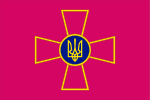
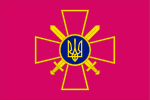
The unified military of the Ukrainian state — ground, air-assault, air, naval, marine, special-operations, unmanned and support branches under the General Staff. Expanded from its pre-2022 professional core into one of Europe's largest wartime militaries; this atlas records its structure at branch and formation level only.
The ground-based air-defence arm of the Air Force — SAM brigades and regiments layered from legacy S-300 and Buk to Patriot, IRIS-T, NASAMS and SAMP/T.
The umbrella military of the Russian state — ground, aerospace, airborne, naval, strategic rocket, special-operations, railway and materiel-support branches under the General Staff. This atlas records its structure at branch, army and formation level only; it publishes no dispositions, strengths or locations, and several of the volunteer and irregular structures fighting alongside it sit outside this tree by design.
Mechanized brigade formed in 2016 as an infantry brigade of the reserve corps and re-roled after 2022; publicly documented in the Kherson-oblast fighting of 2022, Bakhmut in 2023 and the Kupiansk and Lyman sectors in 2024; reported to have joined the 3rd Army Corps in July 2025.
Mechanized brigade raised in 2014 and in near-continuous line service in the Donbas since — Marinka, Avdiivka and the Donetsk-city sectors; reported to have joined the 3rd Army Corps in August 2025.
Mechanized brigade in line service through the full-scale war's eastern and southern battles, publicly associated with the Lyman and Siversk sectors; reported to have joined the 3rd Army Corps in August 2025.
Heavy mechanized brigade formed in the later reorganisations from the 125th Territorial Defence Brigade, a Lviv formation whose 2024 Kharkiv-border record was publicly debated; reported to have joined the 3rd Army Corps in August 2025.
Long-standing regular mechanized brigade from Yavoriv in the west, named for the medieval king of Galicia; fought in the Donbas from 2014 and through the major positional battles of the full-scale war, most publicly the long defence of Chasiv Yar in 2024. No corps assignment is published.
Mechanized brigade built around Western equipment — publicly documented operating Bradley IFVs and Abrams tanks in the 2023 southern offensive and after.
Kharkiv-region brigade, prominent in the September 2022 Kharkiv counteroffensive that it helped spearhead from its home ground; converted from a mechanized to an assault brigade in the later reorganisations and publicly associated with the Kupiansk and border sectors since. No corps assignment is published.
The Kryvyi Rih tank brigade, one of Ukraine's small number of dedicated tank formations, reorganised in late October 2024 as the Ground Forces' first heavy mechanized brigade after its tank battalions had spent 2022–24 dispersed among mechanized brigades. No corps assignment is published.
Heavy artillery brigade of the high-command reserve, formed in autumn 2014 — publicly documented operating the war's largest tube systems, the 203 mm 2S7 and the PzH 2000, and a fixture of the artillery duel since 2022. No corps assignment is published; the reserve status is the reason.
Airmobile brigade committed across the war's crisis points — the defence of Soledar and Bakhmut in the winter of 2022–23, then the Orikhiv axis in the 2023 southern offensive.
Airmobile brigade formed in summer 2022 in the Air Assault Forces' wartime expansion; joined the defence of Bakhmut after Soledar fell in January 2023 and has served on the eastern front since.
Air assault brigade from Mykolaiv, publicly associated with the defence of the south in 2022, the Siverskyi Donets fighting that summer, and years of Donbas fighting since — Marinka and the Kurakhove sector among the most documented.
Air assault brigade from Lviv with a prominent public record from Bakhmut in 2023 and the northern axes; the formation from which the 82nd Brigade was raised in December 2022.
Airmobile brigade re-established in 2014–15 with a Donetsk airport lineage; long service in the Donbas including the Sloviansk front in 2022 and the Bakhmut and Siversk sectors since.
Air assault brigade formed in December 2022 from a battalion group of the 80th Brigade and equipped with Western vehicles — Challenger 2, Marder and Stryker — publicly documented at Robotyne in the 2023 southern offensive and in the August 2024 Kursk incursion.
Veteran air assault brigade from Zhytomyr — the 2014 "longest raid" behind separatist lines and years of front-line rotations anchor its public history; publicly documented on the Izium axis in 2022 and in the Donbas rotations, Bakhmut and Kreminna among them, since.
Tactical aviation brigade of the MiG-29 fleet, from Vasylkiv near Kyiv — the workhorse fighter of Ukraine's wartime air defence, dispersed within hours of the February 2022 strikes and adapted to fire Western weapons before the F-16 arrived.
Tactical aviation brigade flying the Su-27 from Myrhorod in Poltava oblast — the heavy fighter arm of the pre-F-16 fleet, dispersed in the first hours of 2022 and kept flying through the years its base was repeatedly struck.
The Kyiv anti-aircraft missile brigade of the air-defence belt around the capital region — publicly documented on legacy S-300 and, from 2023, on Patriot, including the intercepts of ballistic and aeroballistic missiles over Kyiv that its commander described publicly in May 2023.
The small-boat surface component — patrol boats and minor combatants after the flagship frigate was scuttled at Mykolaiv in February 2022; the two corvettes under construction in Türkiye remain the future capital element, the first launched in 2022 and on trials since 2024.
The riverine arm — a Dnipro river flotilla raised in 2022 against the threat from the north and expanded in 2023 with a second division for the southern river, holding the estuary approaches and the Kherson reach with small craft.
The naval air arm — a single naval aviation brigade of transport aircraft, helicopters and Bayraktar TB2 drones; publicly documented for the drone operations over Snake Island and the north-western Black Sea in 2022.
The navy's share of Ukraine's maritime-drone campaign; much of the publicly known USV effort is run by intelligence services, so this record stays deliberately broad.
Marine brigade with long service on the southern front — the 2023 southern offensive, where it took Urozhaine with the 38th, and the Dnipro left-bank operation at Krynky from October 2023 to the withdrawal in 2024.
Marine brigade formed in February 2023 from an existing marine battalion in the corps' expansion, and committed within months to the 2023 southern offensive, where it took Urozhaine with the 35th.
The half of the Logistics Forces that owns weapons and vehicles — the central directorates for armour, automotive and missile-artillery equipment, and the repair estate behind them. The ministry publishes the Armament/Rear split and the branch's tasks; the directorate list beneath it is published compilation, which is why every child edge is graded reported.
The half of the Logistics Forces that owns consumption — fuel, food, general materiel and military signals supply, through central directorates and the storage bases beneath them. The ministry publishes the Armament/Rear split; the directorate list is published compilation and every child edge is graded reported for that reason.
The Kyiv centre at the top of the military medical system — the Main Military Clinical Hospital, the referral end of an evacuation chain that begins at a casualty collection point hundreds of kilometres away, and the clinical base of the Military Medical Academy.
The training and doctrine institution of the medical branch, founded by Cabinet resolution on 13 January 1993 — where the wartime revisions to Ukrainian battlefield medicine are taught, and the constraint on how fast the branch can grow.
Forces under the Ministry of Internal Affairs fighting alongside the army — a parallel military strand whose combat brigades hold front-line sectors under operational control of the AFU's commands while remaining institutionally interior. Its two corps of 2025 — the 1st built around Azov, the 2nd around Khartiia — are the most publicly documented example.
The National Guard's second army corps, announced on 15 April 2025 and built on the 13th Brigade "Khartiia", whose commander leads it — the Kharkiv counterpart to the Azov-built 1st Corps in the Guard's 2025 corps reform.
Kharkiv-raised National Guard brigade known for technology-heavy operations, and since 15 April 2025 the core of the National Guard's second corps, which its commander leads.
National Guard operational brigade raised in 2015 with a strong public combat record from the Kyiv airport fighting in 2022 and Bakhmut in 2023; reported assigned to the Guard's second corps in 2025 and attached to the 1st Corps for the Pokrovsk–Dobropillia sector in 2026.
Combat formations publicly associated with intelligence and security services (HUR/GUR, SBU). A browsing group, not a command — the two services answer to different institutions (the Ministry of Defence and, for the SBU, the President), each member's actual parent is stated on its own record, and much of this space is deliberately under-documented.
Military-intelligence service whose combat operations became a publicly prominent part of the war — including the maritime drone campaign widely attributed to it in public reporting. Deliberately under-documented here: only publicly claimed or widely reported associations are recorded.
Special operations · under Intelligence & security-linked formations
The security service's publicly known combat arm — its special operations centre and the directorate publicly associated with the Sea Baby maritime drones, the 2023 Crimean Bridge strike and the June 2025 strikes on strategic bomber airfields. Recorded here only to the extent of public claims and wide reporting.
Special operations · under Intelligence & security-linked formations
Foreign volunteer and anti-Kremlin opposition formations fighting on the Ukrainian side. A browsing group only — these organisations do NOT share a command; each serves under its own documented Ukrainian parent structure, stated on each record. Two frameworks recur beneath the grouping: the International Legion created in February 2022 under the Ground Forces, and the formations publicly associated with Defence Intelligence.
Belarusian volunteer regiment formed as a battalion in March 2022 and raised to a regiment in May 2022 — the largest Belarusian formation on the Ukrainian side, reported within the Armed Forces under Defence Intelligence, and the parent of several successor and breakaway Belarusian units.
Volunteer / irregular · under Belarusian volunteer formations
The formal framework for foreign volunteers in Ukrainian service, announced on 27 February 2022 and raised under the Ground Forces; its combat battalions were folded into assault regiments in the 2024 reorganisation, so the Legion is carried as a lineage record rather than a standing unit.
Volunteer / irregular · under Other foreign volunteer formations
The prestige Kantemirovite tank division of the 1st Guards Tank Army, from Naro-Fominsk; its retreat from the Izium sector in September 2022, with independently counted T-80 losses of around half its strength, was among the most visible Russian losses of the war. Reconstituted and tracked on the Svatove–Kreminna sector since.
The Taman division of the 1st Guards Tank Army — Moscow's ceremonial and showcase formation, the first publicly fielding the T-90M — turned into a line division: the Izium bridgehead in spring 2022, the September retreat, and the Kupiansk axis since.
Combined-arms army of the old Western MD, since 2024 under the re-created Moscow MD; parent of the 3rd and 144th Motor Rifle Divisions re-formed in 2016, and engaged on the north-eastern axes through the war.
Motor-rifle division of the 20th Army re-formed in 2016 at Valuyki in Belgorod oblast, on the Ukrainian border itself; committed on the Kharkiv axis in 2022 and tracked on the Kupiansk sector since.
Motor-rifle division of the 20th Army re-established in 2016 in Smolensk oblast as part of the return to divisions on the western frontier; committed on the northern axes in 2022 and tracked on the Svatove–Kreminna line since.
Military district re-established on 1 March 2024 from the Western MD split, oriented toward the Baltic and Finland and including the Kaliningrad exclave; peacetime parent of the 6th Combined Arms Army.
The Leningrad Military District's army-level formation — re-formed in the 2010 reform as the Western district's north-western army, engaged on the Kharkiv axis in the full-scale war, and assessed in 2026 to hold divisions in which UAV battalions are expected to be raised.
Southern MD army re-formed in 2017 at Novocherkassk, on the Donbas border, around a division re-established the year before; closely associated with the Donetsk axis since 2022, from the Mariupol operation to the Donetsk-city sectors, and the first Russian parent of the former separatist corps after the 2022 annexations.
North Caucasus army headquartered at Vladikavkaz; held the Zaporizhzhia line against the 2023 Ukrainian offensive — Moscow's most consequential defensive success of the war — and lost its commander that July after he complained publicly of attrition and rotation.
The 58th Army's Chechnya-garrisoned motor-rifle division, re-formed in 2016 from three brigades; a backbone of the 2023 Zaporizhzhia defence in the Robotyne–Verbove sector, holding the fortified belts against the Ukrainian offensive.
Volga-region combined-arms army headquartered at Samara, committed since the first weeks of the invasion on the Kharkiv and Izium axes and tracked on the Kupiansk–Lyman sector since.
Siberian combined-arms army headquartered at Novosibirsk; committed in the 2022 northern operation around Chernihiv, where its deputy commander was publicly reported killed, and tracked on the Svatove–Kreminna line since.
Far Eastern combined-arms army headquartered at Ussuriysk, deployed west in 2022; long service on the southern Donetsk axis from the Vuhledar assaults to the 2024 capture of Kurakhove, for which the ministry publicly commended its brigades.
The Ivanovo airborne division, committed across the war's axes — the 2022 Kyiv operation, then the Bakhmut flanks in 2023, where its regiments were publicly identified — and used, like the rest of the VDV, as line assault infantry.
The Tula airborne division, one of the VDV's two parachute divisions; withdrawn from the 2022 northern operation via Belarus, then given the long Bakhmut-flank commitment of 2023, where both its regiments were publicly identified.
The Novorossiysk mountain air-assault division — the VDV's southern formation, engaged from the 2022 Kherson operation onward and publicly prominent in the 2023 defence of the Zaporizhzhia line at Robotyne.
Separate air-assault brigade from Buryatia in the Far East, one of the VDV's independent brigades; documented in the war from the 2022 northern operation onward and employed as line assault infantry since.
Separate air-assault brigade from Ussuriysk in the Far East, formed in 1986; publicly placed in the Kyiv-axis occupation zone in 2022 and committed on the southern and eastern axes since.
The fleet at the war's centre: flagship lost to missiles in 2022, headquarters and bases struck repeatedly, and major units publicly reported relocated eastward from Sevastopol.
Small flotilla with outsized reach — the force that fired the first ship-launched Kalibr strikes into Syria in October 2015 and an early launch platform for Kalibr strikes into Ukraine; based at Kaspiysk since its relocation from Astrakhan in 2020.
The Arctic-based strategic fleet — home of most of Russia's ballistic-missile submarines — stripped of its joint strategic command status in February 2024 when its regions passed to the re-created Leningrad Military District; peripheral to the Black Sea theatre but a source of Kalibr-capable units and a naval-infantry brigade for the land war.
The Far Eastern fleet, in this war a source of formations rather than of ships: its two naval-infantry brigades were committed to the land war from 2022, mauled in the Vuhledar assaults, and the Vladivostok brigade was announced re-formed as a division in December 2025.
The Russian fleet of the Baltic — based in the Kaliningrad exclave and at the head of the Gulf of Finland, answering to the Navy's main command since the 2024 command reform; contributes naval infantry and coastal formations to the land war, and was assessed in 2026 to have formed a regiment of unmanned naval strike vehicles.
The submarine arm — Improved Kilo boats of the Black Sea Fleet are among the war's persistent Kalibr shooters, the platform Ukrainian defences can least answer; one was publicly documented destroyed in dry dock at Sevastopol in 2023 and another struck by an underwater drone at Novorossiysk in December 2025, by Ukrainian claim.
The fleet air arms — maritime patrol, anti-ship strike and shipborne helicopter forces organised per fleet; in this war the Black Sea Fleet's arm, whose Crimean airfields were struck from August 2022 and whose fighter regiment's losses have been independently counted.
Shore-based anti-ship missile forces — the Bastion and Bal systems held by each fleet's coastal troops — which in this war have been fired from Crimea at land targets around Odesa as often as at ships.
Pacific Fleet naval infantry formation — the much-reconstituted 155th Brigade of the Vuhledar assaults, whose re-formation as the 55th Division the fleet announced on 1 December 2025, reviving a division that existed from 1968 to 2009.
Pacific Fleet marine brigade from Kamchatka, committed to the land war and publicly documented spearheading the unsuccessful assaults on Vuhledar in 2022–23 alongside the 155th Brigade.
The Northern Fleet's marine brigade from the Sputnik garrison in Murmansk oblast, part of the amphibious grouping sent to the Black Sea before the invasion and documented on multiple axes of the land war since.
Baltic Fleet naval infantry at Baltiysk, committed to the land war as the 336th Guards Brigade and announced expanded to divisional status in December 2025; the division's own designation is reported, not confirmed.
A dedicated railway-engineering arm within the armed forces' material-technical support system — a Russian structural particularity that matters in a war supplied overwhelmingly by rail, and the builder of the 2024 line through occupied territory that bypasses the Crimean Bridge.
Formations recruited in or branded from Chechnya. Explicitly NOT a unified "Chechen army": "Akhmat" is partly an official designation and partly a brand, and the real parents differ — Ministry of Defence, Rosgvardia, or the Chechen Interior Ministry — as stated on each member's record.
The former "people's republic" corps and their notable formations of 2014–2022. A historical and lineage category: after the 2022 annexations these structures were absorbed into regular Russian ones — the two corps reported re-formed as the 51st and 3rd Combined Arms Armies in 2024 — and are not shown here as if unchanged.
The Donetsk 'people's republic' corps of 2014–2022; integrated into regular Russian structures after annexation, reported as the 51st Combined Arms Army.
The Luhansk counterpart corps of 2014–2022; formally incorporated into the Russian armed forces after the annexation and reported re-formed as the 3rd Combined Arms Army in 2024 — carried as a lineage record.
One of the Ground Forces' four territorial operational commands, covering the north and the Belarusian border. The 2025–26 corps reform placed the new army corps beneath the four commands rather than abolishing them; the corps under this command are reported but not carried as records, so the tree ends here by design.
One of the Ground Forces' four territorial operational commands, covering the south and the lower Dnipro. The 2025–26 corps reform placed the new army corps beneath the four commands rather than abolishing them; the corps under this command are reported but not carried as records, so the tree ends here by design.
One of the Ground Forces' four territorial operational commands, covering the east. The 2025–26 corps reform placed the new army corps beneath the four commands rather than abolishing them; the corps under this command are reported (the 20th Army Corps among them) but are not carried as records, so the command's tree ends here by design.
One of the Ground Forces' four territorial operational commands, covering the west — the rear, the training base and the border with NATO states. The 2025–26 corps reform placed the new army corps beneath the four commands rather than abolishing them; the corps under this command are reported but not carried as records, so the tree ends here by design.
One of the Air Force's four regional air commands, covering the capital region and central Ukraine; each command combines aviation, surface-to-air missile and radio-technical forces for its sector. The Air Force publishes the four commands but not their brigade lists, so none is drawn beneath it.
One of the Air Force's four regional air commands, covering the east and the air defence of the front-line rear; each command combines aviation, surface-to-air missile and radio-technical forces for its sector. The Air Force publishes the four commands but not their brigade lists, so none is drawn beneath it.
One of the Air Force's four regional air commands, covering the south and the Black Sea coast; each command combines aviation, surface-to-air missile and radio-technical forces for its sector. The Air Force publishes the four commands but not their brigade lists, so none is drawn beneath it.
One of the Air Force's four regional air commands, covering the west and the approaches from Belarus and over NATO's border; each command combines aviation, surface-to-air missile and radio-technical forces for its sector. The Air Force publishes the four commands but not their brigade lists, so none is drawn beneath it.
Armoured-vehicle equipment across the force: pattern management, repair policy and the recovery of a fleet that has absorbed heavy losses and heavy foreign resupply at once. Carried from published compilation of the Armament service's structure; the ministry names the service, not the directorate.
The soft-skinned fleet — trucks, tractors and light vehicles — which is what actually moves a war of this size when the railway stops. Carried from published compilation of the Armament service's structure; the ministry names the service, not the directorate.
Guns, launchers and above all ammunition: the directorate at the centre of the war’s defining scarcity. Carried from published compilation of the Armament service's structure; the ministry names the service, not the directorate.
A named repair establishment under the armament service — the kind of rear installation whose throughput, not its existence, is the analytically interesting quantity. Carried from published compilation as the representative of a repair estate the ministry describes only generically.
Fuel supply for the whole force, run against an energy system that has been a declared strike target since 2022. Carried from published compilation of the Rear service's structure; the ministry names the service, not the directorate.
Rations and food supply — the least discussed and most continuous of the sustainment problems. Carried from published compilation of the Rear service's structure; the ministry names the service, not the directorate.
Clothing, equipment and general materiel: the directorate that absorbed the largest share of donated non-lethal aid. Carried from published compilation of the Rear service's structure; the ministry names the service, not the directorate.
Communications equipment as a supply problem rather than an operational one — issue, repair and replacement of the radios a dispersed force runs on. Carried from published compilation of the Rear service's structure; the ministry names the service, not the directorate.
The Lviv regional centre: the western end of the evacuation chain, and the closest large military hospital to the Polish border and onward treatment abroad. One of the five regional centres the branch publishes; capacity and caseload are not.
The Odesa regional centre, covering the southern axis and the coast. One of the five regional centres the branch publishes; capacity and caseload are not.
The Kharkiv regional centre — a major military hospital inside a city that has itself been under repeated strike since 2022. One of the five regional centres the branch publishes; capacity and caseload are not.
The Dnipro regional centre, the principal receiving hospital for the eastern front and by wide reporting the busiest node in the chain. One of the five regional centres the branch publishes; capacity and caseload are not.
The Vinnytsia regional centre, covering the central rear and part of the onward-treatment flow. One of the five regional centres the branch publishes; capacity and caseload are not.
The numbered mobile hospitals (59th, 61st, 65th, 66th and 71st) as one record at the level this atlas works: deployable surgical capacity sitting between front-line stabilisation and the regional clinical centres. A category record by design; where any of them is deployed is never authored.
Combat formations raised under the Interior Ministry outside the National Guard — police-based assault units, most visibly the assault brigade the ministry's Offensive Guard programme raised from police special-purpose regiments in 2023. A browsing group, not a command; each member's actual parent institution would be stated on its own record. The group currently has no records beneath it, which is a research gap and not a claim that none exist.
Formations of Russian citizens fighting against Moscow on the Ukrainian side — the Freedom of Russia Legion, the Russian Volunteer Corps and the Siberian Battalion, publicly associated with Defence Intelligence and named together in the 2023–24 cross-border raids. A browsing group, not a command: each unit's Ukrainian parent structure is stated, and graded, on its record.
Volunteer / irregular · under Foreign & opposition formations
Russian émigré volunteer corps formed in 2022, publicly known for the 2023–24 cross-border raids into Bryansk, Belgorod and Kursk regions; its politics and command relationships are contested in public reporting — described by Ukrainian officials at different times as an independent organisation and as a formation Ukraine helps, and by reporting as associated with Defence Intelligence.
Volunteer / irregular · under Russian anti-Kremlin formations
Volunteer unit of Russian citizens formed within Ukrainian military structures in October 2023 — publicly confirmed by Kyiv at the time — and named with the Freedom of Russia Legion and the RDK in the March 2024 cross-border raids. Reported as part of Defence Intelligence's international legion; public information beyond that is thin and largely self-published.
Volunteer / irregular · under Russian anti-Kremlin formations
Belarusian volunteer formations fighting on the Ukrainian side, of which the Kalinoŭski Regiment raised in March 2022 is the largest and the only one carried here. A browsing group, not a command; the regiment's own record states its reported parent.
Volunteer / irregular · under Foreign & opposition formations
Chechen formations aligned with the Ichkerian cause fighting on Ukraine's side since 2014 — distinct from, and opposed to, the Kadyrov-aligned units on the Russian side. A browsing group, not a command: the two battalions carried here have different relationships to Ukrainian structures, stated on their own records.
Volunteer / irregular · under Foreign & opposition formations
Chechen volunteer battalion named for Ichkeria's first president, formed in 2014 by a veteran of the Chechen wars and active on the Ukrainian side since; described in reporting as within Ukrainian force structures and filed by compilation under Defence Intelligence, neither of which is a published subordination.
Volunteer / irregular · under Chechen & Ichkerian formations
Chechen volunteer battalion of veterans of the two Chechen wars, active on the Ukrainian side since 2014 and re-formed in March 2022; by consistent public accounts the one Chechen unit that has remained a volunteer formation outside formal Ukrainian force structures.
Volunteer / irregular · under Chechen & Ichkerian formations
Reviewed foreign volunteer formations outside the Russian, Belarusian and Chechen groups — in practice the International Legion of February 2022, the Ground Forces' legal framework for foreign volunteers, carried as a lineage record after its 2024 reorganisation. A browsing group, not a command.
Volunteer / irregular · under Foreign & opposition formations
A routing node, not a command. The Kyiv-aligned backers — the United States, the European Union, NATO and Poland — supply weapons, financing, intelligence and transit rather than forces, and none of them commands anything in this tree. Each now carries its own strategic profile, including stated and assessed objectives, constraints and leverage, under Profiles.
The military-space component of the Aerospace Forces — launch from the Plesetsk cosmodrome, satellite control and the missile attack warning system. Its contribution to this war (reconnaissance, navigation, warning) is structural rather than documented, and the atlas does not author it.
Ulyanovsk air-assault brigade, documented in the war from 2022; publicly reported to have become the basis of the re-formed 104th Guards Air Assault Division in September 2023, a plan announced in 2015 — carried here as a lineage record pending source review of the successor.
The land-based strategic nuclear arm — a separate branch of the armed forces alongside the ground, aerospace and naval services. Listed for structural completeness only: this atlas deliberately carries no detail below this line, by policy rather than for want of sources.
Volunteer and contract formations raised under Ministry of Defence structures — the BARS combat-reserve detachments and the formations recruited through the Redut shell. A browsing group, not a single command: each member's documented parent is stated on its record, and both members are category records because the ministry publishes no list of the units.
The Ministry of Defence's combat army reserve, created in 2015 on a part-time contract model and expanded from 2022 into numbered volunteer detachments across the front — a category record; individual detachments are not tracked here because no list of them is published.
Volunteer / irregular · under MoD volunteer formations
Volunteer formations recruited through the Redut structure — described by investigative reporting and UK Defence Intelligence as a recruitment shell operated for Russian military intelligence, whose contractors were offered ministry contracts after 2022 and which fed more than twenty formations. A category record: the composition is deliberately opaque in public reporting.
Volunteer / irregular · under MoD volunteer formations
The best-known Akhmat-branded formation — a Ministry of Defence-subordinated volunteer unit publicly fronted by the Chechen leadership, whose commander was appointed to a ministry post in 2024. Branding and structure are entangled by design: the unit publicly claims roles (Bakhmut 2023, the Belgorod and Kursk border in 2023–24) that independent reporting confirms only in part.
Volunteer / irregular · under Chechnya-based & Akhmat formations
Rosgvardia regiment recruited in Chechnya — the 'Kadyrovite' core formation, documented in the war from the 2022 Kyiv operation onward. Its formal parent is the National Guard's Chechen directorate; the Akhmat grouping above it is navigation only, and its combat record since 2022 is contested in public reporting.
Interior / security · under Chechnya-based & Akhmat formations
The best-known Donetsk separatist battalion of 2014, named in 2017 for its assassinated first commander; later a reconnaissance unit of the 1st Army Corps and, by public reporting, of the corps' Russian successor — carried as a lineage record because its current designation is not consistently reported.