


Ukraine–Russia
Interstate warAn interstate war reshaping European security.
Vigil connects current developments to the actors, institutions, forces, geography and pressures that shape what happens next.
One corpus, four ways in. Read the analysis, inspect the system, start from geography, or follow what could change the assessment.
Briefs & analysis
What changed, and what it means: Weekly Briefs, Analytical Notes and each area’s standing written coverage.
Open Read
Systems & actors
How the system fits together: actors, diplomacy, forces, campaigns, geography, logistics, economy and humanitarian conditions as connected objects.
Open Explore
Geography & tempo
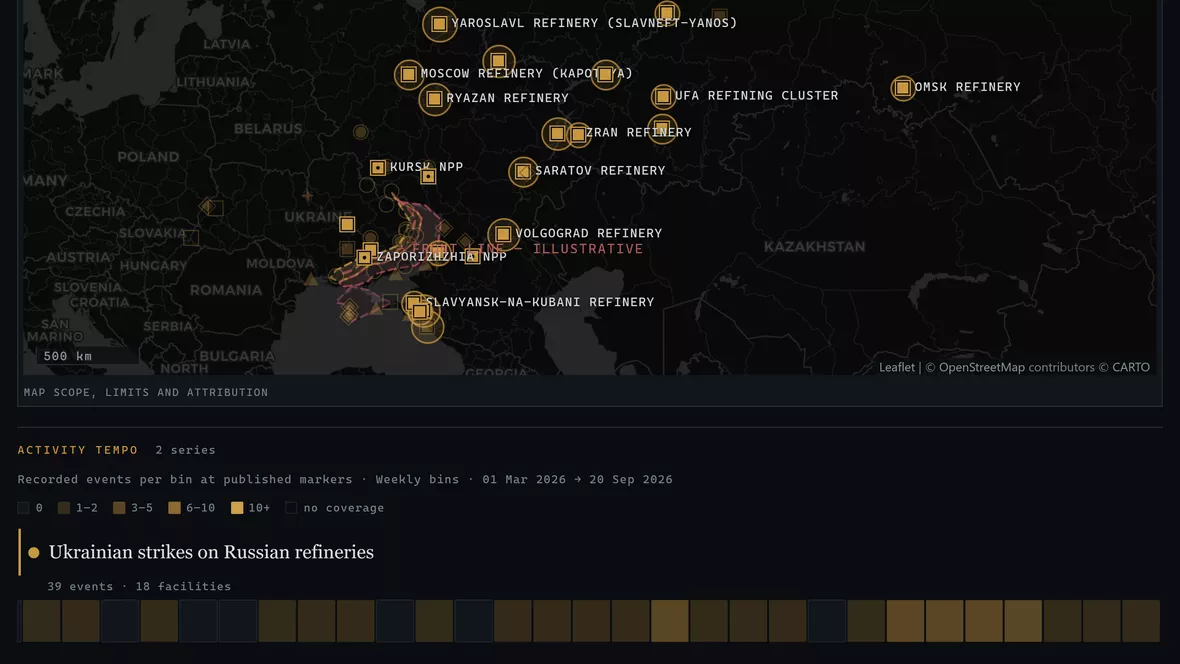
Map basis — located infrastructure + recorded events per bin · a count of records, not a measure of effect
Where and when it happens: each area’s geography and infrastructure and, where a series is recorded, the tempo of dated events at its markers.
Open Map
Questions & observables
Reviews, not forecasts — no probability, no severity grade, no alert
What could change the assessment: the standing questions, the evidence Vigil is waiting for, and what each dated review found.
Open Watch
The four open the same records, and you can move between them: a Note opens its connected objects, an Explore object leads back to the written record, a Map marker opens the standing record behind it, and a Watch question links to the system and the analysis it rests on.
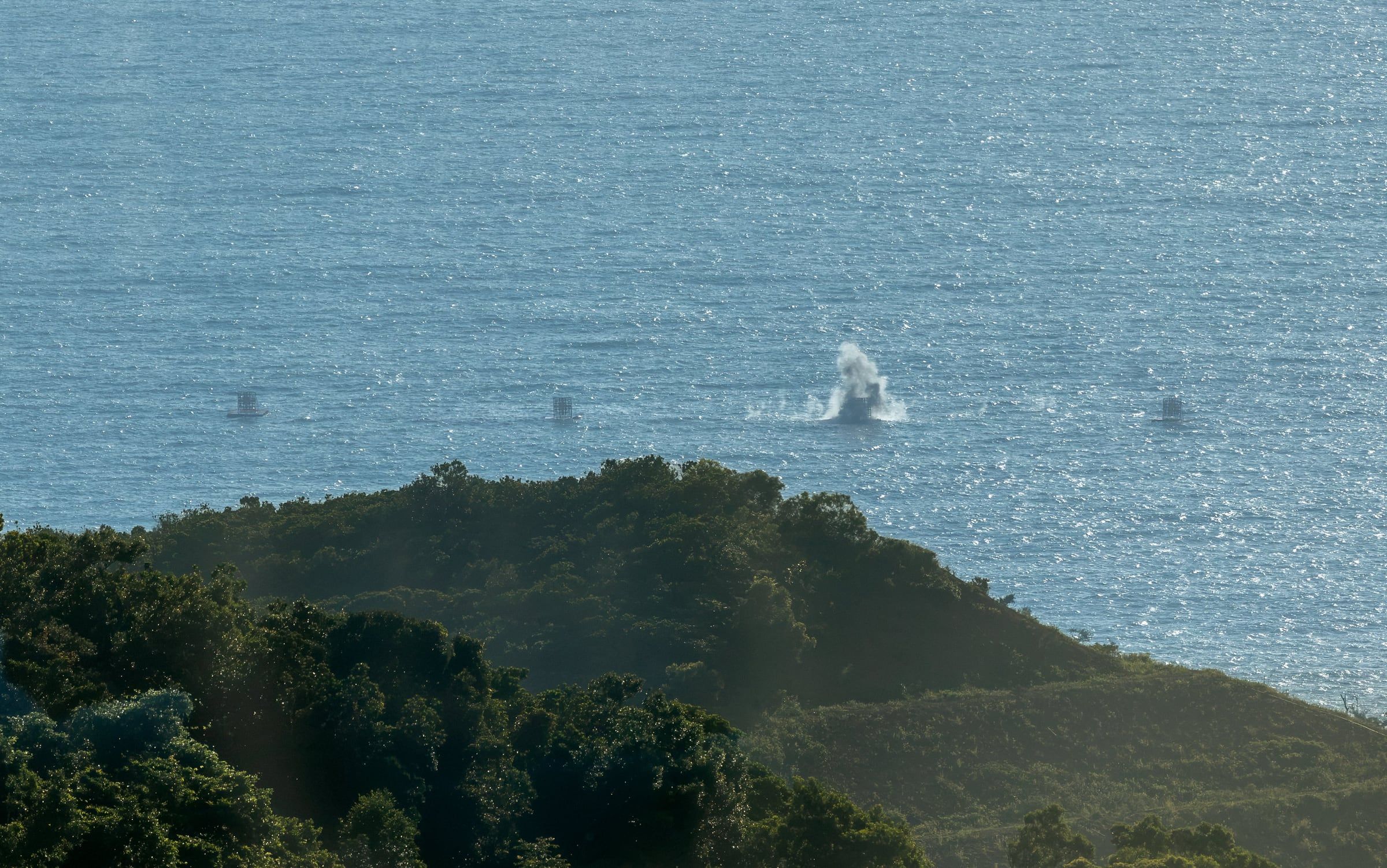
The defence ministry's own account describes more than weapons firing side by side: ship, air-control, radar and drone sensors joined through a battlefield network to missiles and attack drones across the services. What no published account yet shows is that chain working with its links jammed or its command nodes gone — a test Taiwan has so far published only for its wargame.
Key judgment
Taiwan's joint precision-missile firing at Jiupeng, 16–18 September 2026, was more than several weapon families firing on one range. The defence ministry's own account says it followed kill-chain procedure — search, target acquisition, identification, target allocation and attack — with shipborne radar, Air Force air control, mobile radar vehicles and drones joined through command nodes and a TAK battlefield-awareness interface to missiles and attack drones across the services, while firing units left protected positions to fire and relocated afterwards. Vigil's brief of 20 September said no such description existed; it was wrong, and the record is corrected. The vocabulary is not new — the ministry has described its missile firings this way since 2024 — but the scale is: three services and a coast guard cutter, attack drones inside the chain, and one named network joining them. What the account establishes is that those connections exist and were exercised under range conditions. The targets were fixed and pre-placed, the published sequence ends at attack, and nothing says what travelled over the link or that any of it was jammed, cut or lost. Taiwan's own planning names exactly those conditions and its April wargame simulated them; no account of a live firing yet describes the chain working through them. That is the next threshold, and it is observable.
GLOBAL WEEKLY REVIEW · published 2026-09-20 · reporting window 2026-09-14 → 2026-09-20. Selected from the seven module reviews in this edition; the full brief carries every item, its sources and its confidence note.
This module opens on the strait every week, and this week the strait's three accesses moved in three different directions at once.
Dioura's camp has been attacked at least four times since 2019 — raided that year, overrun in 2023, taken and looted in May 2025 — and on each of those occasions the attackers left and the state came back.
What is new is the instrument, not the policy. Sanctions on Russian energy have until now acted on Russia, on the vessels that move the oil or on the banks that clear it; this one acts on the buyers, and it does so through tariffs rather than through the financial system.
A memorandum describes an intention; a port call describes a practice, and the two have now been laid beside each other. A joint training centre does not require a resupply run by a destroyer, an oiler and a sanctioned cargo ship with transponders off — that is the behaviour of a supply line.
The attractive reading of this exercise is that the capability is in the connection rather than the inventory, and this module treats that as a good question and not as a conclusion.
Also reviewed this week Caucasus · NATO Eastern Flank
Vigil Dispatch
Get Vigil’s Weekly Briefs and new Analytical Notes by email.
One confirmation email, then Weekly Briefs and new Analytical Notes. Unsubscribe at any time.
All seven published modules are reviewed every week. Each receives a dated weekly brief; quiet weeks explicitly record when no material change was identified.
An interstate war reshaping European security.
One conflict system across three states, with no single front.
Unresolved wars inside a changing regional system.
A civil-war legacy shaping a regional transition.
A pressure system where deterrence, not fighting, is the subject.
A regional system where energy, water and security run through one strait.
Deterrence, reinforcement and resilience across NATO's eastern theatre.
Every published area is reviewed on its stated cadence — weekly — and the findings are published as a dated brief, including the weeks where the finding is that nothing material changed.
A development is linked back to the actors, relationships, forces, geography, logistics, economic channels, humanitarian conditions, campaigns and events the area already runs through — so it is read against the system it enters rather than on its own.
Sources, dates, confidence grades, claim states, stated information gaps and review status travel with the record and the assessment — including where Vigil does not know.
When an unresolved question could materially change an assessment, Vigil carries it forward in Watch: a standing question, the observable evidence that would move it, and a dated record of what each review found.
What each of those terms means is defined in the methodology; how the work is produced, reviewed and published is set out in the editorial process.
What each term means is defined in the methodology; how the work is produced and reviewed is set out in the editorial process.
Standing records, brief items, Notes and Watch questions cite registered sources; a citation that is not in the registry fails the build.
High, moderate or low — with a note saying what the grade rests on, and never a substitute for the evidence itself.
Publication, assessment and review dates mean different things and are kept apart; a date is shown only where the record itself authors it.
Material errors are corrected in place and logged with a date, never quietly edited away.
No current positions, strengths, movements, routes or targeting detail — the content model has no fields for them.
Each published area is reviewed weekly and receives a dated brief; a quiet review says so explicitly.