
Stated · Vigil assessment
Objectives
What the 7 actors this module authors a posture for are trying to achieve — stated positions and Vigil’s assessments, kept apart. Every other party appears under Profiles without one.
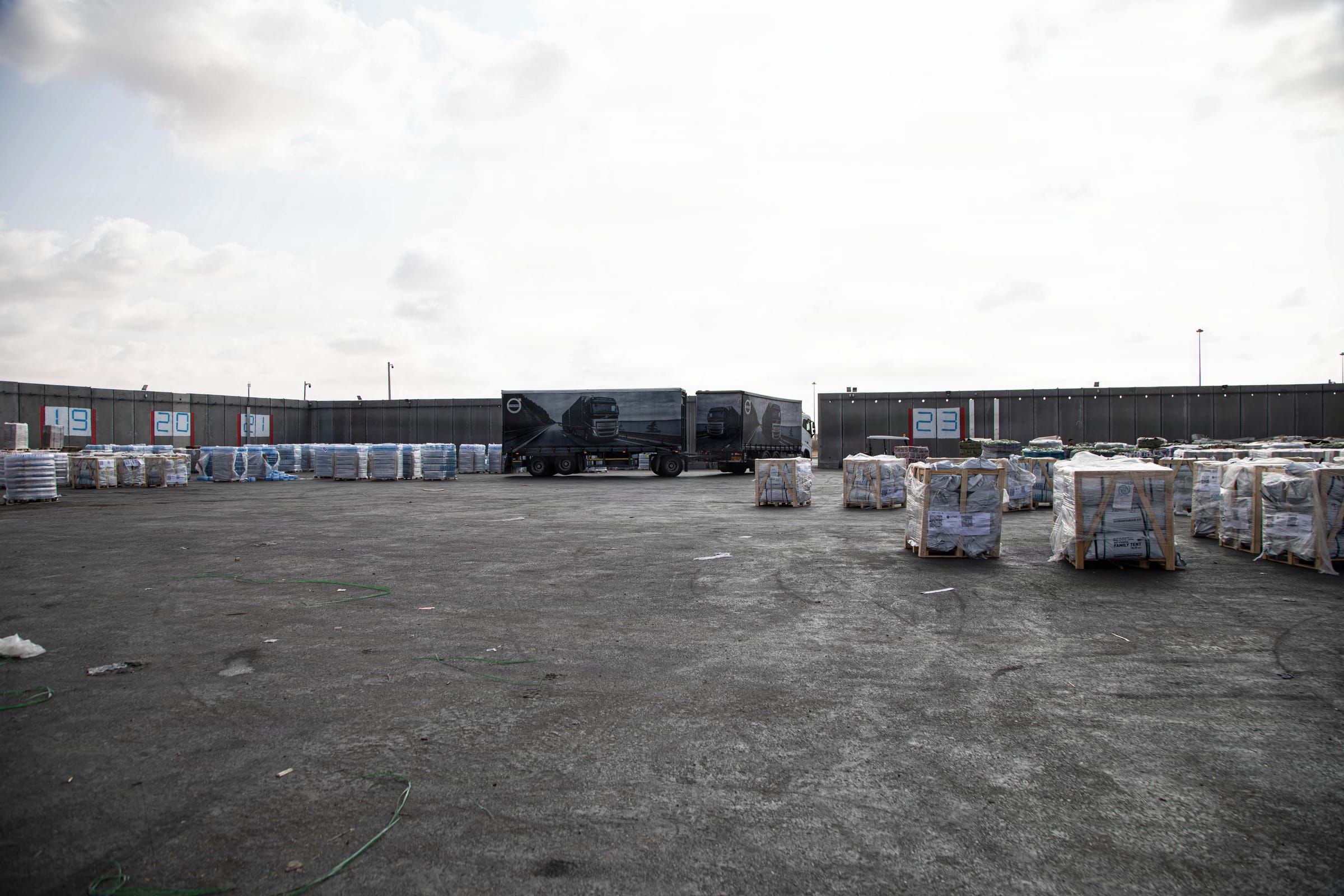
Kerem Shalom, 13 November 2025, a month into the Gaza ceasefire. Aid cargo palletised on the yard between the numbered gates of the crossing, where goods for Gaza are offloaded, inspected and reloaded; the lorry is leaving after unloading. Kerem Shalom is the cargo crossing through which goods enter the Strip.US Army / DVIDS · public domain · resizedImage: A wide, empty asphalt yard under an overcast sky, enclosed by a tall grey concrete wall marked with large gate numbers, with rows of shrink-wrapped pallets of boxed tents and bottled water on the right and a lorry with a trailer driving out through a gap in the wall.
Current state
Graded per item · As of 2026-10-11
Levant is one conflict system in which no arena is settled and each is held in place by an arrangement rather than a settlement. In Gaza, the ceasefire of October 2025 stands under UN Security Council resolution 2803 and a Board of Peace whose Palestinian administrative committee still works from Cairo and whose stabilization force has not deployed; Israeli strikes continue, Israeli forces hold a line enclosing about 60 per cent of the Strip by Israel's own account (OCHA records access restrictions on 65 per cent of its land), and goods enter through a single cargo crossing. In the West Bank, the Oslo-era fiscal and administrative architecture is formally in force and hollowed out: Israel has transferred no clearance revenue since May 2025, deductions are now written into Israeli statute, and the banking link that settles Palestinian trade runs on extensions to the end of 2026. On the Israel–Lebanon frontier, the 2026 war gave way to a ceasefire in effect since 19 June and a Trilateral Framework that ties Israeli redeployment, civilian return and reconstruction to verified disarmament zone by zone, with no timeline, while Israeli forces hold an area up to 10 km north of the Blue Line and UNIFIL ends its operations on 31 December 2026 with no successor decided. The regional interface runs through the same channels — Egyptian, Qatari, Turkish and US guarantees in Gaza, Israeli gas to Egypt and Jordan, and the war with Iran, during which Israel closed Gaza's crossings and Leviathan and Karish were shut from 28 February 2026. In Vigil's assessment the connecting mechanism is conditionality: in every arena, access, money and withdrawal are made to wait on disarmament or reform that has not happened, so the arrangements suspend the conflict rather than resolve it.
Counts cover this module’s mapped places, events, zones, campaigns, terrain, corridors, impact chains and actor profiles. A country count is what is specifically about that country; it is not the whole of what bears on it.
And by arena
GazaWest Bank & JerusalemIsrael–Lebanon / Blue LineRegional interface
Two dimensions, deliberately not the same one. An arena is the mechanism a record belongs to; a country is whose territory it concerns. Naming the arenas after the three states would have rebuilt three national modules inside one, and lost the cross-border explanation this module exists for.
Why it matters
The arrangements built here in 2025 and 2026 are new instruments being tested for the first time: a transitional administration authorised by the Security Council but run outside the UN, a stabilization force under US unified command, and a border framework that makes no mention of the UN force on that border. More than two million people in Gaza depend on aid that passes one cargo crossing, and the Palestinian Authority's payroll depends on a transfer Israel has suspended. Egypt and Jordan import Israeli gas, and power cuts were reported in both when Israeli fields shut in 2026, which ties two treaty partners' electricity to the same system.
Stated · Vigil assessment
What the 7 actors this module authors a posture for are trying to achieve — stated positions and Vigil’s assessments, kept apart. Every other party appears under Profiles without one.
Vigil assessment
What limits those options. A constraint is a structural limit, not a risk rating.
Vigil assessment · Observed
The module’s current phase — The 2026 war and the re-founded Lebanon front (Feb 2026 – present) — and the newest dated review.
Vigil assessment
The standing arrangements this module authors between its parties. Each line is the record’s own signature; the analysis, dates and sources are on the record.
Observed
The standing questions Vigil is following on this module, each with what its latest review found. The evidence that would change the assessment is on the question.
Vigil assessment · Observed
3 exposure channels and 6 watch items, as of 2026-10.
Vigil assessment · Observed
57 dated figures at regional granularity, each with its own basis, as of 2026-10. No operational detail is published.
This is the module's first brief, and its baseline: a week in which every arrangement holding the Levant system in place marked time while the violence each was meant to end continued beside it. The Gaza ceasefire reached its first anniversary on 10 October with none of its second-phase bodies working inside the Strip — the Palestinian administrative committee is in Cairo, no stabilisation-force contingent has deployed, no weapon has been handed over — and Israeli strikes continued on most days of the window. In Lebanon, Hezbollah's leader offered "weapon containment" on his own terms while Israeli officials called the first pilot zone a failure; no zone moved, a UNIFIL position took small-arms fire, and Lebanese authorities seized a consignment of explosives on the Bekaa–Beirut road. In the West Bank and East Jerusalem, a demolition displaced 69 people, and the Palestinian president moved national elections to September 2027 as the PLO put the withheld clearance revenue near 7 billion dollars. The ten standing questions this module will be reviewed against were established at baseline on 12 October; from the next cycle they carry review outcomes rather than an opening position.
Scope of this coverage. Development build, not published. Levant's actors, relationships, geography, forces, monitoring and translations are still being researched and authored, and no part of this module is yet a published Vigil assessment. The standing frame describes the system as of early October 2026; where it carries a casualty, displacement or damage figure, the figure is the counting body's, attributed and dated, never Vigil's own.
Source registryMethodology Corrections logGlossary
Found an error in Levant coverage? Corrections are logged in public with the date and what changed — see the corrections log.