
Vigil Consilium
A geopolitical research workspace, built on an auditable corpus.
Public Vigil is where you understand the system. Professional is where you work with it — the records beneath every published assessment, the evidence beneath those, and somewhere to keep what you do with them.
€129 / monthOne named user. One full Professional workspace. Cancel at any time.
Open ProfessionalSee how it works Walk through one real record
The workspace opens at My Vigil for a subscriber. Anyone else is asked to sign in first — nothing is charged by opening it.
Vigil Professional is available to subscribe to. No part of the public Vigil corpus is behind a payment, and nothing that is free today moves behind the subscription.
- 6conflict modules
- 56standing questions
- 306observable records
- 586dated evidence entries
- 8Standing Watch scopes
- 18scenario templates
Maintained on a weekly editorial cycle, with 149 registry sources cited across the corpus. Counts of published records — nothing here is an estimate, a projection or a total of anything Vigil has not recorded.
Public Vigil
Understand the system.
Every module, brief, Note, Watch question, profile and map — free, without an account, and staying that way.
Vigil Professional
Work with the system.
One research desk over the same maintained corpus: monitoring, evidence, comparison, conditional analysis, briefing production, and work that is still there when you come back.
The workflow
One path, with things hanging off it.
Professional is not a suite of twelve tools. It is five steps, in order, over one maintained corpus — and everything else supports them.
01
Monitor
What moved, and what was checked and held.
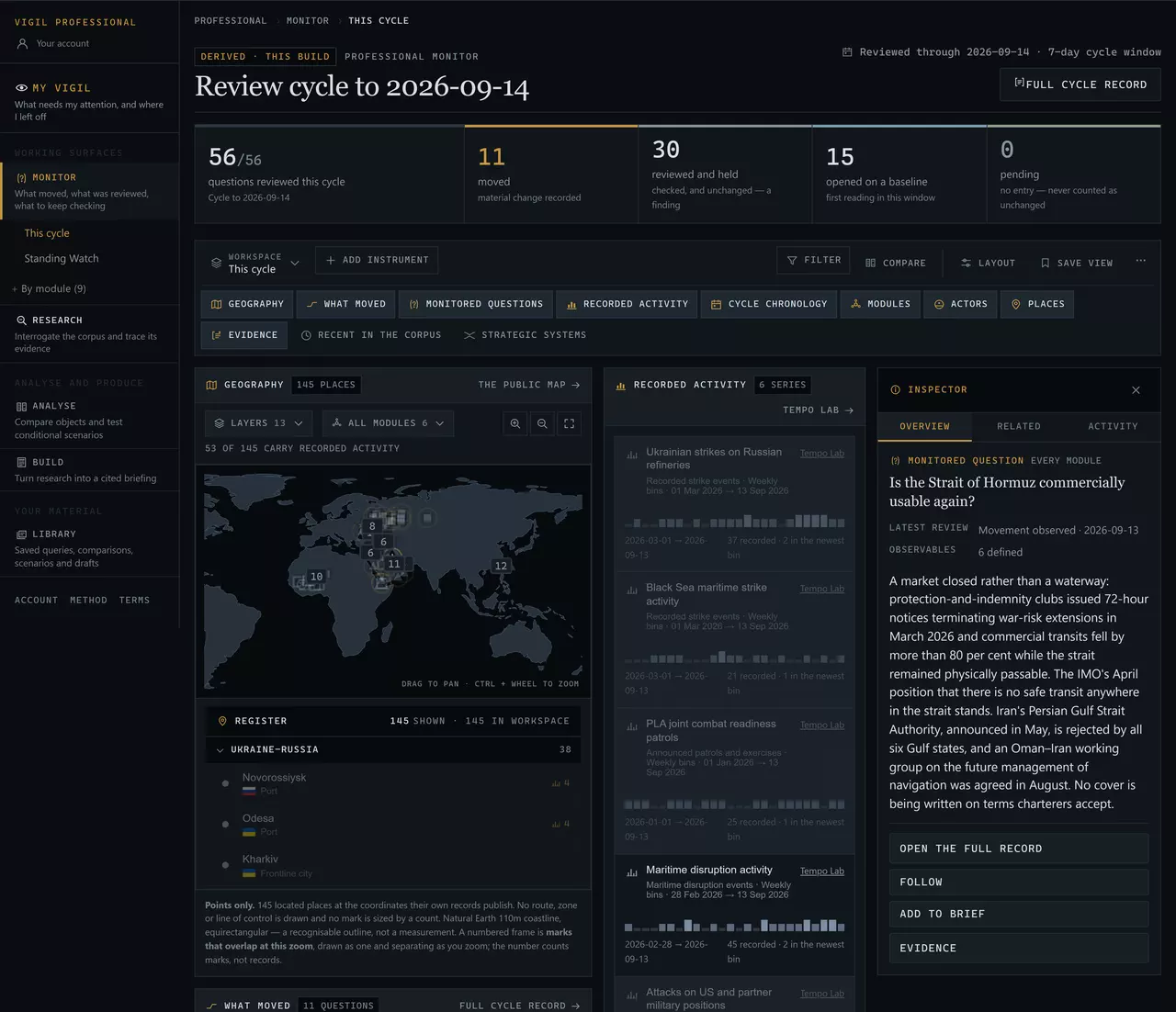
Every review in the cycle in Watch’s own outcomes, over the module’s geography and its recorded activity. A week in which nothing moved says so, and says who checked.
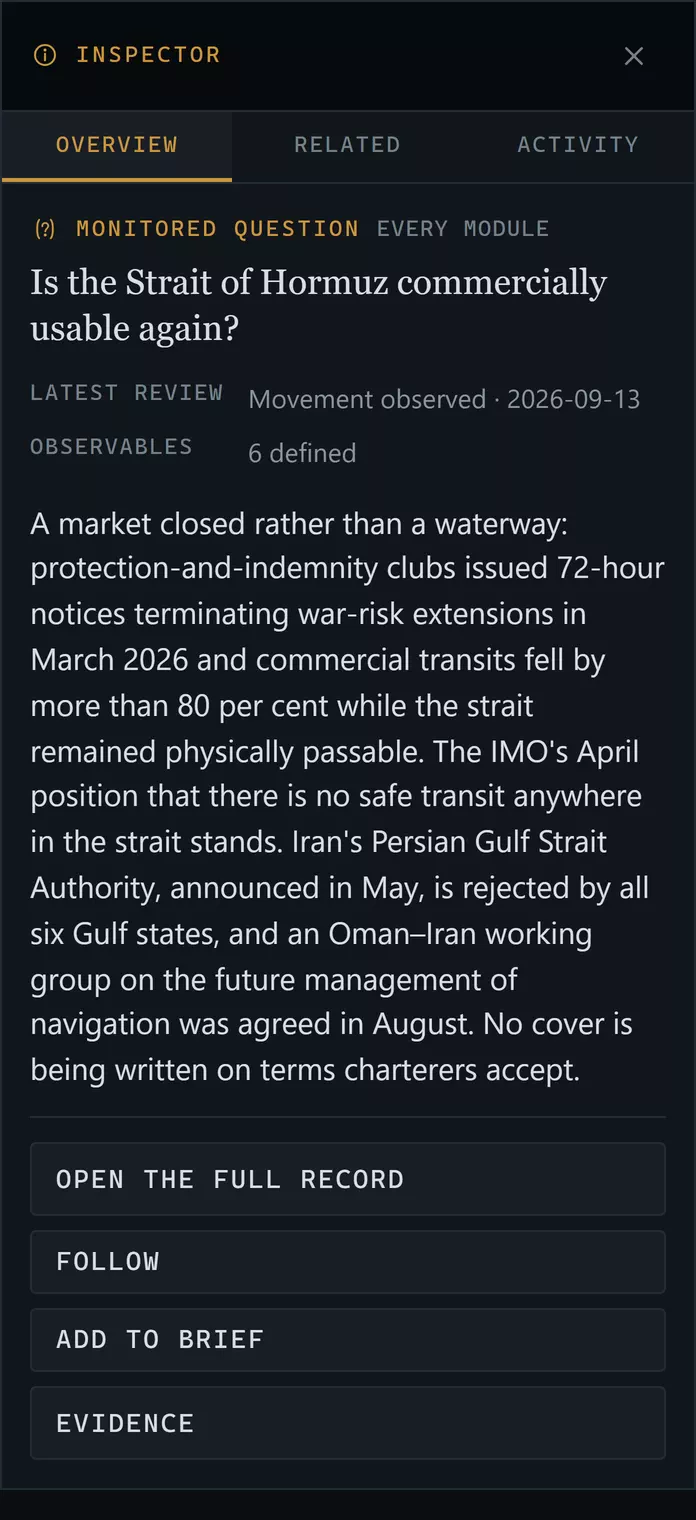
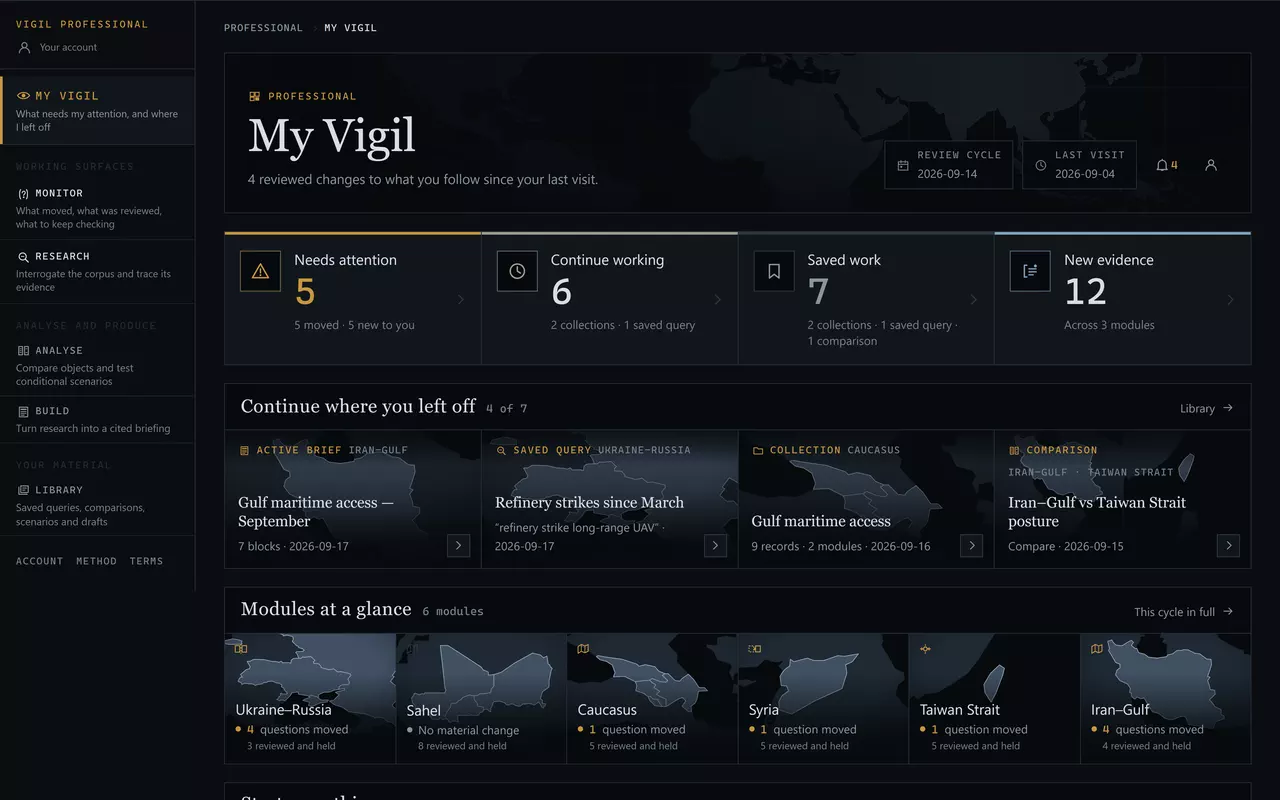
Selecting anything on the workspace fills the inspector with the record behind it, and with what can be done with it next. 02
Research
What the reading rests on.
Query the corpus by object, module, register and date; select a record and read the chain beneath it down to dated entries and named sources.
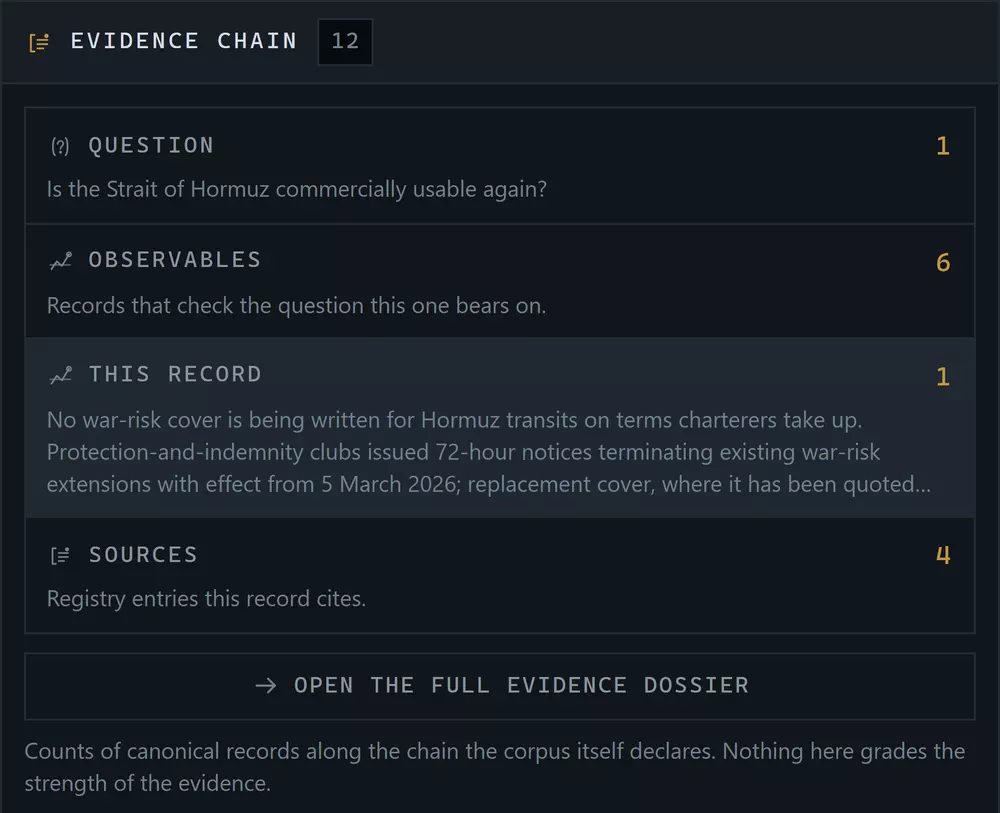
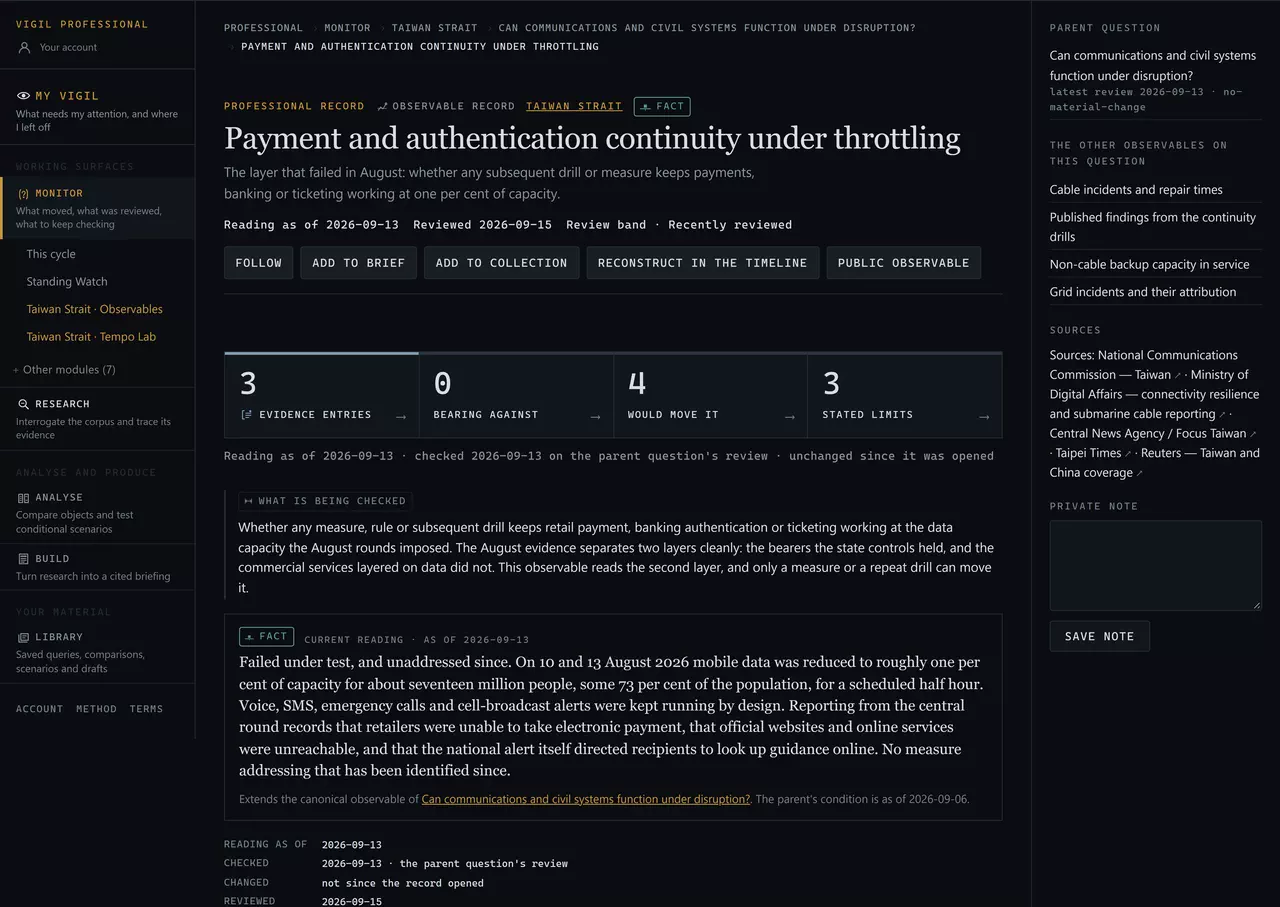
Question, observables, the record, its sources. Four counts of canonical records, declared by the corpus — nothing here grades how strong the evidence is. 03
Analyse
Two records side by side, or one assumption held.
Compare on the dimensions the records themselves carry. Or hold a condition and read which parts of the recorded system the template says become relevant, affected or stressed.
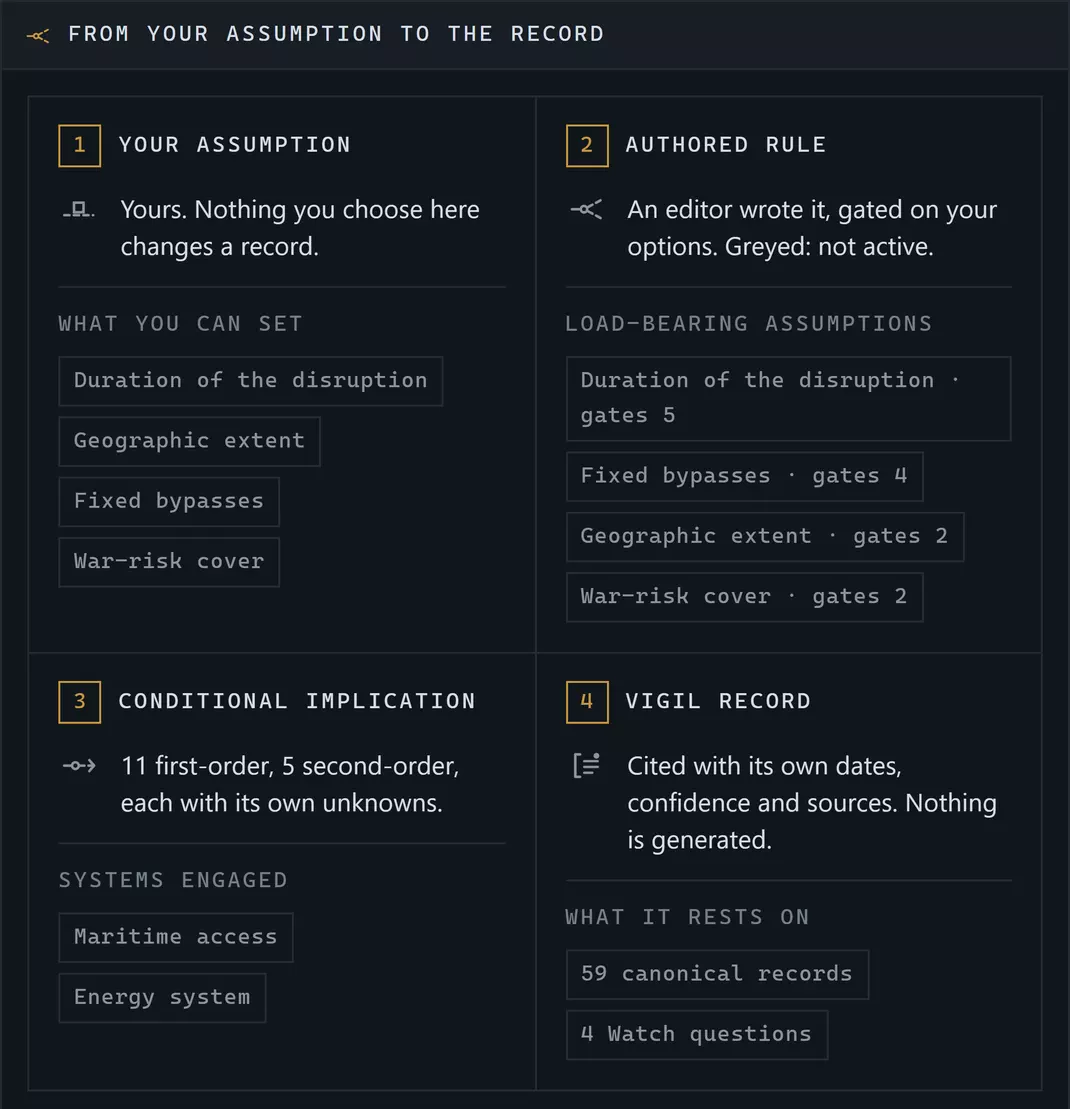
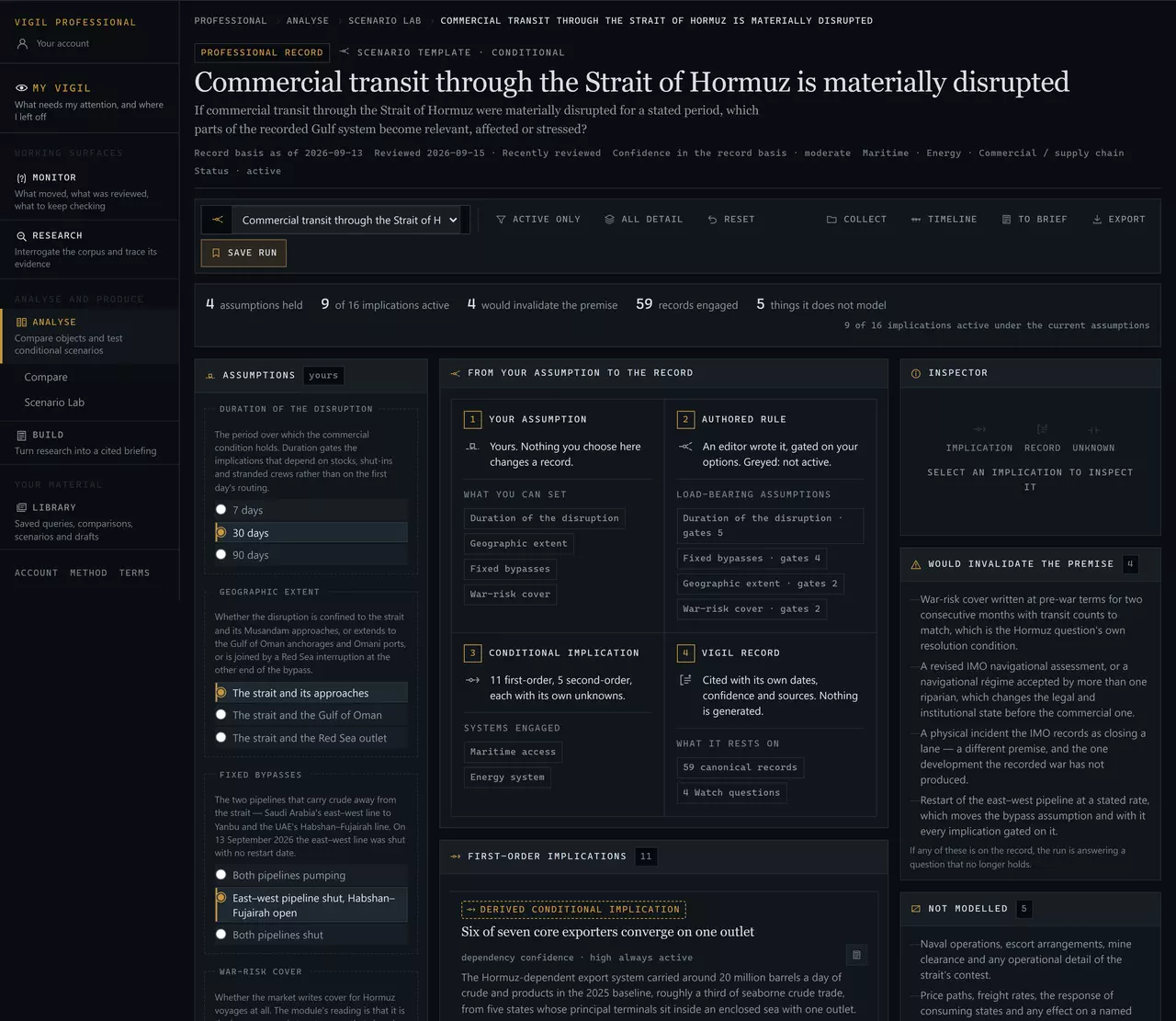
The whole method of a Vigil scenario, printed on the surface that runs it. 04
Produce
Something somebody else can check.
Assemble a briefing from canonical blocks that print their own wording, dates, confidence and sources, with your own text labelled as yours. Export it.
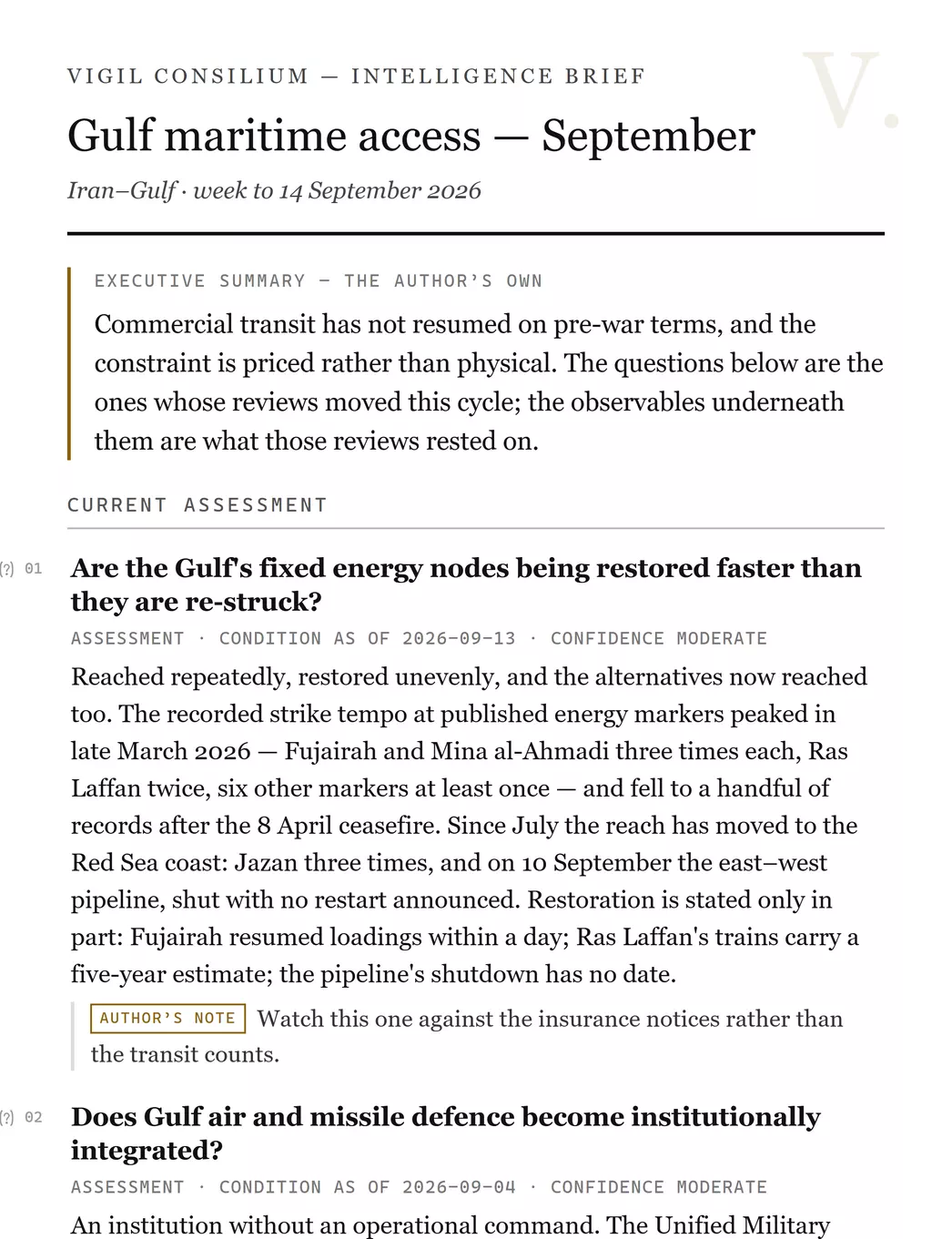
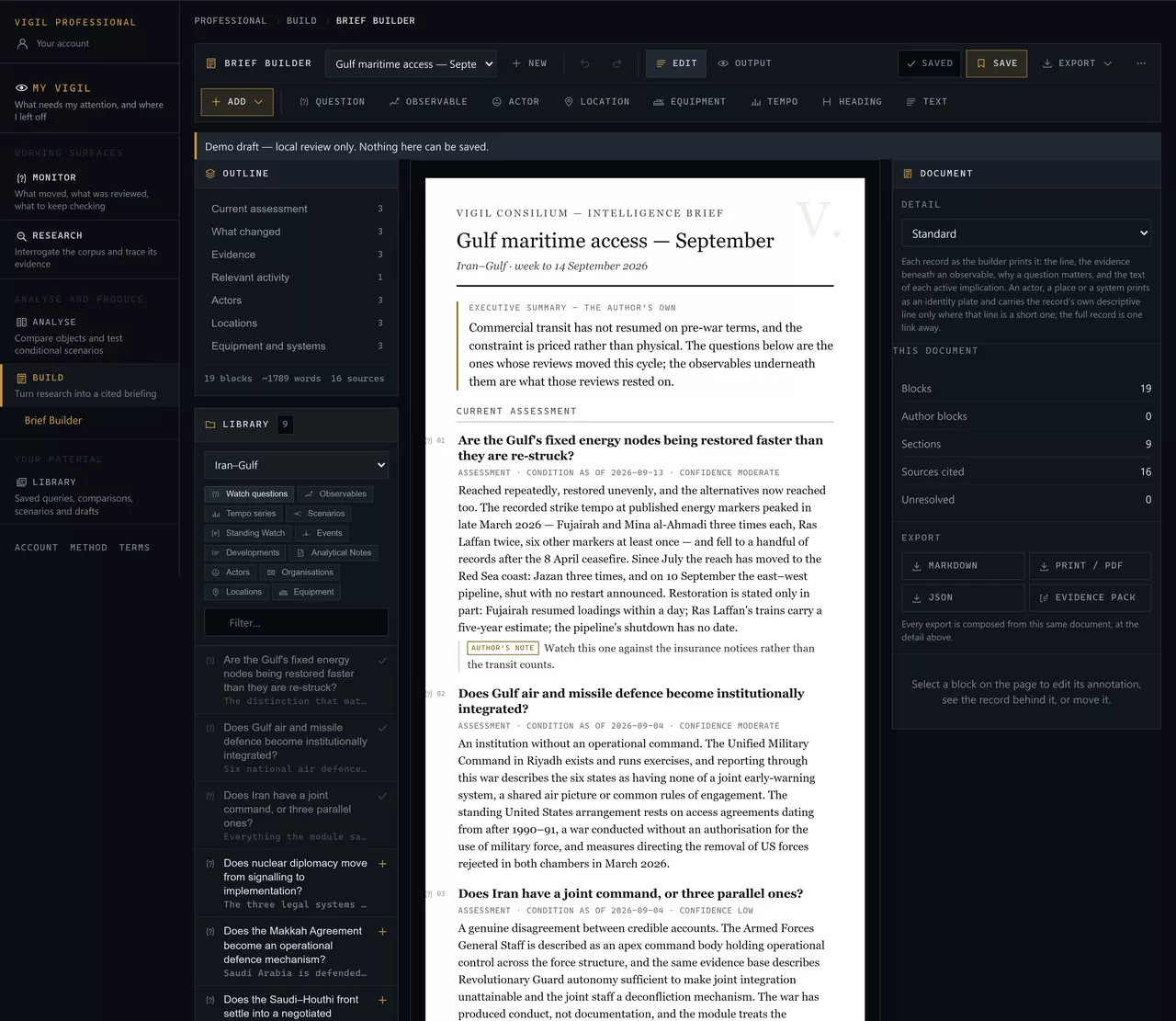
The document the builder is assembling. Vigil’s wording prints as Vigil’s; the author’s prose is marked as the author’s, on the page and in every export. 05
Return
And it is still there next week.
Collections, queries, comparisons, timelines, runs and drafts are held as references to canonical records — so a correction reaches what you saved instead of leaving you with a stale copy.
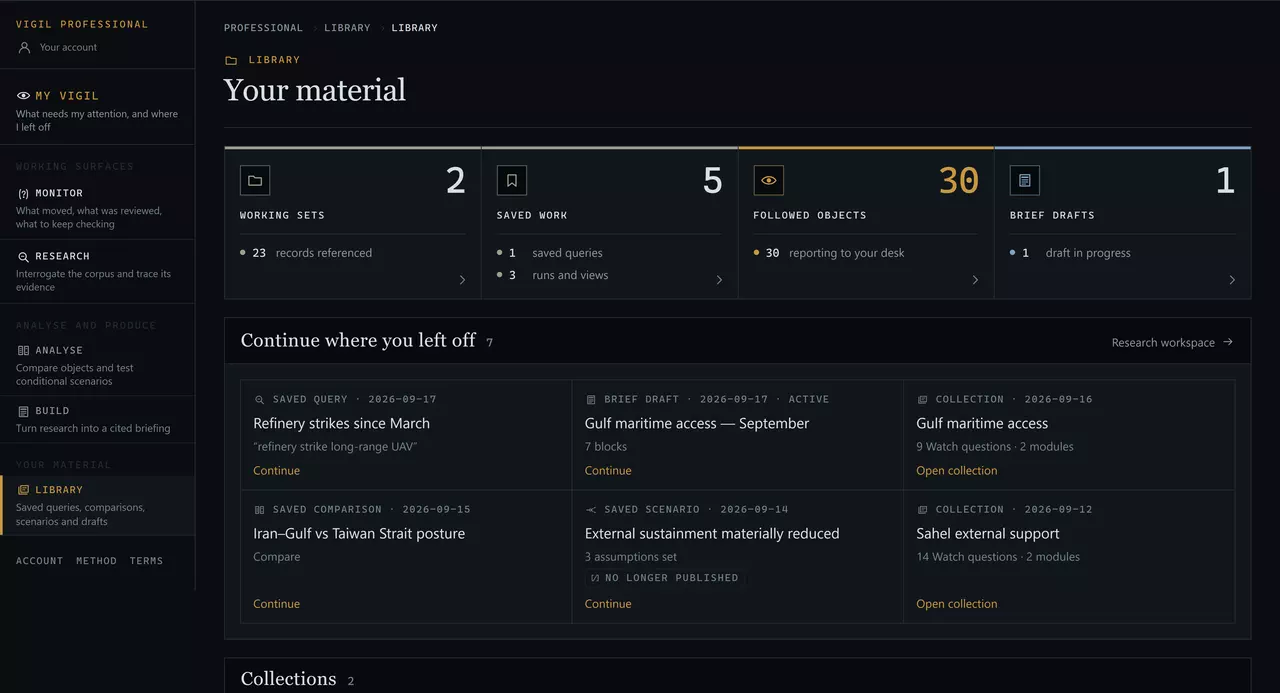
Saved work holds references to canonical records, never copies. When a record is retired the saved run says so — visible here on a scenario marked “no longer published” — instead of quietly showing something that has stopped being true.
Monitor
Monitor what you are responsible for.
Reviewed change, on a stated cadence — not automated detection.
Monitor is the cycle made legible. Every standing question Vigil maintains is reviewed on its own cadence, and the workspace shows the result of that review: what moved, what was checked and found unchanged, what opened on a baseline, and what is still pending. The counts are of reviews, never of events, and an unchanged review is recorded as a finding with its date and its basis — because an unchanged reading nobody checked and an unchanged reading somebody checked are different things.
Around the review state sits the module: its published geography, the actors and places its records name, its recorded-activity series where it has them, and the chronology of the days entries were written on. Select anything and the inspector opens the record behind it, with what can be done with it next — follow it, take it into a brief, open its evidence.
Follows are how the cycle reaches you. You follow a question, an observable, a series or a standing scope; when its reviewed state materially changes, Professional can tell you, in the product and by email if you turn that on. Nothing is sent because a source published, because an event occurred, or because a week was busy. A quiet review sends nothing, which is the point.
What it does not doThere is no threat level, no automated detection and no alerting service. Vigil delivers reviewed changes to things you chose to follow, on the cadence the public record states.
Standing Watch
A named exposure, held across several questions at once.
Public Vigil shows you the scope. Professional is where you work with it.
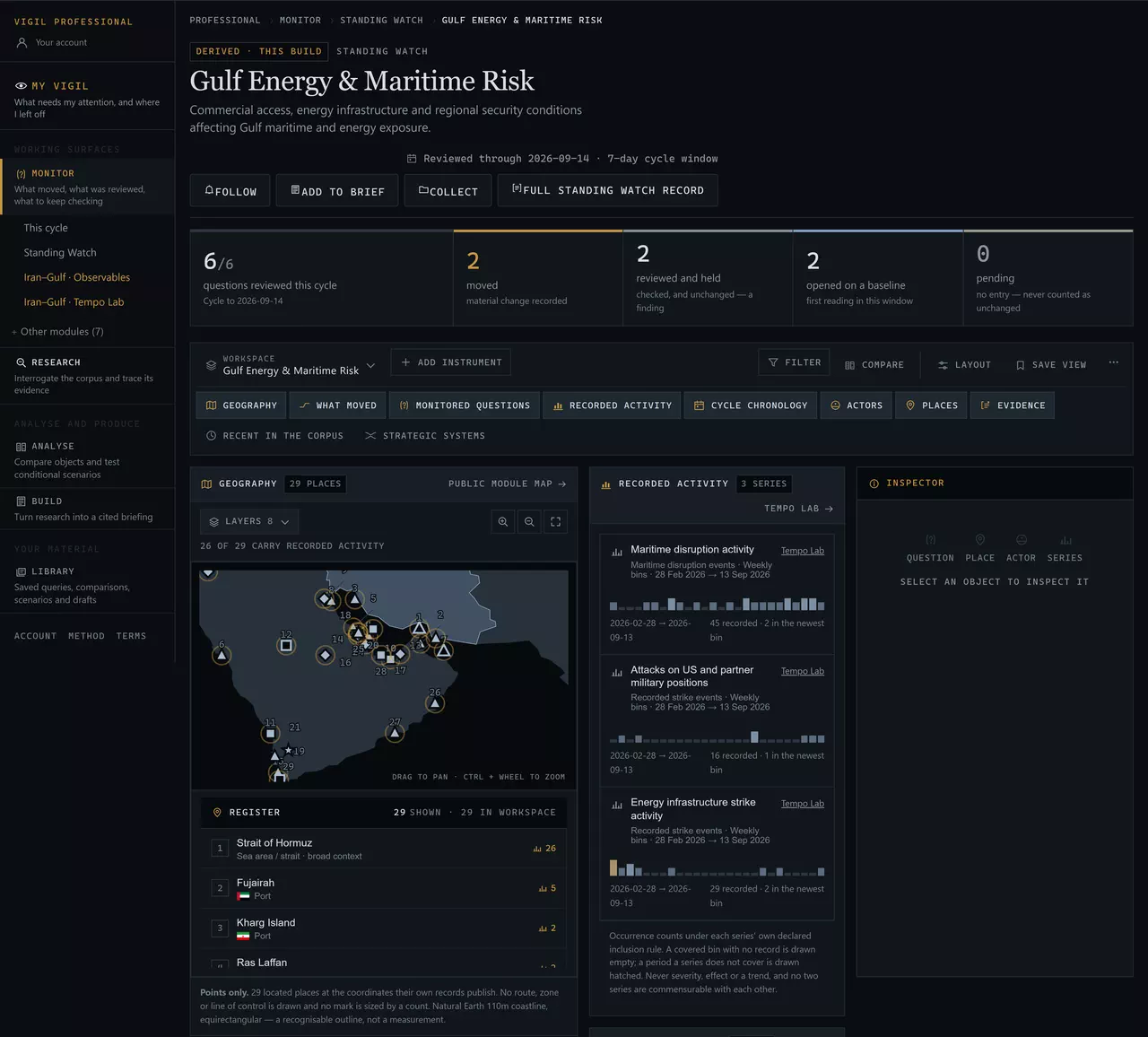
A Standing Watch groups canonical Watch questions around one defined exposure — a route, a sector, a decision context — and states what the scope covers, for whom, what it depends on, and what it cannot tell you. Everything under it is the public corpus: the same questions, the same observables, the same dated records, the same sources, the same review outcomes, produced by the same weekly cycle. A scope consumes that work; it does not run a second research process, and it produces no risk score.
One scope is public and stays public. Gulf Energy & Maritime Risk can be read in full today, with no account, because a monitoring model is a claim and a claim should be checkable before it is bought.
Read the public Gulf Energy & Maritime Risk scope
Of the 8 scopes maintained in total, one is public and stays public; the rest are in Professional. The public one is not a reduced version of the others.
What Professional adds around it
- The module’s geography and the places the scope’s records name
- The actors, systems and evidence beneath each question in the scope
- Recorded-activity series where the module maintains them
- Follows, saved views and layout, so the scope is a surface you return to
- Routes straight into Research, the Timeline and the Brief Builder
Research
Trace what a reading rests on.
A working surface over the corpus, not a search box.
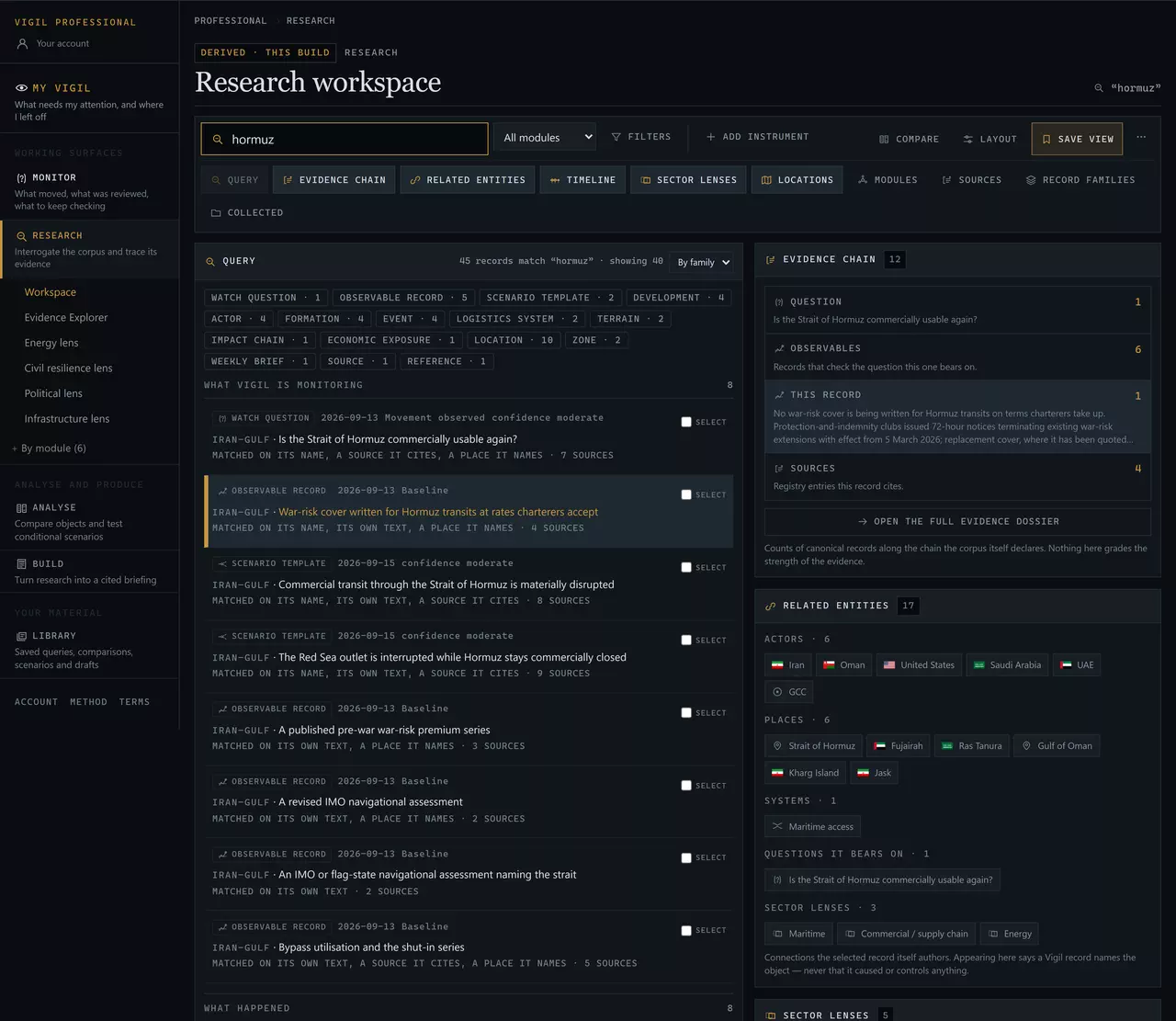
A query returns records by family — questions, observable records, scenario templates, developments, actors, formations, events, locations, logistics systems, terrain, briefs, sources — and says what each one matched on. Select one and the surface fills around it rather than navigating away: the evidence chain beneath it, the actors and places it names, the sector lenses it falls under, its position in the timeline.
Beneath every public Watch question, Professional publishes observable-level records. Each states the test Vigil applies, where the reading stands today and in which register, what has held, what would constitute movement — written in advance, so a later change can be checked against what Vigil said would count — and what the reading cannot establish. Each walks down to dated evidence entries, and each entry names the canonical development, event, Note or brief it rests on, and the registry sources behind that.
The chain is the product. Question, observable, reading, evidence, source: four kinds of canonical record, each addressable, each dated, each with its own page. Nothing on the way down is generated, summarised or inferred.
What it does not doA citation count is a count of citations. Vigil does not grade a source’s quality, score a claim’s strength, or rank one body of evidence against another.
Analyse
Put two records side by side. Or hold a condition and read the record at it.
Two instruments, and neither of them predicts anything.
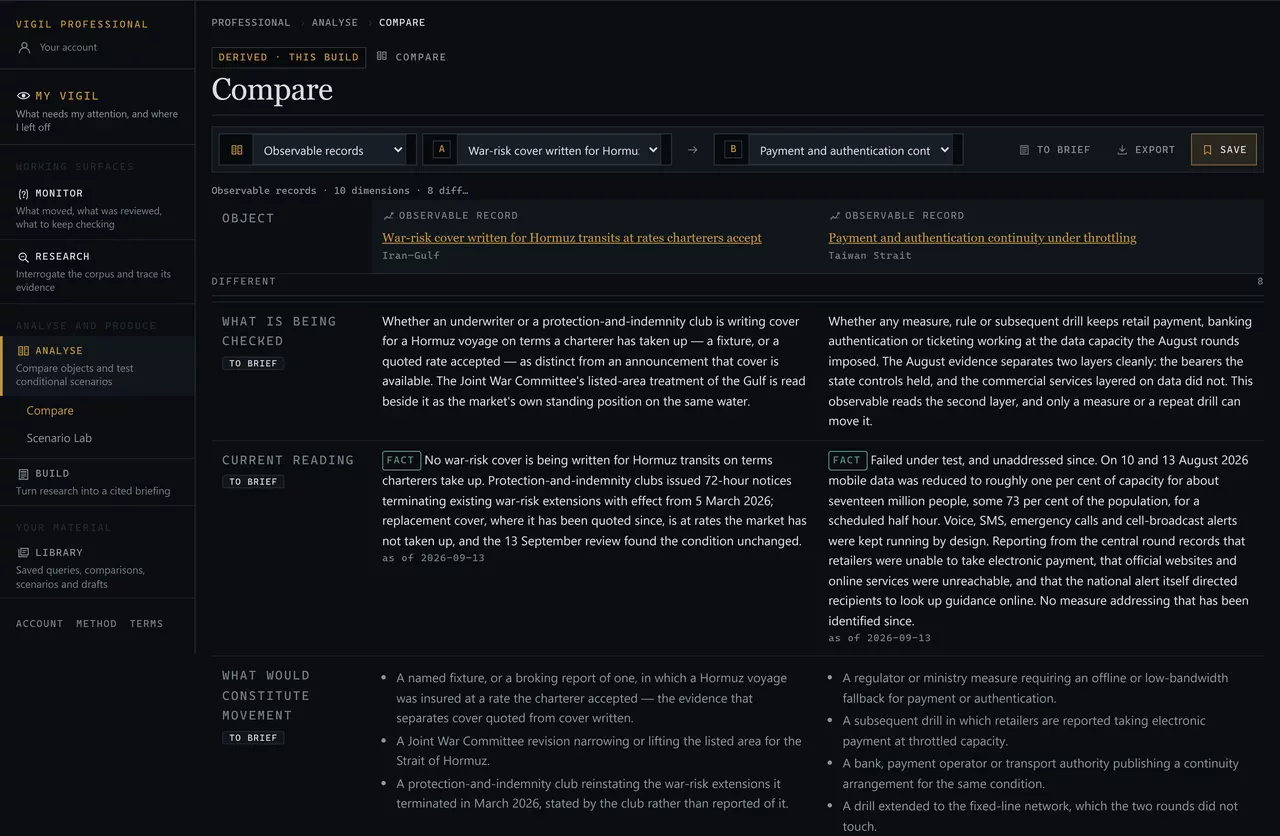
Compare takes two objects of one kind and sets them out on the dimensions their own records carry — what is being checked, where each stands, what would move it, what has held, what it cannot establish. Where one holds a dimension the other does not, the row says NOT COMPARABLE and gives the reason. Nothing is filled in to complete a row, because a blank in a comparison is read as a zero and a zero is a claim.
Scenario Lab is the distinctive one. You choose which conditions to hold — a duration, a geographic extent, an instrument in force or not — and the template reports which parts of the recorded system become relevant, affected or stressed. Every implication is an authored rule gated on those conditions, citing the canonical records it rests on and stating its own unknowns. Nothing is generated: change an assumption and different authored rules become active, and the records they cite are the same records the rest of Vigil publishes.
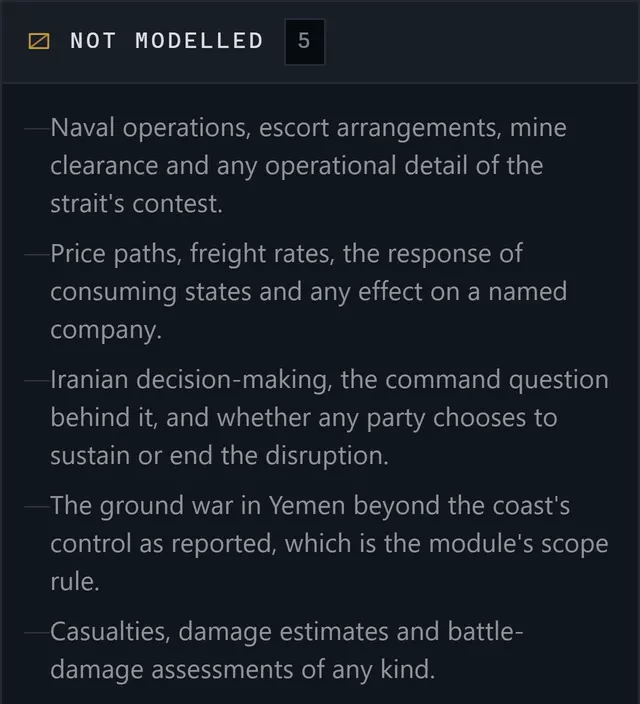
Every template publishes what it does not model, and that list is the reason the rest of it is worth reading.
What it does not doA scenario run carries no probability, no likelihood, no score and no horizon. It is a conditional reading of the record under assumptions you set and can see, and it is never a forecast.
Produce
Turn the research into something somebody else can check.
This is where reading Vigil and working with Vigil stop being the same activity.
The Brief Builder assembles a briefing from the corpus you have been working in. Insert a question, an observable, an actor, a location, a piece of equipment, a Tempo series or a whole standing scope, and the block prints the record as Vigil holds it — its wording, its register, its condition date, its confidence and its sources — which you cannot edit, because a briefing whose quotations could be adjusted in place is not evidence of anything. Your own summary, annotations and headings print as yours, marked as yours, on the page and in every export.
The document is a document. It composes on paper white, with the sections in the order you put them, a map of the locations it names, and a live count of blocks, sections, sources cited and unresolved references. Export it as Markdown, print it or take a PDF, take the structured JSON, or take an evidence pack.
And because the blocks are references rather than copies, a brief you built three weeks ago is still correct today — or tells you, in as many words, that one of its records is no longer published.
What it does not doVigil’s wording is never rewritten, softened or summarised into your brief, and nothing in the document is written for you.
My Vigil and the Library
Your work stays connected.
Save, leave, come back, continue.
The problem Professional exists to solve is continuity. Following a slow question for a year means remembering what you concluded, what it rested on, and whether any of it has changed since — and the usual apparatus for that is a folder of PDFs, a note file, thirty tabs and last week’s brief.
My Vigil is the desk you land on: what needs attention under what you follow, what you were in the middle of, what you have saved, and what new evidence has arrived across your modules. The Library is the same material filed — collections, saved queries, saved comparisons, scenario runs, timelines, brief drafts and private notes.
Everything saved is a reference to a canonical record. A correction propagates into your collection, your timeline and your brief instead of leaving you holding a copy that still looks right; and where a record has been retired, the saved work says so rather than quietly showing something that has stopped being true.
Activity Tempo
Recorded activity, where the counting rule can be defended.
Counts of what was recorded. Never a trend, a score or an intensity.
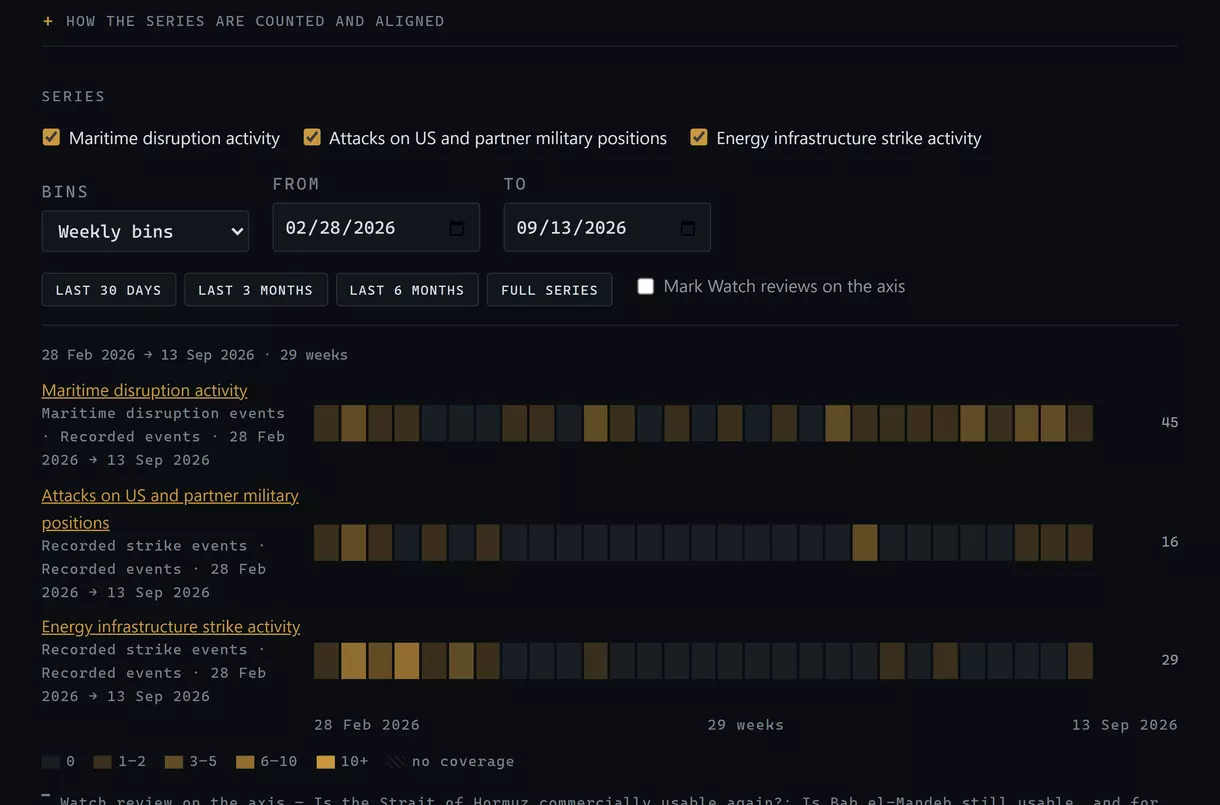
An activity series is a defined population stated in full: what it counts, what it deliberately does not count, which published markers it counts at, where its records come from, and the gaps it knows about. A record in a series is a dated, reported occurrence at a published marker — not a measure of damage, duration, output lost, casualties or effect, and there is no field on the schema for any of those.
Records are placed in weekly or monthly bins and counted. There is no smoothing, no interpolation, no normalisation and no heatmap. A period a series does not cover is drawn as no coverage and is visibly distinct from a covered period with no records, because “we were not counting” and “we counted none” are different statements. Two series can be read on one axis so their timing can be compared; that does not make them commensurable measures of anything.
CoverageActivity Tempo is maintained where Vigil has a defensible, repeatable event definition. Current Tempo coverage is Ukraine–Russia, Taiwan Strait and Iran–Gulf. The other modules do not have it, and Vigil does not create activity series for feature consistency. Of 6 modules, that is a deliberate boundary rather than a gap in the data. Sahel, Caucasus and Syria do not currently have it. 6 series are maintained in total.
A module without Tempo is not a quiet module and not a lesser one. It is a module for which Vigil has not established an inclusion rule it would be prepared to defend, and publishing counts it could not defend would be worse than publishing none.
In full
What is in the workspace.
The inventory, after the story rather than instead of it. Every line is a surface that exists and works today.
Monitor
- The review cycle across every module, in Watch’s five outcomes
- Standing Watch scopes at depth — exposure, mechanisms, dependencies, limits
- Module geography, actors, places and strategic systems
- Activity Tempo, where a module maintains it
- Follows, and reviewed-change notifications on them
- Saved Monitor views, with their layout and selection
Research
- Query the whole corpus by object, module, register, lens and date
- Observable records under every public Watch question
- The Evidence Explorer — a reading down to its dated basis and named sources
- Sector lenses across modules
- The module timeline, and timelines you assemble yourself
Analyse
- Compare, on the dimensions the records carry
- Scenario Lab — conditional templates over canonical records
- Saved comparisons and saved scenario runs
Produce
- Brief Builder, over the same maintained corpus
- Markdown, print and PDF, JSON and evidence-pack exports
- CSV and JSON exports on activity series and Watch state
Organise
- My Vigil — attention, continuation and what arrived
- The Library — every saved thing in one place
- Collections, saved queries and private notes
- Persistent workspace state across sessions and devices
Method
Built to be inspected, not simply trusted.
Everything below is checkable on the public site today, without an account.
Canonical records, addressed
Every object in the product is a published record with an id, a date and a page. Nothing on any surface is composed prose about a record; the surfaces compose the records themselves.
Fact and assessment are never blended
A reading is marked as an observed fact or as an assessment, in its own register mark, and the two are kept apart in the record, in Compare, and in anything you export.
Unknown stays unknown
Where Vigil does not know, the record says so and keeps saying so until evidence changes it. Nothing is estimated to fill a field.
Covered zero is not no coverage
A count of zero in a covered period and a period that was never counted are drawn differently and named differently, everywhere the distinction exists.
Nothing is forced into a comparison
Where two records do not both carry a dimension, Compare says NOT COMPARABLE and gives the reason instead of showing a blank.
Your assumptions stay yours
A scenario run holds conditions you chose and can see. The implications are authored rules citing records, each stating its own unknowns, and every template publishes what it does not model.
No score, no probability, no threat level
There is no universal risk number, escalation index, threat level or probability of war anywhere in the product, and no hidden model producing one.
Corrections propagate
Saved work holds references, not copies, so a correction reaches your collections, timelines and briefs. Corrections are logged publicly whether the error was in a free brief or in paid material.
Payment buys no editorial influence
A subscription buys access to tools and depth. It buys no say in what is covered, what is concluded, how a question is graded, or what is corrected — and the terms say so.
One editorial standard
Paid material meets the same sourcing, attribution, evidence-state, confidence and review rules as everything Vigil publishes openly. There is no subscriber-grade claim.
Professional methodology · Vigil methodology · Corrections log · Editorial process
Free and Professional
The free product is not a sample.
If something is necessary to understand Vigil's public assessment, it stays free. Professional adds depth beneath that assessment and tools for working with it — it never removes anything from the public record, and it never puts a conclusion behind a payment.
Public Vigil — free, and staying free
- Every conflict module, brief and Note
- Public Watch — every question, its condition, its named observables and its review ledger
- Actor, organisation, equipment and location profiles, and the Force Atlas
- Maps, Explore and site-wide search
- Methodology, editorial process, the source registry and the corrections log
- Data exports on the public records
No account. No payment. No agreement.
In Professional
- Observable-level records: the test applied, the current reading in its register, what would constitute movement, and the stated limits
- Evidence Explorer — every reading walked down to its dated basis
- Standing Watch at depth: exposure, mechanisms, dependencies and limits
- My Vigil: follows, what moved, what held, and your open work
- Collections, saved queries, comparisons, timelines and private notes
- Scenario Lab and Compare
- Brief Builder and professional exports
- Reviewed-change notifications on what you follow
Depth beneath the public assessment, and tools for working with it.
Everything Vigil publishes today stays public and stays free. Professional is intended to add monitoring and personal tooling on top of the public record — never to remove anything from it, and never to require an account to read Vigil.
Worked examples
What a week in it looks like.
Professional was built for the individual researcher who returns to the same questions every week — not, yet, for a team deployment.
Investment and energy
Hold a view on Gulf energy and maritime exposure through a quarter.
- Follow the standing scope and the questions inside it
- Read what moved this cycle, and what was checked and held
- Trace a reading down to its dated evidence and named sources
- Assemble the week’s position as an internal note with its citations
Political risk and consulting
Answer a client question about a mechanism that is changing.
- Query the corpus for the instrument, the actors and the places
- Compare the two records the answer turns on
- Test the client’s stated assumption against the recorded system
- Produce a brief whose every claim carries its own source
Policy and diplomacy
Understand what an institutional dependency actually rests on.
- Open the actors, offices and relationships a question names
- Read the observable records that check it, and their limits
- Hold one condition and read which parts of the system it reaches
- Keep the working set as a collection you return to
Conflict and security research
Track a theatre continuously rather than incident by incident.
- Follow the module’s questions and its recorded-activity series
- Inspect the dated records behind a period that changed
- Build a timeline from canonical events and developments
- Publish a structured brief with its evidence pack
The problem it solves is continuity. The work of following a slow question is remembering what you concluded, what it rested on, and whether any of it has changed since — and the usual tools for that are a folder of PDFs, a note file, thirty tabs and last week's brief. Professional keeps the questions, the evidence and your own work in one place that is reviewed on a stated cadence, so returning after two weeks away costs a minute rather than an afternoon.
Price
One plan.
One named user. One full Professional workspace. No feature tiers.
Vigil Professional
€129 / month
One named user. One full Professional workspace. Cancel at any time.
- No tiers, and no feature held back for a higher one
- No trial that starts billing quietly
- No annual lock-in — the only plan is monthly
- Cancel at any time; access runs to the end of the period already paid for
- Vigil never receives or stores card or bank details
Included
- Monitor, Standing Watch and Activity Tempo where covered
- The Research workspace, observable records and the Evidence Explorer
- Sector lenses and the module timelines
- Compare and Scenario Lab
- Timeline Builder and Brief Builder
- Markdown, print and PDF, JSON, CSV and evidence-pack exports
- My Vigil, the Library, collections and saved work
- Follows, and reviewed-change notifications
What is not in it, and is not being sold in advance
- Shared team workspaces, seats and administration
- An API, single sign-on, or procurement terms
- Any form of alerting, forecasting or risk scoring
None of these is being sold in advance, and none is on a published roadmap. Each waits for actual demand.
What an account is
A Vigil account exists to hold a Professional workspace, and nothing else. Reading Vigil has never required one and will not.
Sign-in is a link sent to your email address — there is no password to choose, store or lose. The workspace it holds is yours alone: saved work is scoped to your account and is not readable by any other.
The privacy notice lists every piece of personal data an account involves, field by field.
Before deciding
See one record in full, free.
Claims about depth are not evidence of depth. The walkthrough follows one real exposure from a standing scope down to one published Professional record — shown complete, with its evidence, its limits and its review ledger — and on to the scenario that cites it and the briefing it can end in. No account, no sign-up, and it is one of 306.
Walk through one recordRead the Handbook Public Watch
The Vigil Professional Handbook is public too: every surface, what it does, what the vocabulary means and how to get a briefing out of it — readable in full before anything is bought.
Availability
What is available today.
Vigil Professional is available to subscribe to. No part of the public Vigil corpus is behind a payment, and nothing that is free today moves behind the subscription.
It is one plan, monthly, for one person, at the price above — there are no tiers, no seats and no enterprise edition, and none is planned. The terms and the Professional methodology state what a subscription costs and what the work behind it is held to, and both can be read in full without an account.
Starting one takes a Vigil account, because a subscription has to attach to something. Sign in at your account and the option is there.
Cancelling ends the renewal. Access continues to the end of the period already paid for and is not cut off at the moment of cancelling.
A different thing
Supporting Vigil is not a cheaper Professional.
Support Vigil is a voluntary contribution to the public research. It buys no access, no features and no influence over what Vigil covers or concludes. Professional is a paid product with a workspace behind it. Neither one is a version of the other, and supporting Vigil has never been and will not become a way to buy the tools.
Questions
Before you ask.
- What is Vigil Professional?
- A research workspace over the corpus Vigil already maintains. Public Vigil publishes an assessment; Professional publishes the records beneath it — what is being checked, where it stands, what would move it, what it cannot establish — and gives you somewhere to keep your own work against them.
- What stays free?
- Everything Vigil publishes today. Modules, briefs, Notes, public Watch, profiles, maps, search, methodology and corrections are public and stay public. Nothing that is free today moves behind the subscription.
- Is it an alert service?
- No. Notifications carry reviewed changes to things you follow, on the editorial cycle. Nothing is sent because a source published or an event occurred, and a week in which your follows were reviewed and held sends nothing.
- Does it predict wars?
- No. There is no probability, no risk score, no threat level and no forecast anywhere in the product, and there is no hidden model producing one. Where Vigil does not know, the record says UNKNOWN and stays that way until evidence changes it.
- Is Scenario Lab a forecast?
- No. A template holds conditions you choose and reports which parts of the record become relevant, affected or stressed, each implication citing the records it rests on. Every template states what it does not model, and no run carries a likelihood or a horizon.
- How often is material reviewed?
- On each question's stated cadence, which the public Watch record shows. A review that finds nothing changed is recorded as a review, with its date and its basis — an unchanged reading that nobody checked and an unchanged reading that somebody checked are different things, and the product keeps them apart.
- What happens to my saved work if a record is corrected?
- It updates. Collections, timelines and briefs hold references to canonical records rather than copies of them, so a correction propagates into what you saved instead of leaving you with a stale copy that still looks right.
- What does it cost?
- €129 / month, for one named user with the full Professional workspace. There are no tiers, no seats, no feature gates and no annual plan: one subscription, monthly, cancellable at any time.
- Can I cancel?
- Yes, at any time, from your account. Access continues to the end of the period already paid for and is not cut off at the moment of cancelling.
- What happens after cancellation?
- The workspace stops being reachable when the paid period ends. Deleting the account removes the saved work and the account record; cancelling alone does not.
- Does supporting Vigil include Professional?
- No, and the two are deliberately unconnected. Support is a voluntary contribution to the public research; it buys no access, no features and no influence over what Vigil covers or concludes. Professional is a paid product with a workspace behind it.
- Do Professional subscribers influence Vigil's analysis?
- No. The Terms say so explicitly. A subscription buys access to tools and depth; it buys no say in what is covered, what is concluded, or how a question is graded.
- Is my payment information stored by Vigil?
- No. Checkout is handled by the payment provider and Vigil never receives or stores card or bank details. What an account holds is listed field by field in the privacy notice.
The public record, and the workspace over it
Vigil publishes one body of work. The public site is the research: modules, weekly briefs, Analytical Notes, standing Watch questions, actor and location records, maps, Explore and site-wide search — free, without an account, and not a sample of something better.
Vigil Professional is a paid workspace over the same maintained corpus, for readers whose work is returning to the same questions week after week. It adds depth beneath the published assessment and tools for working with it: observable-level records, evidence tracing, comparison, conditional scenarios, briefing production, and saved work that stays correct when a record is reviewed.
The rule that separates them does not move: if something is necessary to understand Vigil’s public assessment, it stays free. Professional never removes anything from the public record and never puts a conclusion behind a payment. A subscription buys access to tools and depth; it buys no influence over what Vigil covers, what it concludes, or what it corrects.
Open Professional · Walkthrough · Handbook · What it costs · Professional methodology · Terms · Privacy · Public Watch · Standing Watch