
One record, in full
This is a real, published Professional record — not a mock-up, not a screenshot and not a simplified version. It is one of 306, shown in the order a subscriber reads it, with the chain it sits in above and below, and with the surfaces they read it on. Everything on this page is free to read and always will be.
What this page is. One observable record of 306, published openly so that the depth can be checked rather than claimed. The other 305 are behind the subscription; this one is not, on purpose. Nothing here is fabricated for demonstration and nothing is simplified: if the record is reviewed next week, this page changes with it.
1 · The exposure
A Standing Watch scope — a named exposure held across several questions at once, narrower than a module and wider than a single question.
Standing Watch
Taiwan Civil Resilience
Whether Taiwan's communications, energy and import systems keep working under sustained coercion and access pressure — read on published requirements, holdings, incidents and thresholds.
An organisation whose operations, obligations or planning depend on civilian systems inside Taiwan continuing to function while pressure is applied below the threshold of attack — an operator, insurer, lender or manufacturer with Taiwanese exposure, a continuity or country-risk function, a government or agency with people and assets on the island. The questions it has to keep checking are not whether an incident occurred, which reporting answers, but whether the conditions that govern continuity have moved: what the communications layer does when data is degraded, what the energy reserves actually are per fuel, whether what arrives keeps arriving, and whether the instrument that would constrain access has been used rather than described.
4 questions in scope · reviewed weekly · 6 stated limits
A subscriber opening this scope sees each of its questions with the mechanism it carries, what the scope depends on, and — set out at length — what the scope cannot tell them. We are going to follow one of its questions down.
2 · The question, which is free
Public Watch. Anyone can read this, today, with no account.
Public Watch question
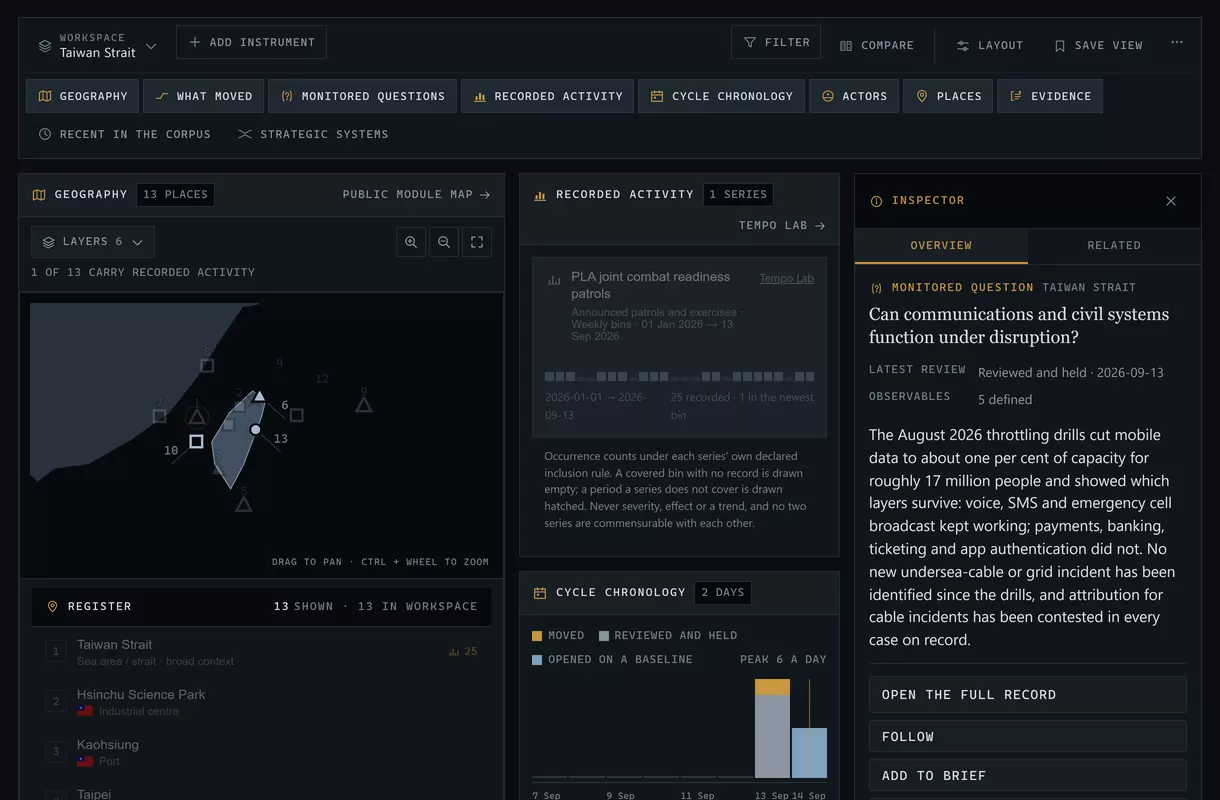
Can communications and civil systems function under disruption?
The August 2026 throttling drills cut mobile data to about one per cent of capacity for roughly 17 million people and showed which layers survive: voice, SMS and emergency cell broadcast kept working; payments, banking, ticketing and app authentication did not. No new undersea-cable or grid incident has been identified since the drills, and attribution for cable incidents has been contested in every case on record.
Condition as of 2026-09-06 · 5 named observables · last reviewed 2026-09-13
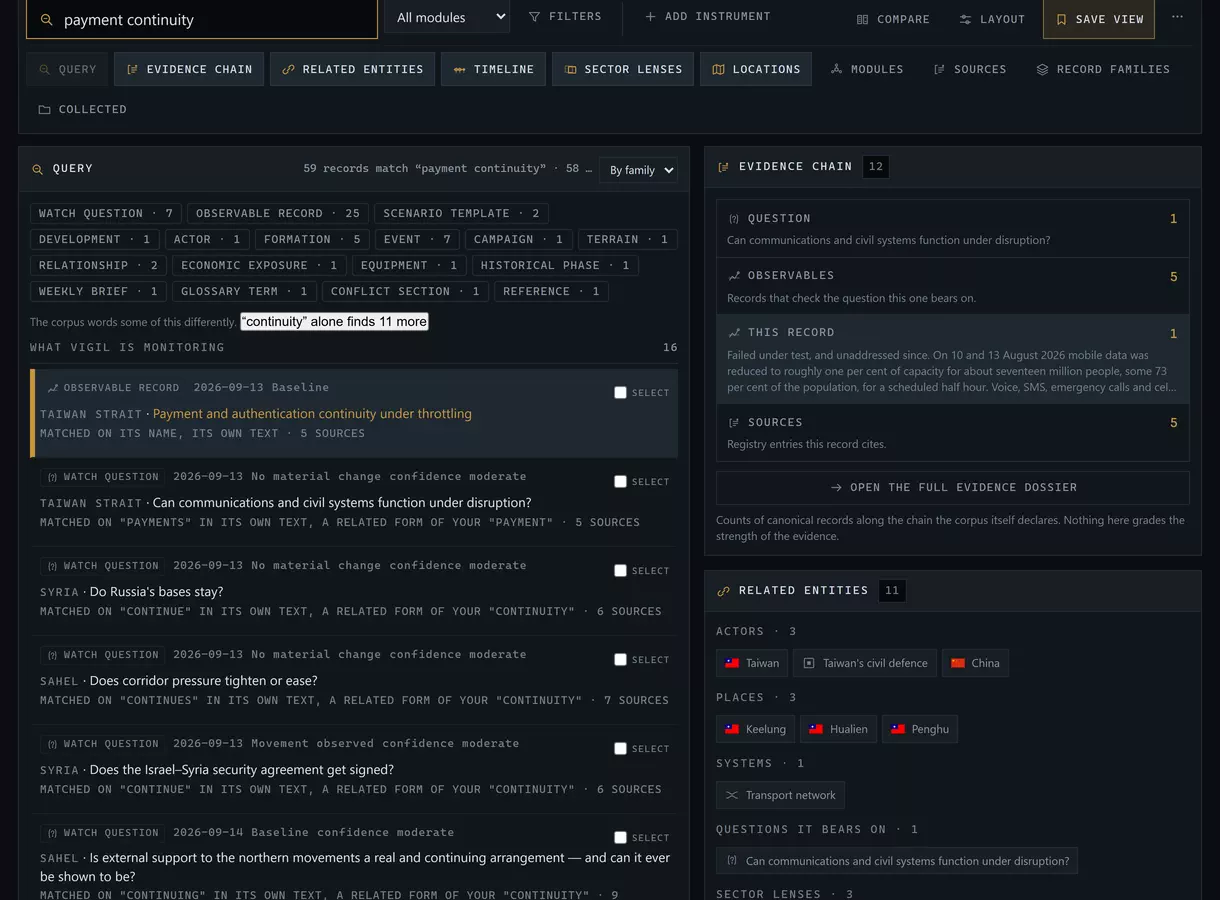
Public Watch names the observables — what evidence would bear on the question — and stops there, because that is what a reader needs in order to understand the assessment. One of the named observables on this question is Payment and authentication continuity under throttling. What follows is what Professional adds beneath it.
3 · The Professional record
This is the paid layer. This is all of it, for this record.
Observable record · Vigil Professional
Payment and authentication continuity under throttling
The layer that failed in August: whether any subsequent drill or measure keeps payments, banking or ticketing working at one per cent of capacity.
What is being checked
Whether any measure, rule or subsequent drill keeps retail payment, banking authentication or ticketing working at the data capacity the August rounds imposed. The August evidence separates two layers cleanly: the bearers the state controls held, and the commercial services layered on data did not. This observable reads the second layer, and only a measure or a repeat drill can move it.
Current reading as of 2026-09-13
FACT
Failed under test, and unaddressed since. On 10 and 13 August 2026 mobile data was reduced to roughly one per cent of capacity for about seventeen million people, some 73 per cent of the population, for a scheduled half hour. Voice, SMS, emergency calls and cell-broadcast alerts were kept running by design. Reporting from the central round records that retailers were unable to take electronic payment, that official websites and online services were unreachable, and that the national alert itself directed recipients to look up guidance online. No measure addressing that has been identified since.
What has held
- The layers that held in August are the ones built on the most robust bearers — voice, SMS, emergency calls and cell broadcast — and they were deliberately excluded from the throttling rather than tested by it.
Evidence 3 dated entries, newest first
2026-09-13bears on it without direction
No further drill announced and no civil-systems measure identified in the review window.
ITEM A reported linkage between a summit and an arms approval, which would change how transfers are timed · 2026-09-13 · sources: taiwan-ncc, cna-focus-taiwan
2026-08-13bears toward the observable being met
The northern round at 256 Kbps, which confirmed the same split between excluded bearers and data-dependent services on a second population.
EVENT The throttling exercise repeats across northern Taiwan · 2026-08-13 · sources: taiwan-ncc, cna-focus-taiwan
2026-08-10bears toward the observable being met
The central round — the condition imposed, the exclusions granted, and the commercial services reported as unusable during it.
EVENT Taiwan runs its first mobile-network throttling exercise · 2026-08-10 · sources: taiwan-ncc, cna-focus-taiwan, taipei-times
Every entry names the canonical record it rests on. In the product each of those is a link, and following one lands on the development, event or brief itself with its own sources and dates.
What would constitute movement 4 conditions
- A regulator or ministry measure requiring an offline or low-bandwidth fallback for payment or authentication.
- A subsequent drill in which retailers are reported taking electronic payment at throttled capacity.
- A bank, payment operator or transport authority publishing a continuity arrangement for the same condition.
- A drill extended to the fixed-line network, which the two rounds did not touch.
Stated in advance, so that a later change can be checked against what Vigil said would count rather than explained after the fact. Vigil never states that it expects any of them, and no likelihood or horizon is attached to any entry.
What this reading cannot establish 3 limits
- The drills throttled the mobile network only. Fixed-line and enterprise connectivity were not degraded, so the exercise does not establish what a payment network does when every path is constrained.
- The reported effects come from journalism rather than from an operator or regulator measurement, and no party has published a count of transactions that failed.
- A scheduled half-hour with the robust bearers protected is the mildest version of the condition, and nothing here is read as establishing behaviour under a longer or unannounced one.
Review ledger
- 2026-09-15 · Baseline — Record opened by the Taiwan propagation pass. This is the clearest instance in the corpus of an exercise producing a negative finding about a civilian system, and the record keeps the finding at the layer it was observed in.
Checked 2026-09-13 on the parent question's review. It has not changed since it was opened, and the ledger says so rather than leaving the reader to guess.
4 · What cites it
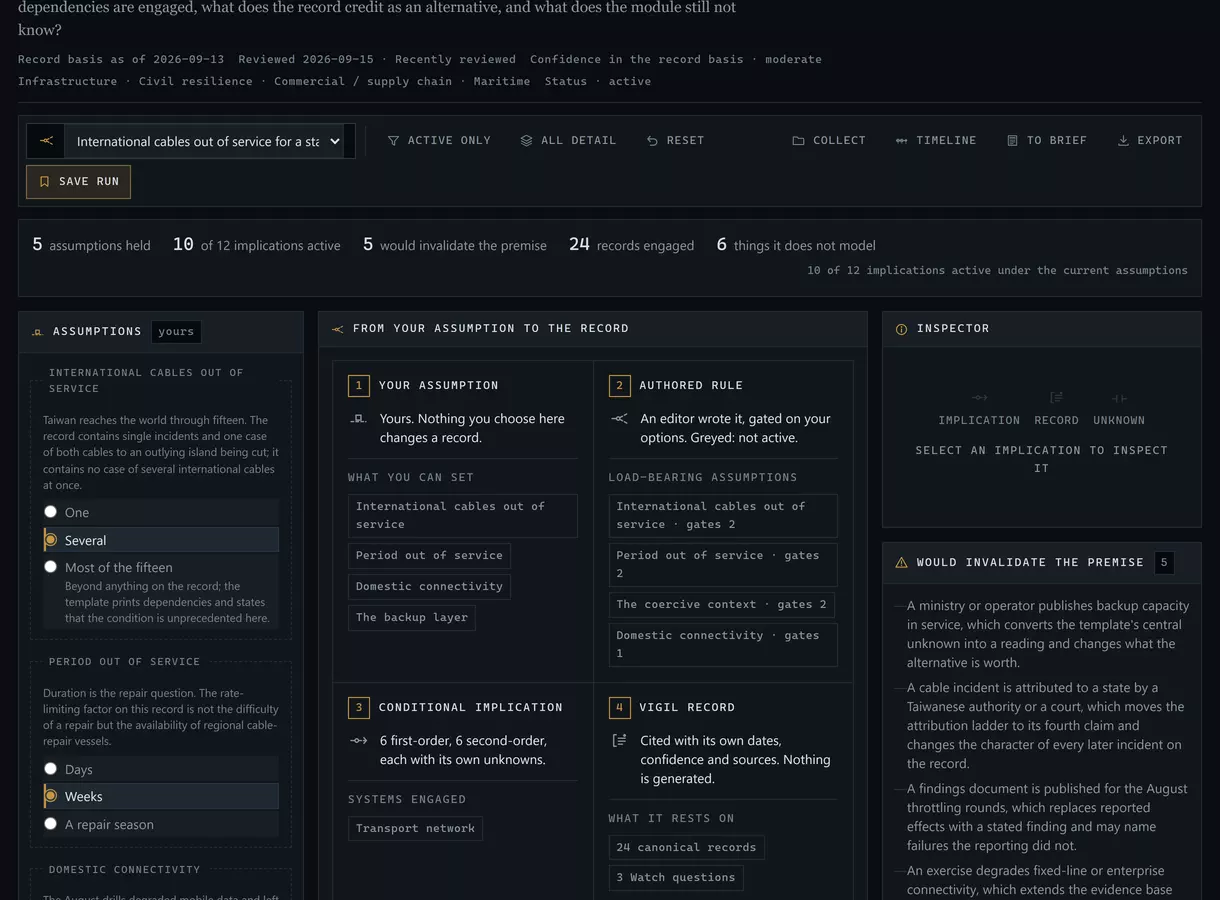
Records are not islands. This one is read by a scenario template.
Scenario template
International cables out of service for a stated period
If a stated number of Taiwan's international cables were out of service for a stated period, which recorded dependencies are engaged, what does the record credit as an alternative, and what does the module still not know?
5 assumptions you set · 12 authored implications, each citing the records it rests on · 5 invalidators
What it does not model
Every template publishes this list, and it is the reason a Vigil scenario is worth reading. A run carries no probability, no score and no horizon. For this template, in its own words:
- Cable routes, landing points, capacity shares and repair methods. None is published here and none would be.
- Attribution of any incident to any party, and the intent behind any incident.
- The semiconductor economy and the global consequences of a Taiwanese connectivity loss. The module records that exposure on separate chains and this template does not reach it.
- Any military scenario. Nothing here describes an attack, a blockade or a contingency, and the coercive context assumption is a context and not an event.
- Public order, information operations and their interaction with a connectivity loss.
- The financial system's internal continuity arrangements, which are not published.
5 · And then out
The end of the chain is something somebody else can check.
A subscriber can put this record into a collection, a timeline or a comparison, and assemble a briefing from canonical blocks that carry their own wording, dates, confidence and sources, with their own text labelled as theirs. What is saved is a reference to the record, never a copy of it — so when this reading is next reviewed, the collection, the timeline and the brief move with it instead of quietly going stale.
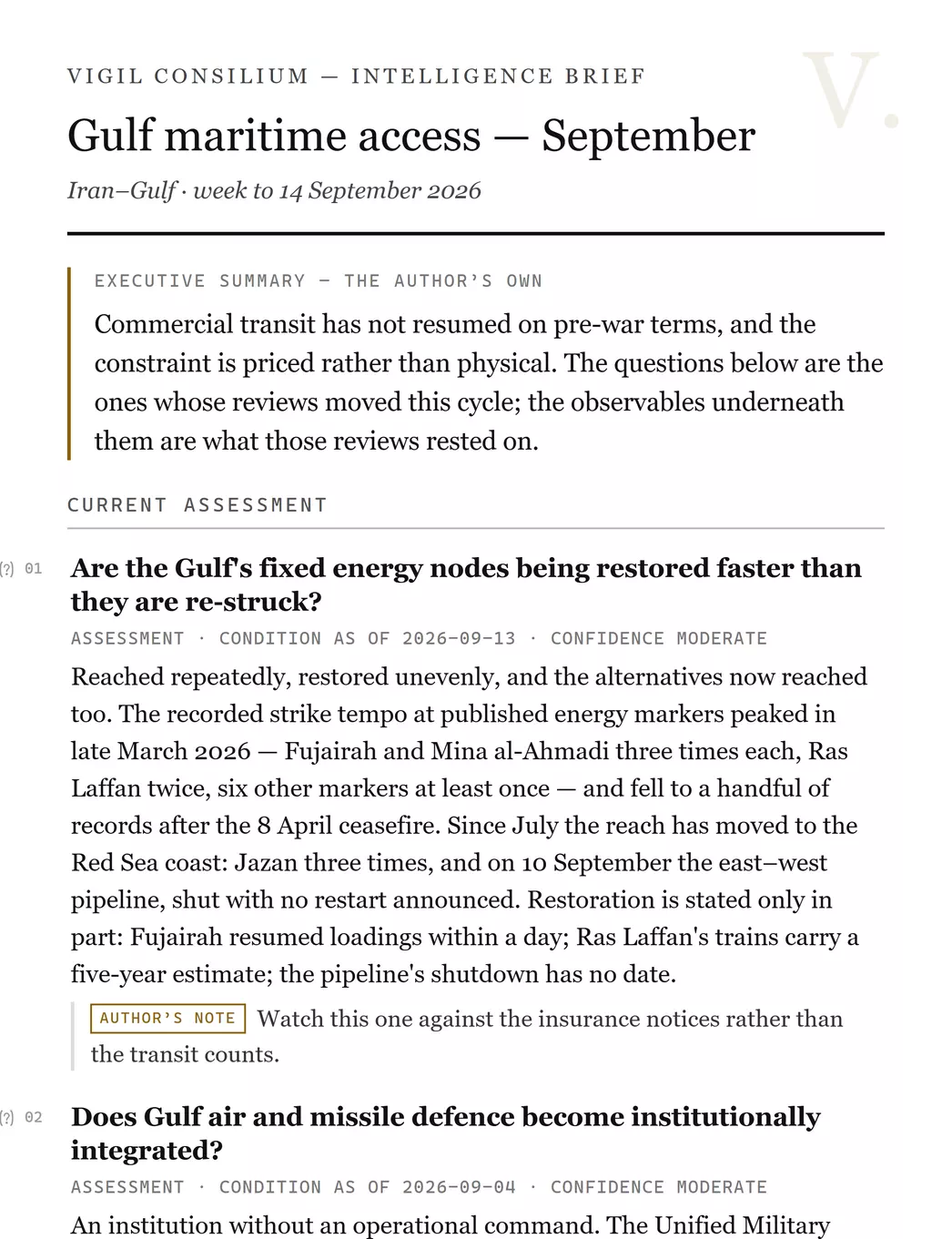
And because they followed the question, the next material change to it reaches them without being looked for. A review that finds nothing changed sends nothing.
That was one of 306
There are 306 records like this one across 6 modules — Ukraine–Russia, Sahel, Caucasus, Syria, Taiwan Strait and Iran–Gulf — under 56 public Watch questions, with 8 standing scopes and 18 scenario templates over them. Each carries its own test, register, evidence, movement conditions, limits and ledger, exactly as this one does.
The full workspace is €129 / month for one named user. Vigil Professional is available to subscribe to. No part of the public Vigil corpus is behind a payment, and nothing that is free today moves behind the subscription.