
Stated · Vigil assessment
Objectives
What the 9 actors this module authors a posture for are trying to achieve — stated positions and Vigil’s assessments, kept apart. Every other party appears under Profiles without one.
CorridorEnergyDe facto stateDisplacementRegional power
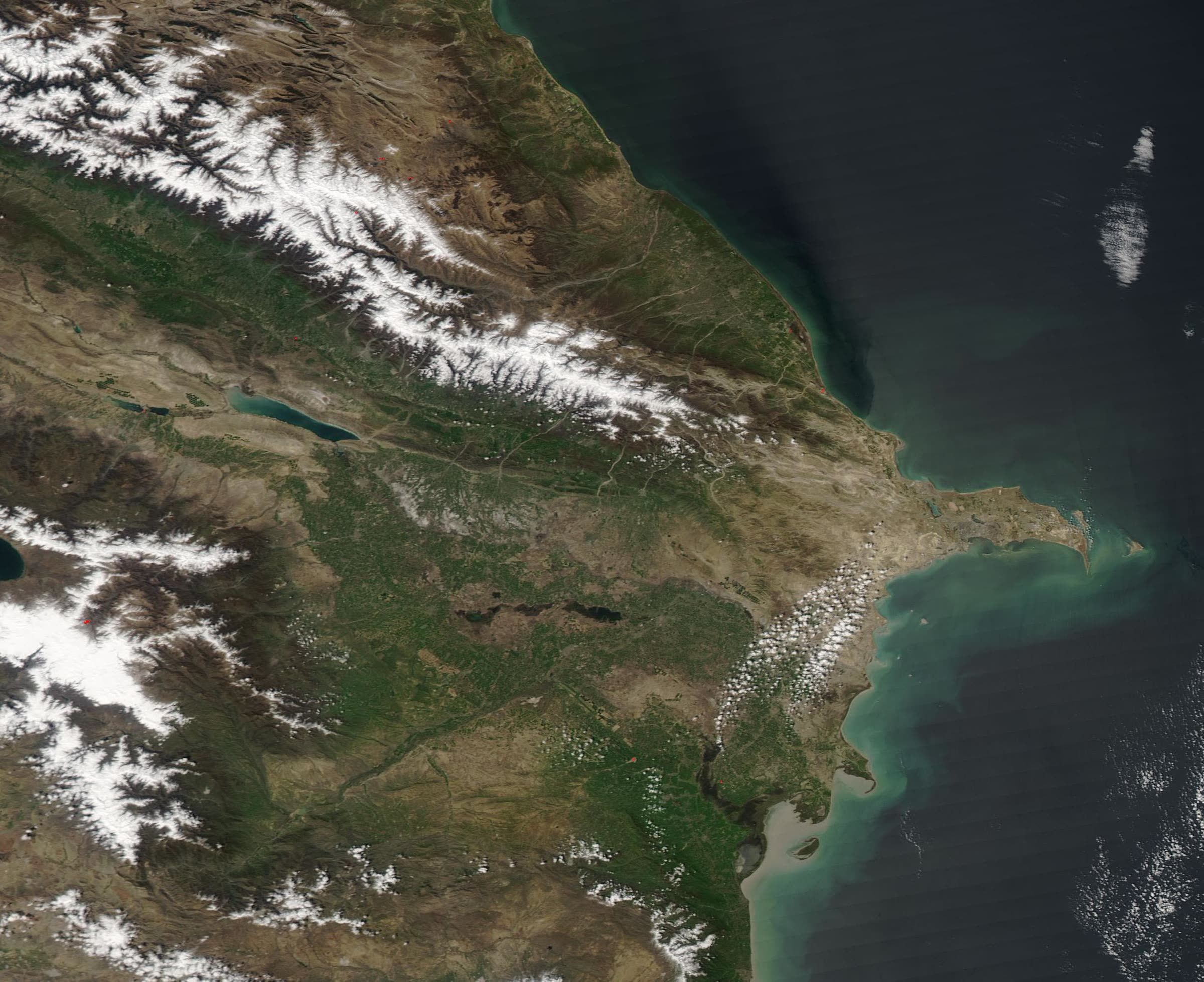
The Greater Caucasus, 14 April 2020. The snow-covered range runs north-west to south-east toward the Absheron peninsula at Baku, with the Kura lowlands and the Lesser Caucasus to the south.NASA / MODIS · public domainImage: A satellite view of a long snow-covered mountain range running diagonally to a sea coast, with green lowlands to one side.
Current state
Graded per item · As of 2026-07
Armenia–Azerbaijan, Georgia's breakaway regions, Chechnya, and the corridors reshaping Russia's southern frontier. The Caucasus is not one war: it is a linked regional security system in which unresolved conflicts, de facto states, Soviet-drawn borders, displacement, energy routes and the competing interests of Russia, Türkiye, Iran and the West all act on each other — and in which Russia's absorption in Ukraine has set the whole system moving at once.
Changed in brief — 2026-10-11 · Status wording updated
Why it matters
This is where three empires' borders were drawn and redrawn, and the seams are still load-bearing. A war ended here in 2023 after thirty-five years, a peace text was agreed in 2025, and neither event resolved the questions underneath — what the borders are, who guarantees them, and which roads and railways may cross them. It also matters to people with no stake in the region's politics: the corridors running through it carry Caspian energy to Europe and a growing share of the overland trade between China and the EU, on routes chosen specifically to avoid Russia and Iran. The Caucasus is small, and what happens to its transit geography is not.
6 points, composed from this conflict’s own sourced records — nothing here is a new claim.
Three separate files sit in this module and they do not resolve together: Armenia and Azerbaijan over Karabakh and their border; Georgia over Abkhazia and South Ossetia; and the North Caucasus inside Russia. They share a region, a set of external powers and a history — not a settlement, a timetable or a set of participants.
Azerbaijan recovered the territory in the 2020 war and took the remainder in a one-day operation in September 2023. Almost the entire Armenian population left within days, and the de facto entity dissolved. The fighting is over; return, property, heritage and the missing are not.
Armenia and Azerbaijan agreed the text of a peace treaty in March 2025; their foreign ministers initialled it in Washington in August 2025 and their leaders signed a separate declaration the same day. It is still not signed. Azerbaijan conditions signature on an Armenian constitutional amendment, which requires a referendum slated for 2027. This module treats an agreed text and a concluded peace as different things.
Russia recognised Abkhazia and South Ossetia as independent after the 2008 war; almost no other state has, and Georgia's territorial claim is unchanged. But calling the file static is wrong: in May 2026 Russia and the South Ossetian de facto authorities signed a treaty merging economic space and opening the entity's offices to Russian citizens, while Abkhazia rejected lesser terms and lost its electricity and budget support until its leadership changed. Nothing has moved on status and a great deal has moved underneath it.
Russian peacekeepers left Karabakh in 2024, Armenia froze its participation in the Russian-led security bloc, Russian border guards have left every Armenian border checkpoint, and Türkiye, the EU and the United States have gained ground. Moscow's base at Gyumri remains on a lease running to 2044, its integration of the two Georgian entities has deepened, and its economic levers are intact. The right reading is lost arbitration, not absence — and nothing has yet replaced the role Russia played between Yerevan and Baku.
Oil and gas pipelines and the rail and road links of the Middle Corridor cross this region because they can avoid Russia and Iran. Which routes open, on whose terms and under whose control is now as central to the diplomacy as territory is — and several proposed routes do not yet exist.
Stated · Vigil assessment
What the 9 actors this module authors a posture for are trying to achieve — stated positions and Vigil’s assessments, kept apart. Every other party appears under Profiles without one.
Vigil assessment
What limits those options. A constraint is a structural limit, not a risk rating.
Vigil assessment · Observed
The module’s current phase — Peace texts, corridor bargaining and new alignments (2024 – 2026) — and the newest dated review.
Vigil assessment
The standing arrangements this module authors between its parties. Each line is the record’s own signature; the analysis, dates and sources are on the record.
Observed
The standing questions Vigil is following on this module, each with what its latest review found. The evidence that would change the assessment is on the question.
Vigil assessment · Observed
5 exposure channels and 5 watch items, as of 2026-08.
Vigil assessment · Observed
5 dated figures at regional granularity, each with its own basis, as of 2026-08. No operational detail is published.
The week produced contact and administration, not commitment. South Ossetia's newly inaugurated president used his first structural act to reorganise the entity's executive around cooperation with Russian federal agencies. He still named no head of government. In Turkmenistan on 9 October, Russia's, Azerbaijan's and Iran's presidents met in a format last used in 2017. A Russian newspaper's report that Armenia's prime minister joined a three-way meeting with Putin and Aliyev was denied by his office. The day before, he had said he discussed missing-persons cooperation with Aliyev, the subject of the initialled agreement's ninth article. The EU's tariff relief for Armenian exports took legal effect on 10 October. The European Parliament called for sanctions on Georgia's leadership, which is a call and not a Union listing. No draft constitution, referendum date, ratification vote or commission meeting followed, and no cross-border fire was documented.
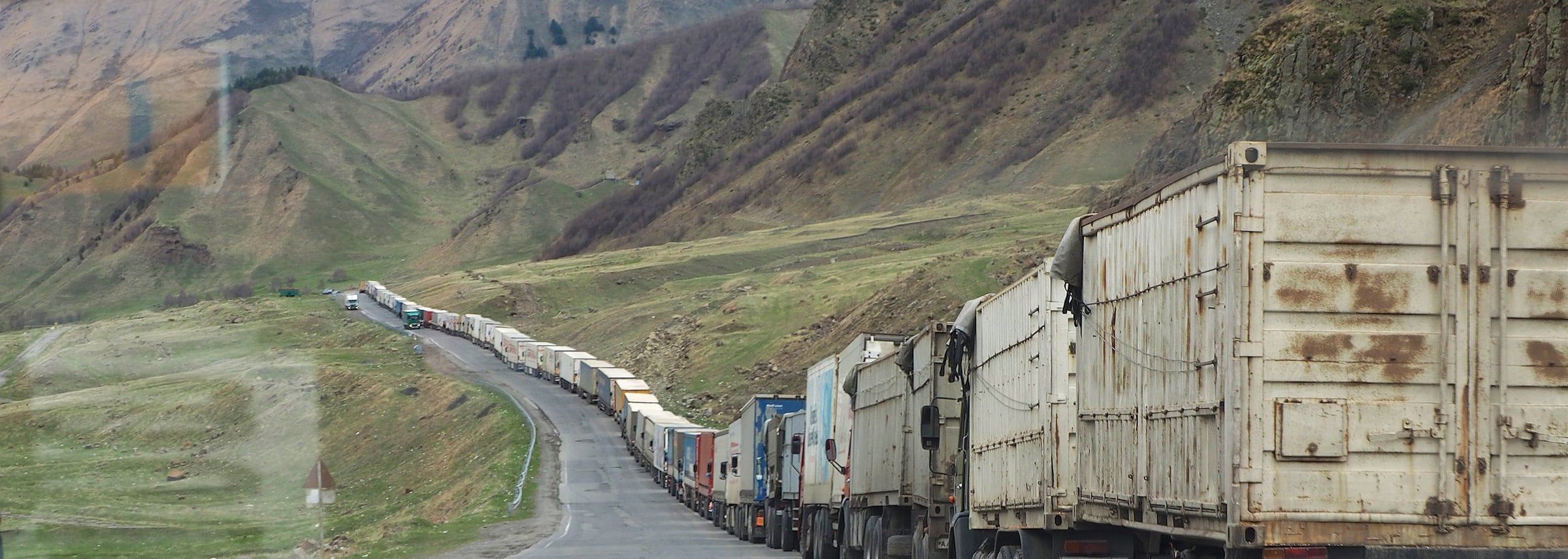
Russia's 2026 restrictions closed the market that buys four-fifths of Armenia's food and drink, and the EU answered with tariff access. That is the channel Armenia can work around, slowly. The gas that powers the country has only been threatened, and nothing built so far could replace it. Both are terms of an EAEU membership the other members have now asked Armenia to put to a vote.
Caucasus zones show de facto administration, historical conflict areas and broad corridor bands. They are status descriptions, not recognition claims, and never depict current military positions or an active front line.
It has not. The land border has been closed since 1993. Armenia and Türkiye agreed in July 2022, and reaffirmed in 2025, to open it to third-country nationals and holders of diplomatic passports; the Margara crossing on the Armenian side has been reported ready since 2023, and Armenia says it is waiting on Turkish implementation. What has changed is adjacent rather than at the border: Armenia has allowed Azerbaijani lorries bound for Türkiye to transit its territory since late 2025. A first crossing by any category of traveller would be the marker; announcements about readiness have recurred for four years.
The territorial question was closed by force in 2023. The consequences were not, and in 2026 one of them moved in the direction of closure against the displaced rather than toward settlement: a Baku court sentenced fifteen former Karabakh officials in February 2026, five to life imprisonment, with a separate twenty-year sentence for Ruben Vardanyan, and an appeal court upheld the verdicts in August 2026. Neither the initialled treaty nor the Washington declaration commits Azerbaijan to release anyone. The other files — some 4,500 missing recorded by the ICRC, property and return claims, mine clearance measured in decades — are unmoved. Watch any release, any return framework, and whether these files are named in the settlement at all.
The material test of whether the region's diplomacy produces connectivity. Middle Corridor volumes rose steeply after 2022 from a small base and are reported on differing bases in the 4.5–5.2 million tonne range for 2025, with container traffic around 77,000 TEU; the binding constraints are Caspian ferry capacity, port throughput and the Baku–Tbilisi–Kars line, not demand. Azerbaijani gas to the EU was about 12.8 bcm in 2025, essentially flat, against expansion commitments that depend on fields not yet producing. Watch whether growth continues, and separately whether any of it crosses a border that was closed — which is the only kind of increase the settlement would explain.
Scope of this coverage. This is regional-system coverage, not a single-conflict frame: it covers the Caucasus as a connected system across four sub-theatres, with a historical and structural focus. It does not track daily events, and it does not map current military positions anywhere.
Source registryMethodology Corrections logGlossary
Found an error in Caucasus coverage? Corrections are logged in public with the date and what changed — see the corrections log.