
Chapter 04
Monitor
Monitor is the editorial cycle made legible: what was reviewed, what moved, and what was checked and found unchanged — over the geography, actors and recorded activity of the module it is scoped to.
The workspace
One toolbar governs everything: what the surface is scoped to, which instruments are on it, and whether the arrangement is kept.

- Workspace — what the surface is scoped to. The whole cycle, one module, or a Standing Watch scope.
- Add instrument — put another panel on the workspace.
- Filter narrows every instrument at once; Compare takes the current selection into Compare.
- Save view keeps the arrangement, the layers and the selection as a row in your Library.
- The instruments. Press one to scroll to it; the workspace decides the layout.
Scope first. If you know which theatre you care about, pick it in the rail on the left — the workspace narrows to that module and its instruments narrow with it. If you do not, stay on This cycle and read across all 6 modules at once.
The cycle, and what the counts mean
The row of figures at the top of Monitor is the review cycle. Every one of them is a count of reviews, never of events: how many standing questions were looked at, and what the looking found.
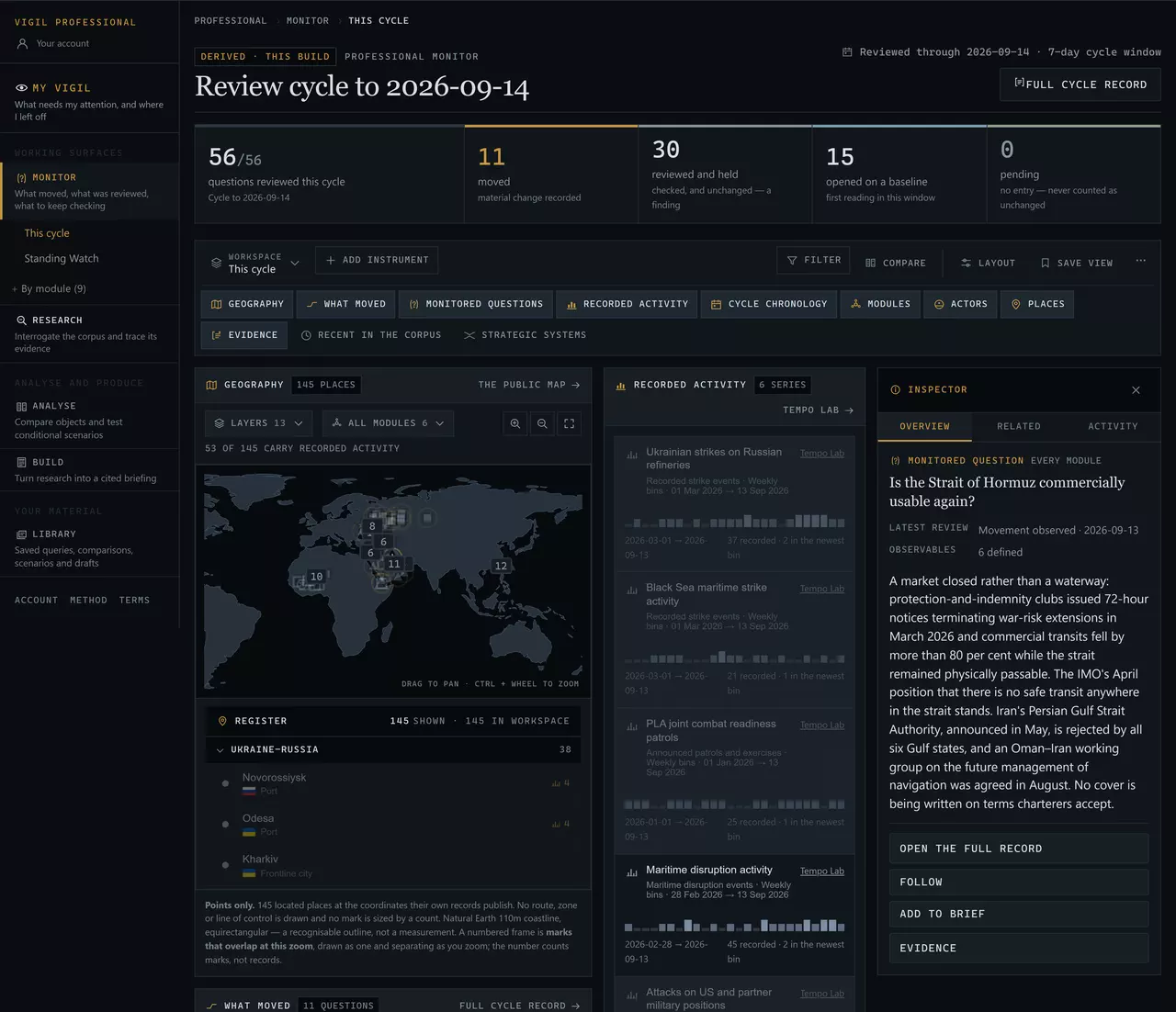
The most important thing on this page“Reviewed and held” is a finding. It means somebody opened the file, checked it against the evidence, and recorded that nothing moved — with a date and a basis. A product that showed only movement would teach you that nothing was looked at. Read the held count as work done, because that is what it is.
Watch questions
A Watch question is a standing question whose answer could materially change an assessment.
There are 56 of them across the 6 modules, and every one is public — you can read any of them today at Watch without an account. What Professional adds beneath them is the observable-level record, which Research covers.
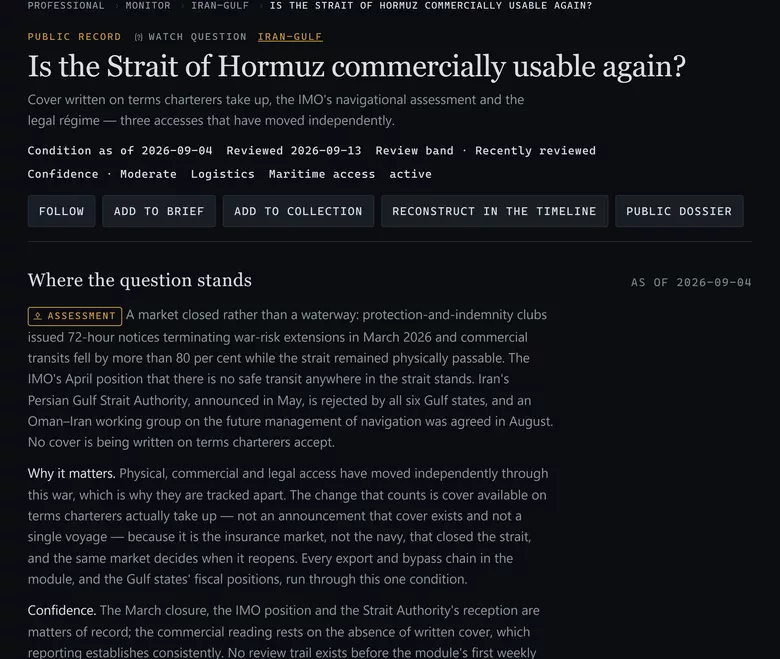
- Three different dates, never merged: what the condition is as of, when it was last reviewed, and the review band that follows from it.
- What you can do with it — follow it, take it into a brief or a collection, put it in the timeline, or open the public dossier.
- The register. This reading is Vigil’s assessment rather than a recorded fact, and the mark says so.
- “Why it matters” and “Confidence” — the record’s own account of what the reading rests on.
The five review outcomes
Every review records exactly one of these, and each means something narrow:
- Baseline
- The question was opened and its current condition recorded. Nothing has been reviewed against it yet.
- No material change
- The standing file was checked and nothing moved. A finding, not an absence.
- Movement observed
- New evidence bears on the question; the assessment holds.
- Observable met
- One of the named observables occurred. "Met" describes evidence, not success.
- Assessment changed
- The evidence moved Vigil’s reading. The condition line advanced on this date.
“Met” does not mean “happened, and that settles it”An observable being met describes evidence: the thing Vigil said would bear on the question occurred. It is not a verdict on the question, and it is not success or failure for anybody. The question's own condition line is the only place the answer moves.
A question that has been answered is retired rather than deleted. It keeps its ledger, and where the work continues it names the successor question that took it on.
Geography
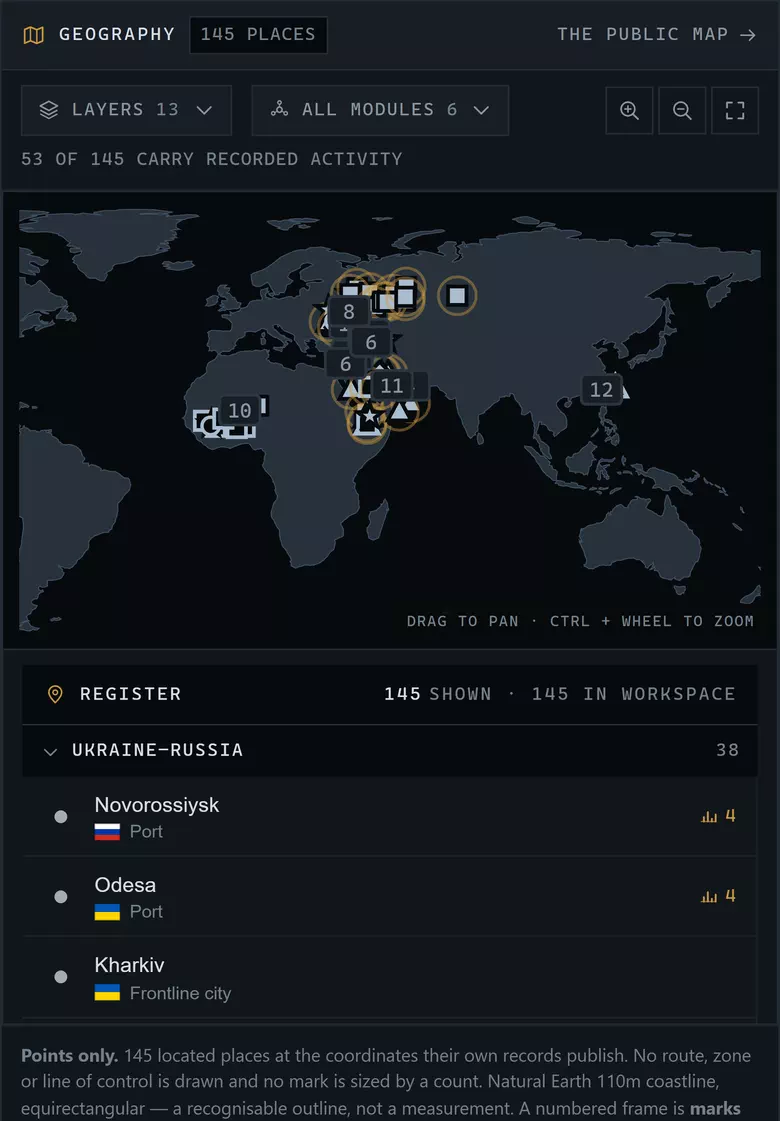
- How many located places are in scope, and a route to the same geography on the public map.
- Layers, and the module filter — which record families are drawn, and from where.
- A numbered mark is several marks overlapping at this zoom, drawn as one. It is never a count of events.
- The register: every place, by module, with how many activity records sit at it.
Standing Watch
A named exposure, held across several questions at once.
A scope groups canonical Watch questions around one defined exposure — a route, a sector, a decision context — and states what it covers, for whom, what it depends on and what it cannot tell you. Everything under it is the public corpus: the same questions, observables, records, sources and review outcomes, produced by the same weekly cycle.
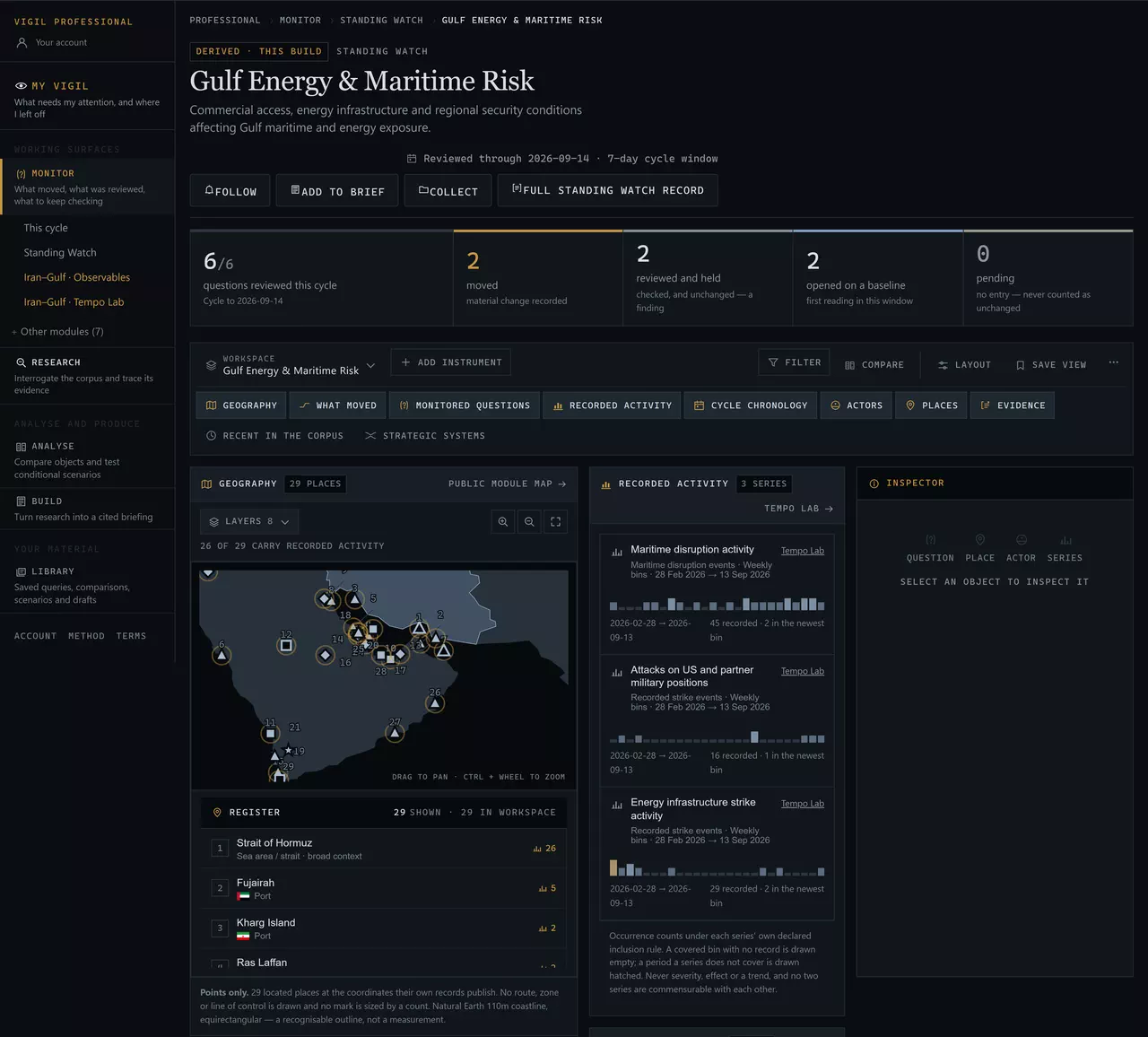
What a scope is notIt runs no second research process, holds no records of its own, and produces no risk score — there is no number anywhere on it summarising the exposure. What it adds is the selection, the stated relevance of each question to the exposure, and a review state derived from the questions' own ledgers.
8 scopes are maintained. One of them — Gulf Energy & Maritime Risk — is public and stays public, so the monitoring model can be checked before it is bought.
Activity Tempo
Counts of dated, reported occurrences at published markers. Nothing else.
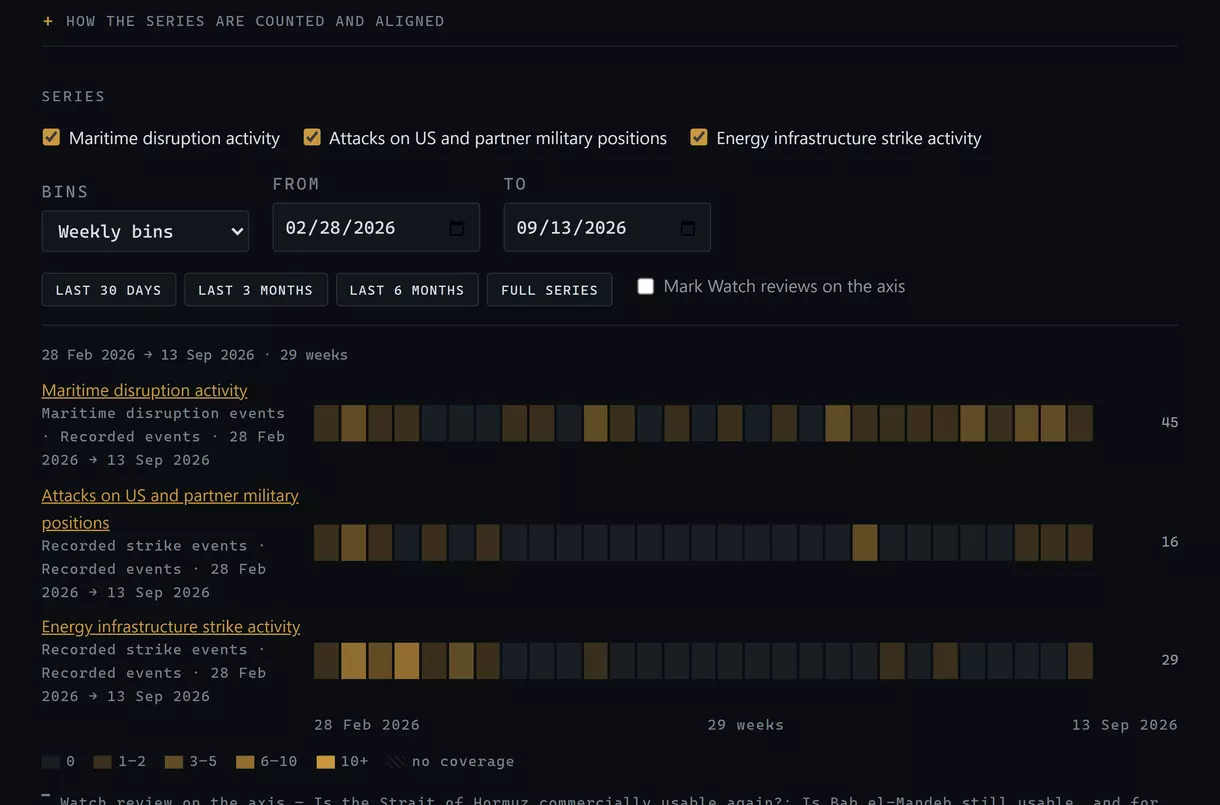
- Each series is selected independently. They are never summed and never drawn as one line.
- Bin size, and the window. Weekly or monthly; the window is stated beside the strip.
- One row per series, on a shared time axis so their timing can be compared.
- The legend: five count bands, and “no coverage” drawn differently from a covered bin with no records.
What a busier bin meansMore records met that series' stated inclusion rule in that period. It does not mean severity, effect, risk, probability, threat, escalation or operational tempo — and a quieter bin may mean that reporting thinned rather than that activity did. Two series are not commensurable with each other, and none of them is commensurable with a figure published by anyone else.
Which modules have Tempo
Not all of them, and that is a decision. A series exists only where Vigil has a defensible, repeatable inclusion rule — a population it can define, published markers to count at, and reporting it can apply the rule to consistently.
Current coverage is Ukraine–Russia, Taiwan Strait and Iran–Gulf, with 6 series in total. Sahel, Caucasus and Syria maintain none, and their Tempo rail is absent rather than empty.
An absent series is not a quiet theatreA module without Tempo is not a less important module and is not one where less is happening. It is a module for which Vigil has not established a counting rule it would be prepared to defend. Counts it could not defend would be worse than none. The same rule is stated in the public methodology.
Keeping a workspace
Scope it
Pick the module or the standing scope you work on.
Arrange it
Add or remove instruments, set the layers, filter to the outcomes you care about.
Select
Leave the object you were looking at selected — the view remembers it.
Save view
It appears in your Library and reopens exactly as it was, against today’s corpus.
Next: Research — what the readings on this surface rest on.