
Chapter 02
How it works
Professional holds no copy of anything. Every surface composes the same canonical records — which is why your saved work stays correct, and why nothing you do in it can move an assessment.
Public Vigil and Professional
They are one body of work with two ways of using it.
Public Vigil publishes the research: modules, weekly briefs, Analytical Notes, standing Watch questions, actor and location records, maps and search. It is free, needs no account, and nothing in it moves behind a payment.
Professional adds two things on top of that corpus. Depth — observable-level records beneath every public question, and the dated evidence beneath those. And instruments — surfaces for monitoring, tracing, comparing, testing a condition, producing a briefing, and keeping what you did.
One record, many surfaces
A single canonical record is read by everything. The same Watch question appears in Monitor as a row in the cycle, in Research as a result and a chain, in Compare as a column, in a Scenario as a cited basis, and in the Brief Builder as a block — and in all five it is the same record, resolved at the moment you look at it.
Canonical record
A Watch question, an observable, an event, an actor, a location, a source — published, dated, with a page of its own.
Editorial. Maintained on the weekly cycle.
Derived surface
Monitor, Research, Evidence, Compare, Scenario Lab, Timeline, Brief Builder. Each composes the record; none copies it.
Composition, never duplication.
Your saved work
A collection, a query, a comparison, a run, a timeline, a brief. Each holds references to records.
Yours. Private to your account.
Four consequences you will meet in ordinary use:
- A correction reaches you. When a record is corrected, the collection, timeline and brief that reference it show the corrected wording next time they are opened. You are never left holding a stale copy that still looks right.
- A retirement is visible. If a record is retired, saved work that points at it says no longer published rather than quietly showing something that has stopped being true.
- Nothing you do changes an assessment. Following a question does not make it reviewed more attentively; holding an assumption does not alter a record; annotating a block does not edit it.
- The figures agree everywhere. A count on one surface and the same count on another come from the same resolver, so two surfaces cannot disagree about the corpus.
The chain beneath a reading
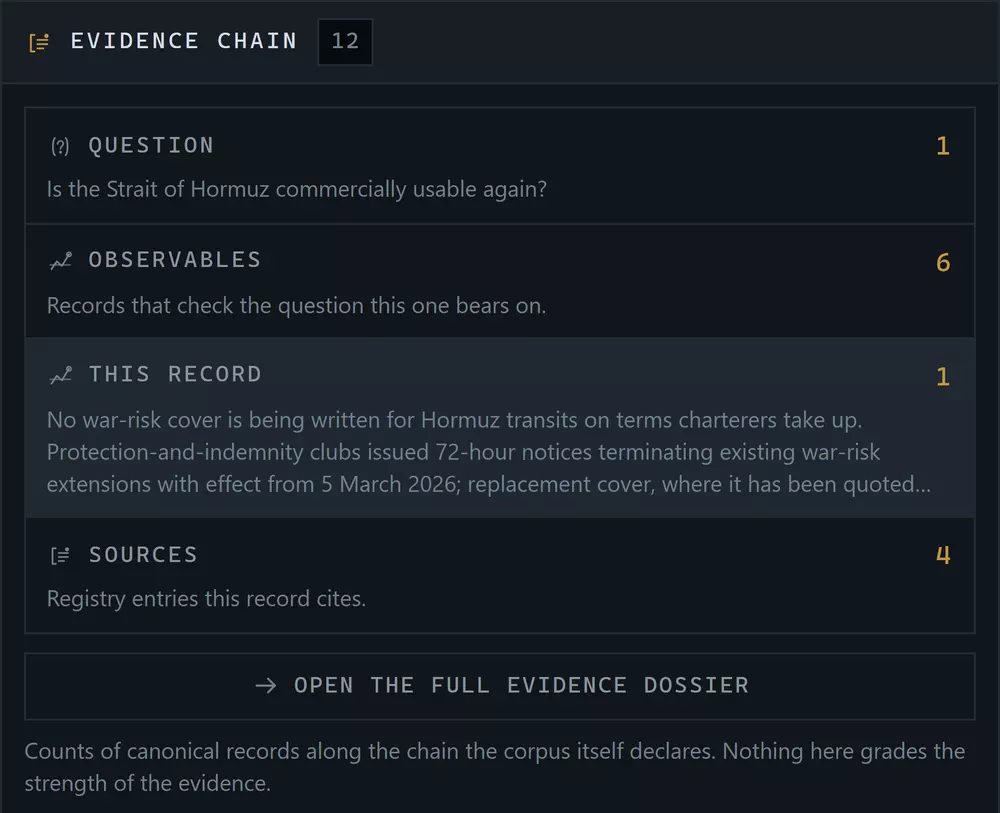
Everything Professional asserts sits on a chain you can walk. It is four links, and each is a record with an address.
Watch question
A standing question whose answer could materially change an assessment.
Public. Anyone can read it.
Observable
What is being checked, where it stands, what would move it, what it cannot establish.
Professional.
Evidence entry
A dated line naming the canonical development, event, Note or brief it rests on, and which way it bears.
Directions never sum.
Source
The registry entry the basis cites, with its type and every place it is used.
A citation count is a count.
The five working surfaces
They are used in an order, and the order is worth learning once because everything else in the product hangs off it.
Monitor
What moved this cycle and what was checked and held, over the module’s geography and recorded activity.
Research
Query the corpus, select a record, read the chain beneath it and what it connects to.
Analyse
Compare two records, or hold a condition and read the record at it.
Produce
Assemble a briefing from canonical blocks and export it with its citations.
Return
My Vigil and the Library. Everything saved, still pointing at live records.
What “maintained” means
The corpus is reviewed on a stated weekly cycle. A review that finds nothing is recorded as a review, with its date and its basis — because an unchanged reading nobody checked and an unchanged reading somebody checked are different things, and the product keeps them apart everywhere.
Weekly review
Every published module is reviewed and receives a dated brief, including the weeks when the finding is that nothing moved.
Canonical update
Questions, observables, events, profiles and series are written, corrected, extended or retired.
Surfaces follow
Monitor, Research, Evidence and Tempo show the new state the next time they are opened. Nothing is cached against you.
Your work follows
Saved references resolve against the updated records; anything retired says so.
What this is notNot a feed, not a data service and not a model. Nothing in Professional is generated, inferred or scored. Every sentence a subscriber reads was written by an editor against evidence, or is a count of records — and the surfaces say which.
The rules that bind all of it are public: the Vigil methodology governs the corpus, and Method in use in this Handbook explains what each label means when you meet it on a screen.