
Chapter 08
Forces & Operations
Forces & Operations is a working environment over the military records Vigil maintains — how armed forces are organised, equipped, employed and sustained — not an order of battle with a score. It shows what the records state about a force, at the precision they state it and no finer.
The workbench
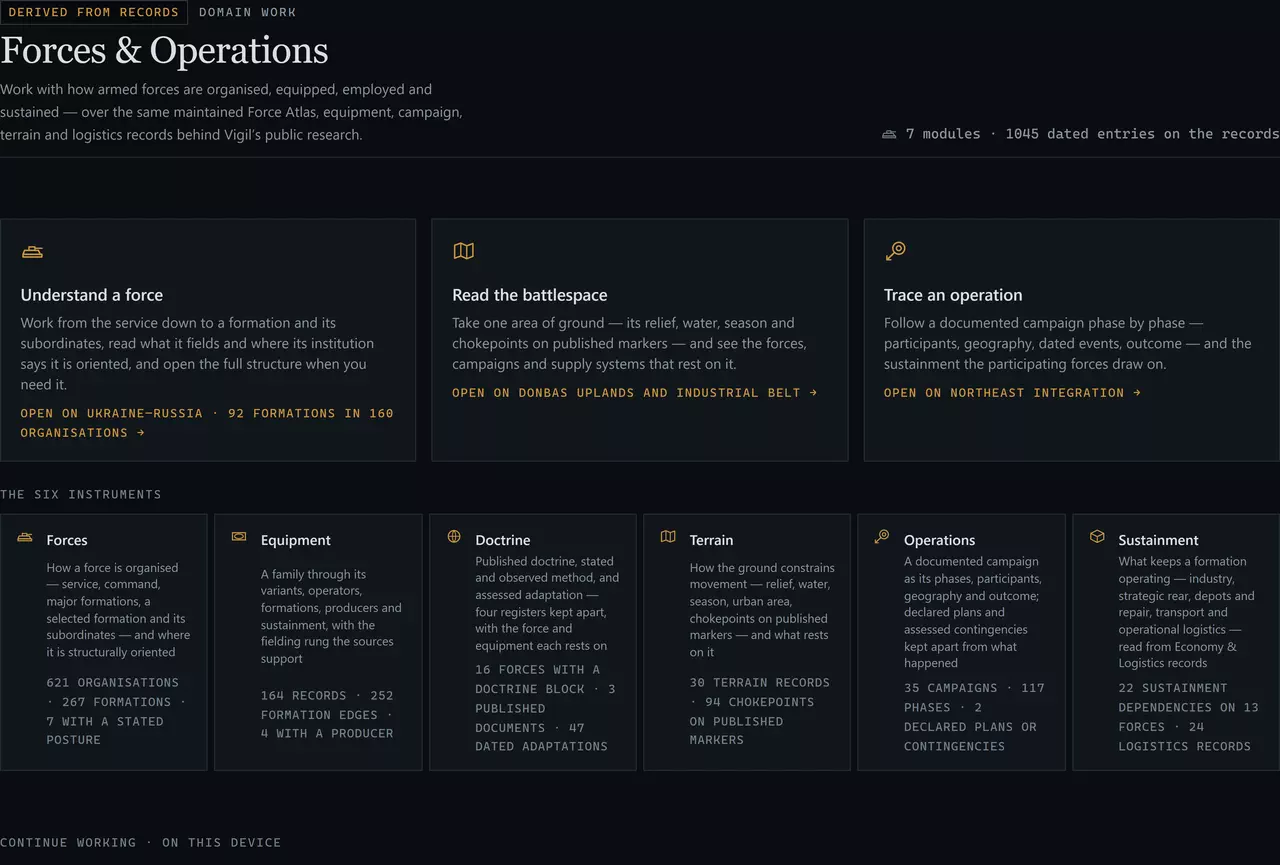
Forces & Operations sits in the Domain work tier beside Economy & Logistics and Humanitarian & Resilience. It works621 organisations in the Force Atlas, of which 267 are formations and 7 carry a stated posture; 164equipment records with 252 formation edges; 16forces with a doctrine block holding 3 published documents and47 dated adaptations; 30 terrain records with94 chokepoints on published markers; 35 campaigns with 117 authored phases; and 22 sustainment dependencies on 13 forces — across 7 modules. Modules are not expected to match: a module at war carries campaigns with phases and dated adaptations; a deterrence module carries command arrangements, postures and declared plans.
Where the records come from
Nothing in the workbench is its own. A force is an organisation record in the Force Atlas — the same tree the public Force Structure page draws — with its command relationships, its equipment claims (each with an evidence grade and, where the record states one, a fielding rung), its doctrine block, its posture, its published seats, its dated changes and its sustainment edges. A platform is an equipment/ record from the catalogue, with its variants, operators and producers. A campaign is a campaigns/ record with its frame, phases and participants; ground is a terrain record. A logistics record, a strategic system or an industrial organisation is an Economy & Logistics record the force names by id, opened there from the inspector rather than copied here. Each record carries two dates kept apart — the date what it states is as of, and the date Vigil last reviewed it. The public Force Atlas, unit and equipment pages print the same records in full; nothing needed to understand a force is held back from them.
What the canvases refuse to doStructure is not effectiveness, and no formation is scored. Brochure capability is not field capability, and a capability picture is a grouping. An announcement is not a delivery, a delivery is not fielding, and fielding is not observed operational use: the rungs are never merged. A maximum technical range is not operational reach. A deployment report is not permanent basing: a seat is a published address, drawn as a square, and nothing is drawn as a disposition. A sustainment edge is a dependency, not route geometry. A terrain constraint is not operational intent. No attack arrow, range ring, strength or readiness appears anywhere, because none is recorded. A movement arrow, a deployment marker and a capability label are each claims that require a basis; sparse data means sparse data.
The same shell as the two domains before it
Module, search, the instruments — Forces, Equipment, Doctrine, Terrain, Operations, Sustainment— and the view toggle; a context line with the counts that belong to the instrument; the canvas at full width with the register folded beneath it;Layers, Changes and Pinsclosed until opened; the inspector only on a selection, concise first, with five tabs; Present for a clean frame. The address carries the module, instrument, record, view, selection, phase and pins. The Economy & Logistics chapterdescribes the shell in full; everything there applies here.
Forces
How a force is organised — from its chain of command to a formation and its subordinates.
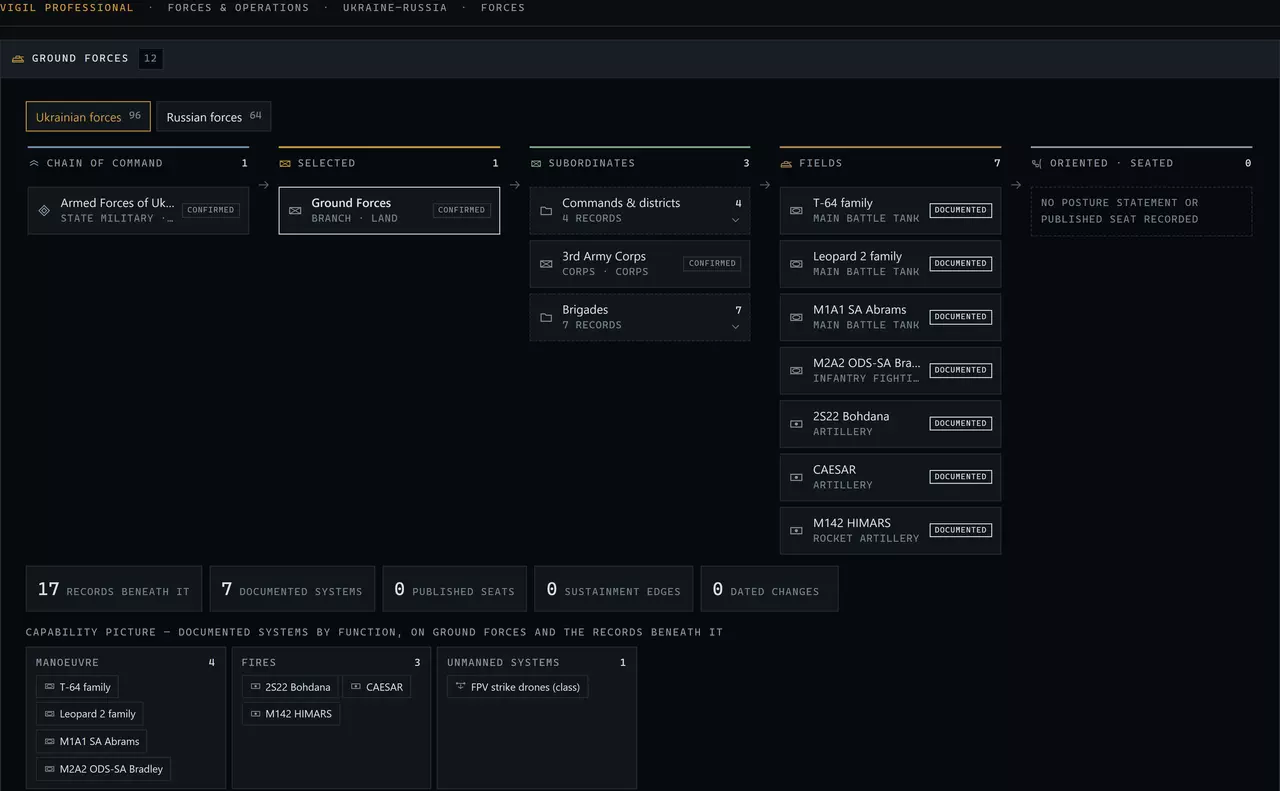
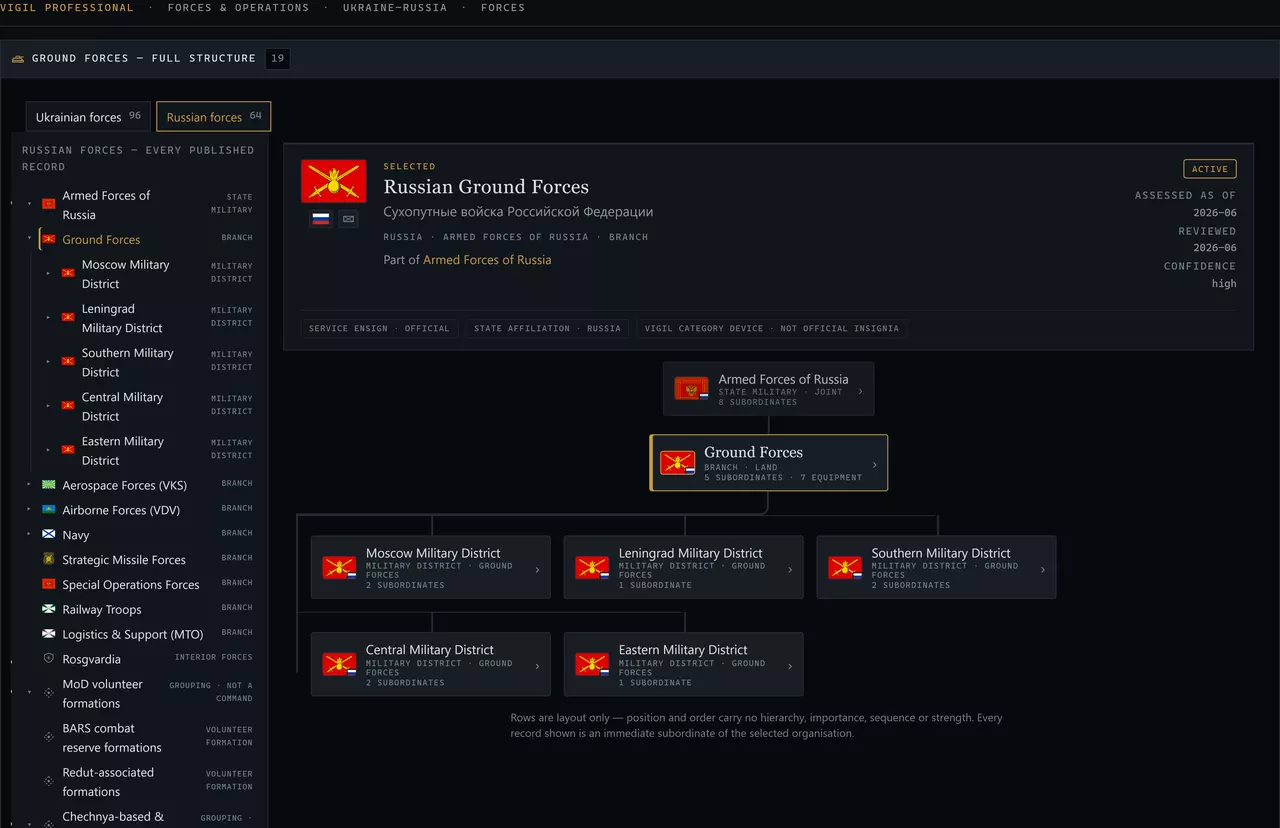
The lane reads left to right as the records connect: the commands above the formation, dimmed until the parent; the formation; its subordinates in the groups the Atlas itself uses, folded where a group is long; the equipment its own record claims, documented first with the grade and rung on each card and the reported, prospective and historical claims folded beneath; and what the institution says about its orientation — a posture with its basis, the published seats, the command arrangements it sits in. The capability picture beneath groups the documented systems by function; it is a grouping and never a score.Full structure draws the same tree the public Force Structure page draws, with every subordinate on request.Geography places the published seats as squares and the module’s generalised military markers hollow, points only.
Equipment
One platform through its variants, operators, formations and industry — announced kept apart from fielded.
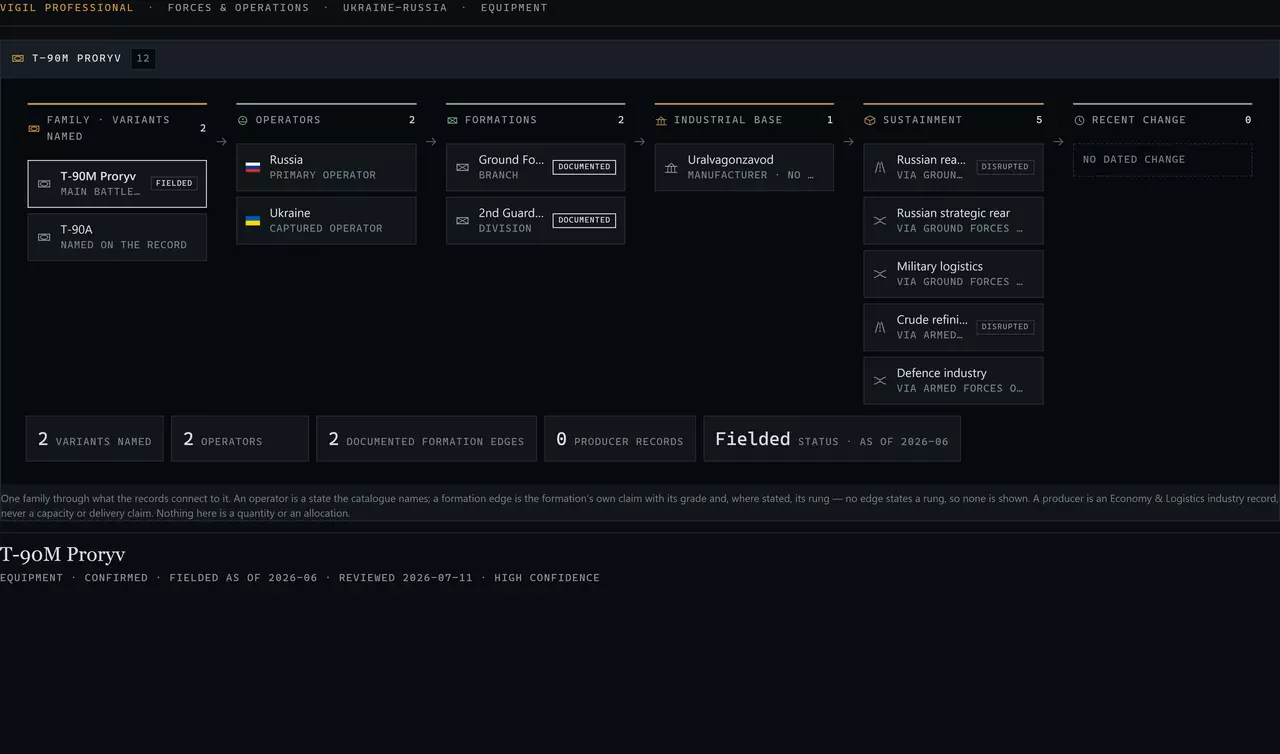
Families is the catalogue in columns by function, each card tagged with the record’s own status. Select a system andOne family draws its lane. An operator is a state the catalogue names, never a formation; a formation edge is the formation’s own claim, with the evidence grade the record gives it and, where the edge states one, the fielding rung. A producer is an Economy & Logistics industry record and opens there; it is a statement that the record names the product, never a quantity or a delivery. Operatorssets the systems by the state that names them, and Mapplaces the published seats of the formations that name the system, as squares.
Announced
A stated intention, a pledge, a programme.
Nothing ordered yet.
Ordered
A contract or an order the sources state.
Nothing delivered yet.
Delivered
Reported handed over, not yet reported in a formation’s use.
Not fielded.
Fielded
Reported in a named formation’s use, with the source that says so.
Never a quantity.
Doctrine
Published doctrine, stated and observed method, assessed adaptation, and where it breaks down — four registers, never merged.
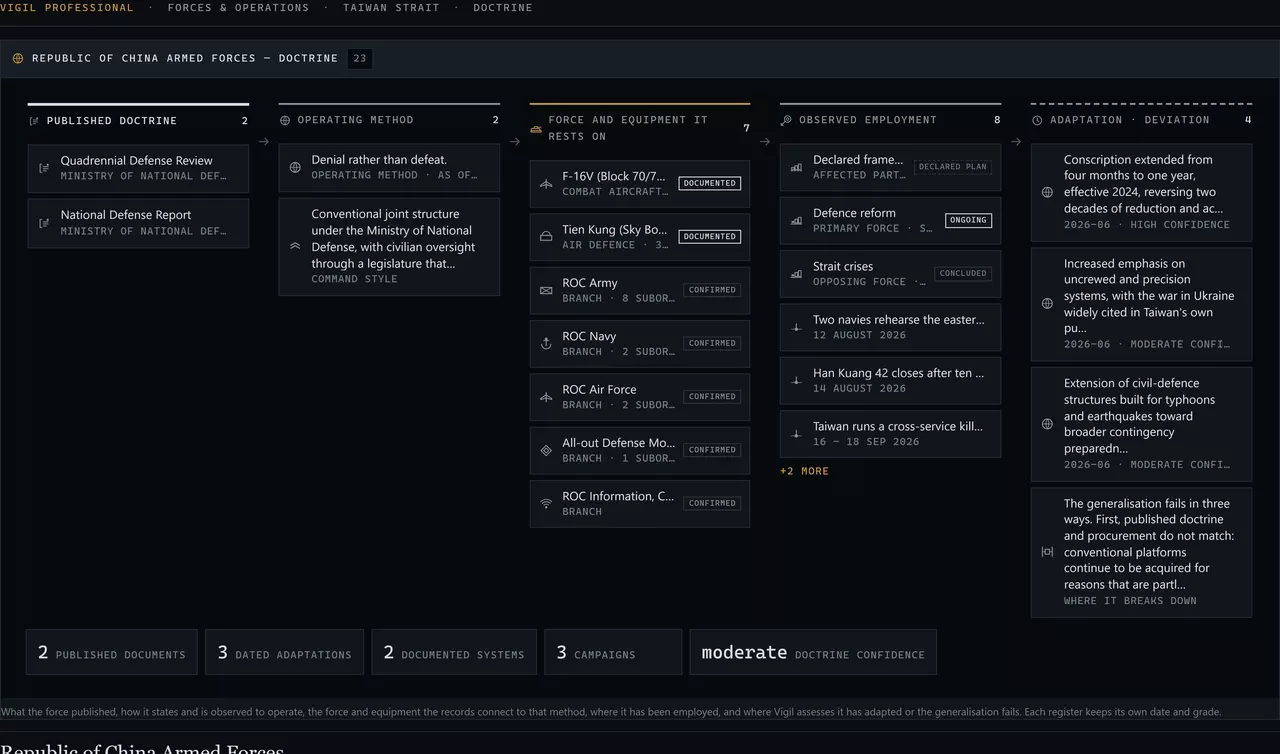
The Registers board sets every force with a doctrine block across four columns — published doctrine, stated and observed method, assessed adaptation, where it breaks down — and a fifth for the declared plans and assessed contingencies the module’s campaign records carry, which are concepts and not operations. One force draws the same registers as a lane from the published document through the method to the force and equipment it rests on, its observed employment and its adaptation. What a force publishes is never read as what it does; a module where no force carries a doctrine block says so.
Terrain
What the ground does to movement, and what rests on it.
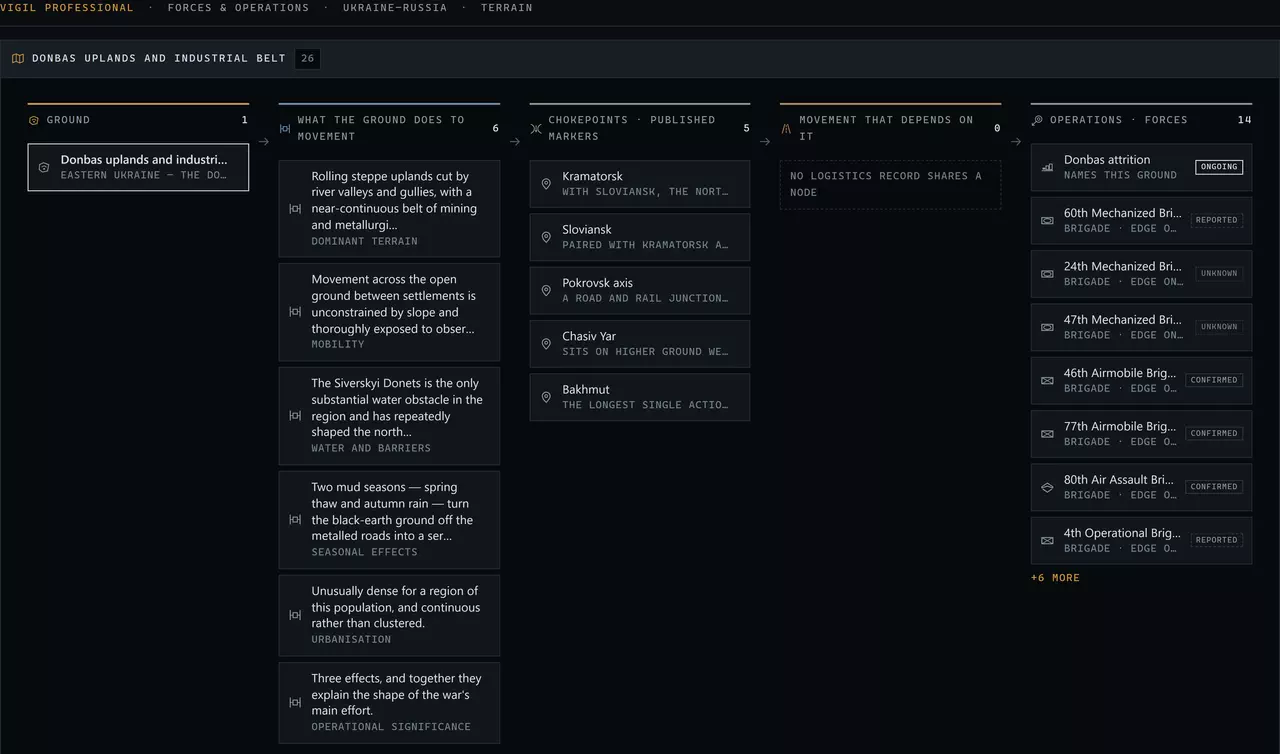
Ground is every terrain record in the module as a row, with the chokepoints it names as static place cards. One area draws the lane; Map places the chokepoints as points. A chokepoint is a marker the module already publishes, with the record’s reason; a constraint is the record’s own statement at the level of published analysis. No key terrain is ranked, no corridor is drawn, and no intent is read from a constraint.
Operations
A documented campaign as its authored phases — a sequence, never a manoeuvre.
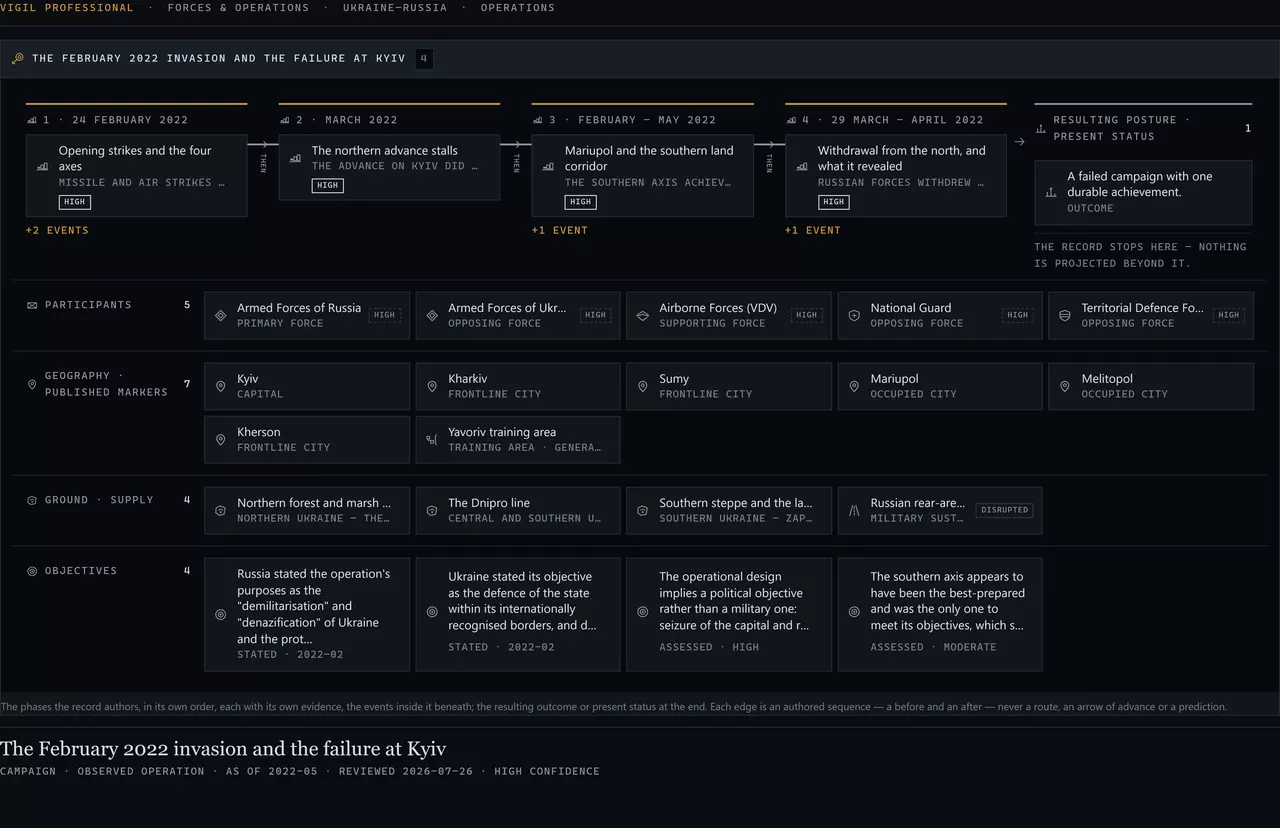
The Board sets campaigns by frame and lifecycle: observed and ongoing, observed and concluded, declared plan, assessed contingency. The last two are concepts a party published or Vigil described, and carry no timeline, status or outcome by construction. Phasesdraws one campaign as its ladder with the rail beside it; select an edge and the inspector says it is a sequence. Map shows only the published markers of the events inside each phase, stepped by phase: no line, arrow or axis joins two phases.
Sustainment
What keeps a formation operating — read from Economy & Logistics records, each edge with its basis.
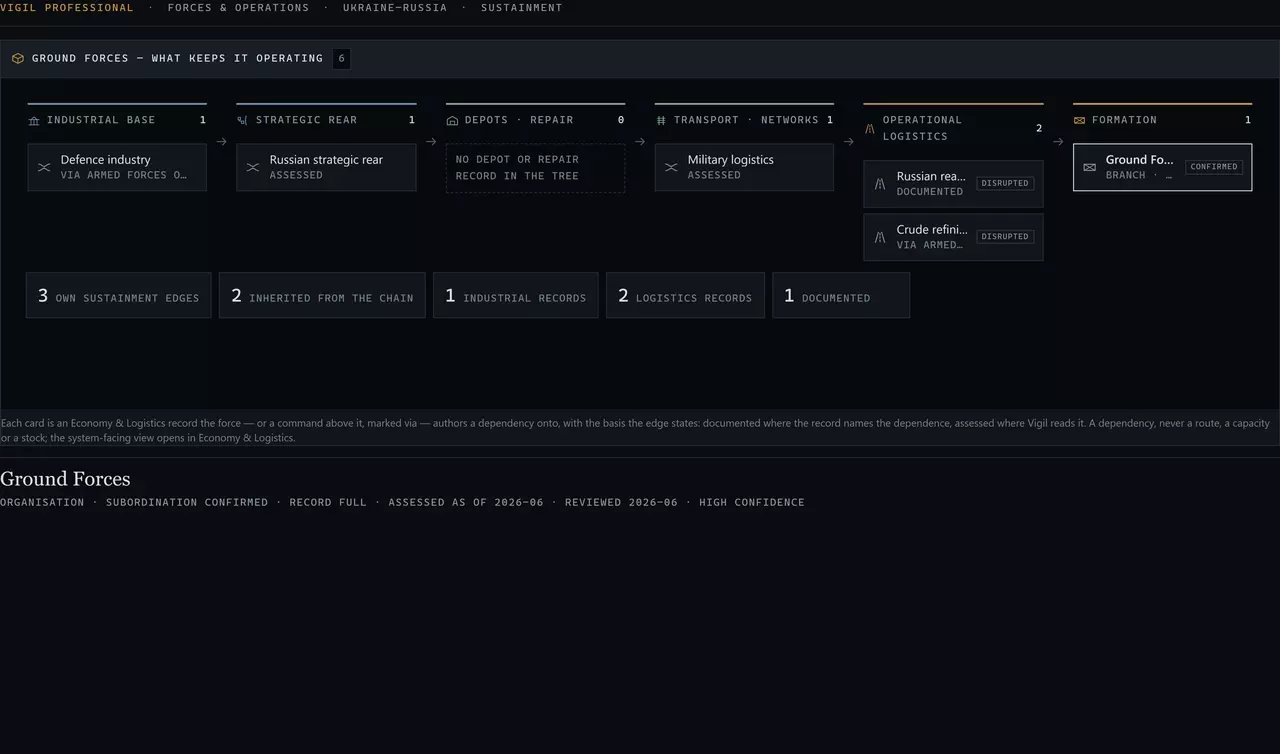
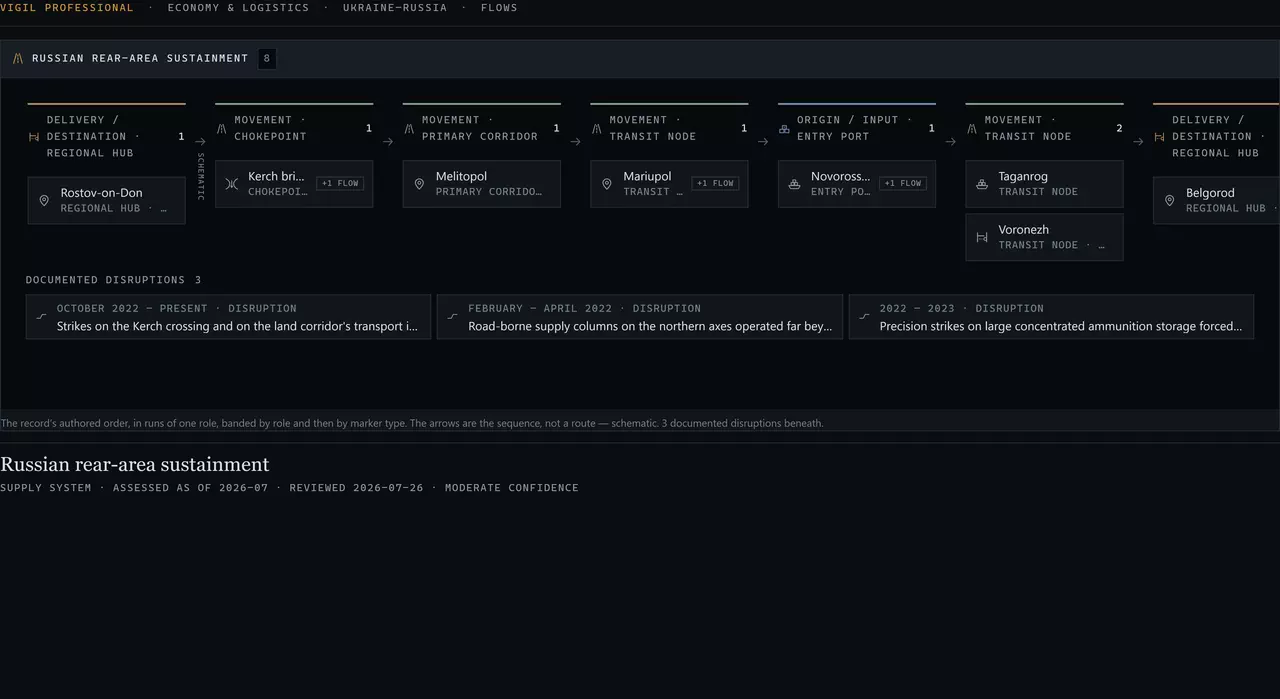
The edge lives on the force record and points at a logistics record or a strategic system by id; the record it points at stays owned by Economy & Logistics. One force draws the lane, folding in the edges the formation inherits from the chain above it, each markedvia; the producers of its documented systems appear in the industrial base. Systems lists every military-sustainment record in the module with the forces that depend on it — a record with no dependent force is a coverage statement, not a finding. A dependency is never a route, a capacity or a stock.
Across the domains
Wherever a force authors a sustainment edge, the inspector offersOpen in Economy & Logistics on the record it names — Flows for a logistics record, Systems for a strategic system, Industry for a producer — and nowhere else: a handoff exists only where an authored edge exists. A location a formation is seated at, a terrain record a campaign names and a Watch question on a force open in their own homes the same way. Nothing is copied between the domains; each record is drawn where it is owned.
Pins, compare and dated changes
Pin up to six records — formations, systems, campaigns, terrain, logistics records — from the inspector or with shift-click. The tray sets them side by side on their own fields: one formation’s documented systems, published seats and sustainment edges beside another’s, a campaign’s phases and participants beside a formation’s. A field one record lacks saysnot comparable, records of different kinds sayNOT COMPARABLE where they share nothing, and nothing is ranked. Changes opens an axis with ten lanes — dated change, formed or reorganised, subordination, equipment claim, command arrangement, posture, adaptation, campaign phase, event and Watch review — one mark each at its own date. It shows when something was recorded to change; it does not reconstruct a past order of battle.
Present
Present strips the shell to the canvas and an identity line — Vigil Professional, the domain, the module, the instrument — with the record’s name and its status line in the footer. Every picture in this chapter is cut from it. The device keeps what this browser last opened on the landing; nothing of it is sent anywhere.
Into work
The inspector offers what fits the selection: Pin; Centre the canvas on it; Show full structure or Show structure; Trace the family; Trace the operation; Show terrain; Show on map; Show changes; Add to a collection and Add to brief (a phase, a claim, an adaptation or a change travels through the record that carries it); Send to Analyse; the public record and Explore; and, wherever a force names one, the record it depends on in Economy & Logistics. A pinned set goes to the Brief Builder from the tray with the records’ own dates, grades and sources.
When something looks wrong
- A formation has no position. The Atlas records a published seat only, drawn as a square; a deployment report is not permanent basing, and nothing is inferred.
- A formation shows no equipment, or no rung. It fields only what its own record claims; an edge that states no rung shows none, because announced, ordered, delivered and fielded are four facts.
- Doctrine is empty for a module. No force in it carries a doctrine block; nothing is inferred from structure or equipment to stand in for a method.
- A campaign has no phases, or no map. It authors none, or its events name no published marker; a plan or a contingency has no phases by construction.
- A sustainment lane is empty. Neither the force nor the chain above it authors an edge; the Systems view shows the module’s records so the gap is visible as coverage.
The Reference chapter carries each of these at length.
Next: Analyse — two records side by side, and one condition held.