
Chapter 07
Humanitarian & Resilience
Humanitarian & Resilience is a working environment over the civilian records Vigil maintains, not a crisis dashboard. It shows where civilian systems stand and what reaches them, at the precision the sources support and no finer.
The workbench
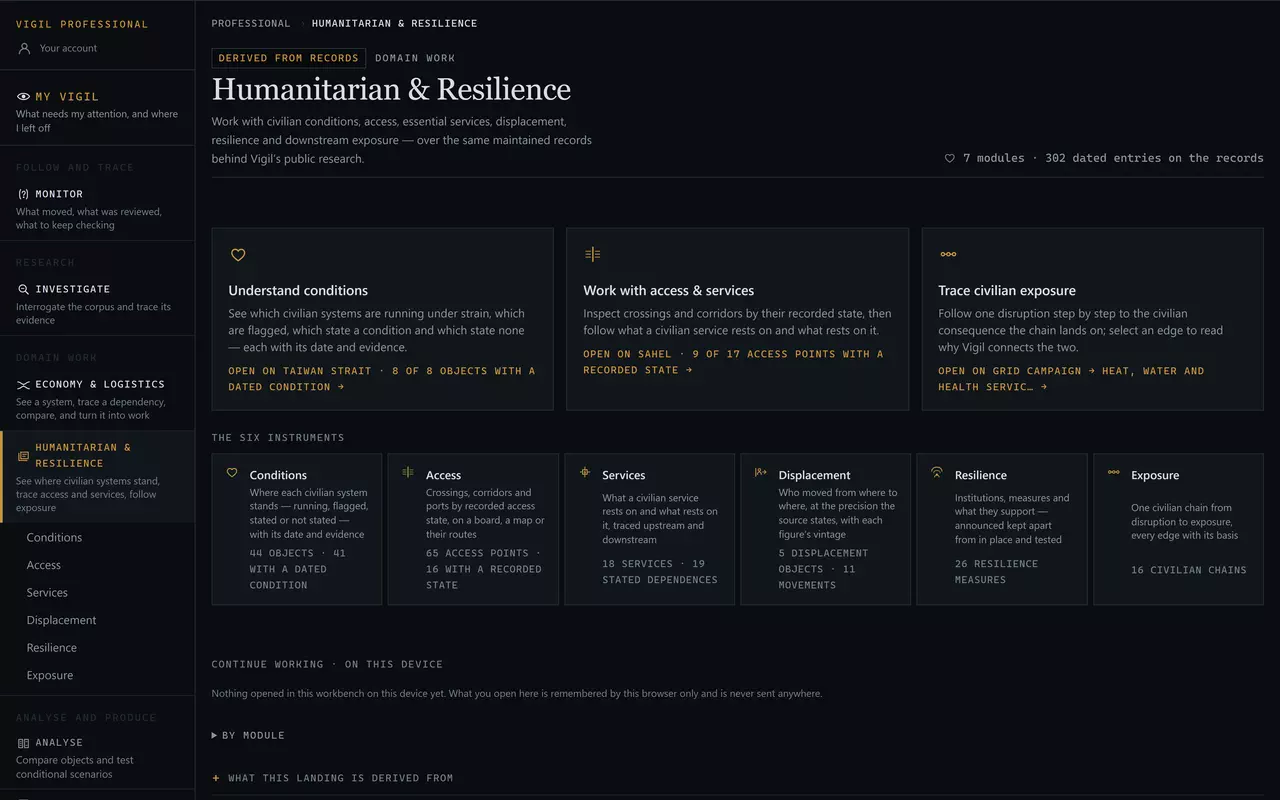
Humanitarian & Resilience sits in the Domain work tier beside Economy & Logistics. It works 44 civilian systems — services, conditions and pressures filed on each module’s humanitarian record —65 crossings, corridors, ports and transport hubs, 26resilience measures, 11 recorded movements and 16civilian impact chains across 7 modules. Modules are not expected to match: a civil-resilience module such as Taiwan documents stockpiles, redundancy and drills where no emergency is under way; an emergency module documents conditions, access and displacement.
Where the records come from
Nothing in the workbench is its own. A civilian service, condition or pressure is a humanitarian object on the module’s public humanitarian record, with its own dated condition where the module states one, the services it rests on, and its resilience measures, movements and dated changes. A crossing or corridor is a locations/ record, and its access state is that record’s. An energy or transport system is an Economy & Logistics systems/ record, opened there from the inspector rather than copied here; ground is a terrain record; a mechanism is an impact chain. Each object carries two dates kept apart — the date what it states is as of, and the date Vigil last reviewed it, or the fact that it has not yet been reviewed as an object. The publicHumanitarian or Civil Resilience page of each module prints the same records in full; nothing needed to understand the civilian picture is held back from it.
What the canvases refuse to doNo severity scale, index, score or ranking appears anywhere, and no colour means worse. A movement is never drawn as a route, and a regional estimate is never narrowed into a point. A reported restriction is never drawn as a closure, and “not recorded” is never drawn as closed. An announced programme is never drawn as capacity in place, and a drill is never drawn as a crisis survived. Two figures from different windows are never added. A chain is never completed for symmetry.
The same shell as Economy & Logistics
Module, search, the instruments — Conditions, Access, Services, Displacement, Resilience, Exposure— and the view toggle; a context line with the counts that belong to the instrument; the canvas at full width with the register folded beneath it;Layers, Changes and Pinsclosed until opened; the inspector only on a selection, concise first;Present for a clean frame. The address carries the module, instrument, record, view, selection and pins. TheEconomy & Logistics chapterdescribes the shell in full; everything there applies here.
Conditions
Where each civilian system stands, in the module’s own dated words.
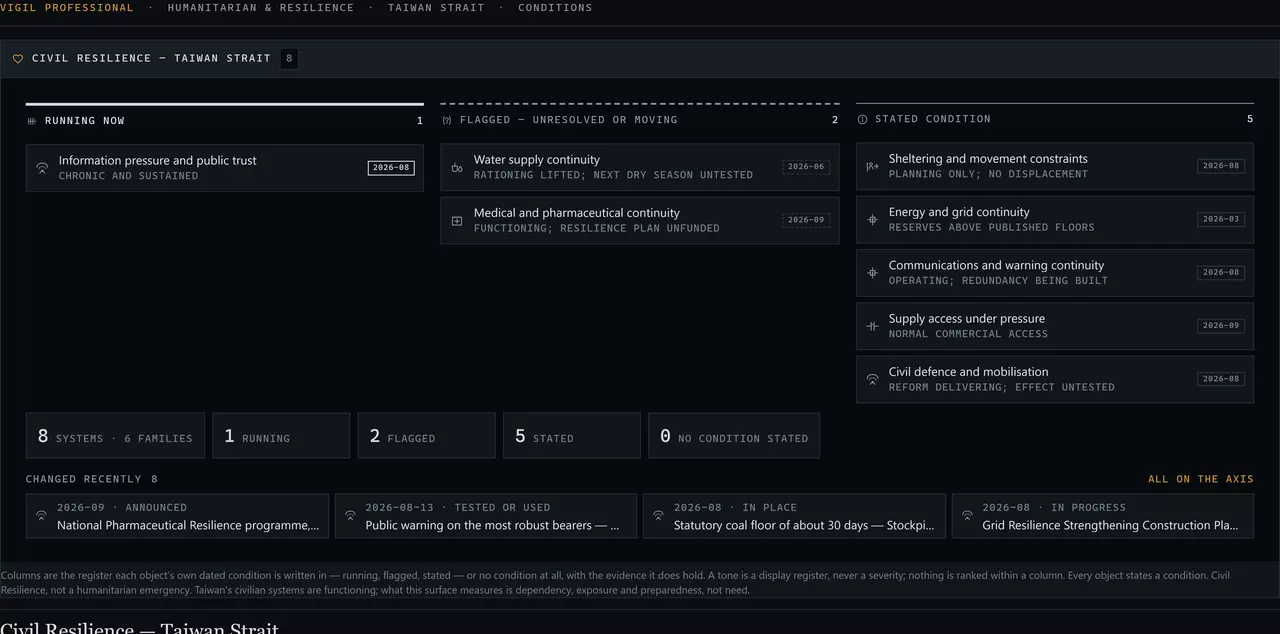
The columns are the module’s own display register, not a severity: a running condition is one the module records as currently under way, a flagged one is unresolved or moving, a stated one is a plain dated fact.By family regroups the same cards by kind of system. Select a card to read its condition, what it rests on, its latest dated change and its basis; the full analysis, figures and gaps are under the inspector’s tabs.
Access
How people, aid and supply can move — by the state each record states.
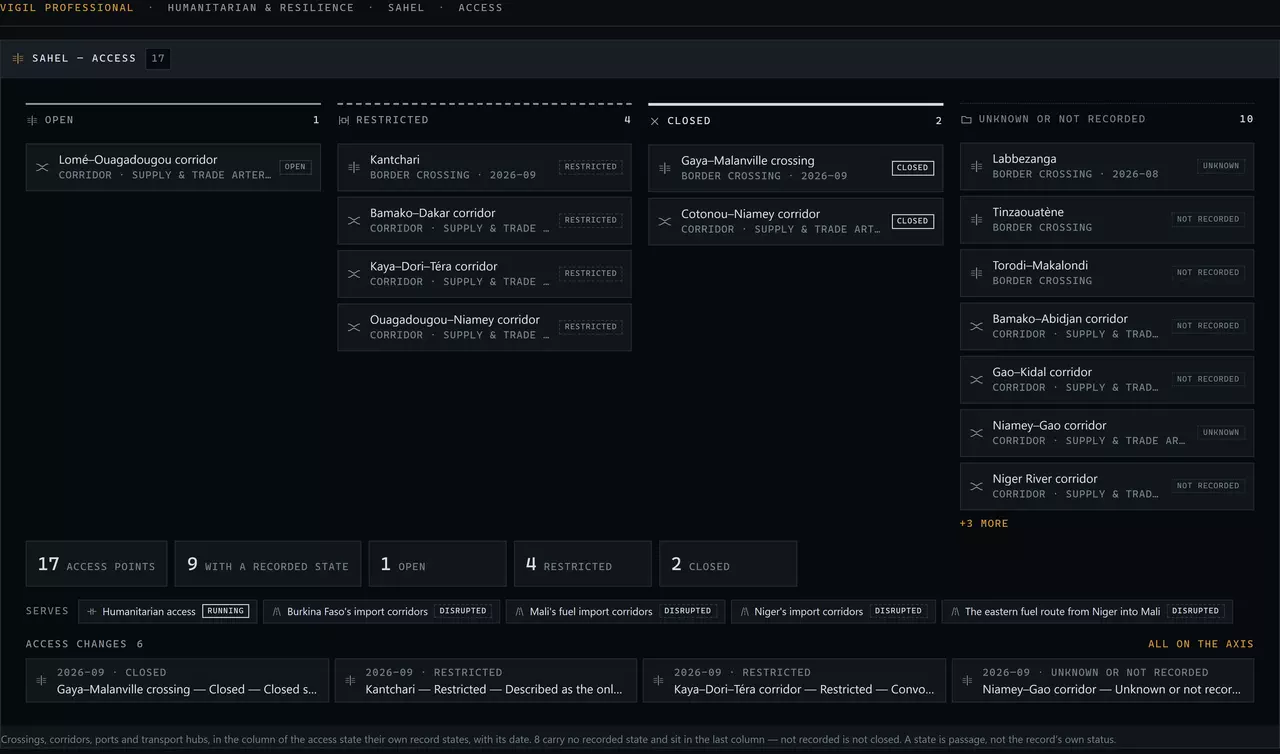
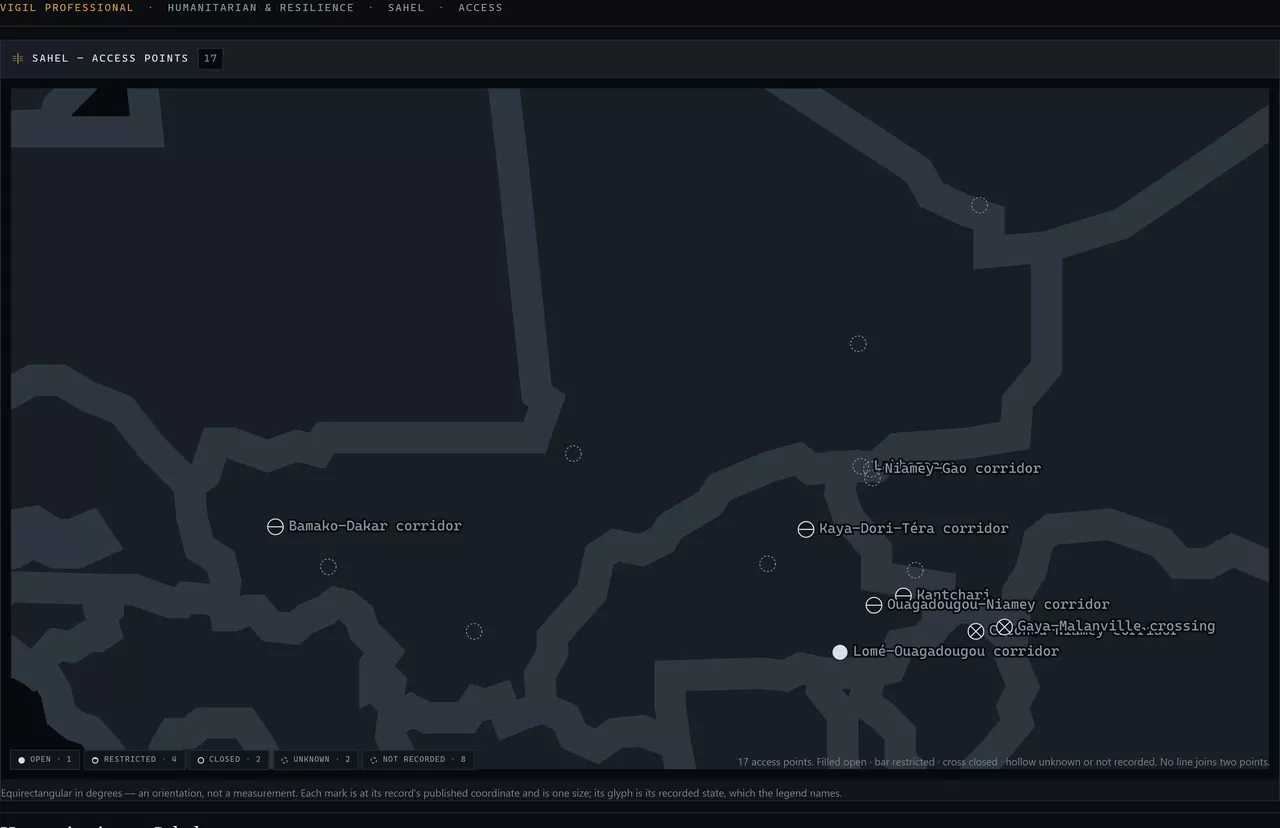
An access state is passage at a point as that location’s record states it, with its date. Unknown is a state a source supports — a vacated post where nothing is established about crossings; a point with no state at all sits in the same column marked not recorded, which is not closed. Map places the same points on the module outline, one size, the state as the glyph; Routes shows the supply and access systems in their authored node order.
Services
What keeps an essential service running, and what rests on it.
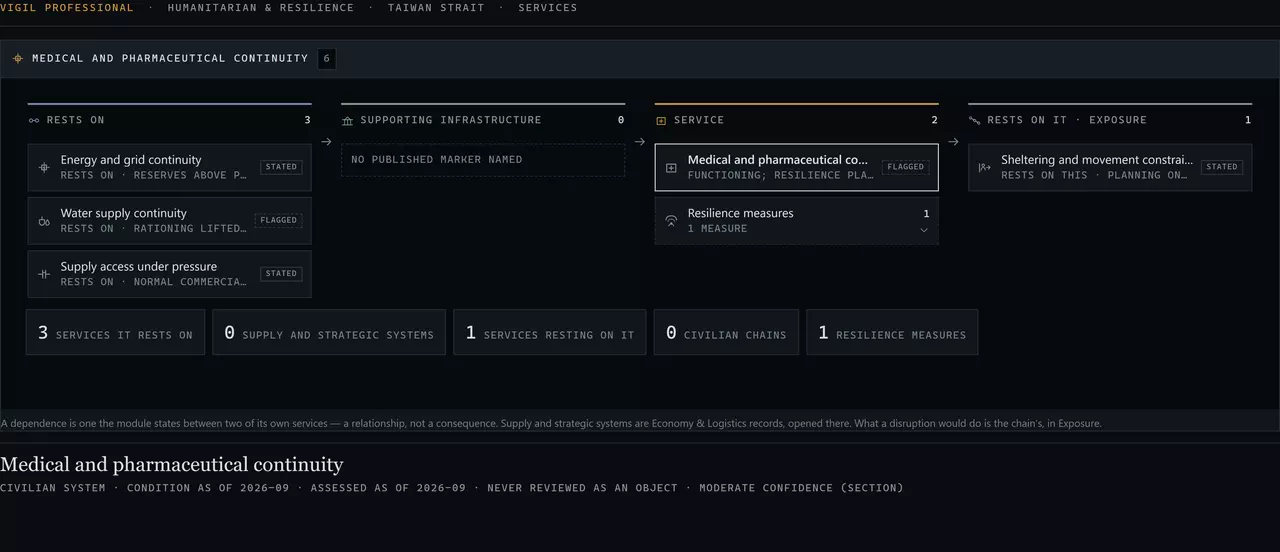
A dependence is one the module states between two of its own services — a relationship, not a consequence. Dependency map draws every service in a stated dependence, layered by how many it rests on, withTrace upstream and Trace downstream from a selected service. A supply or strategic system is an Economy & Logistics record: the inspector opens it there.
Displacement
Who moved from where to where, at the precision the source states.
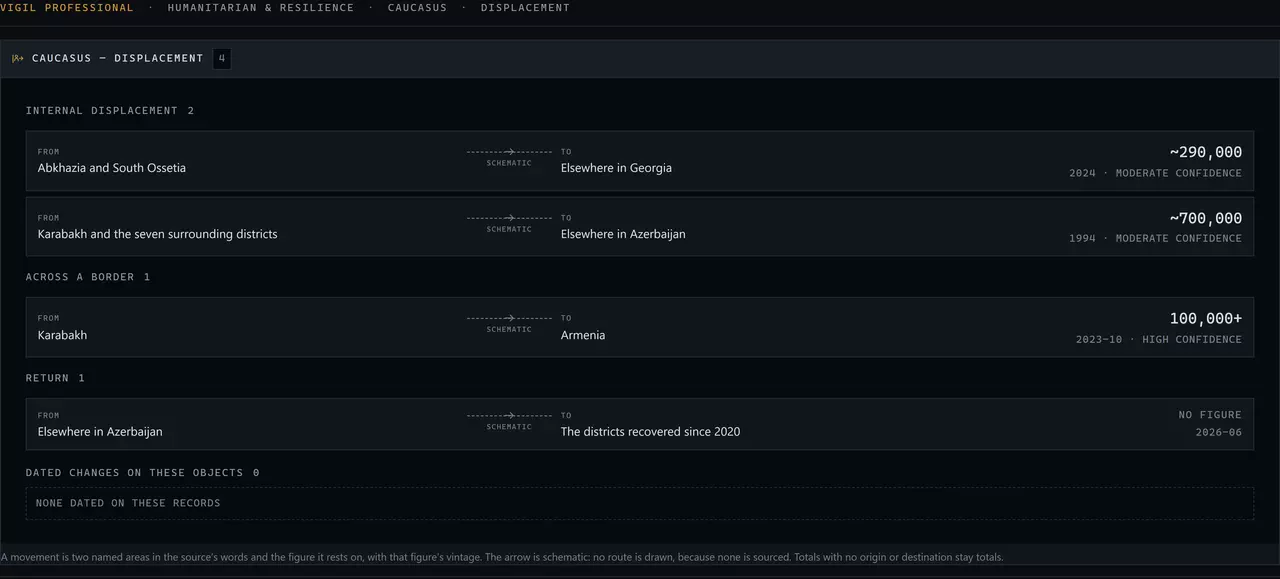
Where only totals exist, totals are shown as totals; where a figure is a flow or a projection it is labelled as one and never added to a stock.Vintages places every displacement figure on a date axis, so a 1994 count and a 2023 count are seen to be different counts. Where a module records no displacement — Taiwan’s object is sheltering planning — the instrument says so.
Resilience
What lets civilian systems continue, absorb disruption or recover — by what is actually in place.
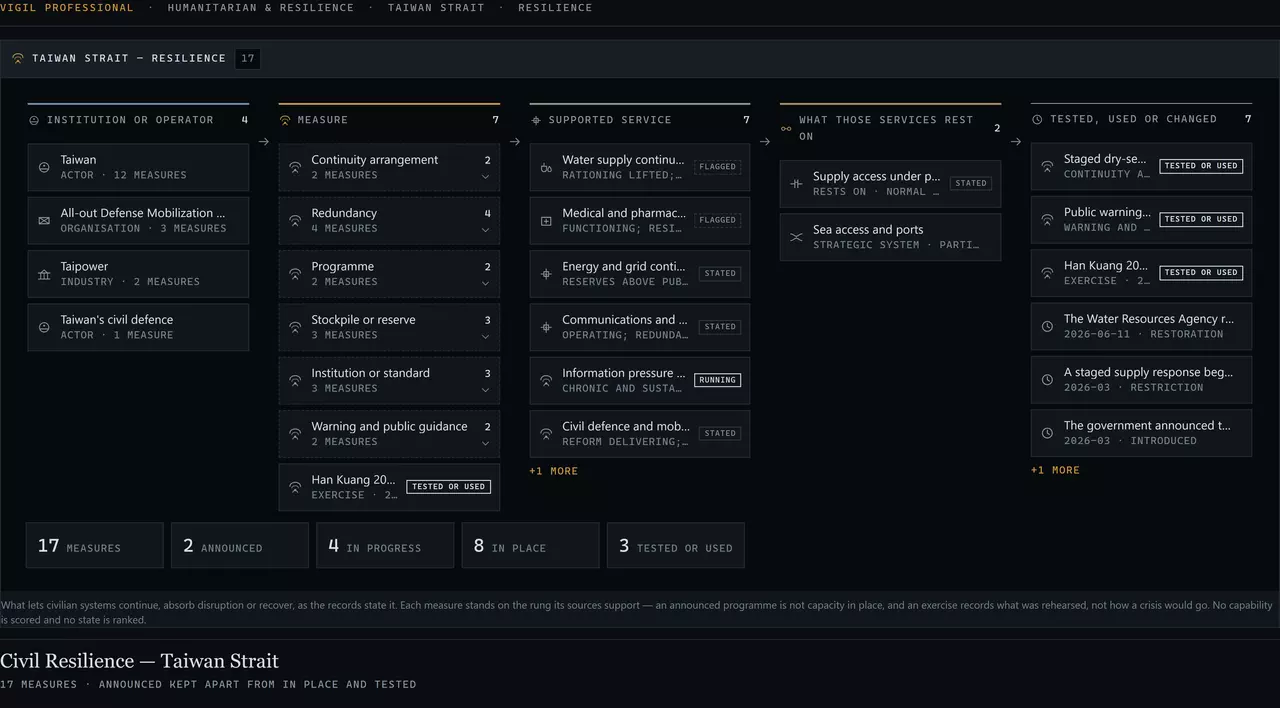
Announced
A stated intention, a programme without appropriation, a planned facility.
Nothing in place yet.
In progress
Funded or under way, not yet reported operating.
Partial.
In place
Reported operating — a requirement in force, a reserve held, an institution standing.
Not a statement of performance.
Tested or used
Exercised in a drill or used in an actual event, with what was reported.
What was tested, never proof it works.
Exposure
One disruption to its civilian consequence, every edge with its basis.
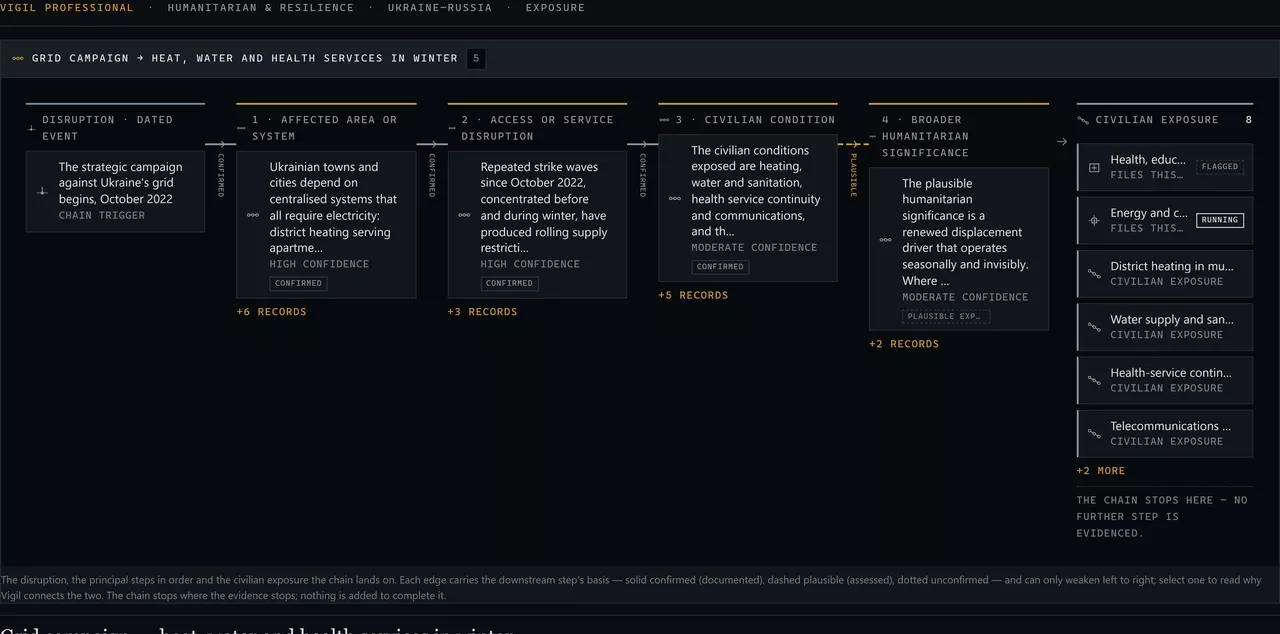
A solid edge is a confirmed step — a documented relationship; a dashed edge a plausible one — an assessed exposure; a dotted edge an unconfirmed scenario. Select an edge to read why Vigil connects the two; select a step to read its claim and sources. Named places shows the markers the steps name, as points.
Pins, compare and dated changes
Pin up to six records — services, access points, measures, chains — from the inspector or with shift-click. The tray sets them side by side on their own fields: a crossing’s access state and its date beside another’s, a service’s measures by rung beside another’s. A field one record lacks saysnot comparable, and nothing is ranked. Changesopens an axis of every dated entry: object changes, condition dates, measures, access states, disruptions, events and Watch reviews, one mark each at its own date. It shows when something was recorded to change; it does not reconstruct a past state.
Into work
The inspector offers what fits the selection: Pin; Trace dependency; Trace exposure; Show access; Show measures; Show on map; Show changes; Add to a collection and Add to brief (a measure, movement or change travels through the object that carries it); Send to Analyse; the public record and Explore; and, wherever a service names one, the system it runs on in Economy & Logistics. From Economy & Logistics, a system, flow or marker that a civilian service names offers the way back.
When something looks wrong
- A route is drawn as a schematic row. The sources give where people moved from and to, not the way; a drawn route would be invented.
- A population figure is broad or old. It keeps the precision and the year of its release — the workbench prints the date beside it rather than presenting it as current.
- A stage is missing, or a chain stops. The chain has the steps the evidence supports; a service lane has only the dependences the module states.
- One module has far less resilience data. Coverage differs by module and is shown, not smoothed; the coverage register lists what is missing.
- A facility is not duplicated here. Each record has one home; the inspector opens the system or marker where it lives.
The Reference chapter carries each of these at length.
Next: Analyse — two records side by side, and one condition held.