
Vigil Assessments
Focused questions. Documented answers.
Commission a focused, evidence-grounded geopolitical assessment, delivered as a sourced research document. One agreed question; a written judgment that answers it; the evidence, the uncertainty and the observables that would change it — typically on five or six A4 pages, as the three demonstrations show.
Request an assessmentView the examples
Focused Assessment€39 / $45Introductory pricing · Subject to scope acceptanceYou choose the billing currency on the request; the written scope states the final price in that currency before any payment.
Requests are reviewed by hand. Every accepted commission has a written scope agreed before any payment, and the three demonstrations above are the format a finished document takes.
What a Vigil Assessment is
A finished answer to one defined question.
Vigil publishes a maintained research system on eight conflict and security modules. An assessment applies that system, and whatever further public evidence the question needs, to one question a reader has — and returns the answer as a document that stands on its own: the judgment, how the evidence supports it, what is uncertain, and what would change it. It is prepared by Vigil, reviewed before delivery, and sent privately.
It is for anyone who needs one question settled on the record — an analyst, a desk, an editor, a researcher, a decision-maker — without taking on a workspace or a subscription; and for a Professional subscriber who, on a particular question, would rather receive a finished document than spend their own working time in the instruments.
Vigil Research
Understand conflicts and developments through independently maintained, public research. Free, and staying free.
Vigil Professional
Work directly with the underlying records, evidence and instruments, week after week, in your own workspace.
Vigil Assessments
Receive a finished, independently prepared answer to one clearly defined research question, as a document.
What an assessment examines
- The maintained Vigil records the question touches: modules, Watch questions and their review ledgers, logistics, systems, events, Notes — each with its own date and grade.
- Primary and institutional sources, official statements and attributed reporting, opened and checked for the dates and figures the answer rests on.
- The geography and the history that bound the question: where things are, what has already happened there, and what the record does not support.
- The actors, capabilities and dependencies at work — and which of them has no alternative.
- The mechanism: the relationships, constraints and institutions that decide the outcome, stated so that they can be tested.
- The uncertainty: what is established, what is attributed, what is Vigil's assessment, what is unresolved, and the limits of what can be concluded.
Every accepted commission has an agreed scope in writing before work begins. An assessment draws on public evidence and Vigil's own maintained research: it does not involve privileged access, original collection in the field, or a guaranteed conclusion, and it does not forecast with a certainty the evidence cannot carry.
Demonstration assessments
Three finished documents, to read in full.
Each was prepared by Vigil to demonstrate the format, on a question of the kind the service answers, with the same evidence standard as a commissioned one. None was commissioned by a client, and each says so on its own pages. Read them for the structure, the sourcing and the way uncertainty is carried — that is what a commission receives.
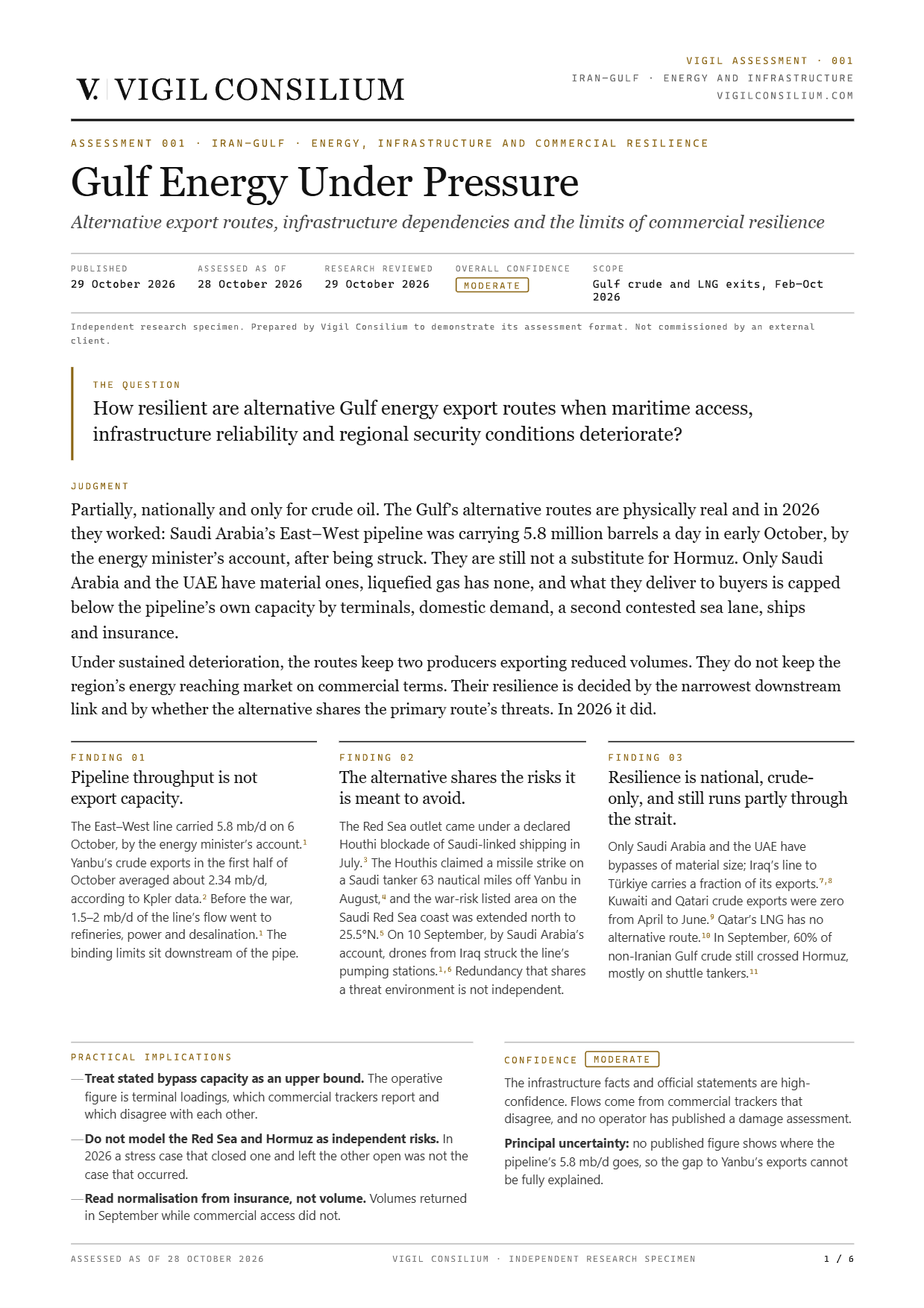
Assessment 001 · Iran–Gulf · Arabian Peninsula, Gulf and Red Sea
Gulf Energy Under Pressure
Alternative export routes, infrastructure dependencies and the limits of commercial resilience
The questionHow resilient are alternative Gulf energy export routes when maritime access, infrastructure reliability and regional security conditions deteriorate?
Separates what a bypass pipeline carries from what its terminal exports, and shows the alternative sea lane sharing the risks it was meant to avoid.
Open the PDF (opens in a new tab)Download
Independent research specimen. Prepared by Vigil Consilium to demonstrate its assessment format. Not commissioned by an external client.
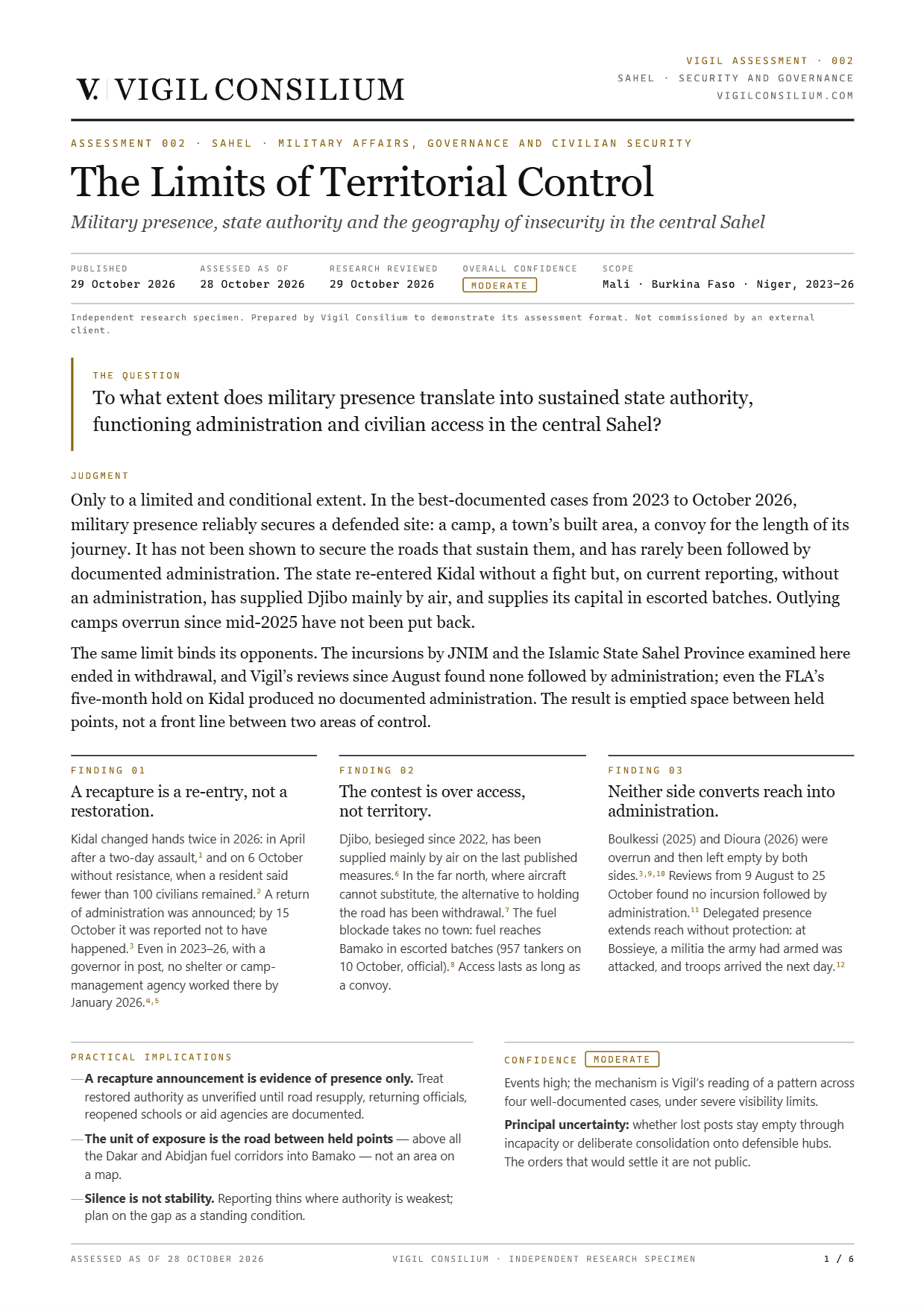
Assessment 002 · Sahel · Mali, Burkina Faso, Niger
The Limits of Territorial Control
Military presence, state authority and the geography of insecurity in the central Sahel
The questionTo what extent does military presence translate into sustained state authority, functioning administration and civilian access in the central Sahel?
Tests four bounded cases against five levels of control, from reported presence to working administration, without drawing a control map.
Open the PDF (opens in a new tab)Download
Independent research specimen. Prepared by Vigil Consilium to demonstrate its assessment format. Not commissioned by an external client.
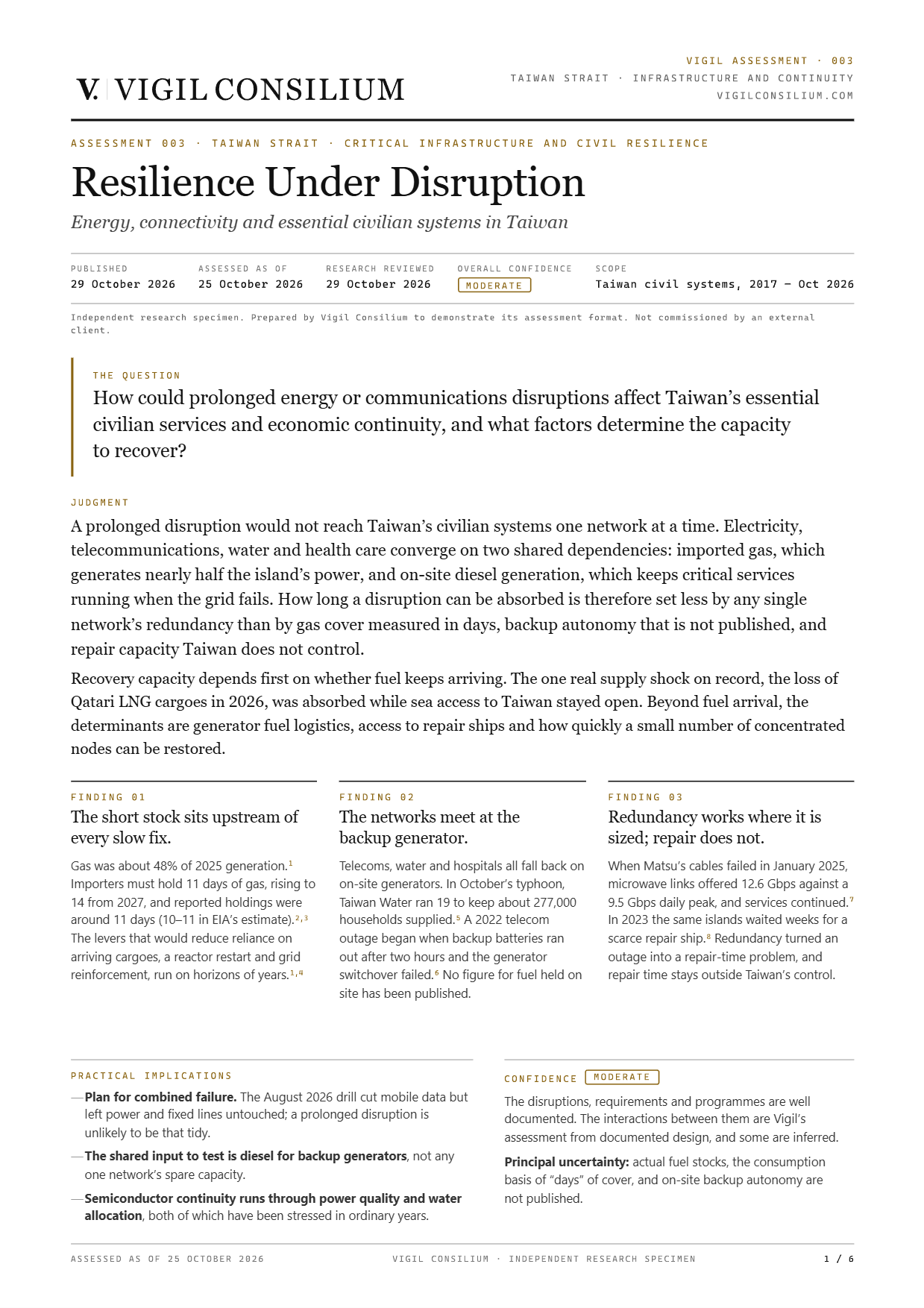
Assessment 003 · Taiwan Strait · Taiwan and its outlying islands
Resilience Under Disruption
Energy, connectivity and essential civilian systems in Taiwan
The questionHow could prolonged energy or communications disruptions affect Taiwan’s essential civilian services and economic continuity, and what factors determine the capacity to recover?
Shows why resilience cannot be judged one network at a time: electricity, telecoms, water and health care share the same fuel and the same backup generators.
Open the PDF (opens in a new tab)Download
Independent research specimen. Prepared by Vigil Consilium to demonstrate its assessment format. Not commissioned by an external client.
What you receive
A document built to be checked.
A commissioned assessment follows the structure the demonstrations show, adapted to the agreed question. Its length follows the question, not a template: the demonstrations run to six A4 pages, and a narrower question is answered in fewer. What does not vary is that every claim is traceable, every date is stated, and the first page is useful on its own.
The question and its scope
The agreed question, the boundary of the answer, the publication date, the assessed-as-of date and the research-review date — three dates kept apart because they mean different things.
The executive judgment
A written answer to the question, its principal findings, the practical implications, an overall confidence grade and the principal uncertainty. The first page, and it stands alone.
Situation and evidence
The documented context, the actors, systems or geography that bear on it, and one evidentiary figure, map or table — drawn only from located records and documented facts, with a caption saying what it shows, what it rests on and what it cannot show.
The mechanism, implications and observables
The relationships and constraints that decide the outcome; what follows, under which conditions; the specific developments that would change the judgment; and the limits of what can be concluded. Conditional pathways carry no invented probabilities.
Sources and method
A numbered register of every source cited, with its kind, date and address; the review basis; what was excluded and why; a source-quality table for the claims the judgment leans on most; and the evidence-status and confidence conventions used.
How it works
Four steps, and the first creates no obligation.
Submit a question
Describe the research question, the subject and the intended use in the form below. Vigil replies to the address you give.
Agree on scope
Vigil reviews whether the question can be answered from defensible evidence, and proposes a written scope: what the answer covers, its depth, the price and a delivery window — or explains why it cannot take the work.
Confirm and pay
After your research scope and final price are agreed, you will receive a secure PayPal payment link for that amount, in the currency of your scope. Payment is made before research begins, on PayPal's own pages, by PayPal balance or the card methods PayPal supports there. Nothing is charged before your acceptance, and the figure on the written scope is the figure that applies.
Receive the assessment
Vigil researches, writes and reviews the document — a separate factual check against its sources is part of production — and delivers it to you privately as a PDF.
Submitting an inquiry is a question, not an order. It does not commit you to a purchase, and it does not commit Vigil to accept the work. The terms set out the process in full.
Pricing
One introductory price, for one focused question.
Focused Assessment
€39 / $45
Introductory pricing · Subject to scope acceptance
You choose the billing currency on the request; the written scope states the final price in that currency before any payment.
- What it covers. A narrowly defined analytical question that can be answered from Vigil's maintained research and a bounded set of public sources, in a document of the form shown above. The written scope states what is inside the answer and what is not.
- What needs a quotation. A question that is broader than one assessment can carry, needs sustained new research, several linked questions, or an institutional format of its own. Vigil says which it is at the scope stage, and quotes separately.
- What it is not. Not a subscription, not a retainer, not a monitoring contract. One payment, one document. Nothing is charged at inquiry, and the amount payable is stated on the written scope before you decide.
- In euros or US dollars. Two fixed introductory prices for the same commission — €39 or $45 — not a conversion of one into the other. You choose the billing currency on the request; the written scope is issued in it, the payment link you receive after acceptance is for that currency, and PayPal shows the amount before you confirm.
- An entry point, not a ceiling. The introductory commission is the smallest piece of work Vigil offers. Extended assessments, multi-part research, comparative studies and institutional commissions are each scoped and quoted individually.
Methodology and independence
The same standards as the public record.
An assessment is held to the rules every published Vigil claim already answers to, set out on the methodology page. The rule that matters most to a customer is the last one: commissioning an assessment does not purchase a conclusion.
Traceable sources
Every substantial claim carries a numbered citation to a source register that prints the publisher, the date and the address. A source that was not opened is not cited.
Evidence kept apart from inference
What is established, what is attributed to a party, what is Vigil's own assessment, what is unresolved and what is conditional are marked as such, in the text.
Explicit uncertainty
Three confidence grades, with the site's definitions. No numerical risk score, no invented probability, no precision the evidence does not have.
Dated
Published, assessed-as-of and research-reviewed dates are all stated; a figure carries its own vintage; figures of different scope are never combined.
Transparent limits
Each document says what it cannot conclude, which sources were excluded and why, and which claims rest on weaker evidence — before a reader has to find out.
Independent conclusions
The judgment is Vigil's, reached from the evidence. It is not shaped to be reassuring, alarming or commercially convenient, and a customer buys the work, not the answer. Material errors are corrected and the correction recorded, as on the public corrections log.
How Vigil's public research is produced, reviewed and maintained is described on the editorial process page; the registry of sources it draws on is the source registry. An assessment may use Vigil's canonical records as evidence; it never changes them, and anything it finds that the public record should carry goes through the same editorial review as any other change.
Request an assessment
Describe the question.
Vigil reads every request, judges whether the question can be answered from defensible evidence, and replies with a proposed scope, price and delivery window — or with a reason it cannot take the work. Submitting this form creates no obligation on either side, and nothing is charged until you accept a written scope.
What you write here is held by Vigil to assess and reply to the request, and for no other purpose. The privacy notice describes exactly what is stored and for how long. Or write to [email protected].
Vigil Assessments is a service of Vigil Consilium, the publisher of Vigil Research and Vigil Professional. Independently maintained; not affiliated with any government, party, military organisation, financial institution, media company or advocacy group. The terms and the privacy notice describe the commission and what is held about a request.