
Chapter 08
Method in use
Every statement in Professional carries a label saying what kind of statement it is. This chapter is what each one commits Vigil to — and what you would be over-reading if you took it further.
The registers
Eight labels. Each is printed beside the statement it governs, as a word and a drawing, and never as a colour alone.
- FACT
A dated, sourced occurrence the corpus records. It says what happened, not what it means.
- ASSESSMENT
Vigil’s graded reading of the evidence, carrying its own confidence and review date.
- USER ASSUMPTION
A condition the user chose to hold true for this run. Vigil does not say whether it will occur.
- DERIVED CONDITIONAL IMPLICATION
What follows inside the Vigil system if the stated assumptions held — an authored rule citing the record it rests on, never a prediction.
- UNKNOWN
Vigil has no reading, or the evidence needed to form one is not recorded.
- NO COVERAGE
This series does not measure here. Distinct from a covered period with zero records.
- NO MATERIAL CHANGE
The file was reviewed and nothing moved. A finding, not an absence.
- SAVED WORK
Your own work. It references canonical records and is private to your account.
The two that are most often confusedUNKNOWN means Vigil has no reading, or the evidence needed to form one is not recorded. NO COVERAGE means an instrument does not measure here at all. Neither is evidence that nothing happened, and they are different claims: one is about Vigil's knowledge, the other about Vigil's instruments.
A register is never conveyed by colour alone, and no surface may present one register as another. If you are building a briefing, the registers print with the blocks — which is what lets a reader of your output tell a recorded fact from Vigil's reading of it from your own assumption.
Dates and freshness
Every Professional record prints the date it is as of, the date it was last reviewed, and where it has one the date it last changed. Those are three different facts and the product never merges them.
A record is banded by how long it has been since its own review date: Recently reviewed within 120 days, Review ageing within 270, and Review overdue beyond that. The band is shown; it is never used to hide a record, and nothing is refreshed automatically to clear it.
There is no composite freshness score anywhere, and no "updated 3 hours ago" language. A date is a date.
The cycle
All six published modules are reviewed every week. Each receives a dated weekly brief; quiet weeks explicitly record when no material change was identified.
A review that finds nothing is recorded as a review. That is why the Monitor cycle counts reviewed and held separately from pending: the first is work that was done, the second is work that has not been.
Corrections, and what happens to your work
Corrections are made in place, dated, and logged publicly — and they reach what you saved.
Something is wrong
Vigil finds it, or a reader writes in.
Same route for free and paid material.
The record is corrected
In place, with a date, and an entry in the public corrections log.
Never quietly edited.
Surfaces follow
Monitor, Research, Evidence and the Tempo Lab show the corrected record the next time they are opened.
Your work follows
Collections, timelines and briefs that reference it show the correction. You are not left holding a stale copy.
Retirement
A question that has been answered, or a template that no longer holds, is retired rather than deleted. It keeps its ledger, and where the work continues it names the successor that took it on.
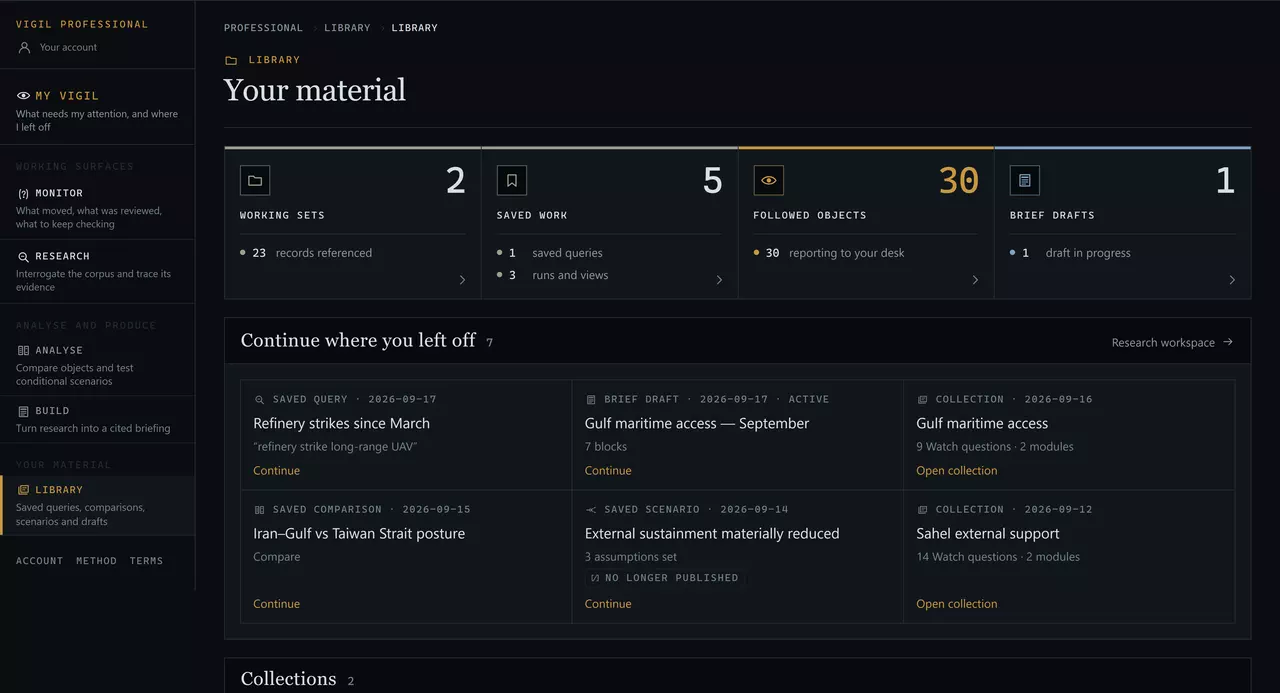
Saved work pointing at a retired record says no longer published and keeps the label it was saved under, so you can see what was there and decide what to do. In a briefing, the block prints a line saying the record was withdrawn rather than vanishing — and the document panel counts it as unresolved.
What the product will not do
Several of these are the reason to trust the rest, and all of them are checkable on the free site today.
- No score. No universal risk number, escalation index, threat level or probability of war anywhere in the product, and no hidden model producing one.
- No forecast. A scenario reports what the record says under conditions you set. It carries no likelihood and no horizon.
- No forced comparison. Where two records do not both carry a dimension, Compare says NOT COMPARABLE and gives the reason.
- No blended registers. A recorded fact and Vigil's reading of it are marked differently and are never merged into one sentence.
- No estimated fields. Where Vigil does not know, the record says UNKNOWN and keeps saying it until evidence changes it.
- No editorial influence from payment. A subscription buys access to tools and depth. It buys no say in what is covered, concluded, graded or corrected.
The full rules are public and were published before the product they govern: the Vigil methodology for the corpus, the Professional methodology for the instruments, and the corrections log for what has been changed.
Next: Worked workflows — five sessions end to end.