
Chapter 09
Worked workflows
Five sessions, each crossing several surfaces in order. They are examples rather than case studies: nobody named here uses Vigil, because the product is not on sale.
The thing worth taking from these is the order. Monitor tells you what to look at; Research tells you what it rests on; Analyse tests it; the Builder makes it sendable; the Library makes next week cheaper.
Energy and investment
Hold a view on Gulf energy and maritime exposure through a quarter, and produce an internal note each week.
- Monitor
Open the Gulf Energy & Maritime Risk scope and follow it, and follow the two or three questions inside it your exposure actually turns on.
- Monitor
Read what moved this cycle and what was checked and held. Select a question to see its current reading and its observables.
- Research
Open the observable the reading rests on and walk its evidence down to the dated entries and the named sources.
- Research
Collect the records you used into a collection named for the exposure, so next week starts where this week finished.
- Brief Builder
Insert the questions that moved, the observables beneath them, the locations they name and the activity series that bears on them.
- Brief Builder
Write the summary in your own voice, annotate the one block that needs a caveat, and export as PDF.
What it leaves behind — A collection that stays current, a saved Monitor view scoped to the exposure, and a brief you can rebuild next week by changing four blocks.
Political risk and consulting
Answer a client question about a mechanism that is changing, with every claim carrying its own source.
- Research
Query the instrument, the actors and the places by name. Read the family facets to see what the corpus holds before reading anything.
- Research
Select the records that bear on the question and collect them.
- Compare
Put the two records the answer turns on side by side, and read what one carries that the other does not.
- Scenario Lab
Hold the client’s stated assumption and read which parts of the recorded system become relevant, affected or stressed. Save the run.
- Brief Builder
Build the answer from the collected blocks, state the assumption explicitly as the client’s, and export with the evidence pack.
What it leaves behind — A saved query, a saved comparison, a saved scenario run under the client’s assumption, and an export whose citations can be checked without you.
Policy and diplomacy
Understand what an institutional dependency rests on, and test one condition against it.
- Monitor
Select the question and read the actors and places its records name.
- Research
Open the observables that check it and read their stated limits before their readings.
- Timeline
Assemble the dated sequence that produced the current position, and keep it as a set.
- Scenario Lab
Hold the one condition the policy question turns on, and read the invalidators as carefully as the implications.
- Brief Builder
Produce a note whose first section is what the reading cannot establish.
What it leaves behind — A timeline you can re-open when the next development lands, and a note that states its own uncertainty.
Conflict and security research
Track a theatre continuously rather than incident by incident.
- Monitor
Open the module, follow its questions and its recorded-activity series, and save the workspace as a view.
- Tempo Lab
Read the series over the window you care about. Open a bin to see the records it counts, with their bases and sources.
- Research
Trace a period that changed down to the events and developments behind it.
- Timeline
Build the sequence from those canonical records.
- Brief Builder
Produce the structured brief, with the Tempo strip printed beside the chronology.
What it leaves behind — A saved Monitor view that reopens exactly as you left it, and a brief whose activity figures carry their own inclusion rule.
NGO and humanitarian research
Establish what is recorded about civil systems and access in a theatre, and what is not.
- Research
Open the Civil resilience lens and read what every module holds on it.
- Research
Select the observables that bear on continuity and read their limits — this is the material where the limits matter most.
- Research
Open the places the records name and collect them with the readings that cite them.
- Brief Builder
Produce a structured output whose gaps section is drawn from the records’ own stated limits rather than written.
What it leaves behind — A collection of what is recorded, and an output that is explicit about what is not.
One record, all the way through
If you would rather see a single record travel the whole chain than a session travel the whole product, the public walkthrough follows one published observable from the exposure above it, through the question it extends and the evidence beneath it, to the scenario that cites it and the briefing it can end in — with the surfaces it is read on at each step.
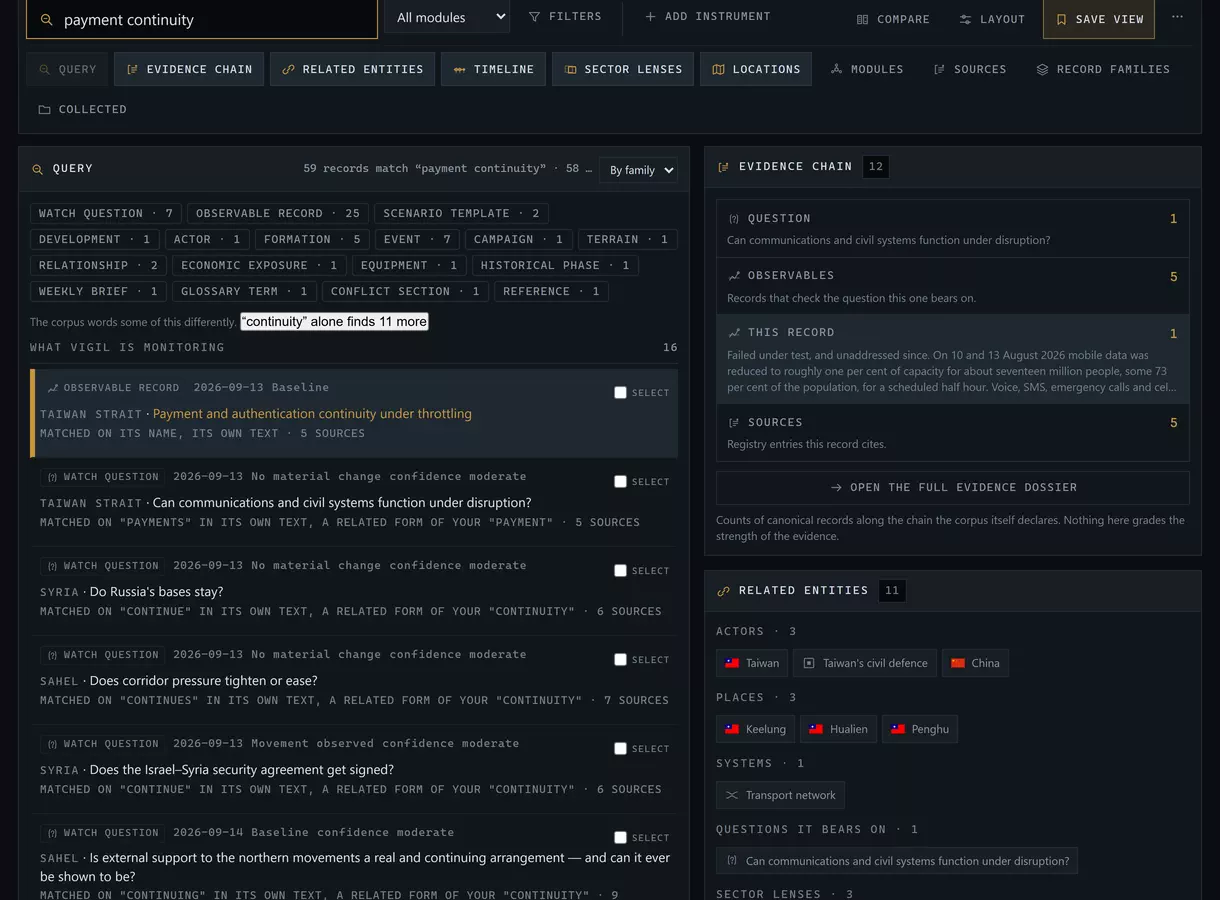
The habit worth forming in week one. Open the draft before you start reading. Every Add to brief you press while researching lands in it, and the briefing assembles itself as you work instead of being rebuilt from memory afterwards.
Next: Reference — troubleshooting and the glossary.