
The finding
Between late May and late July 2026, Russia closed most of its market to Armenian food, plants, drinks and dairy. On 24 September the Council of the European Union adopted a two-year suspension of duties on most Armenian exports, and said it was responding to those restrictions. The pairing invites a story about Armenia leaving one economic bloc for another. The evidence supports something narrower, and more useful.
Russian leverage over Armenia is not a single condition. It runs through separate channels: the market for Armenia’s food and drink, the gas that powers the country and the network that carries it, the railways, the right to work in Russia. In 2026 Russia used these channels in different ways. It restricted the market. It threatened the terms of the gas, in writing. It left the rest alone. The channel it used is the one Armenia can most readily work around. The channel it held back is the one Armenia cannot yet replace. And almost all of them sit inside one institution, the Eurasian Economic Union, whose other members have now asked Armenia to choose.
Dependence, leverage, pressure, outcome
Four different things are often run together as “leverage”, and this Note keeps them apart. Dependence is exposure: a large share of something important comes from, or goes to, one place. Leverage is the capacity to exploit that exposure — a regulator that can close a market, an agreement that can be denounced. Pressure is that capacity being used. An outcome is the target changing what it does as a result.
Armenia depends on Russia in all of these channels. Russia has leverage in most of them. It has used one. No source yet describes the outcome that pressure is usually meant to produce.
The market: the lever that was pulled
Armenia’s headline trade figures hide where the dependence lies. In 2025 Russia took 35.1 per cent of Armenian exports and supplied 36.0 per cent of imports, according to the Statistical Committee’s tables. Exports since 2022 have been inflated by re-exports of gold and precious stones, mostly to the United Arab Emirates and Hong Kong, and of electronics, mostly to Russia. Set the precious metals aside and Russia took 55 per cent of Armenia’s 2024 exports. For food and drink other than tobacco it took about 80 per cent. For fish, vegetables and fruit it took 94 to 98 per cent, and for beverages and spirits 82 per cent. The EU took 2.4 per cent of the same goods. The farm economy was built for one buyer.
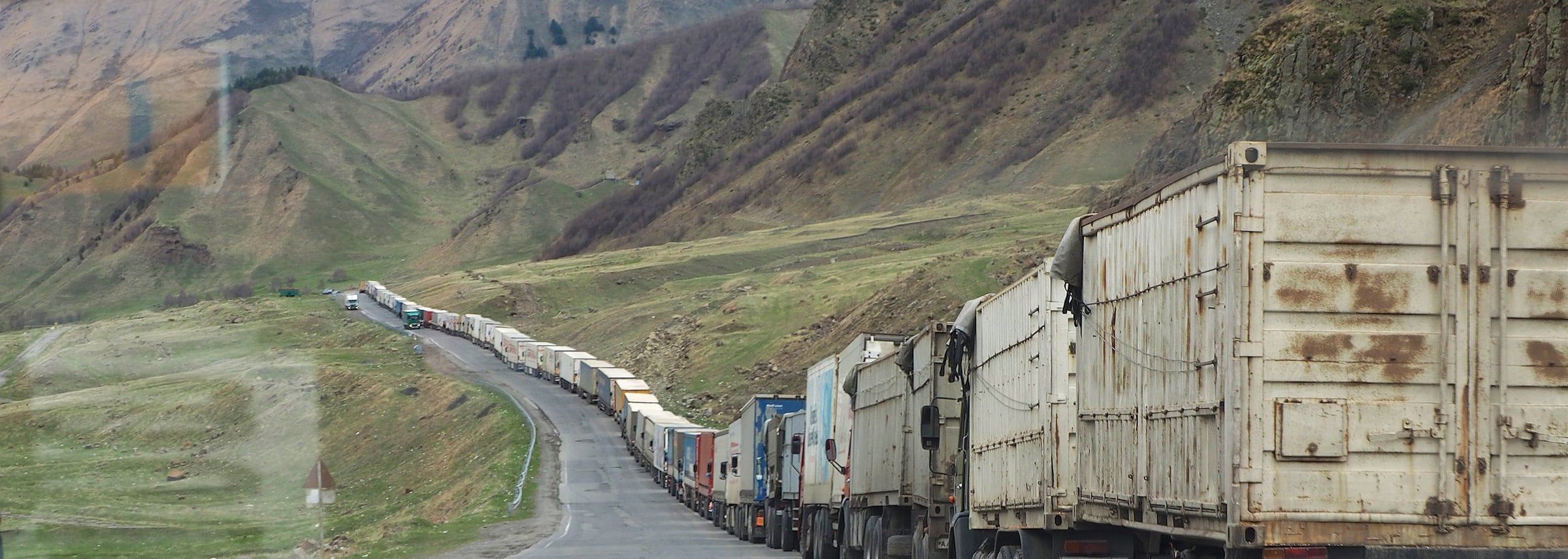
The restrictions came in stages. Rosselkhoznadzor, Russia’s agricultural and veterinary inspectorate, restricted cut flowers from 22 May, fresh vegetables and strawberries from 30 May, stone fruit and grapes from 2 June, and other fruit, potatoes and dried fruit from 3 June. In late May Rospotrebnadzor, the consumer-safety agency, stopped sales of Jermuk mineral water and of named wines and brandies from three producers. On 11 June, three days after Armenia’s parliamentary election, Rosselkhoznadzor announced that from 12 June it would restrict all quarantine-regulated products of Armenian origin, and their transit through Russia to other members of the Union. Fish stopped on 26 June and dairy from four producers on 27 July. On 25 September the inspectorate declined to lift the fish and dairy measures, saying it had received assurances but no documents.
How the restrictions worked matters as much as what they covered. Each was a regulator’s notice citing pests, traceability or labelling, issued under powers the EAEU Treaty itself provides: Article 29 allows restrictions for life and health, and Article 56 allows temporary sanitary measures. Both are conditioned — the measures must not be “a disguised restriction on trade”. That is the lever’s shape. It takes no political act to pull and is hard to contest from inside. Armenia’s answer has been to argue the condition. Its prime minister said on 2 June that these were “wrong steps, because they turn people against the EAEU”, while conceding problems at individual companies. On 8 September the deputy economy minister said a complaint had been lodged within the Union.
Whether this was pressure is the part the parties dispute. Rosselkhoznadzor’s head told Rossiyskaya Gazeta on 17 June that the reasons “lie in product quality and safety, not politics”. The inspectorate had raised violations in Armenian dairy and plant exports in 2023 and tightened the rules on Armenian flowers in 2025. The Council of the EU calls the measures “trade restrictions recently imposed by Russia”. The broadest measure followed Armenia’s election by three days. Vigil records the sequence and both accounts, and adopts neither.
The EU’s answer: access in law, not yet a market
The EU measure is real, and it is specific. The Commission proposed it on 2 July. It suspends duties for two years on lines covering about 80 per cent of Armenia’s exports to the Union, with duty-free quotas for eight fruit and vegetable products. The Council says those lines take in almost 99 per cent of the fresh fruit, vegetables and plants, and more than 91 per cent of the beverages and spirits, that Armenia sold to Russia. The Parliament approved it on 15 September and the Council adopted it on 24 September. It takes effect the day after publication in the Official Journal, which had not been found by the time this Note was written.
Its form matters too. It is unilateral and temporary, and it is not an agreement. That is not an accident of drafting. Under Article 35 of the EAEU Treaty, free-trade arrangements with third countries are made by the Union, not by its members. This is why Armenia gave up an EU free-trade agreement in 2013 when it chose the Russian-led customs union, and why its 2017 partnership agreement with the EU has no free-trade chapter. A tariff suspension that the EU grants on its own is the one kind of EU market access Armenia can receive while still in the Union. It widens Armenia’s options without forcing the choice.
What it does not do is supply a market. The Russian trade came with buyers, distribution, familiar standards and a short road north. The EU trade has to be built: buyers found, EU sanitary rules met, and produce moved through Georgia and across the Black Sea. The government has helped at the margin, subsidising greenhouse exports to other markets from June. Armenian exports to the EU rose about 70 per cent in January–July 2026, but that figure covers all goods and came before the measure existed; exports to Russia fell 8 per cent in the same months, and 18 per cent from May to July. No figure yet shows fresh produce moving west at volume. This is the channel Armenia can most readily work around, because a market can be replaced by other buyers. It will take seasons, not weeks.
Gas: the lever held
Gas is where the dependence is physical. Armenia imported 2.705 billion cubic metres in 2025, and Russia supplied 2.229 billion of it — 82 per cent — according to the regulator’s figures. It arrives by one pipeline through Georgia into a network Gazprom has owned outright since January 2014: distribution, the Armenian section of the transit line and the storage site at Abovyan. The nuclear plant, which generates a large part of Armenia’s electricity, runs on Russian fuel.
Russia has not used the supply. Gazprom stopped deliveries from 15 to 25 September for pipeline maintenance. Gazprom Armenia covered the gap from storage and extra Iranian gas, and supply resumed on schedule. The same pipeline was taken out for maintenance in mid-September 2025. This was a recurring window, not a cut.
What Russia has used is the price. The low border price rests on an intergovernmental agreement of 2 December 2013, which removed Russia’s export duty on gas, oil products and rough diamonds sent to Armenia. It was signed as Armenia turned toward the customs union. On 1 April 2026 Russia’s president contrasted Armenia’s US$177.5 per thousand cubic metres with European prices above US$600. On 27 May the energy minister wrote that Russia might suspend or denounce the 2013 agreement because of Armenia’s closer ties with the EU. On 25 September, as supply resumed, Alexey Shevtsov, a deputy secretary of Russia’s Security Council, answered his Armenian counterpart Alen Simonyan’s statement that Armenia would buy gas wherever it could. Other supply would cost significantly more, he said, and commercial purchases from Iran would bring Armenia under US sanctions. That is leverage stated as a price, with the supply held in reserve.
The alternative is small. Iran supplied 476 million cubic metres in 2025 under a swap that pays for gas with Armenian electricity, and the swap runs to 2030. Armenia’s infrastructure minister says the pipeline can carry more than 2 billion cubic metres a year. He says volumes could at least double once a third high-voltage line to Iran is built, which has been delayed for years. Doubled, Iranian gas would still be under half the Russian volume. Azerbaijani oil products have reached Armenia since December 2025, 20,000 tonnes in a year, which diversifies fuel but not gas. Armenian officials have named Azerbaijan and Türkiye as possible gas suppliers. No agreement or pipeline exists. A ten-day scheduled outage covered from storage is the least demanding test of substitution there is. It does not show that a winter-long interruption could be covered.
The membership that joins them
The EAEU is the channel that holds the others together. The market Russia restricted is the Union’s single market, restricted under the Union’s Treaty. The duty exemption that prices Armenia’s gas came with Armenia’s turn to the Union’s customs union. The right of Armenians to work in Russia without permits is Article 97 of the Treaty. About two-thirds of money transferred to individuals in Armenia through banks comes from Russia, according to central bank figures reported in February. That is the payment channel, not a measure of migrant labour.
In 2026 the membership itself became the subject. Armenia’s parliament had legislated in 2025 to begin an EU accession process, and on 1 April Russia’s president said membership of a customs union with both the EU and the EAEU was impossible. On 29 May the presidents of Russia, Belarus, Kazakhstan and Kyrgyzstan went further. Meeting in Astana, they called for an Armenian referendum “within the shortest possible timeframe” on the EU or the Union. They also commissioned a report for the December 2026 Supreme Council on “the possible consequences of suspending the application” of the Treaty to Armenia. The Treaty provides for a member to leave on twelve months’ written notice (Article 118); Armenia’s prime minister has spoken of six months, a statement no official text reconciles with the Treaty. The Treaty contains no procedure for suspending a member.
Armenia has done neither of the things that would settle the question. Its prime minister told parliament on 24 August that an EU application may soon be made, with a referendum to follow, and on 3 September that Armenia had notified no withdrawal. It attends the Union’s councils. Its answer to Russia’s restrictions has been the Union’s own complaint procedure. Each side is asking the other to bear the cost of ending the membership. Until one of them acts, every benefit the membership carries is still in place, and so is every threat against it.
Routes and rail
Russia sits on fewer of Armenia’s routes than the phrase “Russian leverage” suggests. With the Turkish and Azerbaijani borders closed, Armenia’s outlets are Georgia and Iran. Georgian roads lead to the Black Sea ports and, through one crossing at Upper Lars, to Russia. Only that last route has Russia on its far side, and it leads only to Russia’s own market. Nothing Russia controls stands between Armenia and European buyers.
The Russian position is in the rails. Russian Railways has operated the whole Armenian network through its subsidiary, South Caucasus Railway, under a concession signed in 2008 for thirty years. Armenia’s prime minister has said repeatedly in 2026 that the arrangement costs Armenia, and that the operator’s sanctioned owner deters shippers. On 13 August he proposed that Russia sell the concession “in full or in part”. Russia’s deputy prime minister had said in April that there were no grounds to sell it, and Russian Railways said in July that it would hold to the contract. On 17 September the prime minister said talks continue without result. The small new flow through Azerbaijan — about 60,000 tonnes to and from Armenia in a year, by the three governments’ count — moves on Russian-operated Armenian track.
The other routes are limited or not yet routes. The Iranian crossing at Agarak operates, and closures were reported there during the attacks on Iran in February and March 2026. The Margara crossing to Türkiye is ready on the Armenian side and closed. The Kars–Gyumri railway has a working group. The TRIPP route through Syunik has a framework agreement and surveys, and no construction.
What is changing, and what is not
Three things are changing. Armenia’s exports are shifting away from Russia at the margin, and the EU has made its market legally open to the goods Russia stopped. Armenia is contesting the terms of its dependence through the institutions that carry it — a complaint inside the EAEU, a negotiation over the rail concession, tariff access from the EU. And the membership that binds these channels has become a question with a date on it.
Much is not changing. Russia remains the only buyer of scale for Armenian food and drink. It supplies four-fifths of the gas through a network it owns. It runs the railways, and it remains the country where Armenians work without permits. None of the restrictions has been lifted, and none of the threats has been carried out. The EU measure is access, not demand, and it is temporary.
What would move this
The assessment turns on acts, not statements, and each is observable. A decision at the December Supreme Council on Armenia’s standing. A lodged EU application, or an Article 118 notice. A suspended or denounced gas agreement, or a new border price. The Russian restrictions lifted, widened or ruled on. And, more slowly, a season’s trade figures showing whether Armenian produce actually moves west once the EU measure is in force. The first of these would show whether the membership changes. The last would show whether the market lever was replaced or only escaped.