
Stated · Vigil assessment
Objectives
What the 5 actors this module authors a posture for are trying to achieve — stated positions and Vigil’s assessments, kept apart. Every other party appears under Profiles without one.
DeterrenceGrey-zone pressureMaritime accessSemiconductorsCivil resilience
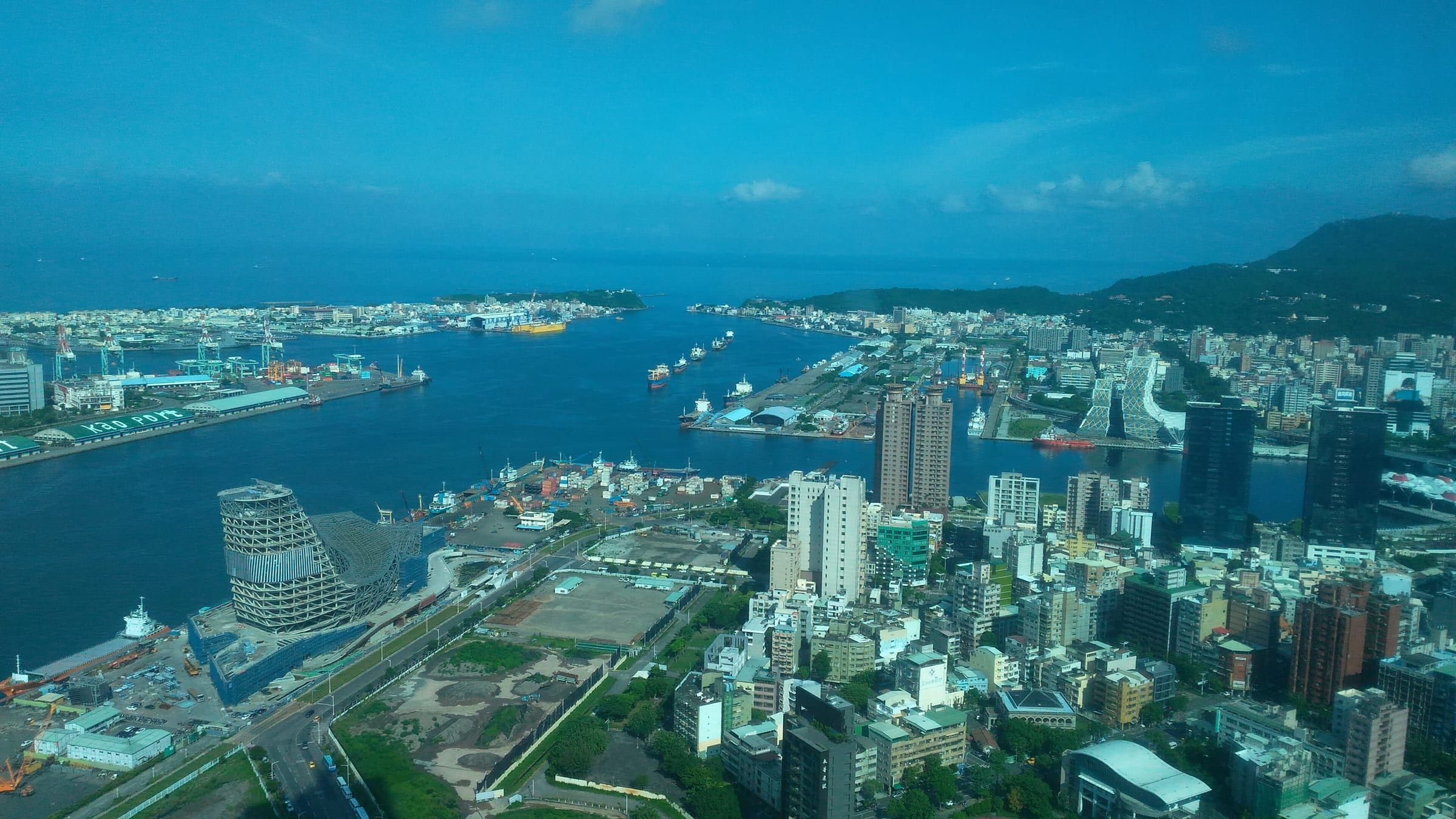
Kaohsiung, 25 July 2019. The First Port entrance and the container centre, with the Cijin peninsula beyond and the city on the right. Kaohsiung handles the great majority of Taiwan's container throughput, and it is the physical form of almost everything this module says about trade.Padai · CC BY-SA 4.0 · resizedImage: An aerial view over a port city: a harbour entrance channel with vessels under way, container terminals along one shore and a dense high-rise city on the other.
Current state
Graded per item · As of 2026-07
Taiwan is not best understood as an invasion waiting to happen. It is a pressure system that has been running for seventy-five years: an island democracy whose status was never settled, a mainland government that treats unification as unfinished business, and an American security relationship deliberately left ambiguous. What moves in that system is rarely combat — it is aircraft crossing a median line, coast guard ships appearing in outlying-island waters, undersea cables breaking, budgets stalling in a divided legislature, and export-control rules written in Washington that land on a company in Hsinchu. The strait matters globally because the most advanced semiconductors on earth are made on one side of it and the world's busiest shipping passes through it. Vigil's coverage explains how that pressure system works — not when, or whether, it breaks.
Changed in brief — 2026-10-04 · Status wording updated
Why it matters
This is the most consequential place in the world where a war is not being fought. The dispute organises the military planning, alliance politics and industrial policy of every major power in Asia and several outside it, and it runs through the chip supply on which almost all modern electronics depend — which means a disruption here reaches economies with no view on the political question at all. It is also the clearest live case of coercion below the threshold of war: what is being contested day to day is not territory but what counts as normal.
6 points, composed from this conflict’s own sourced records — nothing here is a new claim.
There is no war in the Taiwan Strait and there has not been one. What exists is sustained military, economic and diplomatic pressure below the threshold that would compel a response, and a set of deterrent arrangements meant to keep it there. This module explains that system, not a conflict.
The Republic of China government has administered Taiwan since 1945 and has never been governed by the People's Republic. Beijing regards the island as a province and unification as unfinished national business. Taiwan's own politics is divided about its future status, and its people elect governments that differ on how to manage it.
Military aircraft and ships operate around Taiwan daily and are reported by Taiwan's defence ministry. The unwritten median line down the strait was observed for roughly half a century and effectively stopped functioning as a restraint after August 2022. The change was in what counts as unremarkable, not in where anything is.
A dozen or so states maintain formal diplomatic relations with Taipei. The rest, including the United States, conduct substantial unofficial relations under one-China policies that are deliberately not identical to Beijing's one-China principle. The ambiguity is the arrangement, not a failure of it.
Taiwan manufactures the large majority of the world's most advanced semiconductors. That concentration gives states with no position on sovereignty a direct material stake in the strait staying quiet, and it is the single largest reason this dispute is treated as a global economic risk rather than a regional political one.
This module records observed activity, historical events, published doctrine and declared positions. Where it describes a contingency it says so explicitly, states what the assessment rests on and what would change it, and publishes no invasion timeline, force estimate or casualty projection. Capability is not treated as intent.
Stated · Vigil assessment
What the 5 actors this module authors a posture for are trying to achieve — stated positions and Vigil’s assessments, kept apart. Every other party appears under Profiles without one.
Vigil assessment
What limits those options. A constraint is a structural limit, not a risk rating.
Vigil assessment · Observed
The module’s current phase — Deterrence under strain — budgets, credibility and access (2026 – present) — and the newest dated review.
Vigil assessment
The standing arrangements this module authors between its parties. Each line is the record’s own signature; the analysis, dates and sources are on the record.
Observed
The standing questions Vigil is following on this module, each with what its latest review found. The evidence that would change the assessment is on the question.
Vigil assessment · Observed
5 exposure channels and 5 watch items, as of 2026-08.
Vigil assessment · Observed
10 dated figures at regional granularity, each with its own basis, as of 2026-09. No operational detail is published.
Beijing's pressure this week ran through measures against named people and a company, not through military escalation. On 12 October its foreign ministry sanctioned two ministers of Taiwan's diplomatic partners under the Anti-Foreign Sanctions Law. On 14 October the Taiwan Affairs Office barred a company it ties to the family of a DPP candidate for Taipei mayor from any dealings with mainland parties, six weeks before Taiwan's local elections. The military and coast guard signals stayed within pattern: one designated PLA patrol, a two-hour coast guard entry at Kinmen, and an entry at Pratas, where Taiwan's coast guard counts eleven expulsions this year. No named exercise followed the National Day address, no second F-16 was delivered, and there was no decision on the held US package.
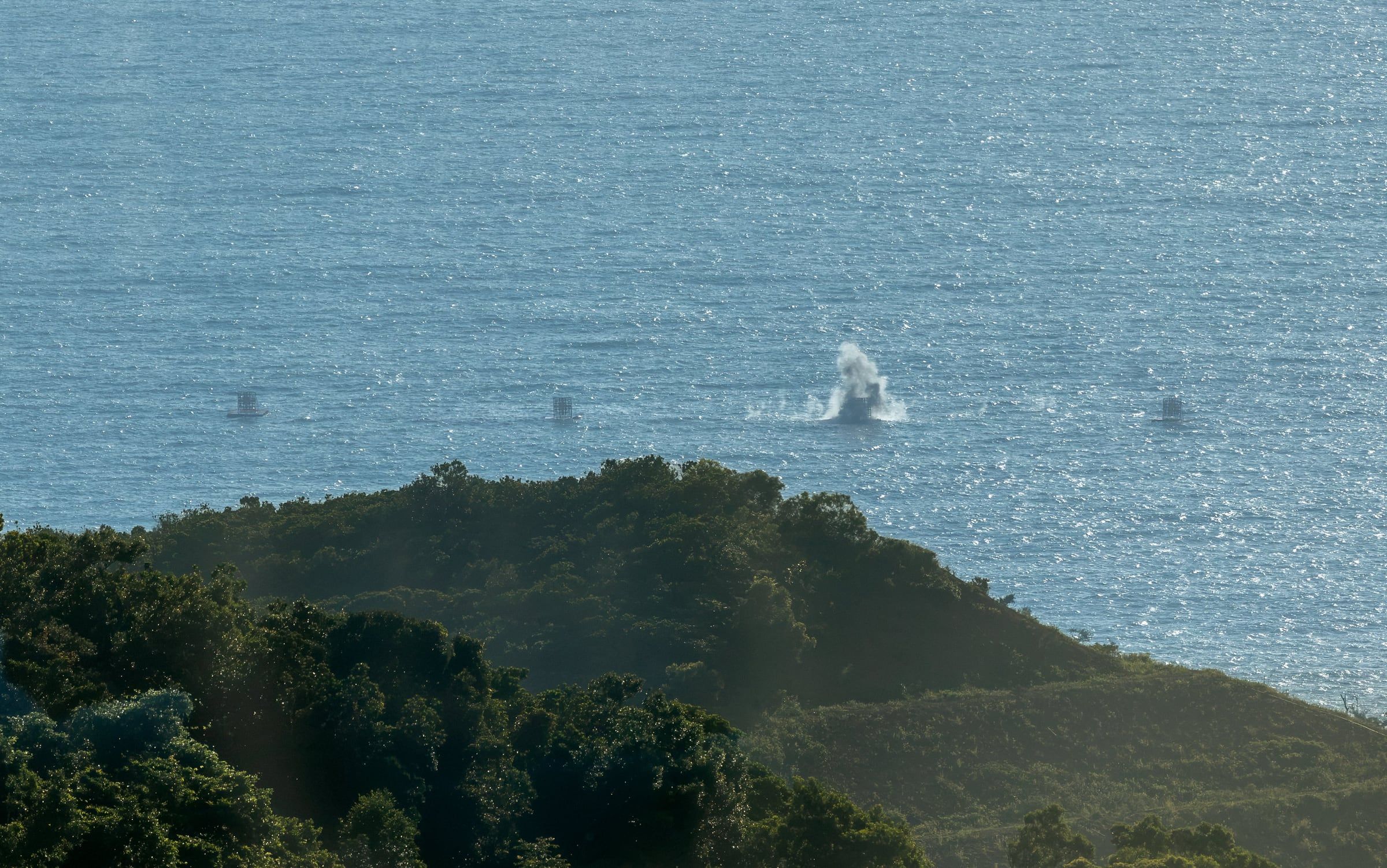
The defence ministry's own account describes more than weapons firing side by side: ship, air-control, radar and drone sensors joined through a battlefield network to missiles and attack drones across the services. What no published account yet shows is that chain working with its links jammed or its command nodes gone — a test Taiwan has so far published only for its wargame.
Changed in brief — 2026-10-18 · Map updated
This map shows broad strategic geography and publicly documented pressure areas. It does not show live military positions, patrol routes, force dispositions, air-defence locations, base layouts or operational vulnerabilities. Zones cover who administers, which sea areas carry access significance, and the island-chain and outlying-island context that explains why the geography matters — orientation overlays only, never an operational picture, and never a depiction of any invasion scenario.
Japanese defence-policy statements and the PRC's economic response to them; Philippine access arrangements and exercise patterns in northern Luzon and the Batanes group. The distinction that matters is between a political signal, a legal obligation and a granted access that remains revocable. Philippine contingency planning is publicly oriented toward evacuating its own nationals from Taiwan rather than toward intervention, and nothing here should be read as a commitment that has not been made.
Trade restrictions, tariff investigations, tourism controls and targeted measures — applied to Taiwan and, since late 2025, to Japan. The inducement side belongs here too: the August 2026 Xiamen package offered Kinmen bridge, electricity and gas connections, which would create dependence rather than impose cost. Economic instruments are the most-used in this system and the least covered.
Overseas fab milestones against Taiwan-based expansion, and the export-control rules that shape both. On completion of announced fabs, roughly 30 per cent of TSMC's 2nm-and-beyond capacity is projected to sit in Arizona — a real change, stated as future-conditional rather than current. Keep two measures apart: TSMC's share of the foundry market is a company figure, and the share of advanced chips fabricated on Taiwan is a geographic one, and they are not interchangeable.
Scope of this coverage. This is strategic-flashpoint coverage. It covers a system under sustained pressure — it is not a prediction, a countdown, or a tracker of live military activity. It maps broad strategic geography, actors, history, capabilities, economic exposure and civil resilience, and it reports major publicly documented signals. It does not publish live positions, current deployments, patrol routes, base layouts or invasion-scenario content, and it does not adjudicate the sovereignty dispute at its centre — it describes the positions the parties hold.
Source registryMethodology Corrections logGlossary
Found an error in Taiwan Strait coverage? Corrections are logged in public with the date and what changed — see the corrections log.