
The finding
Taiwan’s defence ministry says it ran a kill chain at Jiupeng, and Vigil said it had not described one. The ministry’s account is the one that stands.
From 16 to 18 September 2026 the armed forces held their annual tri-service joint precision missile firing at the Jiupeng range in Pingtung county. On the morning of the 18th President Lai Ching-te inspected the last day. On the 19th the ministry’s own news agency published its account, and it is specific. The exercise, it says, integrated the missile units of all three services with surveillance and drone assets and followed “kill-chain procedure”: search, target acquisition, identification, target allocation and attack. It drew on shipborne radar, the Air Force’s air control network, mobile radar vehicles and drones as “multiple surveillance means”, combined them with command-and-control nodes and a TAK battlefield-awareness interface, and linked them to precision missiles and attack drones across services and platforms. The firing units began in force-preservation positions, moved to firing positions on order, emplaced, engaged and fired, and then relocated quickly.
Vigil’s Taiwan brief of 20 September, written from the English-language wire reporting, headlined the exercise as co-location rather than a chain and said that no reporting described a cross-service data path. The ministry’s description had been published the day before. That sentence was wrong, the event record has been corrected, and the correction is logged.
What survives from the brief is its caution, and this Note carries it forward on better evidence. The account establishes that the connections exist and were exercised. It does not establish that they hold when someone is trying to break them, and on that question — which Taiwan’s own planning treats as the decisive one — it is silent.
What was connected
The weapons are the easy part of the record. The agency’s captions list, by service, what was fired: Patriot PAC-2, Tien Kung III and vehicle-mounted Sky Sword I air-defence missiles by the Air Force’s air-defence units; land-based Sky Sword II and HIMARS rockets by the Army; Hsiung Feng III anti-ship missiles by the Navy’s littoral combat command and by a coast guard cutter; Hsiung Feng II and Standard SM-1 missiles from Navy ships; and MICA air-to-air missiles from a Mirage 2000. The president’s office said that multiple types of attack drone took part in a joint combat exercise for the first time. The missions, in the president’s words, followed the Taiwan–Penghu defence operations plan: joint air defence, counter-operations, sea-air coordination, littoral strike and near-shore defence.
That list alone would support the reading Vigil gave it on 20 September — a great deal fired, from three services and a coast guard, in one event. The account’s second paragraph is what changes it. It names the sensors, names the layer that joined them to the shooters, and names the steps the joined system went through. The president’s schedule adds one physical node: before watching the firing he inspected the range’s safety control centre, which the agency’s caption calls the joint fire coordination and safety control centre — where a joint chain on a range is run from. The phrase “kill chain” is the ministry’s news agency’s; the president’s own remarks speak of command and control and cooperation between the services.
Why a chain is a different claim
A missile firing tests a missile. A chain tests whether a target found by one part of the force can be struck by another, and that is a problem of organisation and networks rather than of weapons.
The shooters at Jiupeng belong to three services and a coast guard and come from at least three countries’ industries. Each arrived with its own service’s sensors and its own way of being told where to shoot. The value Taiwan’s defence concept puts on numerous, dispersed, relatively cheap shooters — the anti-ship missiles, the rocket artillery, the loitering munitions the legislature argued over in May — depends on something none of them carries: a picture of where the targets are, and a way of passing a target to whichever shooter can reach it. The module’s own record of Taiwan’s loitering munitions calls finding targets the harder half of that capability. A kill chain is the harder half.
So the ministry’s claim matters in its own terms. It is a claim that a Navy radar, the Air Force’s air picture and shooters from all three services worked from one picture, and that the step between seeing and shooting — allocation — was carried out across the boundaries between them.
The same words, a wider chain
The vocabulary is not new, and the Note would overstate Jiupeng if it implied otherwise. In August 2024 the commanding officer of the air-defence unit that fired two Patriot and one Tien Kung III missile at the same range said the firing was run in “decentralised command-and-control” mode, with scenario-driven units engaging “according to kill-chain engagement procedure”. The ministry’s 2025 National Defense Report describes the Navy’s and Air Force’s missile firings in the same terms — firing units moved into tactical positions by the scenario, target allocation by a joint target-processing procedure, and engagement along the kill chain, under a safety control group the Navy runs. Han Kuang 41 in July 2025 listed building a kill chain from joint surveillance as a counter-landing task.
What changed in 2026 is the width of the chain. The 2024 firing was one service’s air defence. The 2025 sea and air precision firing joined the Navy, the Air Force and the coast guard, whose minister said this year was its second consecutive one firing Hsiung Feng missiles in the event. The 2026 firing added the Army’s HIMARS and land-based Sky Sword II, put several types of attack drone into the same account of the same procedure, and named the layer joining them. The ministry says the tactical network and TAK were first supplied as American military aid to build a common ground picture and decentralised command, and that TAK can currently be set down to platoon level. The president called the drones’ inclusion a first. That is a real development in the thing that matters — how many different shooters one picture can feed — and it is a development of an established procedure rather than the arrival of a new one.
Where the evidence stops
It stops at the words. The account names five steps and one network, and describes none of them. It does not say what passed over the TAK interface — tracks, coordinates, imagery — or between which nodes, or how quickly. It does not say which sensor held which target or which shooter it was handed to. It does not say whether allocation answered a live track or followed the exercise plan. And its sequence ends at attack: no damage assessment, no re-attack, no target passed to a second shooter after a miss. The one statement about results is that every training subject met its objective, which is the ministry’s and the president’s statement and not an assessment stage.
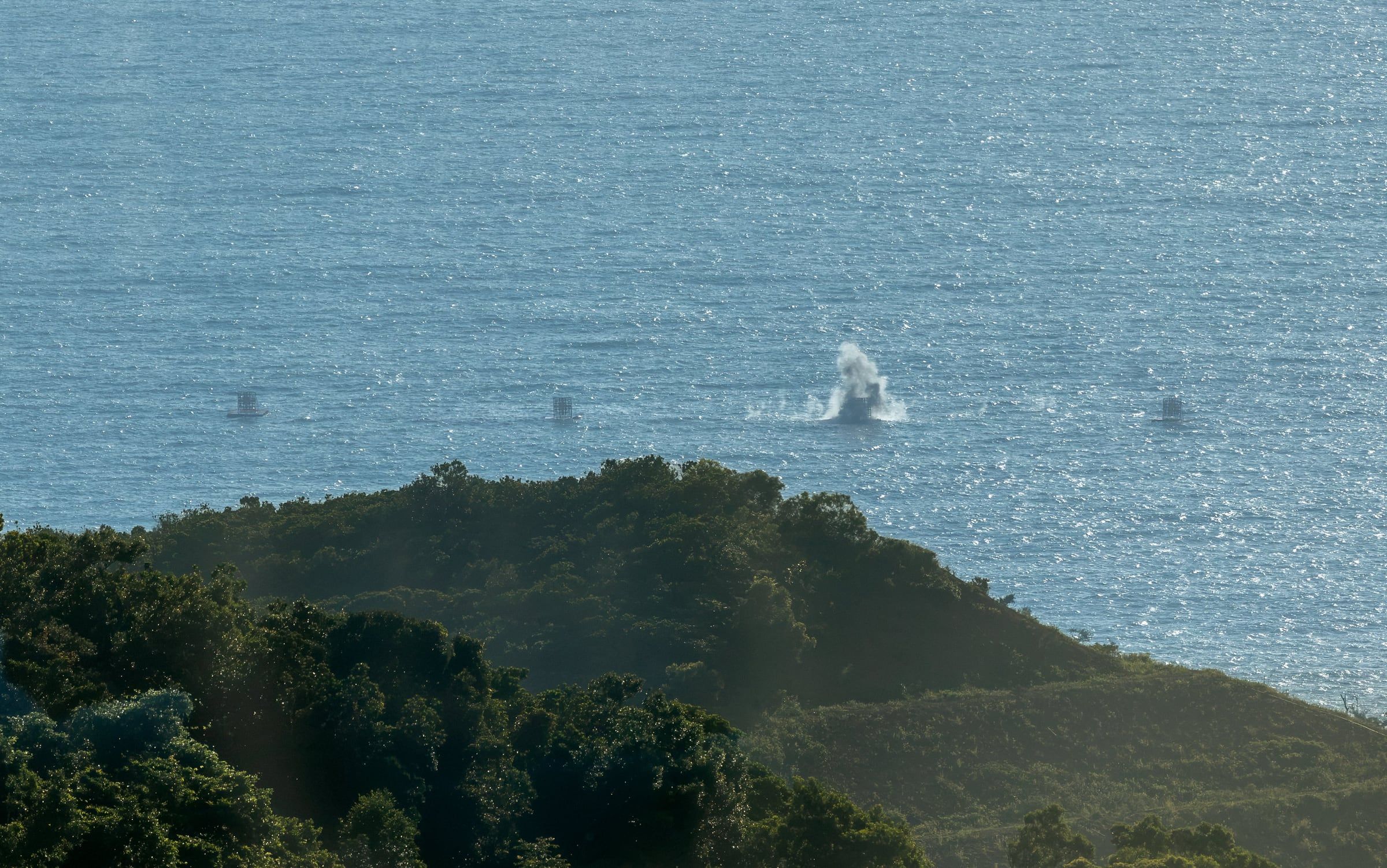
The conditions were a range’s conditions. The only openly licensed photograph of the target area, taken by the president’s office on the 18th, shows four identical lattice targets moored at even intervals, one of them struck. The targets were fixed and pre-placed in a declared sea area. The HIMARS launchers fired M28 training rockets at the sea targets, as the national news agency captioned an official photograph of the firing. The fire coordination centre was also the range’s safety control. None of this is a criticism: a national live-fire range with declared danger areas is exactly where a procedure should first be proved, and a live missile cannot be fired safely any other way. It is the reason a range firing cannot answer the question that comes next.
The account does contain one survivability measure, and it is worth being precise about which. The firing units waited in protected positions, moved to fire on order and relocated afterwards. That exercises the survival of the shooter — a launcher that does not stay where it fired. What the account does not show being exercised is the survival of the connections: nothing in it describes a link jammed, a node lost or a sensor taken away. That is a limit of the published record, not proof that no such condition was set on the range.
The test Taiwan has published only for its wargame
Taiwan does not need to be told that the network is the target. Its 2025 Quadrennial Defense Review warns that the PLA’s electronic warfare, coupled with hard-kill strikes, threatens the communications and navigation its forces depend on, and names mission command, decentralised operation and redundant backup systems as the answer. Its 2025 National Defense Report sets the aim of command systems that keep operating, uninterrupted, while being jammed and struck. The planning already assumes the chain will be attacked.
And the test has been run — in pieces. The computer-assisted phase of Han Kuang 42, fourteen days and thirteen nights on a theatre-level simulation in April 2026, listed as validation items a command system spread across dispersed centres and alternate staff sites; command held in “a complex electromagnetic environment” with communications obstructed, falling back from primary to alternate, contingency and emergency means; and the resilience of joint fire coordination on a distributed network joining command nodes, sensors and fire units. That is the Jiupeng chain, degraded — in a wargame. The field phase in August rehearsed command-post takeover after simulated special-forces and fire attack, which is node loss for command posts rather than for a fires chain, and its published plan carries no communications-denied item. Closing it, the defence minister said decentralised operation, intelligence sharing and battlefield-awareness kits were being “gradually integrated” into training. The 2025 defence report lists joint electronic warfare among the subjects of the annual joint fires test, without saying whether Taiwan’s own links were ever the thing being jammed.
So the two halves exist, and they are published for different events. Degradation has been simulated. A live-fire chain has been connected. No account of a live firing yet describes the chain working through degradation. There may be good reasons — range safety is one, security another — and the absence of a description is not evidence that nothing was done. Brookings’ reading of Han Kuang 42 makes the same point from outside: observers still do not know, among other things, how units performed after losing communications.
There is also a serious argument that the answer is not a more resilient chain at all. A February 2026 study from the Center for a New American Security proposes dense drone strikes that deliberately give up efficient targeting, precisely because it judges attacks on Taiwan’s networks and command nodes likely. Taiwan’s own defence research institute, writing on the TAK rollout in May, lists the physical limits of the network layer: too few radios that can form their own networks, transmissions that give positions away, batteries, and screens that overload the people reading them. Jiupeng exercised the centralised answer — a picture, and an allocation from it. The question of what happens when the picture goes is the one both of these are about.
The network that joined it
One more boundary sits under the chain, and it is money. The special defence act promulgated in May 2026 funds a list of American weapons — self-propelled howitzers, HIMARS and anti-armour missiles among them — and contains no network item; the Taiwan Tactical Network and the Team Awareness Kit were among the things left out, although the ministry had grouped a tactical network and an intelligence-sharing kit into its original proposal. The United States had notified the Tactical Mission Network to Taiwan in December 2025 as a case of about a billion dollars, and the module’s record of the arms backlog has carried it as held at appropriation since June. In April the ministry said it would keep acquiring the network and the kits “through multiple channels”, and the Cabinet’s supplementary budget of 3 September includes NT$900 million for the tactical network’s cross-domain intelligence integration, still before the legislature.
That some of the layer is in service is plain, since it was used at Jiupeng. How much, at which echelons and in which units is not stated. What can be said is that the component Taiwan’s own defence report names as a priority target for the PLA is also the one being paid for piecemeal, while the weapons it connects have a special act of their own.
What would move this
The finding is narrower than the phrase “joint kill chain” invites, and more useful. Taiwan has shown, in its own account, that it can connect sensors from several services to shooters from several services through a common network, and that it now treats doing so as the purpose of its main annual missile firing. It has shown, in its wargame, that it knows what the network has to survive. It has not yet published both for one event.
The observable is therefore specific. It is an exercise account — Han Kuang, a Jiupeng firing, anything with live rounds — that states the chain was run with a link jammed or cut, a command node removed or a sensor denied, and says what happened next. That would be the first public evidence that the chain Taiwan connected at Jiupeng is also one that survives disruption. Until it appears, the honest description is the one in the title.