
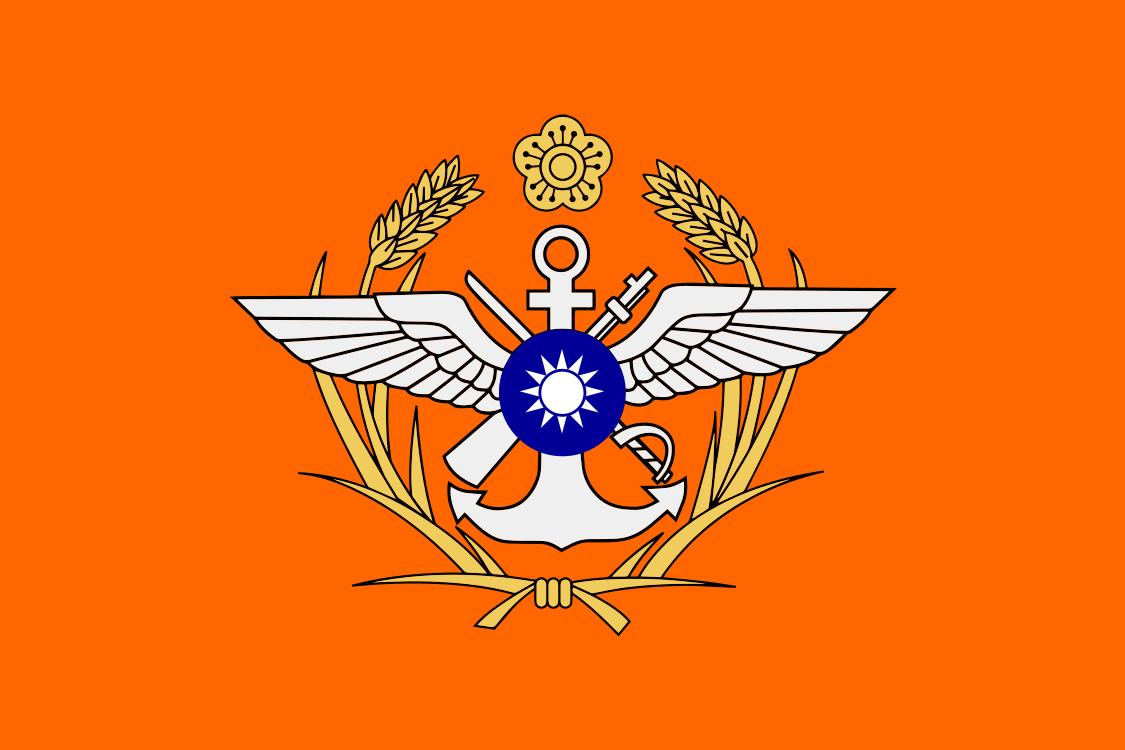
- Institutional emblem · official
- State affiliation · Taiwan
- Vigil category device · not official insignia
Identity provenance
Institutional emblem: Flag of the Ministry of National Defense — the ministry these forces sit under. THE MINISTRY'S FLAG, NOT THE ARMED FORCES' OWN, and the label says so: the Republic of China Armed Forces are under civilian control through the Ministry of National Defense, and the ministry's flag is the institutional identity the whole structure sits beneath. The services that have flags of their own author them and override this; the ones that do not inherit it, which is the correct reading of what they are. WHAT CHANGED THE EARLIER REFUSAL. The Taiwan pass refused every ROC mark on the SYMBOL test — the ROC Copyright Act names no exclusion for military symbols, so no supplied file could clear. That reasoning was about the FILE'S LICENCE and was applied to a question it does not reach: this Commons file is tagged PUBLIC DOMAIN in its own right, with the ROC Ministry of National Defence recorded as the author of the original, so there is no licence to satisfy and no attribution or share-alike obligation attaches. FILE: Wikimedia Commons "ROC Ministry of National Defense Flag.svg", public domain. Optimised for web display — editor metadata removed and coordinate precision reduced to two decimals on a 1000-unit canvas; no path, colour, proportion or viewBox altered.
State affiliation: Taiwan.
The smaller square mark is a Vigil category device, drawn from this record’s own domain, echelon and role — not an official insignia.
In brief
Taiwan's armed forces — army, navy, air force and mobilisation organisation — under civilian control through the Ministry of National Defense and an elected president.
- Scope
- Structure, role, lineage and links. 5 subordinate records published.
- Subordination
- Subordination confirmed
- Sources
- 4 on the record
- Record state
- Full
- Broad area of activity
- Taiwan and its administered island groups
- Notable history
- Descended from the Nationalist forces that withdrew to Taiwan in 1949, the armed forces spent the Cold War as a large conscript military oriented toward the offshore-island crises and, nominally, the recovery of the mainland. Democratisation from 1987 brought them under civilian parliamentary control and progressively out of party politics. Since the 1990s the mission has narrowed to defence of the island, and since roughly 2017 planning has shifted — unevenly and with internal disagreement — toward asymmetric concepts emphasising survivability and denial over like-for-like matching of a much larger opponent. Conscription, reduced to four months in the 2010s, was restored to one year from 2024.
- Strengths
- Operates under stable civilian democratic control with a professional officer corps and long-standing training relationships with the United States. Defends known terrain with interior lines and a mountainous interior. Has substantial layered air and missile defence and an increasingly indigenous defence-industrial base, with domestic programmes in air defence, anti-ship missiles and submarines.
- Limitations
- Faces an opponent of far greater size and industrial depth. Recruitment and retention are persistent problems, reserve training quality is widely criticised by Taiwanese and outside analysts alike, and procurement depends on a single foreign supplier whose delivery timelines and political reliability are both currently uncertain. The internal debate between asymmetric capability and conventional prestige platforms remains unresolved, and budgets pass through a legislature the executive does not control.
Subordinate formations
 ROC ArmyBranchROC NavyBranch
 ROC Air ForceBranchAll-out Defense Mobilization AgencyBranchROC Information, Communications and Electronic Force CommandBranch
Rows are layout only — position and order carry no hierarchy, importance, sequence or strength. Every record shown is an immediate subordinate of the selected organisation.
Documented equipment
Related organisations
- Taiwan Coast Guard Administration Institutionally linked to · as of 2026-08 · high confidence
Separate civilian agency under the Ocean Affairs Council; transfers to defence command only under specified wartime conditions. The two services ran their first joint anti-blockade exercise on 12 August 2026 inside Han Kuang 42, escorting a simulated merchant vessel to east-coast ports — the first observable test of that transition. The arrangement is exercised, not established.
- US Indo-Pacific Command Externally supported by · high confidence
Training, doctrine and procurement relationship conducted unofficially under the Taiwan Relations Act framework.
Denial rather than defeat: make a rapid outcome unavailable, survive the opening period, and impose costs disproportionate to what the systems imposing them cost. The concept is published; how far procurement has followed it is the unresolved argument.
Published documents
- Quadrennial Defense Review Ministry of National Defense, Republic of China (Taiwan) · 2025
The four-yearly statement of defence strategy and force planning the published denial concept is set out in.
- National Defense Report Ministry of National Defense, Republic of China (Taiwan) · 2025
The biennial public report on the force, its posture and its modernisation programmes.
Preferred operating methods
Denial rather than defeat. Taiwan's published defence concept is built on the proposition that it does not need to win a conventional engagement, only to make a quick result unavailable — layered coastal and air defence, large numbers of cheap precision systems, dispersal and hardening, and a reserve system able to generate manpower after the opening period. The corollary is asymmetry: value systems by cost imposed per unit spent rather than by capability per platform. Alongside it sits a second, older strand that the published documents also carry — conventional platforms that perform peacetime presence, intercept routine activity and signal normality, which the asymmetric concept does not do. The two coexist in doctrine and compete in procurement, and that competition is a public argument rather than a resolved position.
A broad generalisation about how this organisation operates, graded as an assessment — not a description of current tactics, and deliberately carrying no capability or effectiveness score.
Command style
Conventional joint structure under the Ministry of National Defense, with civilian oversight through a legislature that has been opposition-held since 2024 and scrutinises procurement closely. Reserve mobilisation was reorganised under a dedicated agency, separating force generation from operational command — a structural change whose effects are not yet demonstrable.
Where this generalisation breaks down
The generalisation fails in three ways. First, published doctrine and procurement do not match: conventional platforms continue to be acquired for reasons that are partly political and partly about peacetime presence, and describing Taiwan's approach as simply "asymmetric" overstates a settled position that does not exist. Second, denial doctrine assumes the opening period is survivable, and that assumption is untested — the module publishes no assessment of it. Third, the doctrine is written for a contingency; the force's actual daily task is intercepting routine activity and responding to natural disasters, which is a different set of demands and consumes real capacity.
Observed adaptations
Conscription extended from four months to one year, effective 2024, reversing two decades of reduction and accepting a real domestic political cost.
Increased emphasis on uncrewed and precision systems, with the war in Ukraine widely cited in Taiwan's own public debate as evidence for the asymmetric case.
Extension of civil-defence structures built for typhoons and earthquakes toward broader contingency preparedness, using arrangements that already exist and are exercised annually.
What remains unknown
- Readiness, stockpile levels and unit manning are not published by this module and are not the basis of any claim here.
- Whether procurement is converging on the published concept is contested among Taiwan's own analysts and among its partners.
- Reserve system effectiveness after the conscription change has not been independently assessed.
Campaigns
Campaigns naming this organisation as a participant. The campaign record owns the relationship and grades it; this list is computed.
- The declared unification framework Affected party · Declared plan · high confidence · as of 2026-06
- Defence reform and civil resilience programme Primary force · Since 2022 · high confidence · as of 2026-06
- The Cold War strait crises Opposing force · 1954 – 1996 · high confidence · as of 1996
Key events
A separate drone budget is proposed, rejected and replaced by a funding principle
Taiwan's Cabinet proposes a standalone special budget of NT$210bn — about US$6.6bn over six years — for domestically produced uncrewed systems on 18 June 2026, covering reported procurement of 1,446 coastal reconnaissance drones, 208,200 coastal attack drones and 1,320 uncrewed surface vessels. The bill exists because the Legislative Yuan had removed approximately NT$470bn of domestic uncrewed-systems funding from the NT$1.25tn special defence package in May, cutting it to NT$780bn while leaving NT$300bn and NT$480bn allocated to two tranches of foreign procurement. Opposition parties, holding a combined majority, voted on 26 June to delay review; committee review concluded on 27 July without agreement. On 27 August the legislature rejected the Cabinet's special act and passed the opposition parties' own Act on Strengthening Defense Autonomy and Developing the Unmanned Vehicles Industry, which sets NT$240bn over six years, NT$40bn a year, as a funding principle to be met through annual budgets rather than a special budget. The defence ministry expressed regret the same day, and the defence minister said the NT$40bn annual figure is below the NT$42.1bn the ministry had planned for drones in the following year alone. President Lai Ching-te promulgated the act on 11 September; the Executive Yuan states that it retains its constitutional authority over budget allocation. The act appropriates nothing: funding reaches a programme only through an enacted annual or supplementary budget.
Two navies rehearse the eastern approaches on the same morning
On 12 August 2026 Taiwan's navy and coast guard conducted their first joint anti-blockade exercise, escorting a simulated merchant vessel — a Yushan-class landing platform dock standing in for the merchantman — through waters off the east coast to Hualien and Suao, where the cargo was offloaded and moved inland. A minesweeper cleared and marked the channel. The Coast Guard Administration described the purpose as cross-agency coordinated response and maritime defence resilience; it was the first time the administration had run an anti-blockade drill with the navy. On the same morning, between roughly 06:30 and 09:30, the PLA Navy Type 054A frigate Honghe and the Indonesian navy frigate KRI I Gusti Ngurah Rai conducted a joint exercise in waters east of Taiwan covering formation manoeuvring, maritime communications and replenishment at sea. It was the first exercise China has conducted with a foreign navy in those waters and the first it has publicly announced there. Taiwan's Mainland Affairs Council condemned the announcement as an infringement of sovereignty and a threat to regional security, and Taipei asked Jakarta to explain its participation; Indonesia said the exercise was not threatening. The US State Department urged Beijing to stop military pressure on Taiwan. Chinese presence east of the island has grown since Beijing began what it calls law-enforcement patrols there in June 2026.
Han Kuang 42 closes after ten days
Taiwan's 42nd Han Kuang exercise concluded on 14 August 2026 at Bo'ai Camp in Taipei, ten days after it began on 5 August, with the chief of the general staff, service chiefs and regional commanders present. Defence Minister Wellington Koo said the exercise had run with fully operational command centres at every level for the first time and had continued the unscripted format, with units responding to developing orders rather than a rehearsed sequence; he praised participating troops and told officers to address the problems the exercise had identified. Reporting describes it as Taiwan's largest military exercise since 1984, mobilising more than 20,000 reservists. Its components across the ten days included the two mobile-network throttling windows recorded separately here, dispersal of weapons production and mobilisation of civilian manufacturing, urban resilience training run inside the military exercise, and the first joint navy–coast guard anti-blockade drill. China's defence ministry issued its first official comment on the exercise on its final day, spokesperson Chen Xi calling it a posturing, wasteful charade and accusing the governing party of stoking war panic.
Taiwan runs a cross-service kill chain at Jiupeng, on a range, with no degradation described
Taiwan's armed forces held the 2026 tri-service joint precision missile firing at the Jiupeng range in Pingtung county from 16 to 18 September 2026; President Lai Ching-te inspected the final day. The Ministry of National Defense's news agency reported on 19 September that the firing followed kill-chain procedure — search, target acquisition, identification, target allocation and attack — using shipborne radar, Air Force air control, mobile radar vehicles and drones, joined through command-and-control nodes and a TAK battlefield-awareness interface to missiles and attack drones across services and platforms, and that firing units moved from force-preservation positions to fire and relocated afterwards. Its captions record Patriot, Tien Kung III and vehicle-mounted Sky Sword I fired by Air Force air-defence units, land-based Sky Sword II and HIMARS by the Army, Hsiung Feng III by the Navy's littoral combat command and by a coast guard cutter, Hsiung Feng II and Standard SM-1 from Navy ships, and MICA from a Mirage 2000. The president's office said multiple types of attack drone took part in a joint combat exercise for the first time. On the exercise's second day, 17 September, the ministry reported a PLA joint combat readiness patrol of nineteen sorties, fifteen across the median line, with a Y-8 electronic-jamming aircraft among the types named; it drew no connection to the exercise and this record draws none. The ministry's daily report published on 18 September, covering the twenty-four hours to 06:00 that morning and so the patrol, counted 28 sorties, 24 across the median line, with seven navy and two official vessels.
Campaign involvement
Taiwan's cabinet proposes the first defence budget above NT$1 trillion
Taiwan's Executive Yuan approved a central government budget proposal for 2027 on 20 August 2026 totalling NT$3.9266 trillion, of which NT$1.1225 trillion is for national defence — the first time the figure has exceeded NT$1 trillion, equivalent to about US$35.1 billion and to 3.01 per cent of projected GDP. The figure combines the regular defence budget with the special budgets used to fund major procurement, and stands roughly 18 per cent above the NT$949.5 billion budgeted for 2026. President Lai Ching-te described defence investment as an investment in peace and stability across the strait and has set a target of 5 per cent of GDP by 2030. The proposal was to be sent to the Legislative Yuan for review by the end of the month. Separately, a proposed NT$210 billion drone procurement bill remains unresolved in the legislature, and an official audit has reported technical shortcomings in counter-drone development.
Quick actions
System access
Where this record connects into the rest of Vigil. Each row is here because this organisation actually reaches it.
Assessed as of — 2026-09 Last reviewed — 2026-09-09
See this force in the structure Interactive: select this record and follow what connects to it.