
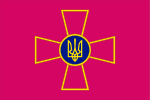
- Service ensign · official
- State affiliation · Ukraine
- Vigil category device · not official insignia
Identity provenance
Service ensign: Ensign of the Armed Forces of Ukraine. The ensign of the Armed Forces of Ukraine. The design itself is excluded from copyright by Article 8 of Ukraine’s Law on Copyright and Related Rights, which names symbols and signs of government authorities, the Armed Forces of Ukraine and other military formations. The file shipped is the Wikimedia Commons SVG "Ensign of the Ukrainian Armed Forces.svg", released under PD-UA-exempt on that basis, so no attribution or share-alike obligation attaches. Optimised for web display; geometry unaltered.
State affiliation: Ukraine.
The smaller square mark is a Vigil category device, drawn from this record’s own domain, echelon and role — not an official insignia.
In brief
The unified military of the Ukrainian state — ground, air-assault, air, naval, marine, special-operations, unmanned and support branches under the General Staff. Expanded from its pre-2022 professional core into one of Europe's largest wartime militaries; this atlas records its structure at branch and formation level only.
- Scope
- Structure, role, lineage and links. 11 subordinate records published.
- Subordination
- Subordination confirmed
- Sources
- 5 on the record
- Record state
- Full
- Broad area of activity
- The full depth of unoccupied Ukraine and the contested areas beyond it — a front measured in hundreds of kilometres, a rear under continuous missile and drone attack, and a maritime and deep-strike reach that extends well past the ground fighting.
- Notable history
- Twice rebuilt in a decade. The force that lost Crimea in 2014 was hollow: a conscript army run down through twenty years of underfunding, in which only a small fraction of nominal strength was deployable. What followed was eight years of reconstruction shaped by the Donbas fighting, NATO training programmes and a professionalising non-commissioned officer corps — the reason the February 2022 invasion met an army rather than a collapse. The second rebuild has been the war itself: a small professional core expanded by mass volunteering and then by mobilisation into one of the largest militaries in Europe, absorbing casualties, cycling formations through regeneration, and adding whole branches that did not exist before — an unmanned systems service stood up in 2024 among them. The most consistent feature across both rebuilds is that structural change has followed battlefield necessity rather than plan.
- Strengths
- Institutional adaptation faster than any comparable force, most visibly in unmanned systems, where new units, new procurement routes and new tactics have repeatedly gone from field improvisation to formal structure within months. Deep combat experience across every branch. Integration of a mixed inventory — Soviet-era, Western and domestically produced — into functioning formations, which is harder than fielding any one of them. Motivation grounded in national survival rather than in policy.
- Limitations
- Manpower is the binding constraint, and it binds at recruitment, training throughput and unit regeneration rather than at any single headline number. Dependence on external supply for the categories it cannot make in quantity — above all guided air-defence interceptors — leaves capability hostage to political decisions taken elsewhere. Experienced cadres lost early are not quickly replaced. Quality varies substantially between formations, and the spread has widened as the war has continued.
Subordinate formations
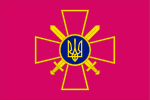 Ground ForcesBranch
 Air Assault ForcesBranch
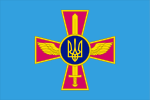 Air ForceBranchNavyBranch
 Marine CorpsBranch
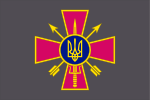 Special Operations ForcesBranchUnmanned Systems ForcesBranchTerritorial Defence ForcesBranchSupport ForcesBranchLogistics ForcesBranchMedical ForcesBranch
Rows are layout only — position and order carry no hierarchy, importance, sequence or strength. Every record shown is an immediate subordinate of the selected organisation.
Sustainment
The supply and industrial records this force depends on, in the record's own words. A dependency, never a route, a capacity or a stock.
- Western assistance corridors Logistics · Documented
Partner-supplied equipment, ammunition and fuel reach the force through the western corridors the record describes.
- Defence industry System · Assessed by Vigil
Domestic production of drones, artillery and munitions alongside partner supply.
Hold what cannot be given up, make everything else expensive, and let new capability enter service before the institution has decided where it belongs. The force fights an attritional defensive war with an unusually short distance between improvisation and doctrine.
Preferred operating methods
Hold what cannot be given up, make everything else expensive. The operating pattern since 2023 is a defence in depth built around drone-enforced denial of the approaches, prepared positions, and artillery and strike used to make the assembly of an assault costly before it begins. Ground is traded deliberately where holding it would cost more than it is worth, and defended past the point of proportion where its loss would be political — a tension the force has not resolved and has paid for at Bakhmut and elsewhere. Offensive action since the 2023 counteroffensive has been mostly local and shaping rather than operational. Alongside this runs a second campaign the ground war does not contain: long-range strike against the systems that fund and supply the Russian army, conducted largely by domestically produced weapons precisely because their use carries no external permission.
A broad generalisation about how this organisation operates, graded as an assessment — not a description of current tactics, and deliberately carrying no capability or effectiveness score.
Command style
More devolved than its Soviet inheritance and less devolved than its partners' doctrine assumes. NATO training and the professionalisation of the NCO corps pushed real authority downward, and drone units in particular operate on decision loops far shorter than the formal chain allows. But senior command has remained centralised and politically supervised, and the friction between the two — visible in the public disputes over the 2023 offensive and in the command changes since — is a recurring feature rather than an episode.
Where this generalisation breaks down
The generalisation fails in three ways. First, it describes the force from mid-2023 onward and not the force of 2022, which fought a mobile defensive campaign and then two successful counteroffensives — the opposite of the pattern described here. Second, "the force" is doing a great deal of work in these sentences: the spread between the best assault and drone formations and the weakest infantry brigades is wide enough that a single doctrinal description misrepresents both ends of it. Third, this record describes structure and observed practice, not effectiveness; nothing here should be read as a comparative assessment against the opposing force.
Observed adaptations
Formation of a dedicated Unmanned Systems Forces branch in 2024, making Ukraine the first state to give unmanned systems a service of their own rather than distributing them among existing branches.
Integration of Western air-defence systems with legacy Soviet ones into a single layered network, including publicly documented ballistic-missile intercepts — an integration task no other force has had to perform under fire.
A domestic long-range strike capability built to escape the political conditionality attached to supplied missiles, which changed what the force could reach without asking.
Recruitment authority devolved to selected formations, allowing units to raise their own replacements rather than receive them through the central system — an admission that the general pipeline was failing at the unit-integration stage.
What remains unknown
- Ukrainian force strengths, dispositions and casualty figures are not published and are treated as instruments by both sides. This record makes no claim about any of them.
- Command relationships during operations differ from the peacetime structure recorded in this atlas, and wartime groupings are not published.
- Variation in quality and equipment between formations is widely reported anecdotally and cannot be assessed systematically from open sources.
Campaigns
Campaigns naming this organisation as a participant. The campaign record owns the relationship and grades it; this list is computed.
- The Ukrainian counteroffensives, 2022–2023 Primary force · September 2022 – November 2023 · high confidence · as of 2023-11
- The eastern attritional campaign Opposing force · Since April 2022 · high confidence · as of 2026-06
- Force generation and mobilisation Primary force · Since February 2022 · high confidence · as of 2026-06
- The February 2022 invasion and the failure at Kyiv Opposing force · February – April 2022 · high confidence · as of 2022-04
Key events
Ukraine appoints Mykhailo Drapatyi as commander-in-chief
President Zelensky dismissed Oleksandr Syrskyi and named Mykhailo Drapatyi Commander-in-Chief of the Armed Forces of Ukraine on 21 July 2026; Major General Ihor Skybiuk was named chief of the General Staff the following day. The command change followed a wider government reshuffle — the dismissal of the prime minister and of reformist defence minister Mykhailo Fedorov — and six days of protests in Kyiv.
Campaign involvement
A defence minister is confirmed, his predecessor calls for elections, and investigators reach the presidential office
Ukraine's parliament confirmed Maj. Gen. Yevhenii Khmara as defence minister on 19 August 2026 by 312 votes, filling the post he had held in an acting capacity since 17 July after the dismissal of Mykhailo Fedorov. Khmara had previously served as acting head of the Security Service of Ukraine from January 2026. Hours before the vote, Fedorov — whose removal in July had drawn six days of protests — released a video calling for wartime elections and warning of a governance crisis. On the same day President Zelensky dismissed Iryna Mudra as deputy head of the Office of the President, as the National Anti-Corruption Bureau and the Specialised Anti-Corruption Prosecutor's Office conducted searches at her residence within an operation they described as targeting a criminal organisation led by a current and a former member of parliament and involving senior officials in the presidential office. Investigators have not named Mudra as a suspect, and neither she nor the President's Office commented on the dismissal.
Quick actions
System access
Where this record connects into the rest of Vigil. Each row is here because this organisation actually reaches it.
Assessed as of — 2026-08 Last reviewed — 2026-08-26
See this force in the structure Interactive: select this record and follow what connects to it.