
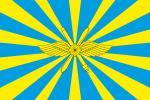
- Service ensign · official · carried by Aerospace Forces (VKS)
- State affiliation · Russia
- Vigil category device · not official insignia
Identity provenance
Service ensign: Flag of the Russian Aerospace Forces (VKS) — carried by Aerospace Forces (VKS), not issued to this record. The service flag of the Aerospace Forces, adopted 2015 when the VKS was formed. The design itself is not an object of copyright: Article 1259(6) of the Civil Code of the Russian Federation excludes official symbols and signs. The file shipped is the Wikimedia Commons SVG "Flag of the Russian Aerospace Forces.svg", released under PD-RU-exempt on that basis, so no attribution or share-alike obligation attaches. Optimised for web display; geometry unaltered.
State affiliation: Russia.
The smaller square mark is a Vigil category device, drawn from this record’s own domain, echelon and role — not an official insignia.
In brief
The ground-based air- and missile-defence component of the Aerospace Forces, layered from point defence to strategic systems.
- Scope
- Structure, role, lineage and links. No subordinate records published.
- Subordination
- Subordination confirmed
- Sources
- 5 on the record
- Record state
- Partial
- Broad area of activity
- Russian territory, organised in air-defence divisions and brigades under the VKS's armies; the field air defence of the ground forces is a separate arm and is not this record. Nothing about sites, coverage or readiness is authored.
- Notable history
- Formed in the 2015 merger that created the Aerospace Forces, inheriting the Soviet-era air-defence districts' mission of defending the state's territory — the capital's missile-defence system, the strategic S-400 regiments, and the layered point defences below them — as distinct from the ground forces' own air defence, which moves with the armies. The war reversed its problem: built to stop bombers and cruise missiles, it has faced since 2023 a campaign of long-range drones in numbers, reaching Engels, Ryazan, Saratov, the Volga refineries and, in August 2026, Nizhnekamsk, the deepest strike of the war. Public Russian accounts and the strike results the module records both describe a system stretched across more territory than it can cover, and the refining constraint the Watch question tracks is one consequence.
- Strengths
- The world's largest inventory of long-range surface-to-air systems, a layered architecture, and a domestic industry that produces the systems.
- Limitations
- Coverage of a territory the size of Russia against a cheap, numerous threat the architecture was not built for; the deep-strike record is the evidence. Nothing about sites, unit locations or interception rates is authored.
Lineage & institutional history
Quick actions
System access
Where this record connects into the rest of Vigil. Each row is here because this organisation actually reaches it.
Assessed as of — 2026-07 Last reviewed — 2026-09-14
See this force in the structure Interactive: select this record and follow what connects to it.