
提供背景,而非指引目標。本圖譜描述結構與歷史。它刻意排除當前位置、即時兵力、部隊調動以及任何作戰敏感內容——內容模型中根本沒有這些欄位。分支的深度反映的是能從公開來源確立的內容,而非一支部隊的規模、能力或重要性:分支單薄意味著該國公開的資訊很少,而紀錄數量從來不是衡量實力的標準。
更多篩選條件
已檢視的概況178份,共185筆紀錄
178筆檢視中。另有7筆紀錄為結構性簡略條目。信心、隸屬關係與來源均載於各紀錄中。
盟軍作戰司令部
司令部北約的作戰戰略司令部,設於蒙斯的SHAPE。聯盟在作戰上所做的一切都由此指揮。
盟軍空軍司令部
司令部該空軍組成司令部,北約表示其負責監督北約防空任務——即空中警戒任務於2026年轉變而成的任務——透過三個聯合空中作戰中心提供24/7的指揮與管制(第三個自2025年10月起設於Bodø),並設有一個可部署空中指揮管制中心。
Bodø聯合空中作戰中心
司令部The newest of Allied Air Command's three combined air operations centres, opened in October 2025, which NATO says covers airspace across the Nordic region and the Arctic — the one that matters most to this theatre's northern half.
盟軍布倫森聯合部隊司令部
司令部One of three operational-level joint force commands, and the one NATO's Military Committee described in May 2026 as the leading command for Eastern Sentry and Baltic Sentry. NATO publishes no mapping of joint force commands to regional defence plans, and none is inferred here.
盟軍拿坡里聯合部隊司令部
司令部The southern of the three operational-level joint force commands, at Lago Patria near Naples. Both Romanian-hosted NATO Force Structure headquarters place it above them on their own published charts, and NATO named it the operational-control authority for the Bucharest division at its 2015 activation.
盟軍諾福克聯合部隊司令部
司令部The alliance's operational headquarters in North America, decided in 2018, established in 2019 and fully operational from July 2021 — and the one joint force command that publishes its own area of responsibility.
盟軍聯合支援與賦能司令部
司令部The enabling command at Ulm, decided in 2018 and fully operational from September 2021, responsible for the rear area and for the movement of forces across Europe.
盟軍陸上司令部
司令部The land component command of Allied Command Operations, at Izmir. NATO describes it as the provider of deployable land command and control and the alliance's principal land adviser; its seat sits outside this theatre's geography while the land headquarters it works with sit inside it.
盟軍海上司令部
司令部The maritime component command of Allied Command Operations, at Northwood. It plans and conducts joint maritime operations and publishes the four standing naval forces as under its control and continuously available; the NATO Shipping Centre is part of it.
北約第一常設海上大隊
多國機構One of NATO’s four standing naval forces, published by Allied Maritime Command as under its control and continuously available. Founded as the Standing Naval Force Atlantic and renamed in 2005; the German Navy describes its normal waters as the North Atlantic, North Sea and Baltic. No composition, rotation or position is recorded.
北約第二常設海上大隊
多國機構The second of NATO’s two standing surface groups, published by Allied Maritime Command as under its control and continuously available. Formed in 1992 as the Standing Naval Force Mediterranean and renamed in 2005; the German Navy describes its normal waters as the Mediterranean. No composition, rotation or position is recorded.
北約第一常設反水雷大隊
多國機構One of NATO’s two standing mine countermeasures groups, published by Allied Maritime Command as under its control and continuously available. Established in 1973 as the Standing Naval Force Channel and renamed in 2005; the Norwegian Armed Forces describe its work as clearing historic mines and patrolling northern European waters. Mine countermeasures is the capability nearest the seabed-infrastructure question this module tracks, which is why the group is authored rather than deferred.
北約第二常設反水雷大隊
多國機構The second of NATO’s two standing mine countermeasures groups, published by Allied Maritime Command as under its control and continuously available. Activated in 1999 and given its present name in 2005; the German Navy describes its normal waters as the Mediterranean. No vessel, contributing state or area assignment is recorded.
北約空中預警管制部隊
司令部The alliance's own airborne early-warning force at Geilenkirchen — one of the few military capabilities NATO owns and operates itself rather than borrowing from members. Its commander reports to SACEUR and NATO lists it under Allied Command Operations.
北約情報、監視與偵察部隊
司令部The alliance's own ISR force at Sigonella, activated in 2015 as the NATO Alliance Ground Surveillance Force and re-designated in September 2023 to reflect an analytic role beyond ground surveillance. NATO lists it under Allied Command Operations.
北約海軍打擊與支援部隊
司令部A multinational maritime headquarters at Lisbon, listed by NATO under Allied Command Operations beside the early-warning and ISR forces. NATO's structure page says it was relocated from Italy to Portugal and has thirteen participating countries.
盟軍轉型司令部
司令部The alliance's second strategic command, at Norfolk, Virginia, responsible for transformation, training, doctrine and lessons learned. NATO lists four centres under it, three of them in Europe and two of those inside this theatre.
A joint NATO–Ukraine centre at Bydgoszcz, inaugurated on 17 February 2025 under Allied Command Transformation to draw lessons from the war and to support Ukrainian interoperability. NATO's structure page lists it as the fourth centre under the transformation command.
聯合部隊訓練中心
中心Allied Command Transformation's tactical-level joint training centre at Bydgoszcz in Poland — one of the few alliance bodies physically seated inside this theatre, and by its own account the first NATO command-structure body established in central and eastern Europe.
聯合作戰中心
中心Allied Command Transformation's operational-level training and warfare centre at Stavanger in Norway, which NATO says trains allied forces at the operational level and works on doctrine and experimentation.
A multinational corps headquarters at Szczecin, formed in 1999 by Denmark, Germany and Poland and part of the NATO Force Structure. NATO says it "covers" the battlegroups in Estonia, Latvia, Lithuania and Poland, and on 30 June 2026 its responsibility for Estonia and Latvia passed to the German–Netherlands corps.
A multinational divisional headquarters at Elbląg, formed in 2017 as the first division-level headquarters under the Szczecin corps. NATO says it "works closely with" the battlegroups in Poland and Lithuania.
A divisional headquarters inaugurated at Ādaži in March 2019 by Denmark, Estonia and Latvia, with forward elements in Latvia and the rest at Karup in Denmark. NATO says it "cooperates closely with" the battlegroups in Estonia and Latvia.
A divisional headquarters at Székesfehérvár, run by Hungary with Croatia and Slovakia and declared fully operational by NATO on 10 February 2025. NATO says it "has responsibility for" the battlegroups in Hungary and Slovakia.
A multinational corps headquarters at Sibiu, formed in 2020 as the second NATO Force Structure corps on the eastern flank. NATO says it "covers" the battlegroups in Bulgaria and Romania with the Bucharest division, and its own chart places SHAPE, JFC Naples and LANDCOM above it.
A divisional headquarters at Bucharest, activated by NATO on 1 December 2015 with Romania as framework nation. NATO says it covers the Bulgarian and Romanian battlegroups with the Sibiu corps, and its own chart places SHAPE, JFC Naples, LANDCOM and that corps above it.
西北多軍級陸上部隊司令部
司令部A NATO land component command at Mikkeli in Finland, operational since 1 September 2025 and inaugurated on 3 October 2025. NATO calls it "the lead command for" the battlegroup in Finland — the only one of the seven headquarters on its page described that way.
A bi-national corps headquarters at Münster, describing itself as a NATO High Readiness Forces Headquarters assigned to NATO and the EU. It took responsibility for Estonia and Latvia on 30 June 2026, and in August 2026 Estonia, Latvia, Denmark and Canada formally joined it.
北約部隊整合單位
多國機構The small allied headquarters established from 2015 under the 2014 Readiness Action Plan to coordinate the reception and integration of allied forces in a host state, support collective-defence planning and assist with exercises. The Slovak defence ministry, which hosts one, states they are part of the NATO Force Structure and not a military base. How many exist in 2026, and where, is not publicly enumerated.
由英國主導、法國參與的Tapa戰鬥群。北約2026年6月17日的頁面未指明其愛沙尼亞東道部隊,因此不採用任何東道旅的說法:對該說法較早的一種解讀未能通過P4.5。
由加拿大主導的部隊,於2024年7月以「北約拉脫維亞多國旅」的名稱成立,當時拉脫維亞成為第一個將其前沿駐軍擴大至旅級規模的東道國。北約2026年6月的頁面仍將九個部隊不論規模一律稱為「多國戰鬥群」,因此名稱與規模被記錄為兩項各自獨立的事實。
由德國主導的部隊。北約曾將德國在立陶宛的駐軍描述為一座永久軍事基地——這是此戰區中唯一被如此描述的駐軍。
由美國主導的戰鬥群。它有別於美國–波蘭雙邊防務協議,也有別於輪調的裝甲旅,兩者都是獨立的安排。
由西班牙主導的戰鬥群。西班牙於2024年7月1日從捷克手中接下框架國角色,因此這段關係比該部署更年輕。
九個部隊中唯一一個框架國同時也是東道國的。因此不存在可供記錄的雙邊東道與框架關係,本模組也不會虛構這樣一段關係。
由法國主導的戰鬥群,由法國以Mission Aigle的名義運作。北約2026年6月的頁面將其描述為戰鬥群層級,儘管其他地方有旅級的描述。
位於黑海側翼、由義大利主導的戰鬥群。
第九支也是最新的部隊,由瑞典擔任框架國領導。其總部駐地羅瓦涅米由瑞典武裝部隊公布;北約未公布其駐地、衛戍地或主導單位,本頁也不從框架關係或地理位置加以推斷。
芬蘭國防軍
國家軍隊The armed forces of the state with the alliance’s longest land border with Russia and its deepest mobilisation system. The defence forces publish the Defence Command, the three services, the Logistics Command and the Army’s eight brigade-level units in English; the wartime structure that the conscript system feeds is not published, and this tree ends where the publication does.
芬蘭空軍
軍種The air service responsible for Finland’s air defence and air operations. It publishes an Air Force Command, three air wings and an academy by name in English; the wings are not authored here because the Atlas refuses basing-level records, and nothing below wing is published.
芬蘭陸軍
軍種The land service, whose eight brigade-level units the Army publishes by name in English with their roles and garrisons. Seven are authored here; the Army Academy is a school and is not. Nothing below brigade is published, and nothing below brigade is carried.
裝甲旅
旅The Army’s armoured training brigade, published on maavoimat.fi with a seat at Parolannummi in Tavastia Proper and a stated specialisation in armoured troops, logistics, ground-based air defence and electronic warfare.
The Army’s brigade-level unit for the capital, published on maavoimat.fi as training troops specialised in urban warfare to defend Helsinki and the Uusimaa region, with its published seat in Helsinki.
獵兵旅
旅The Army’s northernmost brigade-level unit, published on maavoimat.fi as specialised in arctic training and ground-based air defence, with its published seat at Sodankylä in Lapland.
A brigade-level unit published on maavoimat.fi with a seat at Kajaani, which states that it maintains readiness in its area of responsibility and is responsible for one third of the Finnish terrain.
A brigade-level unit published on maavoimat.fi with a seat at Vekaranjärvi near Kouvola in south-eastern Finland, which states that it maintains readiness and immediate operational capability and produces troops for the defence forces.
A brigade-level unit in western Finland, published on maavoimat.fi as training conscripts at two seats, Säkylä and Niinisalo, and preparing voluntary reservists for crisis-management deployments.
The Army’s special forces and helicopter unit, published on maavoimat.fi as home to the special forces and the helicopter operations of the defence forces, with its published seat at Utti near Kouvola.
The joint logistics command, published by the defence forces directly under the Commander alongside the three services. Its own site names a headquarters, three logistics regiments, a Joint Systems Centre, an Explosives Centre, a Centre for Military Medicine, a Logistics School and a Codification Centre; none of them is authored below this record.
芬蘭海軍
軍種The naval service, operating in the Gulf of Finland and the northern Baltic under three statutory tasks. It publishes a Navy Command, a Coastal Fleet, two coastal brigades and an academy by name in English; those formations are unauthored pending a deliberate pass, and nothing below them is published.
芬蘭邊防衛隊
內部安全部隊The border service under the Ministry of the Interior, which states that it is part of the national defence system and participates in NATO’s collective defence. It publishes eight administrative units by name; the mechanism by which its border troops attach to the Defence Forces is not set out on the English site.
瑞典武裝部隊
國家軍隊位於波羅的海中央地帶的武裝部隊。其組織頁面公布的是單位類別——團、聯隊、支隊、中心與學校——且無論以哪種語言都沒有列出任何一個單位的名稱。此樹狀結構之所以只有五筆紀錄,正是出於這個原因,別無其他。
瑞典空軍
軍種The air service, which the armed forces describe as protecting Swedish airspace from violations around the clock and preparing its units for operations beyond Sweden’s borders. No wing is named on the armed forces’ organisation pages, and this record is childless for that reason.
瑞典陸軍
軍種The land service, which the armed forces describe in one sentence as the force that provides defence on the ground when threats affect Sweden. No regiment or brigade is named on the armed forces’ organisation pages, and this record is childless for that reason.
Hemvärnet
內部安全部隊The Home Guard, the territorial component of the Swedish Armed Forces, which the armed forces describe as the national and territorial base for the defence of Sweden, organised in battalions under the military regions. No battalion or training group is authored here.
瑞典海軍
軍種The naval service, which the armed forces describe as securing Sweden’s waters and coasts through the constant readiness of naval flotillas, above and below the surface. No flotilla is named on the armed forces’ organisation pages, and this record is childless for that reason.
挪威武裝部隊
國家軍隊The armed forces of the High North, a founding member’s military whose own organisation page names four services, two further branches and a set of joint organisations including the Joint Headquarters at Reitan. The organisation page names no brigade; the Army’s own sub-pages now do, and that finding is recorded below rather than authored.
The Norwegian Cyber Defence, published as the armed forces’ organisation for establishing, operating and protecting their information and communications systems, in five published divisions with its main seats at Jørstadmoen, Kolsås and Eggemoen. None of the divisions is authored.
The Norwegian Defence Logistics Organisation, published as the armed forces’ provider of storage, transport and distribution, with a central staff, three regional logistics regiments and a national logistics operations centre that holds the alliance role of Norway’s joint logistics support group. None of them is authored below this record.
The Norwegian Joint Headquarters, which the armed forces state holds overall command and control of all military activity in Norway and of Norwegian personnel abroad, seated at Reitan east of Bodø. The one national joint command in this module that publishes its own surveillance and total-defence roles.
Hæren
軍種The Norwegian Army, whose task the armed forces state as securing Norway’s sovereignty on land. The armed forces’ organisation page names no brigade; the Army’s own units page names Brigade Nord, Finnmarksbrigaden and a planned Brigade Sør, none of which is authored here yet.
The Norwegian Home Guard, published as a branch in its own right and described by the armed forces as a vital part of the military first line of defence, organised in eleven nationwide districts with rapid-reaction forces. The districts are not authored.
The Norwegian Air Force, which the armed forces describe as monitoring, controlling and asserting sovereignty in Norwegian airspace and holding the national quick-reaction alert. It publishes its air wings by station and its main aircraft types; the wings are basing records and are not authored.
The Norwegian Navy, published as two arms — the Navy proper (Marinen) and the Coast Guard (Kystvakten) — under a Navy Staff, with its main base published at Haakonsvern near Bergen. Neither arm is authored below this record.
The Norwegian special forces, published as a branch in its own right with two tactical units — the Army-origin special command (FSK) and the naval special command (MJK) — and a staff seated at Akershus fortress in Oslo. Neither unit is authored below this record.
丹麥國防軍
國家軍隊The armed forces of the state that controls the Baltic approaches and co-frames a multinational division. Defence Command Denmark in Copenhagen is published as the overall military command authority over the Army, the Navy, the Air Force, Joint Arctic Command and Special Operations Command; the Home Guard is a separate agency under the ministry and is a separate root here.
丹麥皇家空軍
軍種The air service, published as an Air Staff, three air wings at three air bases, an Air Control Wing with command-and-control facilities and radars, an Operations Support Wing and the Joint Movement and Transport Organisation. None of the wings is authored: they are published by base.
北極聯合司令部
司令部The Kingdom of Denmark’s joint command for Greenland, the Faroe Islands and the seas around them, formed on 31 October 2012 by merging the Greenland and Faroe Islands commands, seated at Nuuk with a liaison element at Tórshavn.
丹麥皇家陸軍
軍種The land service, which publishes an Army Command at Karup, two brigades with their garrisons and nine regiments in English — the deepest such publication in the Nordic set — and warns on the same page that its regiments are garrison support units carrying names and traditions, not manoeuvre formations.
第1旅
旅The Danish Army’s heavy brigade in the making, published with its headquarters at Dragonkasernen in Holstebro and described by the Army as built for full-scale offensive and defensive operations as an independent formation, drawn from seven regiments across Denmark.
第2旅
旅The Danish Army’s development and training brigade, published with its headquarters at Slagelse and described by the Army as responsible for technical and tactical development in reconnaissance, tanks and light infantry, and for training the Army’s contributions to national and international operations.
丹麥皇家海軍
軍種The naval service, published as a Navy Command with a National Maritime Operations Centre and four naval squadrons at two naval bases, Frederikshavn and Korsør. The squadrons are not authored: the Atlas refuses ship rotations and task-group composition, and a squadron is published only by base.
丹麥特種作戰司令部
特殊單位The joint command published by Danish Defence as the owner of its special operations capacity, holding the Army’s Jaeger Corps, the Navy’s Frogman Corps and the Sirius Dog Sled Patrol in Greenland, with its published seat at Vadum near Aalborg. None of the three units is authored below it.
丹麥本土防衛隊
內部安全部隊The voluntary, unpaid military force for the protection of Denmark, published as its own agency under the Ministry of Defence beside Defence Command Denmark, with a Home Guard Command at Vordingborg and three guards — Army, Naval and Air Force Home Guard — none of which is authored.
愛沙尼亞國防軍
國家軍隊The reserve-based armed forces of the alliance’s most north-easterly member, organised as a Joint Headquarters over the Land Forces, the Navy, the Air Force and a set of commands. Their own structure page, dated 10 September 2024, publishes the services and commands; the divisional page of September 2026 goes one level deeper.
愛沙尼亞空軍
軍種The air service, whose published task is to monitor Estonian airspace and to support allied forces as host nation. Its published structure is a headquarters, Ämari Air Base, an air defence wing, an air surveillance wing and a military aviation authority; the wings are where the published structure stops.
The command whose published mission is to conduct operations in cyberspace in order to provide command support across the Ministry of Defence’s area of responsibility. Its page publishes four components — an ICT centre, a cyber and information operations centre, a strategic communications centre and a headquarters and support company.
愛沙尼亞陸軍
軍種The service the Defence Forces call their main arm. Its page publishes an infantry-brigade training frame, territorial units, deployable battalion tactical groups and support units as categories, and lists the Estonian Division and the commands beneath it; the brigades themselves appear only on the Division’s page.
The divisional headquarters the Defence Forces publish as their largest land unit, whose stated purpose is to unite the territorial forces, the brigades and units from the other commands and to act as the link between Estonia and allied military capabilities. Two NATO placements are published for it and both are carried as typed edges, not as a parent.
愛沙尼亞海軍
軍種The naval service, re-established in 1994, whose published structure is four squadrons — mine warfare, coastal defence, combat service support and patrol boats — and a naval training establishment. Squadron is where the published structure stops, and this record stops with it.
The command the Defence Forces describe as their so-called fourth armed service: it must ensure the daily functioning of the force — ammunition, arms, equipment, transport and medical services. Its page publishes six units, from a logistics school to a medical centre, and its seat at Paldiski.
愛沙尼亞國防聯盟
內部安全部隊The voluntary national defence organisation, a legal person in public law under its own Act, organised on military principles into four territorial defence regions and regional units called malevs whose areas generally follow the counties. Its Commander is subordinate to the Chief of Defence; the organisation is not part of the Defence Forces’ tree.
拉脫維亞國家武裝部隊
國家軍隊The armed forces of the state hosting the alliance’s first brigade-scale forward formation, described by their own site as three formations — the regular forces, the National Guard and the reserve — under a commander whose institution is the Joint Staff. Their Latvian-language units page publishes the services, the commands and the brigades; the English estate does not.
拉脫維亞空軍
軍種The air service, re-established by ministerial order on 17 June 1992, whose published structure is a staff, an air defence divizions, an airspace surveillance squadron, an aviation squadron, an air base and a training centre. Its published tasks are airspace control and defence, search and rescue and air transport; squadron is where the structure stops.
拉脫維亞陸軍
軍種The land service, which its own armed forces publish not as a page but as the institution the Mechanized Infantry Brigade belongs to: the brigade is the Land Forces’ brigade by name, and the brigade commander is simultaneously the Land Forces commander. One brigade is the whole of the published regular land structure.
拉脫維亞的正規機械化旅。其本國武裝部隊以拉脫維亞語將其公布為陸軍的機械化步兵旅,並描述其為負責培訓各國家營以及戰鬥支援與勤務支援單位的部隊;北約則另行指出,2024年10月多國戰鬥群即是從該部隊移交給北約拉脫維亞多國旅。其兵力或駐地均未予記錄。
拉脫維亞海軍
軍種The naval service, seated at Liepāja, whose published task is the inviolability, control and defence of the state’s waters and whose published structure is a staff, the Coast Guard Service, a mine countermeasures squadron, a patrol boat squadron, a specialised coastal defence battalion and a technical support centre. Squadron is where the published structure stops.
Zemessardze(國民警衛隊)
內部安全部隊The National Guard, founded by law on 23 August 1991 as a voluntary militarised self-defence formation and now a component of the National Armed Forces under a 2010 law, whose commander answers to the armed forces commander. Its own site describes it as the armed forces’ largest and most territorially distributed structure, organised since 3 January 2018 into four regional brigades — the only Latvian component that publishes its brigades.
The National Guard’s brigade for the capital, seated in Riga, formed on 30 June 1992 as the 1st Riga district brigade and given its present form on 3 January 2018. Its published task is the defence of the state’s land territory in support of the National Armed Forces; its battalions are published and sit below this module’s floor.
The National Guard’s brigade for Vidzeme, north-eastern Latvia, seated at Valmiera since 1 June 2018. Formed on 1 July 1992 as the 2nd Brigade at Cēsis, it became a district in 2003 and regained its brigade name in 2017. Its published task is the defence of the land territory in support of the armed forces; its battalions are published and sit below this module’s floor.
The National Guard’s brigade for Latgale, the region on the Russian and Belarusian border, seated at Rēzekne. Founded on 30 June 1992, reorganised as a district on 1 December 2003 and renamed the 3rd Latgale Brigade on 3 January 2018. Its published task is the defence of the land territory in support of the armed forces; its battalions are published and sit below this module’s floor.
The National Guard’s brigade for Kurzeme, western Latvia and the Baltic coast, seated at Kuldīga since 1 September 2018, when the headquarters moved from Liepāja. Formed on 30 June 1992 as the 4th Kurzeme district brigade and restored as a brigade in 2018. Its published tasks are training and the defence of the land territory; its battalions are published and sit below this module’s floor.
立陶宛武裝部隊
國家軍隊The armed forces of the state that holds one side of the Suwałki ground and hosts the presence NATO describes as a permanent German base. Its components are established here from the Lithuanian legal-acts register and the Seimas’s principal-structure law rather than from its own web estate, which remains bot-gated.
The defence staff. The Land Force statute of 1 September 2026 has the Land Force assigning capabilities to the Chief of the Defence Staff for operational direction and collecting military intelligence to the Defence Staff’s collection plan; the ministry’s work regulations make the Chief directly subordinate to the Commander of the Armed Forces. Its own statute is approved separately and was not served by the register to this pass.
立陶宛陸軍
軍種The land service, defined by ministerial order V-780 of 1 September 2026 as a type of force of the Lithuanian Armed Forces subordinate to their Commander, responsible for the military protection and defence of Lithuanian land territory. Seated in Vilnius. Its published tree runs through the First Division to two brigades and an engineer regiment, with the Volunteer Force beside the division.
The divisional headquarters between the Land Force and Lithuania’s manoeuvre brigades, named by the Seimas on 25 June 2025 and given operative form by the 2026 brigade and regiment statutes. Its place under the Land Force comes from the engineer regiment’s statute, which lists the orders governing the regiment in descending order — Commander of the Armed Forces, Land Force commander, First Division commander.
一個機動旅。其2026年4月8日的條例明確規定,該旅是第一師轄下、隸屬於師長的部隊,並訂其駐地為Jonava區的Rukla——即北約公布的德國擔任框架國之多國戰鬥群的衛戍地。
立陶宛第二個機動旅,駐地為克萊佩達。其2026年8月31日的條例將其定為隸屬第一師師長的部隊,並廢止2015年的命令——在該命令下,此旅的名稱為摩托化步兵旅;榮譽稱號即為現行番號。
該師的工兵團,駐地為考納斯。其2026年7月10日的條例規定其直接隸屬於第一師師長。這是登錄冊各名稱所確立的唯一具名師屬部隊;各旅的營級單位位於本模組的結構下限之下。
立陶宛國防志願軍
軍種The volunteer force, a component of the armed forces in its own right under the defence-system law. Its place in the tree comes from the Land Force statute of 1 September 2026, which exempts the Volunteer Force commander from the rule that the Land Force commander approves the statutes of directly subordinate unit commanders. Its regional rinktinės are named only in municipal cooperation agreements and are not authored.
立陶宛空軍
軍種The air service. A ministerial order approves the statutes of the Air Force and of its structural units, and the Land Force statute names it among the services the land service trains with. Its subordinate units appear in that order’s title only as a class, so none is authored; the principal-structure law names them as an air base, an airspace surveillance and control command and an air defence battalion.
立陶宛海軍
軍種The naval service, its statute and structure approved by ministerial order V-152 of 17 February 2016 together with the statutes of its subordinate units, amended since. Those subordinate units are not named in the order’s title and none is authored here; the principal-structure law names them as a warship flotilla and a sea and coastal surveillance service.
The special operations service, named as a component of the Lithuanian Armed Forces in the Land Force statute of 1 September 2026 and governed by a standing order of the Commander of the Armed Forces on selection into it. The principal-structure law names its units as a jaeger battalion and a special missions service; no structure below the service is authored.
The force-development body. The principal-structure law lists a training and doctrine directorate with an instruction regiment among the armed forces’ components, and the Land Force statute of 1 September 2026 has the Land Force coordinating training-area occupancy plans with it. No source establishes where it sits in the Lithuanian command structure, so it carries no tree parent: its own official name places it inside the armed forces and no further.
波蘭武裝部隊
國家軍隊The largest land force on the eastern flank. The armed forces’ own portal publishes a command layer — the General Staff, two operational-level commands and a support inspectorate — and five services, and the ministry’s gov.pl pages state which of those commands the Chief of the General Staff has held since the 2018 reform. No Polish source read names a division or a brigade, so the tree stops at command and service level.
The strategic-level staff of the Polish Armed Forces. The ministry publishes its tasks — strategic deployment planning, long-term force development and supervision of the armed forces’ general and operational activity — and records that since the 2018 reform the General Commander, the Operational Commander and the Chief of the Support Inspectorate answer to its Chief. Those three bodies remain filed beside it under the root, not beneath it, as a modelling choice recorded in the pass report.
波蘭武裝部隊軍種總司令部
司令部The joint command that, in the ministry’s English description, commands the military units of the branches of the armed forces in peacetime and crisis and trains commanders, staffs, forces and reserves. The services remain filed under the armed forces root rather than under this command: the only ministry page stating that relationship is undated and places the command under the Minister, which the ministry’s own 2018 reform pages superseded, so no dated Polish source states the current relationship.
The operational-level command of the Polish Armed Forces. The ministry describes it as the main body responsible for operational command of the forces assigned to it by decision of the Minister, including contingents abroad, the protection of the air and maritime borders and the planning of the state’s air-defence system; since 2018 its commander answers to the Chief of the General Staff. What it holds at any moment is assigned, not standing, and is not recorded.
The logistics inspectorate of the Polish Armed Forces, published on the armed forces’ portal beside the General Staff and the two commands. The ministry’s 2018 reform pages describe it as the body responsible for military logistics and place its chief under the Chief of the General Staff. It is the Polish body nearest in function to the host-nation support role this module treats as reinforcement infrastructure, and it holds no location edge.
波蘭空軍
軍種The air service of the Polish Armed Forces, one of the five services the armed forces’ portal lists. Its equipment section names the types it flies; no wing, base or squadron is named on any Polish page read, and none is authored.
波蘭陸軍
軍種The land service of the Polish Armed Forces, one of the five services the armed forces’ portal lists on its front page. Its own pages describe arms of service — armoured and mechanised, air-mobile, missile and artillery and the rest — and name no division or brigade, which is why the largest army on the flank has no formation beneath it in this atlas.
波蘭海軍
軍種The naval service of the Polish Armed Forces, one of the five services the armed forces’ portal lists. The ministry’s English page for the General Command names flotillas as a class it holds; no Polish page read names one, and none is authored.
波蘭特種部隊
軍種The special-operations service of the Polish Armed Forces, one of the five services the armed forces’ portal lists. Its portal page states that it conducts special operations at home and abroad and names its units — JWK, GROM, AGAT, NIL, FORMOZA and an air special-operations unit; all sit below this atlas’s floor and none is authored.
波蘭國土防衛部隊
軍種The territorial defence service of the Polish Armed Forces, one of the five services the armed forces’ portal lists: professional soldiers and part-time volunteers, in the ministry’s description, tasked with deterrence, defence, crisis-management support, host-nation support to NATO elements and countering hybrid and asymmetric action. Its brigades are not named on any Polish page read and none is authored.
斯洛伐克共和國武裝部隊
國家軍隊The Slovak armed forces. The only structure their ministry publishes is one PDF, opened in P4.5 and read again in text on 2026-09-28 in its edition effective 1 August 2026: it charts the MINISTRY — the minister, state secretaries, sections, departments and divisions — and names no formation, no command and no general staff branch. The root with nothing beneath it is the ceiling, not an unopened file.
匈牙利國防軍
國家軍隊The Hungarian Defence Forces — the only host that frames its own forward battlegroup, and the state publishing the deepest structure in this theatre, entirely in Hungarian: its unit index names the General Staff, the commands directly under it and every brigade and regiment under each command. This tree carries the four commands and two brigades and states where it stops.
The joint operations command of the Hungarian Defence Forces, formed on 1 January 2025 by merging the land command, the air command and the General Staff’s joint operations centre. Its page names twelve subordinate organisations — brigades, regiments, an air wing, a helicopter wing, an air-defence missile regiment and an air operations centre; two brigades are authored here and the rest are named in the gaps.
An infantry brigade of the Hungarian Defence Forces under the joint operations command, whose page states its purpose as the armed defence of the homeland and the securing of the state border. It is one of two brigades carried from the command’s published list of twelve subordinates; the others are named on hu-joint-ops.
An armoured infantry brigade of the Hungarian Defence Forces under the joint operations command, listed on the defence forces’ index as the 30th. Its page states its purpose as the armed defence of the homeland and the securing of the state border, and records its establishment under the present form on 1 January 2023 after a reorganisation.
The logistics support command of the Hungarian Defence Forces, directly under the General Staff: formed on 1 August 2020 in succession to a logistics centre, it carried reserve-training and territorial tasks until those were split off in 2023 and was re-cut under its present name on 1 July 2023. Its page names a supply depot, a logistics regiment, a combat training centre and garrison-support bodies beneath it; none is authored.
The special operations command of the Hungarian Defence Forces, formed on 1 February 2025 by merging two predecessor units into one command directly under the General Staff. Its page states its purpose as the military defence of Hungary’s independence, integrity and borders, NATO special operations and treaty-based peace support, and records that it was established with an integrated special-operations air detachment from the outset.
The territorial defence and recruitment command of the Hungarian Defence Forces, established on 12 November 2024 directly under the General Staff. Its page states its purpose as preparing and executing the call-up of the voluntary reserve, and names seven territorial defence regiments beneath it; the regiments are not authored and are listed in the gaps.
捷克共和國軍
國家軍隊The Czech armed forces — depth, industry and logistics behind the central flank. The ministry publishes their structure in English to command and directorate level: five major commands and a special forces directorate under the Chief of the General Staff, and beneath the land and air commands the brigades, regiments and bases they hold. This tree carries the commands and the directorate and names the rest in the gaps.
空軍司令部
司令部The tactical-level command of the Czech air force. The ministry states its principal task as securing the integrity of Czech airspace within NATO’s integrated air defence system, and names six components: three air bases, an air-defence missile regiment, an air command, control and surveillance regiment and an airport authority. The bases are basing facts and are refused; the two regiments are candidates listed in the gaps.
聯合作戰司令部
司令部The operational command of the Czech armed forces, which the ministry describes as reporting directly to the Chief of the General Staff and holding comprehensive responsibility for planning, deploying, controlling and sustaining Czech forces on operations. The cyber and information warfare command is filed beneath it because that command’s own page says it reports here.
網路與資訊戰司令部
司令部The Czech armed forces’ command for cyber and information operations, which the ministry calls a strategic tool for the security and defence of the state. Its own page states that it reports to the Joint Operations Command, and it is filed there for that reason; the ministry’s structure page lists it among the major commands without stating a reporting line.
陸軍司令部
司令部The tactical-level command of the Czech land forces. The ministry’s page describes it as providing command and control, planning and training of land forces and names what it holds: two brigades and an airborne regiment, four combat-support regiments and a logistic support regiment. None of them is authored in this pass; they are listed in the gaps as candidates.
The special-forces directorate of the Czech armed forces, listed on the ministry’s structure page directly under the Chief of the General Staff. The ministry describes it as a highly flexible strategic tool for the state’s defence and security, covering special reconnaissance and intelligence, offensive action, support and influence engagement, and notes that the air force provides it a special operations air task unit.
國土司令部
司令部The Czech armed forces’ territorial command, which the ministry describes as a tactical-level component that reports to the Chief of the General Staff in peacetime and passes into the subordination of the joint force commander in crisis and war. It is filed under the root on its peacetime line; the wartime line is recorded here in prose and not as a second parent.
羅馬尼亞武裝部隊
國家軍隊The armed forces of the alliance’s Black Sea shoulder. The defence portal publishes the Defence Staff and the three services and nothing under them; the Defence Staff’s own site adds six joint commands, and each service publishes its own chart — the Land Forces name two divisions and no brigade, the Naval Forces name their fleet and river commands, and the Air Force names its units and the systems it flies.
羅馬尼亞空軍
軍種The air service of the Romanian Armed Forces, which flies the air-policing mission over the Black Sea flank. Its own site lists twenty units by name and publishes its equipment by type; three units are authored — the air component command and the two ground-based air-defence formations — and the rest are bases, schools and support bodies that this module does not carry.
空中組成部隊司令部
司令部The Romanian Air Force’s component command, subordinate to the Air Force Staff on its own page, which plans and conducts air operations under national, NATO or EU command and coordinates air support to civil emergencies and counter-terrorism. It is the national body through which Romanian air activity meets allied air command; its page records that on accession its reporting and control centre passed air surveillance and air policing to NATO command by transfer of authority to SACEUR, and no relationship beyond that is asserted here.
Romania’s ground-based air-defence brigade, published on the Air Force’s unit list with its own page: formed in 1973 from two anti-aircraft artillery regiments and named under its present designation on 1 September 2001, it performs air-policing combat duty under national command. Its sites, sectors, holdings and readiness are not published and are refused here: this module records that an air-defence formation exists, never where its coverage lies.
The regiment named for the Patriot system on the Romanian Air Force’s unit list, established on 1 December 2018 under the Air Force Staff on its own page — which is why it is filed under the service and not under the surface-to-air missile brigade. Its published mission is the defence of Romanian airspace and of NATO’s eastern flank with long-range air-defence systems. No site or battery is recorded.
羅馬尼亞陸軍
軍種The land service of the Romanian Armed Forces, which its own site calls the most numerous component of the armed forces, intended for military action of a land or air-mobile character in any zone or direction. Its staff’s organisation chart names two infantry divisions and lists every brigade, regiment and base as an unnamed class, which is where this tree stops.
One of the two divisions on the Romanian Land Forces Staff’s own organisation chart, carrying the honorific “Getica”. The chart lists the division’s combat brigades, mixed artillery regiments, air-defence regiment, logistic base and supporting battalions as classes and names none of them.
The second of the two divisions on the Romanian Land Forces Staff’s organisation chart, carrying the honorific “Gemina”. Its subordinate brigades and regiments are listed as classes without names, and no formation below the division is authored for Romania. The ministry states that it continues the traditions of the 4th (Northern) Army founded on 15 August 1916.
羅馬尼亞海軍
軍種The naval service of the Romanian Armed Forces, whose own organisation page names two commands — the Fleet and the River Flotilla — a naval logistic base, and beneath them the frigate flotilla, the marine infantry regiment and the divizioane, groups and centres. The two commands, the flotilla and the regiment are authored; the divizioane are below this atlas’s floor.
羅馬尼亞艦隊司令部
司令部The seagoing command of the Romanian Naval Forces, formed on 1 May 2006 in succession to the naval operational command and heir, on its own page, to the Sea Division of 1896. It commands the navy’s maritime combat formations; its subordinate divizioane are battalion-equivalents and sit below this module’s structural floor, so only its frigate flotilla is authored.
第56巡防艦支隊
小艦隊Romania’s frigate flotilla, the largest formation the Naval Forces publish under the Fleet Command, formed under its present name on 1 May 2006 as heir to the destroyer division of 1920. Its published role is to command maritime military action in its area of responsibility and to build and maintain the operational potential of the forces made available to NATO. No vessel, holding, readiness state or basing detail is recorded: the record is the organisation, not its order of battle.
羅馬尼亞內河艦隊司令部
司令部The Danube command of the Romanian Naval Forces, subordinate to the Naval Forces Staff on its own page and raised to a command in 2015 from the river service that preceded it. It holds administrative and operational responsibility for the management of the river space, the defence of river, lagoon and land communications and the freedom of navigation. It is the formation that makes Romania’s river frontage an organised military space rather than only a border, and it is authored for that reason.
Romania’s marine infantry regiment, listed under the River Flotilla Command on the Naval Forces’ organisation page: raised as a battalion on 29 November 1971 and made a regiment on 1 June 2018, it is the naval service’s light infantry for the coastal, river and lagoon zone. Its strength, equipment and stations are not published and none is inferred.
保加利亞武裝部隊
國家軍隊The Bulgarian armed forces. Their ministry’s own sitemap, read in Bulgarian as well as English at P4.5 and in English again on 2026-09-28, carries no armed-forces structure section at all; its sections are policy, missions, documents, cooperation, arms control and the multinational battlegroup on Bulgarian territory, and the one military body it linked at P4.5 was the NATO force integration staff element. The root with nothing beneath it is the ceiling.
德國聯邦國防軍
國家軍隊The German armed forces — four services (Heer, Luftwaffe, Marine and the Cyber- und Informationsraum) and a joint support area under one ministry, reorganised in 2024–25 around territorial and alliance defence; framework nation of the brigade permanently stationed in Lithuania and the transit depth behind the flank. The organisation hub publishes services and top-level commands, and this tree ends at the service by rule.
The cyber and information domain service — the Bundeswehr's fourth service since May 2024, led by Kommando CIR, with a reconnaissance-and- effects command, an IT-services command and a training centre published beneath it; its published remit runs from cyber defence and electronic warfare to geoinformation and countering disinformation.
Heer
軍種The army — the largest service. Its organisation page names Kommando Heer, four divisions (1st and 10th Panzer, Schnelle Kräfte and Heimatschutz) and the multinational corps it contributes to, and lists Panzerbrigade 45 under the 10th Panzer Division for Lithuania; this tree stops at the service by rule and does not model the divisions.
德國空軍
軍種The air force — Kommando Luftwaffe over three published pillars (an Air Component Command, the Luftwaffentruppenkommando and the Weltraumkommando), with quick-reaction alert, ground-based air defence, air transport and space operations as its published roles. The service names its main wings but publishes no basing map, and this tree stops at the service.
Marine
軍種The navy — the smallest service, commanded from the Marinekommando at Rostock, with two Einsatzflottillen, a naval-aviation command and a support command published beneath it. Since 1 October 2024 it has provided Commander Task Force Baltic, a national headquarters with multinational participation that plans maritime exercises and operations and leads NATO-assigned naval forces in the Baltic.
The joint support area — placed in service on 29 April 2025 under the Unterstützungskommando der Bundeswehr in Bonn (established October 2024), dissolving the Streitkräftebasis and the central medical service into one organisation for medical care, logistics, military police, CBRN defence and civil-military cooperation: the enabling structure behind German reinforcement and transit.
荷蘭武裝部隊
國家軍隊The armed forces of the Netherlands — four services (navy, army, air and space force, Marechaussee) beside two support commands and a central staff under the minister; host of Allied Joint Force Command Brunssum, co-framework nation of 1 (German/Netherlands) Corps, and the state whose army brigades are integrated into German divisions.
The air and space service — publishes five air bases, an air-operations control station, the Defence Helicopter Command and a reserve group by name, holds fighters on stand-by for the protection of Dutch airspace, and alternates the Benelux quick-reaction alert with Belgium.
荷蘭皇家陸軍
軍種The land service — publishes its headquarters, three brigades, the ground-based air-defence command, a commando corps, a national reserve corps and its support and training commands by name in English, and lists 1 (German/Netherlands) Corps among its units; garrisons are given only as "barracks across the Netherlands and abroad".
The army's rapidly deployable light-infantry brigade, moving on foot, in light vehicles and by helicopter; with the Defence Helicopter Command it forms 11 Air Manoeuvre Brigade. Garrisons are not published — the army says only "barracks across the Netherlands and abroad".
The army's mechanised brigade — part of the German 1st Panzer Division since 17 March 2016 by the service's own statement, with a fully integrated German–Dutch tank battalion through which it uses Leopard 2A6 tanks. Garrisons are not published.
國防地面防空司令部
司令部The joint ground-based air-defence command, published on the army's units page — it protects "vital Dutch and allied buildings and locations, units and areas from the ground against aircraft, helicopters, cruise missiles and ballistic missiles" with Patriot, NASAMS, Fennek Stinger platforms and TRML radars, independently and within NATO.
Koninklijke Marechaussee
內部安全部隊The gendarmerie — a police organisation with military status, published as one of the four services, with three core tasks: border control, security and surveillance, and military and international police duties, including policing for foreign forces stationed in the Netherlands.
荷蘭皇家海軍
軍種The naval service — the oldest of the four; publishes the Admiralty at Den Helder, the Netherlands Maritime Force as its deployable operational staff, the Marine Corps and its shore organisations by name, and combines its operational staff with Belgium's as the Admiralty Benelux.
比利時國防軍
國家軍隊The Belgian armed forces — five published components (land, air, navy, medical and cyber) under one defence staff. The land component page gives a capability count — one special operations headquarters and five motorised infantry battalions — without naming a single unit, which is why this tree stops at component level.
The air component — publishes "5 air bases" and nine aircraft types without naming the bases, a Meteo Wing and an Air Competence Centre by name, and states that the Benelux quick-reaction alert "is alternately ensured by Belgium and the Netherlands"; no wing or squadron is named.
比利時網路部隊
軍種The cyber component — published as one of five components, with a four-line remit: secure Defence networks and weapon systems, collect information in cyberspace for the military intelligence service, conduct operations in cyberspace, and contribute to national cyber resilience. Its creation date and structure are not published.
The land component — published as a mission line and a capability count (one special operations headquarters, five motorised infantry battalions) with a Special Operations Regiment mentioned by name and no brigade, unit or base named; the thinnest published land structure in the module.
The naval component — "10 operational ships", frigates and minehunters that "operate worldwide, often as part of NATO missions", run through the Admiralty Benelux at Den Helder, the single operational staff the Belgian and Dutch navies share; no ship or base is named on its own page.
美國歐洲司令部
國家軍隊The US combatant command for Europe, seated at Stuttgart. Its commander is dual-hatted as Supreme Allied Commander Europe — NATO's own structure page states that SACEUR "is also the commander of the US European Command, which shares many of the same geographical responsibilities".
美國陸軍歐洲及非洲司令部
國家軍隊The US Army service component command for the European and African theatres — a single four-star headquarters at Wiesbaden formed on 20 November 2020 by consolidating US Army Europe and US Army Africa, whose published mission is to provide "ready, combat-credible land forces to deter, and, if needed, defeat aggression" in both theatres.
第五軍
軍美國陸軍的一個軍,其前進指揮所於2022年6月宣布永久駐紮在波蘭——美國國務院稱之為首批永久駐紮在北約東翼的美軍。
美國海軍歐洲–非洲部隊
國家軍隊The US Navy service component command for the European and African theatres — headquartered at Naval Support Activity Naples, directing its naval operations through US Sixth Fleet, with a commander who also serves as Commander, Allied Joint Force Command Naples according to the command's own published text.
美國駐歐洲空軍–非洲空軍
國家軍隊The US Air Force service component command for the European and African theatres — a major command headquartered at Ramstein Air Base, the air component for both US European Command and US Africa Command, whose published role is to protect the homeland with allies and partners, project combat-ready airpower in Europe, Africa and beyond, and deter aggression.
列寧格勒軍區
軍區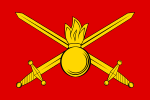 陸上 · 隸屬陸軍
Military district re-established on 1 March 2024 from the Western MD split, oriented toward the Baltic and Finland and including the Kaliningrad exclave; peacetime parent of the 6th Combined Arms Army.
第6諸兵種合成集團軍
集團軍陸上 · 隸屬列寧格勒軍區The Leningrad Military District's army-level formation — re-formed in the 2010 reform as the Western district's north-western army, engaged on the Kharkiv axis in the full-scale war, and assessed in 2026 to hold divisions in which UAV battalions are expected to be raised.
波羅的海艦隊
艦隊The Russian fleet of the Baltic — based in the Kaliningrad exclave and at the head of the Gulf of Finland, answering to the Navy's main command since the 2024 command reform; contributes naval infantry and coastal formations to the land war, and was assessed in 2026 to have formed a regiment of unmanned naval strike vehicles.
駐Baltiysk的波羅的海艦隊海軍步兵,以近衛第336旅的番號投入陸上戰爭,並於2025年12月宣布擴編為師級;該師本身的番號係據報導,尚未獲證實。
白俄羅斯武裝部隊
國家軍隊The Belarusian armed forces — published by the ministry as a Ministry of Defence and General Staff over two services (Ground Forces, Air Force and Air Defence), the Special Operations Forces and special troops. Every structural claim on this side of the module rests on the ministry's own positions and on think-tank and civil-society monitoring rather than on allied government assessment, and the records carry that grade.
The combined air and air-defence service — formed in 2001 by merging an air force created in 1992 from the Soviet 26th Air Army with air-defence forces descended from the 2nd Separate Air Defence Army, and reorganised in 2002 into two operational-tactical commands, Western and North-Western; its published purpose is the defence of centres, areas and troop groupings from air attack and the support of the Ground Forces.
The general staff — created on 21 December 2001 as the central organ of military command for the operational direction of the armed forces, its chief doubling as First Deputy Minister of Defence, with published directorates for operations, organisation and mobilisation, territorial defence and communications.
西北作戰司令部
司令部One of the two operational commands the ministry publishes as the basis of the Ground Forces — created on 25 December 2001 from the 65th Army Corps, heir to the Soviet 65th Army and 7th Tank Army, on the north-western operational direction; a documented, dated commander vacancy has been recorded for it in 2026.
白俄羅斯特種作戰部隊
特殊單位The special operations forces — a command created on 1 August 2007 from the Mobile Forces, whose lineage the ministry traces to the Soviet 103rd Airborne Division, 38th Air Assault Brigade and 5th Spetsnaz Brigade stationed in Belarus; the ministry names two brigades in its structure, and it is the only branch for which 2026 unit formation is documented in the monitoring read.
白俄羅斯國土防衛部隊
內部安全部隊The territorial defence component — troops formed on mobilisation by the regional and district executive authorities under a Directorate of Territorial Defence in the General Staff, rehearsed in the ministry's published exercises since the 2000s; a system, not a standing force, and published as such.
西部作戰司令部
司令部One of the two operational commands the ministry publishes as the basis of the Ground Forces — created in December 2001 from the 28th Army Corps, with its headquarters published at Grodno, facing the Polish and Lithuanian borders; the ministry publishes its structure as categories of unit, not as named formations.
One of Allied Air Command's three combined air operations centres, which NATO says covers airspace south of the Alps. NATO states the three centres' areas overlap to provide redundancy and publishes nothing more about this one; its seat and its area lie outside this theatre, and it is carried because the parent command's structure is read as a whole.
One of Allied Air Command's three combined air operations centres, which NATO says covers airspace north of the Alps — the centre through which Baltic Air Policing has been controlled. NATO states that the relevant centre decides which air base an interception is flown from and that the three centres' areas overlap for redundancy; it publishes nothing more about this one, and the centre's own site is closed to tools, so this record stops at NATO's sentence.
可部署空中指揮管制中心
司令部Allied Air Command's deployable air command and control element, at Poggio Renatico in Italy — listed by NATO beside the three combined air operations centres as the fourth body under the air command. NATO's pages name it and its seat and say nothing more; its own description of its deployable surveillance and control elements is on a site closed to tools, so this record stops at the name.
北約航運中心
中心The alliance's permanently manned point of contact with the merchant shipping community, part of Allied Maritime Command and co-located with it at Northwood. Its own search-visible description calls it the primary point of contact for the exchange of merchant-shipping information between NATO's military authorities and the international shipping industry; its site is closed to tools, so nothing beyond that description is carried.
愛沙尼亞特種作戰部隊
特殊單位The special operations force, published by name on the Defence Forces’ structure page and under the Land Forces heading. Its own page is a contact entry and publishes no mission, history or structure, so this record is a placeholder by source ceiling rather than by omission.
The cyberspace defence component of the Polish Armed Forces, named from the ministry’s English navigation. The armed forces’ portal lists five services on its front page and this is not one of them; the body appears on the portal only as the cyberspace defence component command that signs its bot-check page. No Polish page read describes its role, structure or subordination, and the record stays a stub for that reason.
The army's motorised light brigade, which its own page describes as swiftly deployable over great distances on light, fast wheeled vehicles with the Fennek reconnaissance vehicle as its backbone; the page names no units, no lineage and no garrison, and its reported integration into the German 10th Panzer Division is not stated there.
沒有符合目前篩選條件的部隊。
已啟用: