
The finding
The transition from Wagner to Africa Corps in the Sahel changed who in Moscow owns the Russian presence more than it changed what the presence does. Between December 2021 and June 2025 Russia’s force in Mali was a company: contracted by the Malian government, commanded through Yevgeny Prigozhin’s network, financed by the Russian state but disowned by it whenever a loss or an atrocity made disowning useful. Since June 2025 the same force, in most of the same places and with most of the same people, has been a Ministry of Defence formation. Its recruits sign Ministry contracts. Its supply line is flown by the Ministry’s own transport aviation. And when it fights, Moscow can say so — and has, twice, in Niger.
What did not change is the substance of the deployment. The missions are the ones Wagner performed: protecting the governments that invited them, escorting what those governments cannot move alone, training their soldiers, and fighting beside them against insurgents. The dependence is the one Wagner created: three governments that expelled their previous partners and have no other on the same terms. And the limits are the ones Wagner met. The best-resourced Africa Corps deployment, in Mali, gave up the north of the country under negotiated terms in April 2026, ten months after the rebranding, and has since fought mostly from the air.
The distinction matters because the two readings of this transition that circulate most widely are both wrong in the same way. “Wagner disappeared” and “Africa Corps is just Wagner renamed” each treat the institution and the activity as one thing. They are two things. Formalisation changed the institution — command, contracts, logistics, responsibility — while the activity, and its results, stayed much as they were. The rest of this note takes those apart, then shows that the arrangement is not even one arrangement: Mali, Burkina Faso and Niger have each received a different version of it.
What Wagner actually was in the Sahel
Wagner arrived in Mali in December 2021 as France was leaving, on a contract the US State Department put at about ten million dollars a month. Bamako called the arrivals bilateral trainers; Western governments called them contractors. Both were true in part. The company’s Mali head, Ivan Maslov, was designated by the US Treasury in 2023 as the principal administrator of Wagner’s units in the country, tasked by Prigozhin and Dmitry Utkin — a private chain of command that ran to a private owner, not to a ministry. In the field, its commanders operated with wide autonomy; formal arrangements placed them alongside the Malian army and Russian defence-ministry advisers, but the company mounted its own operations, including the one at Moura in March 2022 that a UN investigation documented as mass killing.
It was not independent of the Russian state, and it is important not to overstate the distance. Putin said in June 2023 that the state had financed Wagner in full. Its aircraft used Russian military airfields in Syria and Libya on the way south. Its African concessions and its Mali deployment served Russian policy, and no one in Bamako doubted whose force it was. What the private form gave Moscow was not independence but deniability: a way to be present without being answerable. Losses were the company’s. Conduct was the company’s. After the mutiny of June 2023 and Prigozhin’s death that August, the state decided that the arrangement’s cost — an armed company with its own leader and its own African revenues — exceeded its use, and began to replace it.
What Africa Corps changed
Africa Corps was announced through Ministry of Defence-affiliated channels in late 2023, after a tour of Mali, Burkina Faso, Niger, Libya and the Central African Republic by Deputy Defence Minister Yunus-Bek Yevkurov and General Andrei Averyanov, then deputy head of Russian military intelligence. Those two are widely reported as the structure’s overseers; no Russian order of subordination has been published, and the note grades the command picture as reported throughout. Below them, reporting places the Mali contingent from early 2026 under a serving airborne major-general, Vladimir Selivyorstov, who commanded a division in Ukraine in 2022. That is a claim about a serving officer of the regular army in command of the deployment — a different kind of person from a Prigozhin lieutenant — and it is precisely the kind of claim the transition makes plausible without making verifiable.
The change that is verifiable is the contract. Africa Corps recruits sign with Ministry of Defence volunteer formations, on one-year terms, at pay advertised in recruitment channels at roughly 230,000 to 280,000 roubles a month while abroad. Investigations into the recruitment network found former Wagner recruiters re-badged as Ministry representatives and a stated preference for former Wagner fighters. The recruit is not a soldier of the regular armed forces — the volunteer-formation status keeps the deployment outside the army’s own establishment — but the counterparty is the state, and the state’s name is on the paper.
The second verifiable change is the supply line. Flight-tracking analysis of the nineteen months from January 2025 to July 2026 identified seventy-five Russian military-linked flights to Bamako, Ouagadougou and Niamey, with the Ministry of Defence’s own transport unit the single largest operator, moving through the Khmeimim base in Syria and Libyan airfields, with state-linked private carriers alongside. Sea deliveries through Conakry, in convoys carrying trucks and armoured vehicles, reached Bamako in early 2025. This is a state logistics chain, documented in a way Wagner’s never was — and its dependence on Russian military airlift is also its constraint. In August 2024 the commander of a Ministry-linked volunteer brigade told a news agency that he had pulled about a hundred men out of Burkina Faso to fight in Kursk. What the Ministry gives, the Ministry can recall.
The third change is the one Moscow chose to make visible: it now speaks for the force. When Islamic State attacked Niamey airport in January 2026, the Russian Foreign Ministry said within days that the attack had been repelled by “the joint efforts of the Russian Ministry of Defence’s African Corps and the Nigerien armed forces”. When Nigerien soldiers mutinied at the same base in August 2026, Russia’s ambassador told the state news agency that the base command had appealed to Russian personnel for assistance, and Niger’s chief of staff visited the Russian compound to thank them. Wagner’s engagements were never acknowledged by anyone in Moscow. These were, and the acknowledgement is itself the mechanism: a deployment Russia will avow is a deployment Russia’s partners can count on, and one whose failures Russia cannot disown.
Around all this sits a new layer of paper. Mali’s president signed an agreement on the fundamentals of relations in Moscow in June 2025, in the same week Wagner left; the three AES defence ministers signed a defence-cooperation memorandum with the Russian minister in August 2025; and Russia and the AES issued a joint statement in Niamey in July 2026 committing Moscow to “continue its support for strengthening the operational capacities” of their armed forces. None of the texts is public, and none has been shown to change the price — reporting still puts Mali’s payment near the Wagner-era figure. What they change is the counterparty. A company’s contract with a government has become a set of state-to-state instruments, and three bilateral relationships have acquired one interlocutor.
Mali, Burkina Faso and Niger are not the same case
Mali is the only country where the transition happened in the literal sense. Africa Corps personnel were deployed there from late 2024 alongside Wagner — in Bamako and the centre while Wagner held the north — and when Wagner posted “mission accomplished” on 6 June 2025, Africa Corps said nothing would change. A diplomatic source told AFP that most Russian-national Wagner personnel would be absorbed into it and remain in the northern regional capitals and Bamako. The force that resulted is put by analysts and US officials at about two thousand, with some accounts up to 2,500. It is the only deployment with a combat record, a documented conduct record, and losses — a helicopter near Gao on the first day of the April 2026 offensive, a Mi-24 near Anéfis in July, convoys ambushed. Its posture changed with those losses. Conflict-event data shows battles involving Russian fighters in Mali falling by a third between 2024 and 2025 and to about two dozen a month by early 2026; after Kidal the force shifted to air support, intelligence for the Malian army, convoy escort and armed and first-person-view drones. A Malian official has stated that “coordination and cooperation have been established” between the army and Africa Corps. Coordination is not integration, and nothing published describes a joint command.
Burkina Faso never had Wagner. Its Russian presence began as an Africa Corps deployment: about a hundred personnel announced arriving in Ouagadougou on 24 January 2024, with a base at Loumbila north-east of the capital and a stated plan to reach three hundred. Alongside them came a Ministry-linked volunteer brigade whose task, by Western assessment and by its own commander’s account, was the protection of the head of state and training. The expansion did not happen; about a hundred were recalled to Russia in August 2024, and current estimates run from one to three hundred. No combat role, casualty or conduct case has been documented, which reflects the size of the contingent and the thinness of reporting from the country rather than a finding either way. Burkina Faso’s war is fought overwhelmingly by its own mobilised forces; the Russian contingent is a political relationship with an instructor mission attached.
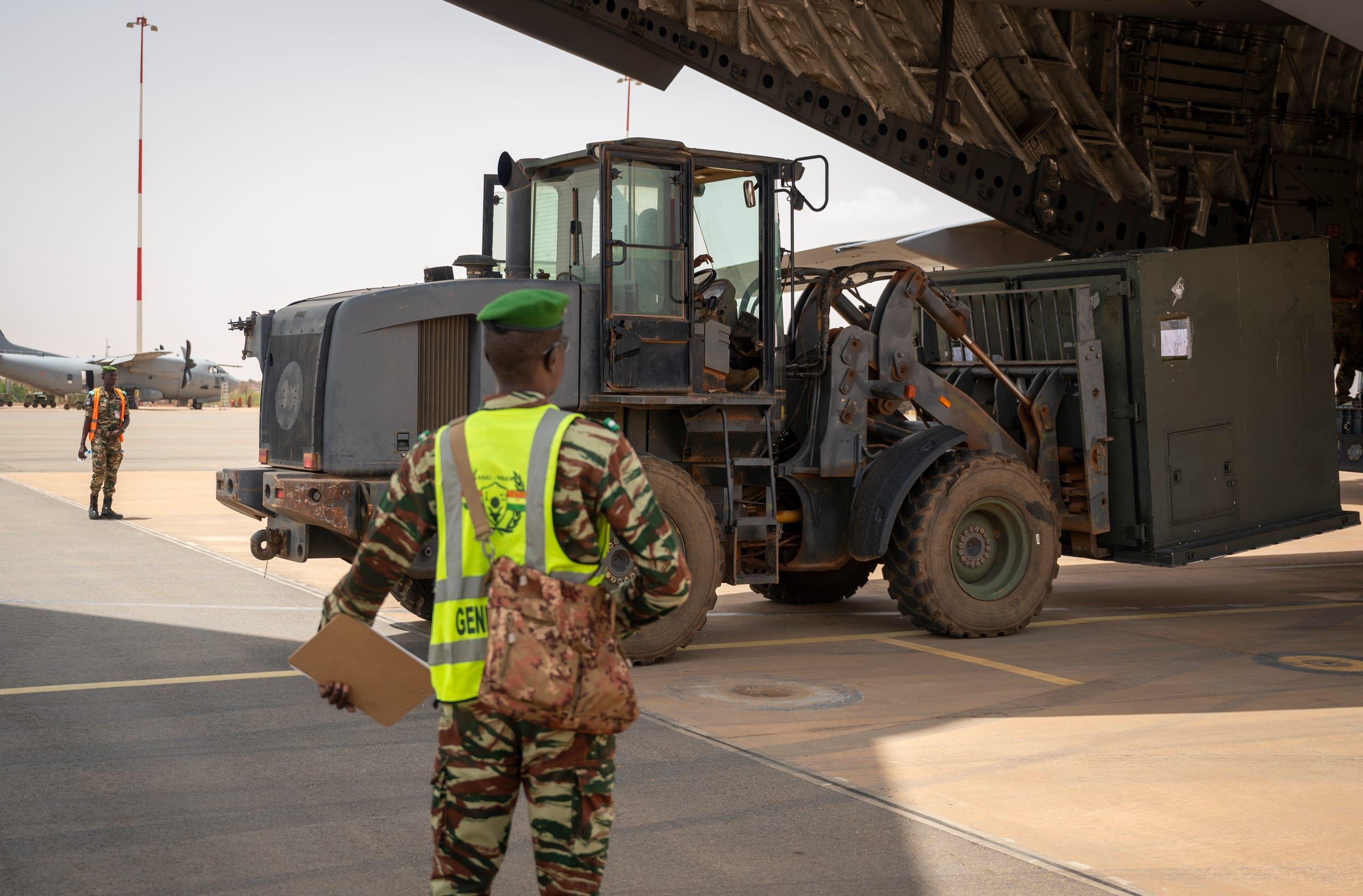
Niger is the case with the best official evidence and the least operational one. Russian instructors and an air-defence system arrived on 10 April 2024, two weeks after a call between Putin and General Tiani, and took up a separate hangar at Air Base 101 in Niamey while American forces were still on the base; the Americans left it in July and the country in September. The contingent is reported at two to three hundred. It has not been reported fighting insurgents in the field. What it has done, twice, is act at the base it occupies: against the January 2026 airport attack, and against the August 2026 mutiny, with aerial and ground support to loyalist forces, drones included by some accounts, on a request that Moscow says came from the base command. That second episode has no parallel in Mali or Burkina Faso. It places a Russian force inside a Nigerien contest between Nigerien soldiers, on the government’s side, with an official Russian statement attached — a regime-security guarantee stated out loud. It sits beside a reported limit: in May 2025 Niamey was reported to have ended technical-intelligence arrangements with Russian and Turkish providers for poor performance. Dependence, even here, is selective.
What did not change
Continuity is the larger half of the picture and deserves the same weight.
The people are largely the same. Analysts and Russian mercenary channels put former Wagner fighters at seventy to eighty per cent of Africa Corps; the Ministry’s own recruitment gave them priority. In Mali the force was re-contracted in place. Wagner-era leaders and networks in the Central African Republic, the lineage’s other stronghold, stayed in post, and the Wagner brand remained visible on the ground long after the announcements.
The missions are the same. Regime security first — the priority that analysts across the spectrum identify, and that Niger in August 2026 made explicit — then escort, training and support to counterinsurgency. What changed inside the mission mix was forced by events, not chosen at the transition: the retreat from offensive ground operations in Mali followed Tinzaouatène in 2024 and Kidal in 2026, not the change of institution.
The host governments’ objectives are the same. Mali, Burkina Faso and Niger sought a partner without governance conditions, and they have one. Their dependence on Russian aviation, escort and political cover is unchanged in kind; the AES framework has made it harder for any one of them to leave.
The geography is largely the same, minus what was lost. Bamako, Sévaré and Gao were Wagner’s hubs and are Africa Corps’; Kidal, Tessalit and Aguelhok were Wagner’s gains and are Africa Corps’ losses.
The conduct record is continuous. Human Rights Watch documented Africa Corps air strikes at Kyrnia in June 2026 and a raid at Bombori in July, in the same Mopti region where Wagner’s Moura operation was documented in 2022, and wrote to both defence ministries about each. Neither replied. Under Wagner a case like that was a contractor’s; under a Ministry formation it is the state’s, and the state’s answer has been the same silence.
And the strategic logic is the same. Russia is in the Sahel to demonstrate that its security offer works where the Western one did not, to hold a position on Europe’s southern approaches, and — by consistent UN panel and investigative reporting, never by disclosure — to secure resource-linked returns. The institution that pursues those aims has changed. The aims have not.
Why the distinction matters
For Moscow, formalisation trades deniability for durability. A Ministry formation cannot mutiny against its owner, cannot run its own foreign policy and cannot be lost with its founder; it can be sustained through military logistics, reinforced from military stocks and written into intergovernmental agreements. The price is that every result is Russia’s. That is why the January and August statements in Niger came quickly and the Mali helicopter losses drew no comment: an avowed force is avowed selectively, and the selection is the tell. It is also why a documented civilian-harm case now lands on a ministry rather than a company, whether or not the ministry answers.
For the host governments, the partner is more reliable and less escapable. A state counterparty is harder to lose to a Russian domestic quarrel and harder to renegotiate away from; the AES layer raises the cost to any one member of ending its own arrangement. What it does not deliver is capacity the partner does not have. The Mali deployment is about two thousand people in a country of 1.24 million square kilometres, with a war in Ukraine capping what can be sent, and its 2026 repositioning is the visible form of that arithmetic. Governments that chose Russia for its willingness to take casualties without conditions now have a partner that weighs risk, in the words of one investigator, “more heavily than its predecessor”.
For the analysis of effectiveness, the transition changes almost nothing, and that is the point. Formal organisation is not capability. The same force under a new chain of command met the same insurgents with the same results, and where the results were worse in 2026 the cause was the war, not the wiring diagram. Sustainment is the one dimension where a real improvement can be demonstrated — a state airlift with a measurable cadence — and sustainment is a precondition for effect, not effect itself.
What this does not mean
Wagner’s disappearance as a brand does not prove that Wagner-era networks vanished. The recruiters, the commanders’ lineage in Mali and the Central African arrangements carried over; only the name and the counterparty changed.
Greater Russian state control does not mean greater combat effectiveness. The best-resourced deployment gave up the north of Mali in the year after the transition, and its engagements fell rather than rose.
Africa Corps’ presence in all three AES states does not mean one model across them. Mali is a combat partnership with a conduct record; Burkina Faso is an instructor mission that contracted; Niger is a regime guarantee that has now been exercised in public.
Russian military support does not by itself demonstrate durable state territorial control. Kidal was held with Russian help for twenty-nine months and left in a weekend.
And the acknowledged interventions in Niger do not establish that Africa Corps will act inside every host state’s internal contests. They establish that it did so once, at its own base, on a request from that base’s command, and that Moscow chose to say so. Whether that is a precedent or a particular is what the next such episode will show.
What to watch next
Five questions carry the assessment forward. They are observables, not forecasts.
Does Russian support become integrated into host-state command structures? Mali has stated that coordination is established; nothing published describes a joint command, Russian officers in national staffs, or an Africa Corps role in training the AES unified force. Any of those would change the presence from a partner beside the state into a component of it.
Does the Niger threshold recur? A Russian force acting in an internal contest, on request, has happened once. A second instance — in Niger, or in Mali or Burkina Faso — would make it the model rather than the exception; an official account of the August 2026 request’s origin and terms would clarify the first.
What is the cadence of the state supply line? Ministry airlift frequency, equipment deliveries into Bamako, and any recall of personnel to Ukraine are the measurable form of Russia’s commitment, and the first thing that would change if that commitment changed.
Does Mali’s posture change again? A return from air support to ground holding in the north would indicate a decision to contest what was conceded; a further contraction onto Bamako would indicate the opposite.
Does documented conduct ever receive a response? Two cases in three weeks in 2026 were put in writing to both ministries. A first investigation, denial or acknowledgement from either would be evidence that a channel exists. None has appeared.