
The finding
In 2025 Vigil recorded 46 Israeli strikes in Syria, counting each place struck once a day, on 26 separate days. In the first nine months of 2026 it recorded three. Read alone, that curve says Israel’s pressure on Syria has almost stopped. It has not. Over the same months the Israeli positions on the Syrian side of the 1974 line stayed where they were and were built on, the raids and detentions around them increased, and Israel’s defence minister stood inside the zone and said the army would stay there as long as threats remained.
The strike record measures one thing well, and it is not the posture. Israel’s posture in southern Syria has three parts: the ground it holds, the operations it runs from that ground, and a negotiation with Damascus over the conditions under which either would change. In 2026 the weight moved from the second part’s air form to the first part. And the negotiation turns out to be less a track separate from the military posture than a negotiation over its terms.
Activity is not posture
The series behind the curve is precise about what it counts. A record is one day of Israeli air, drone or missile strikes on one place in Syria, attributed to Israel on stated rules. It does not count ground incursions, raids, arrests, checkpoints, demolitions or shelling, and it does not count air fire in support of Israeli troops in contact on the ground. That exclusion is deliberate: a strike is a comparable event across months, and a patrol is not.
From the MapRecorded strike events · Monthly bins · 08 Dec 2024 → 26 Sep 2026
What the strike record shows — and what it cannot
- Records in the bin
- Covered zero
- No coverage — not a zero
- Key development
- 8 December 2024Damascus falls; the Assad era ends
- July 2025The Sweida violence and Israeli strikes on Damascus
- December 2025 – 2026Israel–Syria security negotiations
- 8 – 9 September 2026A UN commission calls the Israeli presence entrenched, and Israel's prime minister calls it dominance
- Records
- 61
- Markers
- 14
- Series status as of
- Reviewed
What the series counts Israeli air, drone and missile strikes on Syrian territory, one record per struck place per day — never ground raids, shelling or unattributed blasts.
The shape is clear. A campaign against the former state’s arsenal in December 2024, when the Israeli military said it struck about 480 targets in 48 hours. Enforcement strikes through the first half of 2025, concentrated on the army bases at Izraa and in the belt south of Damascus, after the prime minister demanded on 23 February 2025 that no Syrian force deploy south of the capital. A spike in July 2025, when Israel struck army columns in Sweida and the General Staff building in Damascus. Then very little: three records in 2026, two of them in the south.
That fall is a real observation, not a gap in Vigil’s search. What it cannot support is the reading that the posture fell with it. The strike record would look exactly like this if Israel had left southern Syria, and it looks exactly like this now that Israel has stayed.
What Israel holds
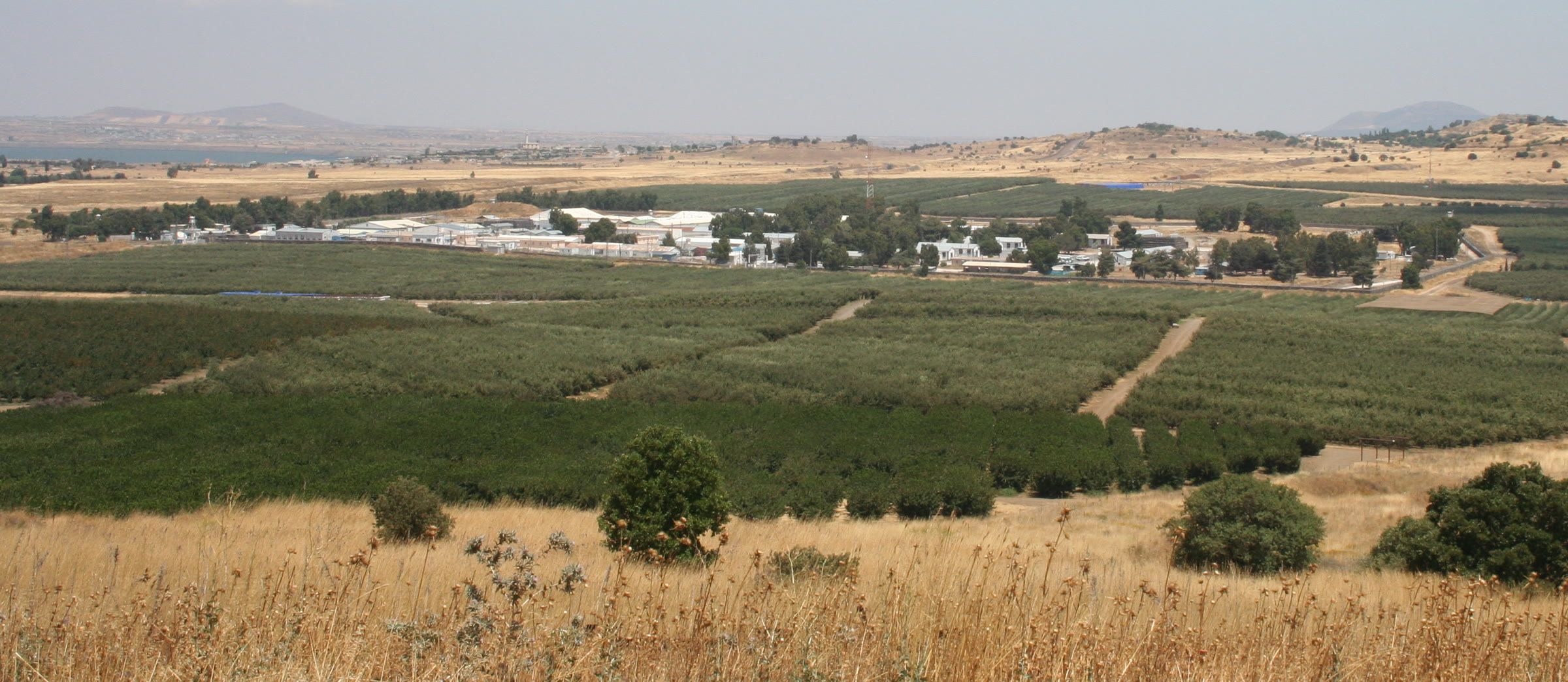
The presence began on 8 December 2024, the day Damascus fell. Israel’s prime minister said the 1974 disengagement agreement had collapsed with the Syrian army’s abandonment of its positions, and ordered the military to seize the buffer zone and the commanding positions nearby. The 1974 agreement had drawn two lines, with an area of separation between them patrolled by the UN Disengagement Observer Force, and limited the forces each side could keep near them. Israeli forces moved into that area, beyond it at points, and onto the Syrian side of Mount Hermon.
What has been documented since is persistence and construction. The UN Secretary-General reports to the Security Council on the force every quarter, from its own observation. In February 2025 it counted ten Israeli positions built in the area of separation; in May, twelve; in August and November, ten; in February and May 2026, eleven — eight in the area of separation, one of them a field hospital, and three beyond it, in the zone where the 1974 agreement limited Syrian forces. The count has moved within that narrow band and no UN report records a withdrawal from a position. The one documented handover is of buildings: the Quneitra governorate offices, vacated on 2 February 2025.
Around the positions the reports record what makes a presence durable rather than provisional: communication masts, nineteen swing gates across the area of separation by November 2025, barriers, earthworks, bulldozed woodland, and from 2026 construction and demolition in the zone beyond the old buffer as well. Since March 2026 the Secretary-General has described the presence as “in the area of separation and beyond”. Amnesty International verified by satellite imagery at least 23 houses and other structures demolished in three Quneitra villages. On 8 September 2026 the UN commission of inquiry on Syria told the Human Rights Council that the presence had become “increasingly sustained and entrenched”, with fixed military infrastructure, particularly in Quneitra and Dara’a.
The language changed faster than the ground. On 8 December 2024 Israel told the UN force its entry was a temporary defensive measure, and its prime minister spoke of a temporary position until a suitable arrangement was found; its letter to the Security Council the next day said Israel remained committed to the 1974 framework. From January 2025 the defence minister spoke of staying “indefinitely”; in June 2026 he said the army would stay in the security zones without any time limit; and on 25 August 2026, visiting the zone, he said it would not leave the Hermon and the security zone as long as there were jihadist threats. On the Hermon on 9 September the prime minister described Israeli control from the summit to the Yarmouk. Israel’s mission in Geneva still calls it a temporary buffer zone of about 0.1 per cent of Syria. Syria calls it an occupation in breach of the 1974 agreement; the UN treats all military presence in the area of separation other than its own as a violation, and the Secretary-General, visiting Damascus in July 2026, called Israel’s violations of the agreement unacceptable.
The observable facts under those words are stable: about a dozen fixed positions, maintained and built on, now in their second year. Whether they are temporary is a statement about the future that the record cannot check. That none has been verifiably given up is a fact about the present that it can.
What the enforcement now consists of
Enforcement in 2026 happens on the ground. Troops set up temporary checkpoints and search passers-by, as at al-Ajraf in northern Quneitra on 9 April. They search houses and detain residents, as in the Quneitra countryside in September. Artillery fires on the outskirts of villages in western Dara’a, as at Abidin in June, where residents fled overnight, and again on 21 September. The UN force itself recorded night searches and detentions in eight villages on both sides of the Bravo line between February and May 2026, and received 40 complaints from residents; on 30 December 2025 it saw about 40 soldiers and two tanks cross the line and detain two civilians. The UN commission identified 49 Syrians detained by the Israeli military as at June 2026 and transferred across the line, some held without contact with their families. The occasional strike in 2026 has followed a specific trigger — army compounds after attacks on Druze villages in March, a vehicle near Beit Jinn in August — rather than a campaign.
Counts of this activity exist, but they are not Vigil’s and they do not agree with each other. The Syrian Observatory for Human Rights, a monitoring group, counts 594 Israeli incursions between January and 19 September 2026, against 460 in all of 2025, and six air strikes among its 2026 attacks. ACLED counted 84 ground incursions in May 2026 alone. Syria’s president told the General Assembly on 23 September of about 500 strikes, more than 1,200 incursions and about 300 detentions since December 2024. The categories differ and no UN series exists, so Vigil uses these figures for their direction, which they share, and not their size.
Two things follow. The activity that now enforces the posture is organised around the held ground: the raids are concentrated in the districts around it — Quneitra above all, then western Dara’a and the slopes below the Hermon at Beit Jinn. And none of it measures whether the posture is working. A rising count of incursions shows more incursions. It does not show more security, more leverage or less Syrian capacity, and Vigil does not read it as any of them.
What is being negotiated
Israel and the Syrian transitional government have no diplomatic relations and have been talking since mid-2025, with the United States mediating: in Paris in July and August 2025, in London in September 2025, and in Paris again on 5 and 6 January 2026. The only document these rounds produced is a joint statement of 6 January from the three governments, creating what it called a joint fusion mechanism — a communication cell under US supervision for de-escalation, intelligence sharing and diplomatic contact. No source read for this Note shows that cell meeting. The talks froze when the war on Iran began on 28 February 2026, by the Syrian foreign minister’s account. He met the head of Mossad in Jordan on 23 August, after Israel struck an airbase in the north; no round has been confirmed since.
From ExploreRelationship record
The relationship the negotiation sits inside
Negotiation and enforcement in parallel — talks over the terms of an Israeli presence that has outlasted every round, with no text signed.
- Type
- Adversarial
- Status
- Active
- Since
- Last material change
- Confidence
- Moderate
ComponentsDefenceBorder securityDiplomatic
- 8 December 2024Damascus falls; the Assad era ends
- 23 – 25 February 2025Israel demands a demilitarised south and strikes to enforce it
- July 2025The Sweida violence and Israeli strikes on Damascus
- December 2025 – 2026Israel–Syria security negotiations
- 18 – 20 August 2026The Abu al-Duhur strike and the Turkish deployment dispute
- 8 – 9 September 2026A UN commission calls the Israeli presence entrenched, and Israel's prime minister calls it dominance
Information gap The negotiated text is reported by officials and mediators and has not been published; "near-complete" is their characterisation.
Open in ExploreDiplomacy · this relationshipRead the record6 linked events
What is on the table is known almost entirely from reporting and from each side’s own account. In September 2025 Axios reported an Israeli proposal, with a map, dividing the area south-west of Damascus into zones with graduated limits on Syrian forces, a no-fly zone for Syrian aircraft, and Israel keeping the Hermon; Reuters reported that month that talks had snagged on an Israeli demand for a humanitarian corridor to Sweida. Israel’s prime minister said publicly on 2 December 2025 that any deal required a demilitarised zone from Damascus to the buffer, including the Hermon’s approaches and summit. Syria’s foreign minister said in February 2026 that the talks concern the areas Israel entered after December 2024, and that the Golan is a separate question.
The two accounts of where the talks stand contradict each other. Syria’s foreign minister told Reuters in August that the sides had “agreed on paper to almost everything”, including zones with a buffer held only by UN forces, and that Israel had avoided implementing it. Syria’s president said on 22 September that about 90 per cent had been agreed before Israel pulled back and added conditions. Israel’s prime minister’s office, answering a December 2025 report that a text had been ready for signature, said the talks had never reached the point of agreements or understandings. Neither account can be checked against a text, because none has been published.
The subjects themselves are the point. Every one of them — the depth of the zone south of Damascus, the Hermon, force limits, who monitors the buffer — is a term of the posture described above. And the sequence each side states is the reverse of the other’s. Syria’s president put it as withdrawal to the 1974 lines first, then security arrangements, then anything further. Israel’s ministers put it as the presence staying until the threats are removed. The negotiation is not a track that runs beside the military posture. It is a negotiation over the conditions on which that posture would change.
What would count as a change
This is the question the strike record cannot answer, and the one that matters for anyone following the file. If the posture is held ground, operations run from it, and conditions for changing both, then a change of posture is a change in one of those — observable, and lasting.
The strongest signal is the ground. A verified withdrawal from documented positions would be a change of posture whatever else continued. The instrument that can register it already exists: the Secretary-General’s reports on the UN force count Israeli positions on the Syrian side of the line every quarter. A fall in that count would matter more than any statement — but only when the report says what happened. The count has fallen before, from twelve in May 2025 to ten in August, without any report calling it a withdrawal; a consolidation and a withdrawal can look the same in a number.
The second is an arrangement that is implemented, not merely signed. A text that fixed zones, set limits on Syrian forces south of Damascus and named a monitoring body — the UN force, or the cell the January statement created — would change the posture’s terms even if Israel kept some positions and some activity continued. The reported drafts suggest it might do exactly that: formalise part of the presence rather than end it. That would still be a change.
The third is sustained change in ground operations: incursions and detentions falling over months, visible in UN reporting as well as in monitors’ counts. One quiet week is not that; nor is one quiet month in the strike record, which has been quiet for most of a year.
What does not count on its own is a meeting, a percentage, a statement of intent in either direction, or a strike count moving. Each of these has happened in 2026 without the ground moving.
What this does not establish
This Note describes the posture from its observable parts. It does not establish Israel’s intent. The record shows persistence, construction and open-ended statements, and it also shows that those statements are phrased as conditional; it cannot say whether the presence is meant as leverage for an agreement, as a lasting arrangement, or as both. It does not establish which side walked away from the talks, because the only accounts are the parties’ own. It does not say whether the ground operations achieve anything, because counts of activity do not measure effect. And it publishes no Israeli position, unit or movement: the places named here are villages and districts, at the precision their own sources give.
The mechanism, once
Israel’s posture in southern Syria rests on the ground it has held since December 2024. The raids and detentions of 2026 are organised around that ground, and the strikes that defined 2025 have almost stopped. The negotiation with Damascus is a negotiation over the terms on which that ground would change. Vigil will say the posture has changed when the ground does — when a documented position is verifiably given up, or when an arrangement fixing zones, limits and a monitor is in force — and not before.