
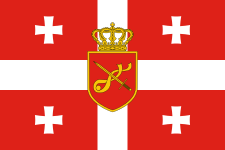
- Service ensign · official
- State affiliation · Georgia
- Vigil category device · not official insignia
Identity provenance
Service ensign: Main military flag of the Georgian Defence Forces. The main military flag of the Georgian armed forces — the five-cross field with the national arms at the centre, adopted 2007. CLEARED WITH A CAVEAT in the earlier manifest and not fetched; now fetched and shipped, and the caveat is kept rather than dropped: the force was renamed from Armed Forces to Defence Forces in 2018 and no source located in this pass establishes whether the flag was restyled with it. The label therefore names the flag rather than asserting a date, and the record's own text carries the institutional history. FILE: Wikimedia Commons "Flag of the Georgian Armed Forces.svg", public domain, credited on Commons to the Georgian Ministry of Defence (mod.gov.ge). 44KB optimised to 28KB — editor metadata removed, coordinate precision reduced to two decimals. Geometry, colours and viewBox unaltered. Inherited by the two territorial commands, the aviation and air-defence command, the special operations forces and the National Guard; the Border Police is a separate root under the Interior Ministry and correctly inherits nothing.
State affiliation: Georgia.
The smaller square mark is a Vigil category device, drawn from this record’s own domain, echelon and role — not an official insignia.
In brief
Georgia's national military — NATO-partnered and Western-trained through two decades, under a government whose westward orientation is now in question.
- Scope
- Structure, role, lineage and links. 5 subordinate records published.
- Subordination
- Subordination confirmed
- Sources
- 3 on the record
- Record state
- Full
- Broad area of activity
- Government-controlled territory; the boundary lines with Abkhazia and South Ossetia are policed by interior structures with the EUMM monitoring from the government side. Broad structural description only.
- Notable history
- Rebuilt twice: after the 1990s civil and secession wars, and after the five-day defeat of 2008. Two decades of NATO partnership — Iraq and Afghanistan deployments among the alliance's largest per capita, US-supported training programmes, a professionalisation drive — built an interoperable light force. The 2024–26 political crisis has strained the Western defence relationships the force was built on, with some cooperation programmes publicly paused by partners.
- Strengths
- NATO-standard training lineage and deployment experience; coherent professional core; mountain and light-infantry suitability.
- Limitations
- Small size and limited heavy/air capability against its only plausible state threat; strategic depth measured in tens of kilometres; a political environment placing its partnership anchors in doubt.
Subordinate formations
Commands & districts 3
Georgian Eastern Defence CommandCommandGeorgian Western Defence CommandCommandGeorgian Aviation and Air Defence CommandCommandUnits & detachments 1
Functional branches 1
Rows are layout only — position and order carry no hierarchy, importance, sequence or strength. Every record shown is an immediate subordinate of the selected organisation. Headings are derived from each record’s own type and echelon. They are not command layers, and no such layer exists in the force tree.
Reported & historical equipment associations
Su-25: Operated the type and hosted its Soviet-era production line at Tbilisi; 2008 war employment documented.
Related locations
Gori: 2008 war operations and the garrison town's historical role.
Total defence within a policy that forecloses offensive options. The unilateral non-use-of-force commitment removes territorial recovery as a military task, leaving deterrence, resilience and interoperability as what the force is actually for.
Preferred operating methods
Territorial defence with a societal component, conducted under a political constraint that is unusual and load-bearing: Georgia committed unilaterally in 2010 not to use force to restore its territorial integrity, which removes the mission a comparable force would otherwise be organised around. What remains is deterrence of further encroachment, resilience against a threat with overwhelming local advantage, and interoperability with partners — the last pursued through two decades of NATO-standard reform and substantial deployment experience abroad, which is the force's most distinctive feature. Reserve and territorial components have been reorganised repeatedly. Defence of the boundary lines themselves is conducted by police rather than military structures, which is a deliberate reflection of the same political framing.
A broad generalisation about how this organisation operates, graded as an assessment — not a description of current tactics, and deliberately carrying no capability or effectiveness score.
Command style
NATO-standard structures adopted over two decades, with civilian control established in law. The variable is political rather than institutional: the partnership orientation that shaped the reform is contested domestically in a way it was not before 2024.
Where this generalisation breaks down
The generalisation fails in one important way: describing this as a military doctrine overstates it. The binding constraints on what Georgia's forces are for are political and legal — a unilateral commitment, a partnership orientation now domestically contested, and an adversary against which no force Georgia could field would be decisive. The doctrine documents follow from those facts rather than driving them.
Observed adaptations
Reorientation after 2008 from an expeditionary and partnership-focused posture toward territorial defence, following a war in which the former proved irrelevant.
Assignment of boundary-line policing to the Border Police rather than to military structures, keeping a disputed line in a law-enforcement frame consistent with the non-use-of-force commitment.
What remains unknown
- Force readiness and dispositions are not published by this module and are not the basis of any claim here.
- The practical implications of the post-2024 political trajectory for partnership-based reform are not yet observable.
- Reserve and territorial component effectiveness has not been independently assessed.
Campaigns
Campaigns naming this organisation as a participant. The campaign record owns the relationship and grades it; this list is computed.
- Georgia's territorial conflicts — Abkhazia and South Ossetia Primary force · Since 1991 · high confidence · as of 2026-06
Key events
The Russia–Georgia War
After months of escalation, Georgia assaults Tskhinvali; Russia's prepared counter-invasion drives Georgian forces from South Ossetia, opens a second front from Abkhazia, and pushes into uncontested Georgia before an EU-mediated ceasefire on the fifth day. The EU's independent inquiry later finds Georgia fired first within a conflict both sides had prepared and Russia had provoked.
Campaign involvement
The South Ossetia war
Fighting between Georgian forces and South Ossetian separatists over the former autonomous oblast kills around a thousand and displaces tens of thousands in both directions. The June 1992 Sochi agreement ends the fighting with a Russian-led mixed peacekeeping format and the region outside Tbilisi's control.
The Abkhazia war and the expulsion of Georgians
War between Georgian forces and Abkhaz separatists — backed by North Caucasus volunteers and Russian elements — ends with the fall of Sukhumi (Sokhumi) on 27 September 1993 and the flight or expulsion of most of Abkhazia's Georgian population, some 200,000–250,000 people, amid documented ethnic violence on both sides.
Quick actions
System access
Where this record connects into the rest of Vigil. Each row is here because this organisation actually reaches it.
Assessed as of — 2026-06 Last reviewed — 2026-07-18
See this force in the structure Interactive: select this record and follow what connects to it.