
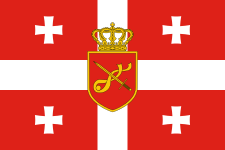
- Pavillon d’armée · officiel
- State affiliation · Georgia
- Emblème de catégorie Vigil · pas un insigne officiel
Provenance de l’identité
Service ensign: Main military flag of the Georgian Defence Forces. The main military flag of the Georgian armed forces — the five-cross field with the national arms at the centre, adopted 2007. CLEARED WITH A CAVEAT in the earlier manifest and not fetched; now fetched and shipped, and the caveat is kept rather than dropped: the force was renamed from Armed Forces to Defence Forces in 2018 and no source located in this pass establishes whether the flag was restyled with it. The label therefore names the flag rather than asserting a date, and the record's own text carries the institutional history. FILE: Wikimedia Commons "Flag of the Georgian Armed Forces.svg", public domain, credited on Commons to the Georgian Ministry of Defence (mod.gov.ge). 44KB optimised to 28KB — editor metadata removed, coordinate precision reduced to two decimals. Geometry, colours and viewBox unaltered. Inherited by the two territorial commands, the aviation and air-defence command, the special operations forces and the National Guard; the Border Police is a separate root under the Interior Ministry and correctly inherits nothing.
State affiliation: Georgia.
La petite marque carrée est un emblème de catégorie Vigil, établi à partir du domaine, de l’échelon et du rôle propres à cette fiche — pas un insigne officiel.
En bref
Les forces armées nationales de la Géorgie — partenaires de l’OTAN et formées par l’Occident pendant deux décennies, sous un gouvernement dont l’orientation occidentale est désormais en question.
- Périmètre
- Structure, rôle, filiation et liens. 5 fiches subordonnées publiées.
- Subordination
- Subordination confirmée
- Sources
- 3 dans la fiche
- État de la fiche
- Complète
- Zone d’activité générale
- Government-controlled territory; the boundary lines with Abkhazia and South Ossetia are policed by interior structures with the EUMM monitoring from the government side. Broad structural description only.
- Historique notable
- Rebuilt twice: after the 1990s civil and secession wars, and after the five-day defeat of 2008. Two decades of NATO partnership — Iraq and Afghanistan deployments among the alliance's largest per capita, US-supported training programmes, a professionalisation drive — built an interoperable light force. The 2024–26 political crisis has strained the Western defence relationships the force was built on, with some cooperation programmes publicly paused by partners.
- Points forts
- NATO-standard training lineage and deployment experience; coherent professional core; mountain and light-infantry suitability.
- Limites
- Small size and limited heavy/air capability against its only plausible state threat; strategic depth measured in tens of kilometres; a political environment placing its partnership anchors in doubt.
Formations subordonnées
Commands & districts 3
Georgian Eastern Defence CommandCommandementGeorgian Western Defence CommandCommandementGeorgian Aviation and Air Defence CommandCommandementUnits & detachments 1
Composantes fonctionnelles 1
Les rangées ne servent qu’à la mise en page — leur position et leur ordre n’indiquent ni hiérarchie, ni importance, ni séquence, ni force. Chaque fiche affichée est un subordonné immédiat de l’organisation sélectionnée. Les intitulés sont dérivés du type et de l’échelon propres à chaque fiche. Ce ne sont pas des niveaux de commandement, et aucun niveau de ce genre n’existe dans l’arborescence des forces.
Associations d’équipement signalées et historiques
Su-25: Operated the type and hosted its Soviet-era production line at Tbilisi; 2008 war employment documented.
Lieux associés
Gori: 2008 war operations and the garrison town's historical role.
Total defence within a policy that forecloses offensive options. The unilateral non-use-of-force commitment removes territorial recovery as a military task, leaving deterrence, resilience and interoperability as what the force is actually for.
Modes opératoires privilégiés
Territorial defence with a societal component, conducted under a political constraint that is unusual and load-bearing: Georgia committed unilaterally in 2010 not to use force to restore its territorial integrity, which removes the mission a comparable force would otherwise be organised around. What remains is deterrence of further encroachment, resilience against a threat with overwhelming local advantage, and interoperability with partners — the last pursued through two decades of NATO-standard reform and substantial deployment experience abroad, which is the force's most distinctive feature. Reserve and territorial components have been reorganised repeatedly. Defence of the boundary lines themselves is conducted by police rather than military structures, which is a deliberate reflection of the same political framing.
Une généralisation large sur la manière dont cette organisation opère, qualifiée comme une évaluation — pas une description des tactiques actuelles, et délibérément sans aucun score de capacité ni d’efficacité.
Style de commandement
NATO-standard structures adopted over two decades, with civilian control established in law. The variable is political rather than institutional: the partnership orientation that shaped the reform is contested domestically in a way it was not before 2024.
Là où cette généralisation ne tient plus
The generalisation fails in one important way: describing this as a military doctrine overstates it. The binding constraints on what Georgia's forces are for are political and legal — a unilateral commitment, a partnership orientation now domestically contested, and an adversary against which no force Georgia could field would be decisive. The doctrine documents follow from those facts rather than driving them.
Adaptations observées
Reorientation after 2008 from an expeditionary and partnership-focused posture toward territorial defence, following a war in which the former proved irrelevant.
Assignment of boundary-line policing to the Border Police rather than to military structures, keeping a disputed line in a law-enforcement frame consistent with the non-use-of-force commitment.
Ce qui reste inconnu
- Force readiness and dispositions are not published by this module and are not the basis of any claim here.
- The practical implications of the post-2024 political trajectory for partnership-based reform are not yet observable.
- Reserve and territorial component effectiveness has not been independently assessed.
Campagnes
Campagnes nommant cette organisation comme participante. La fiche de campagne détient la relation et lui attribue son degré de confiance ; cette liste est calculée.
- Les conflits territoriaux de la Géorgie — Abkhazie et Ossétie du Sud Primary force · Since 1991 · high confidence · as of 2026-06
Événements clés
La guerre russo-géorgienne
Après des mois d’escalade, la Géorgie attaque Tskhinvali ; la contre-invasion préparée de la Russie chasse les forces géorgiennes d’Ossétie du Sud, ouvre un second front depuis l’Abkhazie et pénètre dans la Géorgie non contestée avant un cessez-le-feu négocié par l’UE le cinquième jour. L’enquête indépendante de l’UE conclut ensuite que la Géorgie a tiré la première, dans un conflit que les deux camps avaient préparé et que la Russie avait provoqué.
Participation aux campagnes
La guerre d’Ossétie du Sud
Les combats entre les forces géorgiennes et les séparatistes sud-ossètes pour l’ancien oblast autonome font environ un millier de morts et déplacent des dizaines de milliers de personnes dans les deux sens. L’accord de Sotchi de juin 1992 met fin aux combats avec un format de maintien de la paix mixte sous direction russe et la région hors du contrôle de Tbilissi.
La guerre d’Abkhazie et l’expulsion des Géorgiens
La guerre entre les forces géorgiennes et les séparatistes abkhazes — soutenus par des volontaires du Caucase du Nord et des éléments russes — s’achève avec la chute de Sukhumi (Sokhumi) le 27 septembre 1993 et la fuite ou l’expulsion de la plus grande partie de la population géorgienne de l’Abkhazie, quelque 200,000–250,000 personnes, au milieu de violences ethniques documentées des deux côtés.
Actions rapides
Accès au système
Là où cette fiche se rattache au reste de Vigil. Chaque ligne figure ici parce que cette organisation y aboutit effectivement.
Évalué au — 2026-06 Dernière revue — 2026-07-18
Voir cette force dans la structure Interactif : sélectionnez cette fiche et suivez ce qui s’y rattache.