
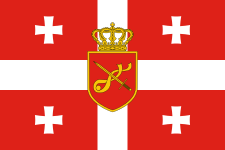
- Dienstflagge · offiziell
- State affiliation · Georgia
- Vigil-Kategoriezeichen · kein offizielles Abzeichen
Herkunft der Identitätsangaben
Service ensign: Main military flag of the Georgian Defence Forces. The main military flag of the Georgian armed forces — the five-cross field with the national arms at the centre, adopted 2007. CLEARED WITH A CAVEAT in the earlier manifest and not fetched; now fetched and shipped, and the caveat is kept rather than dropped: the force was renamed from Armed Forces to Defence Forces in 2018 and no source located in this pass establishes whether the flag was restyled with it. The label therefore names the flag rather than asserting a date, and the record's own text carries the institutional history. FILE: Wikimedia Commons "Flag of the Georgian Armed Forces.svg", public domain, credited on Commons to the Georgian Ministry of Defence (mod.gov.ge). 44KB optimised to 28KB — editor metadata removed, coordinate precision reduced to two decimals. Geometry, colours and viewBox unaltered. Inherited by the two territorial commands, the aviation and air-defence command, the special operations forces and the National Guard; the Border Police is a separate root under the Interior Ministry and correctly inherits nothing.
State affiliation: Georgia.
Das kleinere quadratische Zeichen ist ein Vigil-Kategoriezeichen, abgeleitet aus Bereich, Führungsebene und Rolle, die dieser Eintrag selbst angibt — kein offizielles Abzeichen.
Kurz gefasst
Georgiens nationales Militär — seit zwei Jahrzehnten NATO-Partner und im Westen ausgebildet, unter einer Regierung, deren Westorientierung inzwischen infrage steht.
- Geltungsbereich
- Struktur, Rolle, Entstehung und Verknüpfungen. 5 unterstellte Einträge veröffentlicht.
- Unterstellung
- Unterstellung bestätigt
- Quellen
- 3 im Eintrag
- Eintragsstatus
- Vollständig
- Allgemeines Tätigkeitsfeld
- Government-controlled territory; the boundary lines with Abkhazia and South Ossetia are policed by interior structures with the EUMM monitoring from the government side. Broad structural description only.
- Bemerkenswerte Geschichte
- Rebuilt twice: after the 1990s civil and secession wars, and after the five-day defeat of 2008. Two decades of NATO partnership — Iraq and Afghanistan deployments among the alliance's largest per capita, US-supported training programmes, a professionalisation drive — built an interoperable light force. The 2024–26 political crisis has strained the Western defence relationships the force was built on, with some cooperation programmes publicly paused by partners.
- Stärken
- NATO-standard training lineage and deployment experience; coherent professional core; mountain and light-infantry suitability.
- Einschränkungen
- Small size and limited heavy/air capability against its only plausible state threat; strategic depth measured in tens of kilometres; a political environment placing its partnership anchors in doubt.
Unterstellte Verbände
Commands & districts 3
Georgian Eastern Defence CommandKommandoGeorgian Western Defence CommandKommandoGeorgian Aviation and Air Defence CommandKommandoUnits & detachments 1
Funktionale Teilbereiche 1
Zeilen dienen nur dem Layout — Position und Reihenfolge bedeuten keine Hierarchie, Bedeutung, Abfolge oder Stärke. Jeder gezeigte Eintrag ist der ausgewählten Organisation unmittelbar unterstellt. Überschriften leiten sich aus Typ und Führungsebene jedes Eintrags ab. Sie sind keine Kommandoebenen, und im Streitkräftebaum gibt es keine solche Ebene.
Gemeldete und historische Ausrüstungszuordnungen
Su-25: Operated the type and hosted its Soviet-era production line at Tbilisi; 2008 war employment documented.
Verwandte Orte
Gori: 2008 war operations and the garrison town's historical role.
Total defence within a policy that forecloses offensive options. The unilateral non-use-of-force commitment removes territorial recovery as a military task, leaving deterrence, resilience and interoperability as what the force is actually for.
Bevorzugte Vorgehensweisen
Territorial defence with a societal component, conducted under a political constraint that is unusual and load-bearing: Georgia committed unilaterally in 2010 not to use force to restore its territorial integrity, which removes the mission a comparable force would otherwise be organised around. What remains is deterrence of further encroachment, resilience against a threat with overwhelming local advantage, and interoperability with partners — the last pursued through two decades of NATO-standard reform and substantial deployment experience abroad, which is the force's most distinctive feature. Reserve and territorial components have been reorganised repeatedly. Defence of the boundary lines themselves is conducted by police rather than military structures, which is a deliberate reflection of the same political framing.
Eine breite Verallgemeinerung darüber, wie diese Organisation vorgeht, eingestuft als Einschätzung — keine Beschreibung aktueller Taktiken und bewusst ohne Punktwert für Fähigkeit oder Wirksamkeit.
Führungsstil
NATO-standard structures adopted over two decades, with civilian control established in law. The variable is political rather than institutional: the partnership orientation that shaped the reform is contested domestically in a way it was not before 2024.
Wo diese Verallgemeinerung nicht trägt
The generalisation fails in one important way: describing this as a military doctrine overstates it. The binding constraints on what Georgia's forces are for are political and legal — a unilateral commitment, a partnership orientation now domestically contested, and an adversary against which no force Georgia could field would be decisive. The doctrine documents follow from those facts rather than driving them.
Beobachtete Anpassungen
Reorientation after 2008 from an expeditionary and partnership-focused posture toward territorial defence, following a war in which the former proved irrelevant.
Assignment of boundary-line policing to the Border Police rather than to military structures, keeping a disputed line in a law-enforcement frame consistent with the non-use-of-force commitment.
Was unbekannt bleibt
- Force readiness and dispositions are not published by this module and are not the basis of any claim here.
- The practical implications of the post-2024 political trajectory for partnership-based reform are not yet observable.
- Reserve and territorial component effectiveness has not been independently assessed.
Kampagnen
Kampagnen, die diese Organisation als Beteiligte nennen. Der Kampagneneintrag ist Träger der Beziehung und stuft sie ein; diese Liste wird berechnet.
- Georgiens territoriale Konflikte — Abchasien und Südossetien Primary force · Since 1991 · high confidence · as of 2026-06
Schlüsselereignisse
Der Russisch-Georgische Krieg
Nach monatelanger Eskalation greift Georgien Tskhinvali an; Russlands vorbereitete Gegeninvasion treibt die georgischen Kräfte aus Südossetien, eröffnet eine zweite Front von Abchasien aus und stößt in das unumstrittene Georgien vor, bevor am fünften Tag ein von der EU vermittelter Waffenstillstand greift. Die unabhängige Untersuchung der EU stellt später fest, dass Georgien in einem Konflikt, den beide Seiten vorbereitet und Russland provoziert hatte, zuerst geschossen hat.
Beteiligung an Kampagnen
Der Südossetienkrieg
Kämpfe zwischen georgischen Kräften und südossetischen Separatisten um das ehemalige autonome Gebiet fordern rund tausend Tote und vertreiben Zehntausende in beide Richtungen. Das Abkommen von Sotschi vom Juni 1992 beendet die Kämpfe mit einem gemischten Friedenstruppenformat unter russischer Führung und belässt die Region außerhalb der Kontrolle von Tiflis.
Der Abchasienkrieg und die Vertreibung der Georgier
Der Krieg zwischen georgischen Kräften und abchasischen Separatisten — unterstützt von Freiwilligen aus dem Nordkaukasus und russischen Elementen — endet mit dem Fall von Sukhumi (Sokhumi) am 27. September 1993 und der Flucht oder Vertreibung des größten Teils der georgischen Bevölkerung Abchasiens, etwa 200,000–250,000 Menschen, inmitten dokumentierter ethnischer Gewalt auf beiden Seiten.
Schnellaktionen
Zugang zum System
Wo dieser Eintrag an den Rest von Vigil anschließt. Jede Zeile steht hier, weil diese Organisation tatsächlich dorthin reicht.
Eingeschätzt zum Stand — 2026-06 Zuletzt überprüft — 2026-07-18
Diesen Verband in der Struktur ansehen Interaktiv: Wählen Sie diesen Eintrag aus und verfolgen Sie, was mit ihm verbunden ist.