
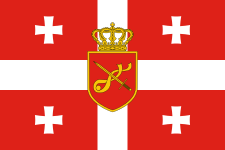
- Bandera rodzaju sił · oficjalna
- State affiliation · Georgia
- Symbol kategorii Vigil · nie jest to oficjalne oznaczenie
Pochodzenie tożsamości
Service ensign: Main military flag of the Georgian Defence Forces. The main military flag of the Georgian armed forces — the five-cross field with the national arms at the centre, adopted 2007. CLEARED WITH A CAVEAT in the earlier manifest and not fetched; now fetched and shipped, and the caveat is kept rather than dropped: the force was renamed from Armed Forces to Defence Forces in 2018 and no source located in this pass establishes whether the flag was restyled with it. The label therefore names the flag rather than asserting a date, and the record's own text carries the institutional history. FILE: Wikimedia Commons "Flag of the Georgian Armed Forces.svg", public domain, credited on Commons to the Georgian Ministry of Defence (mod.gov.ge). 44KB optimised to 28KB — editor metadata removed, coordinate precision reduced to two decimals. Geometry, colours and viewBox unaltered. Inherited by the two territorial commands, the aviation and air-defence command, the special operations forces and the National Guard; the Border Police is a separate root under the Interior Ministry and correctly inherits nothing.
State affiliation: Georgia.
Mniejszy kwadratowy znak to symbol kategorii Vigil, wyprowadzony z domeny, szczebla i roli podanych w samym wpisie — nie jest to oficjalne oznaczenie.
W skrócie
Narodowe siły zbrojne Gruzji — partner NATO, szkolone przez Zachód od dwóch dekad, pod rządem, którego prozachodnia orientacja stoi obecnie pod znakiem zapytania.
- Zakres
- Struktura, rola, rodowód i powiązania. Opublikowane wpisy podległe: 5.
- Podporządkowanie
- Podporządkowanie: potwierdzone
- Źródła
- We wpisie: 3
- Stan wpisu
- Pełny
- Szeroki obszar działania
- Government-controlled territory; the boundary lines with Abkhazia and South Ossetia are policed by interior structures with the EUMM monitoring from the government side. Broad structural description only.
- Istotna historia
- Rebuilt twice: after the 1990s civil and secession wars, and after the five-day defeat of 2008. Two decades of NATO partnership — Iraq and Afghanistan deployments among the alliance's largest per capita, US-supported training programmes, a professionalisation drive — built an interoperable light force. The 2024–26 political crisis has strained the Western defence relationships the force was built on, with some cooperation programmes publicly paused by partners.
- Mocne strony
- NATO-standard training lineage and deployment experience; coherent professional core; mountain and light-infantry suitability.
- Ograniczenia
- Small size and limited heavy/air capability against its only plausible state threat; strategic depth measured in tens of kilometres; a political environment placing its partnership anchors in doubt.
Formacje podległe
Commands & districts 3
Wschodnie Dowództwo Obrony GruzjiDowodzenieZachodnie Dowództwo Obrony GruzjiDowodzenieDowództwo Lotnictwa i Obrony Powietrznej GruzjiDowodzenieUnits & detachments 1
Komponenty funkcjonalne 1
Wiersze służą wyłącznie układowi — położenie i kolejność nie wyrażają hierarchii, znaczenia, sekwencji ani siły. Każdy pokazany wpis jest bezpośrednio podległy wybranej organizacji. Nagłówki wynikają z własnego typu i szczebla każdego wpisu. Nie są warstwami dowodzenia i w drzewie sił nie istnieje żadna taka warstwa.
Zgłoszone i historyczne powiązania ze sprzętem
Su-25: Operated the type and hosted its Soviet-era production line at Tbilisi; 2008 war employment documented.
Powiązane lokalizacje
Gori: 2008 war operations and the garrison town's historical role.
Total defence within a policy that forecloses offensive options. The unilateral non-use-of-force commitment removes territorial recovery as a military task, leaving deterrence, resilience and interoperability as what the force is actually for.
Preferowane metody działania
Territorial defence with a societal component, conducted under a political constraint that is unusual and load-bearing: Georgia committed unilaterally in 2010 not to use force to restore its territorial integrity, which removes the mission a comparable force would otherwise be organised around. What remains is deterrence of further encroachment, resilience against a threat with overwhelming local advantage, and interoperability with partners — the last pursued through two decades of NATO-standard reform and substantial deployment experience abroad, which is the force's most distinctive feature. Reserve and territorial components have been reorganised repeatedly. Defence of the boundary lines themselves is conducted by police rather than military structures, which is a deliberate reflection of the same political framing.
Szerokie uogólnienie tego, jak działa ta organizacja, ze stopniem pewności jak każda ocena — nie opis bieżącej taktyki i celowo bez żadnej punktacji zdolności czy skuteczności.
Styl dowodzenia
NATO-standard structures adopted over two decades, with civilian control established in law. The variable is political rather than institutional: the partnership orientation that shaped the reform is contested domestically in a way it was not before 2024.
Gdzie to uogólnienie przestaje obowiązywać
The generalisation fails in one important way: describing this as a military doctrine overstates it. The binding constraints on what Georgia's forces are for are political and legal — a unilateral commitment, a partnership orientation now domestically contested, and an adversary against which no force Georgia could field would be decisive. The doctrine documents follow from those facts rather than driving them.
Zaobserwowane adaptacje
Reorientation after 2008 from an expeditionary and partnership-focused posture toward territorial defence, following a war in which the former proved irrelevant.
Assignment of boundary-line policing to the Border Police rather than to military structures, keeping a disputed line in a law-enforcement frame consistent with the non-use-of-force commitment.
Co pozostaje nieznane
- Force readiness and dispositions are not published by this module and are not the basis of any claim here.
- The practical implications of the post-2024 political trajectory for partnership-based reform are not yet observable.
- Reserve and territorial component effectiveness has not been independently assessed.
Kampanie
Kampanie wymieniające tę organizację jako uczestnika. Relacja należy do wpisu kampanii i to on nadaje jej stopień pewności; ta lista jest wyliczana automatycznie.
- Konflikty terytorialne Gruzji — Abchazja i Osetia Południowa Primary force · Since 1991 · high confidence · as of 2026-06
Kluczowe wydarzenia
Wojna rosyjsko-gruzińska
Po miesiącach eskalacji Gruzja atakuje Cchinwali; przygotowana rosyjska kontrinwazja wypiera siły gruzińskie z Osetii Południowej, otwiera drugi front z Abchazji i wkracza w głąb niespornej części Gruzji, zanim piątego dnia dochodzi do zawieszenia broni wynegocjowanego przez UE. Niezależna komisja UE ustala później, że to Gruzja strzeliła pierwsza w konflikcie, do którego obie strony się przygotowały, a który Rosja sprowokowała.
Udział w kampaniach
Wojna w Osetii Południowej
Walki między siłami gruzińskimi a osetyjskimi separatystami o dawny obwód autonomiczny zabijają około tysiąca osób i wysiedlają dziesiątki tysięcy w obu kierunkach. Porozumienie z Soczi z czerwca 1992 r. kończy walki, wprowadzając mieszany format pokojowy pod przewodnictwem Rosji i pozostawiając region poza kontrolą Tbilisi.
Wojna w Abchazji i wypędzenie Gruzinów
Wojna między siłami gruzińskimi a abchaskimi separatystami — wspieranymi przez ochotników z Kaukazu Północnego i elementy rosyjskie — kończy się upadkiem Suchumi (Sochumi) 27 września 1993 r. oraz ucieczką lub wypędzeniem większości gruzińskiej ludności Abchazji, około 200,000–250,000 osób, wśród udokumentowanej przemocy etnicznej po obu stronach.
Szybkie działania
Dostęp do systemu
Miejsca, w których ten wpis łączy się z resztą Vigil. Każdy wiersz jest tu dlatego, że ta organizacja rzeczywiście tam sięga.
Ocena na dzień — 2026-06 Ostatni przegląd — 2026-07-18
Zobacz te siły w strukturze Interaktywnie: wybierz ten wpis i prześledź, co się z nim łączy.