
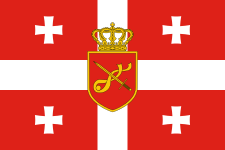
- Прапор виду збройних сил · офіційний
- State affiliation · Georgia
- Категорійне позначення Vigil · не офіційна емблема
Походження ідентифікації
Service ensign: Main military flag of the Georgian Defence Forces. The main military flag of the Georgian armed forces — the five-cross field with the national arms at the centre, adopted 2007. CLEARED WITH A CAVEAT in the earlier manifest and not fetched; now fetched and shipped, and the caveat is kept rather than dropped: the force was renamed from Armed Forces to Defence Forces in 2018 and no source located in this pass establishes whether the flag was restyled with it. The label therefore names the flag rather than asserting a date, and the record's own text carries the institutional history. FILE: Wikimedia Commons "Flag of the Georgian Armed Forces.svg", public domain, credited on Commons to the Georgian Ministry of Defence (mod.gov.ge). 44KB optimised to 28KB — editor metadata removed, coordinate precision reduced to two decimals. Geometry, colours and viewBox unaltered. Inherited by the two territorial commands, the aviation and air-defence command, the special operations forces and the National Guard; the Border Police is a separate root under the Interior Ministry and correctly inherits nothing.
State affiliation: Georgia.
Менший квадратний знак — категорійне позначення Vigil, утворене з власних домену, ешелону і ролі цього запису, — а не офіційна емблема.
Коротко
Національні збройні сили Грузії — партнер НАТО, що два десятиліття навчався за західними стандартами, під урядом, чия західна орієнтація нині під питанням.
- Обсяг
- Структура, роль, спадкоємність і зв’язки. Опубліковано підпорядкованих записів: 5.
- Підпорядкування
- Підпорядкування підтверджено
- Джерела
- У записі: 3
- Стан запису
- Повний
- Широкий район діяльності
- Government-controlled territory; the boundary lines with Abkhazia and South Ossetia are policed by interior structures with the EUMM monitoring from the government side. Broad structural description only.
- Примітна історія
- Rebuilt twice: after the 1990s civil and secession wars, and after the five-day defeat of 2008. Two decades of NATO partnership — Iraq and Afghanistan deployments among the alliance's largest per capita, US-supported training programmes, a professionalisation drive — built an interoperable light force. The 2024–26 political crisis has strained the Western defence relationships the force was built on, with some cooperation programmes publicly paused by partners.
- Сильні сторони
- NATO-standard training lineage and deployment experience; coherent professional core; mountain and light-infantry suitability.
- Обмеження
- Small size and limited heavy/air capability against its only plausible state threat; strategic depth measured in tens of kilometres; a political environment placing its partnership anchors in doubt.
Підпорядковані формування
Commands & districts 3
Східне командування оборони ГрузіїКомандуванняЗахідне командування оборони ГрузіїКомандуванняКомандування авіації та протиповітряної оборони ГрузіїКомандуванняUnits & detachments 1
Функціональні роди військ 1
Рядки слугують лише для розміщення — позиція й порядок не означають ієрархії, важливості, послідовності чи сили. Кожен показаний запис є безпосередньо підпорядкованим вибраній організації. Заголовки виведено з власного типу та ланки кожного запису. Це не рівні командування, і такого рівня в дереві сил не існує.
Повідомлені та історичні зв’язки з технікою
Su-25: Operated the type and hosted its Soviet-era production line at Tbilisi; 2008 war employment documented.
Пов’язані місця
Gori: 2008 war operations and the garrison town's historical role.
Total defence within a policy that forecloses offensive options. The unilateral non-use-of-force commitment removes territorial recovery as a military task, leaving deterrence, resilience and interoperability as what the force is actually for.
Переважні способи дій
Territorial defence with a societal component, conducted under a political constraint that is unusual and load-bearing: Georgia committed unilaterally in 2010 not to use force to restore its territorial integrity, which removes the mission a comparable force would otherwise be organised around. What remains is deterrence of further encroachment, resilience against a threat with overwhelming local advantage, and interoperability with partners — the last pursued through two decades of NATO-standard reform and substantial deployment experience abroad, which is the force's most distinctive feature. Reserve and territorial components have been reorganised repeatedly. Defence of the boundary lines themselves is conducted by police rather than military structures, which is a deliberate reflection of the same political framing.
Загальне узагальнення того, як діє ця організація, зі ступенем впевненості як оцінка, — не опис поточної тактики, і навмисно без жодної оцінки спроможностей чи ефективності в балах.
Стиль командування
NATO-standard structures adopted over two decades, with civilian control established in law. The variable is political rather than institutional: the partnership orientation that shaped the reform is contested domestically in a way it was not before 2024.
Де це узагальнення не спрацьовує
The generalisation fails in one important way: describing this as a military doctrine overstates it. The binding constraints on what Georgia's forces are for are political and legal — a unilateral commitment, a partnership orientation now domestically contested, and an adversary against which no force Georgia could field would be decisive. The doctrine documents follow from those facts rather than driving them.
Спостережені адаптації
Reorientation after 2008 from an expeditionary and partnership-focused posture toward territorial defence, following a war in which the former proved irrelevant.
Assignment of boundary-line policing to the Border Police rather than to military structures, keeping a disputed line in a law-enforcement frame consistent with the non-use-of-force commitment.
Що залишається невідомим
- Force readiness and dispositions are not published by this module and are not the basis of any claim here.
- The practical implications of the post-2024 political trajectory for partnership-based reform are not yet observable.
- Reserve and territorial component effectiveness has not been independently assessed.
Кампанії
Кампанії, які називають цю організацію учасником. Відносини належать запису кампанії, і він визначає їхній ступінь впевненості; цей перелік обчислюється.
- Територіальні конфлікти Грузії — Абхазія та Південна Осетія Primary force · Since 1991 · high confidence · as of 2026-06
Ключові події
Російсько-грузинська війна
Після місяців ескалації Грузія атакує Цхінвалі; заздалегідь підготовлене російське контрвторгнення витісняє грузинські сили з Південної Осетії, відкриває другий фронт з Абхазії та просувається на неоспорювану територію Грузії до перемир’я за посередництва ЄС на п’ятий день. Незалежне розслідування ЄС згодом встановлює, що Грузія відкрила вогонь першою в конфлікті, до якого готувалися обидві сторони і який спровокувала Росія.
Участь у кампаніях
Війна в Південній Осетії
Бої між грузинськими силами та південноосетинськими сепаратистами за колишню автономну область забирають життя близько тисячі людей і змушують десятки тисяч покинути домівки в обох напрямках. Сочинська угода червня 1992 року припиняє бойові дії, запроваджуючи змішаний миротворчий формат під проводом Росії, а регіон залишається поза контролем Тбілісі.
Війна в Абхазії та вигнання грузинів
Війна між грузинськими силами та абхазькими сепаратистами — яких підтримували добровольці з Північного Кавказу та російські елементи — завершується падінням Сухумі (Сохумі) 27 вересня 1993 року та втечею або вигнанням більшої частини грузинського населення Абхазії, близько 200,000–250,000 осіб, на тлі задокументованого етнічного насильства з обох боків.
Швидкі дії
Доступ до системи
Де цей запис з’єднується з рештою Vigil. Кожен рядок наведено тому, що ця організація справді до нього сягає.
Оцінено станом на — 2026-06 Востаннє переглянуто — 2026-07-18
Переглянути ці сили в структурі Інтерактивно: виберіть цей запис і простежте, що з ним пов’язано.