
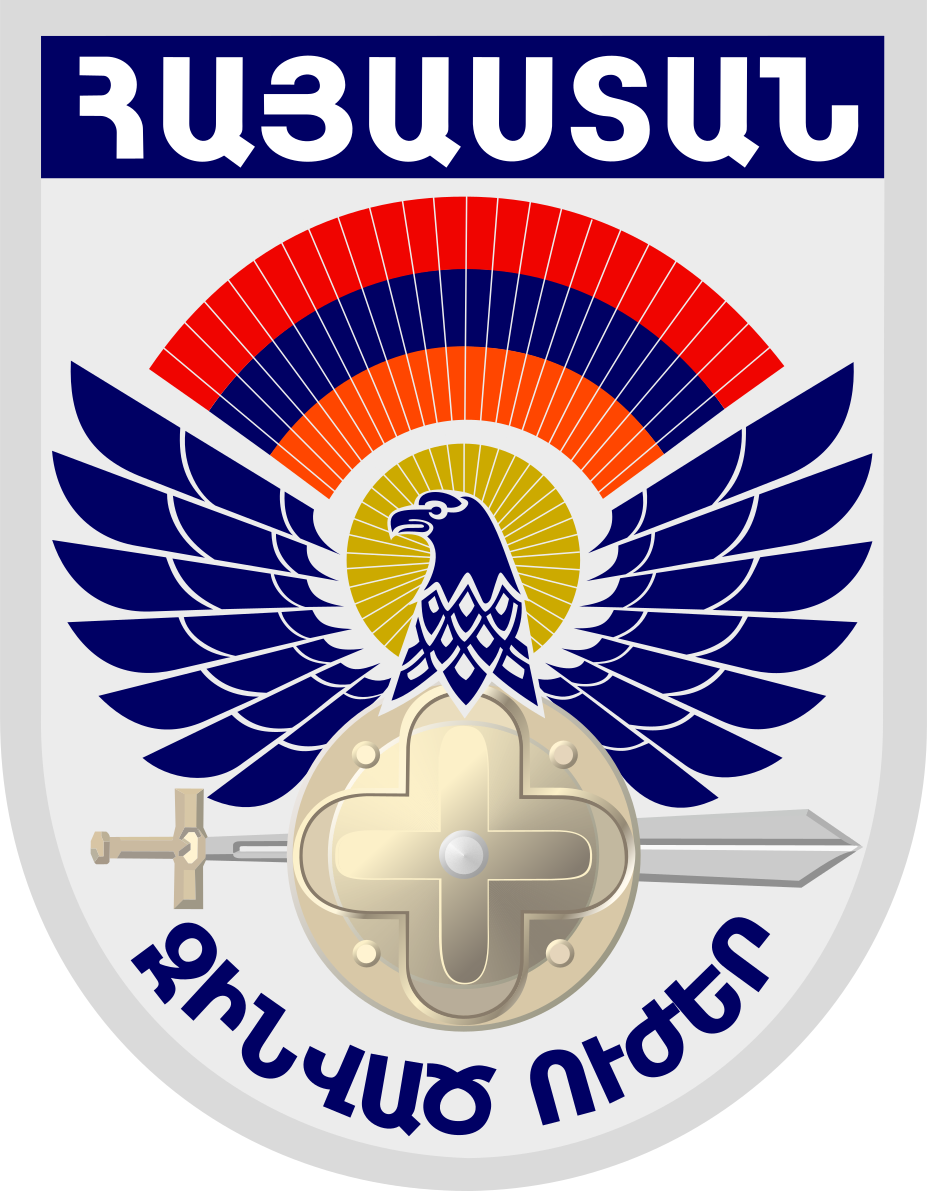
- Service emblem · official · carried by Armenian Armed Forces
- State affiliation · Armenia
- Vigil category device · not official insignia
Identity provenance
Service emblem: Emblem of the Armed Forces of Armenia — carried by Armenian Armed Forces, not issued to this record. The emblem of the Armed Forces of Armenia — a shield bearing the eagle-and-lion arms over crossed elements, with the service's name in Armenian. A SERVICE-EMBLEM, NOT A FLAG, and the kind field says so: no flag file of the Armed Forces was located, and an emblem is what the institution publishes. This candidate was CLEARED ON LICENCE in the earlier manifest and not fetched; it is now fetched, checked and shipped. Public domain on Commons, no attribution obligation. LEGIBILITY, STATED: a badge on a transparent ground has no field colour, so at 18x12px it reads as a pale form rather than as itself. It carries real identity at 38x26 and 40x40, which is where the Atlas shows a mark on a card and a masthead, and that is the basis on which it was kept. FILE: Wikimedia Commons "Emblem of the Armed Forces of Armenia.svg", public domain, vectorised by Arman Militosyan. 111KB optimised to 65KB — editor metadata removed, coordinate precision reduced to two decimals on a 24,529-unit canvas. Geometry, colours and viewBox unaltered. Inherited by the five army corps, the ground forces, the air force and air defence, and the peacekeeping brigade; the Border Guard is a separate root under a different ministry and correctly inherits nothing.
State affiliation: Armenia.
The smaller square mark is a Vigil category device, drawn from this record’s own domain, echelon and role — not an official insignia.
In brief
The land force — five territorial army corps of Soviet-pattern regiments and fortified regions, built for the defence the 2020 war defeated, and the service the 2024–2035 transformation concept is rebuilding around brigades, professional soldiers and a non-commissioned officer corps it never had.
- Scope
- Structure, role, lineage and links. 6 subordinate records published.
- Subordination
- Subordination confirmed
- Sources
- 3 on the record
- Record state
- Partial
- Broad area of activity
- The whole national territory, with corps sectors facing the frontier with Azerbaijan in the north-east, east and south-east, the closed Turkish frontier in the west and the capital. Broad structural description only.
- Notable history
- The ground force was built in the first Karabakh war from Soviet stocks and volunteer detachments and organised afterwards into five army corps, each holding a sector of the frontier with motor-rifle regiments, independent battalions and, around the capital, fortified regions — a structure designed to hold prepared positions against a conventional attack. The 2020 war defeated that design rather than its soldiers, and the transformation concept the defence ministry published in November 2024 says so: brigades are to become the standard combat unit in place of the divisions and regiments, rapid-response forces are to be created at the operational level, special forces expanded, the senior officer corps reduced and a professional non-commissioned officer corps built. The corps below are the structure that exists while that concept is implemented, and the records say which is which.
- Strengths
- A society-wide reserve tradition, hard-won institutional experience of drone-era defence, and — since 2023 — supplier relationships with India and France that the force had never had.
- Limitations
- A Soviet-pattern territorial structure that the ministry itself has judged unfit, in the middle of a reform whose delivery cannot be assessed from outside; the loss of the Russian equipment pipeline without a full replacement; and the 2020 gaps — air defence density, unmanned systems, counter-battery depth — publicly acknowledged as long-term projects. No strength, holdings, positions or readiness are published.
Subordinate formations
Corps 5
Armenian 1st Army CorpsCorps · subordination reportedArmenian 2nd Army CorpsCorps · subordination reportedArmenian 3rd Army CorpsCorps · subordination reportedArmenian 4th Army CorpsCorps · subordination reportedArmenian 5th Army CorpsCorps · subordination reportedBrigades 1
Rows are layout only — position and order carry no hierarchy, importance, sequence or strength. Every record shown is an immediate subordinate of the selected organisation. Headings are derived from each record’s own type and echelon. They are not command layers, and no such layer exists in the force tree.
Campaigns
Campaigns naming this organisation as a participant. The campaign record owns the relationship and grades it; this list is computed.
- The Karabakh conflict, 1988–2023 Opposing force · February 1988 – September 2023 · high confidence · as of 2020-11
The corps-based territorial force whose posture the 2020 war defeated.
Quick actions
System access
Where this record connects into the rest of Vigil. Each row is here because this organisation actually reaches it.
Assessed as of — 2026-06 Last reviewed — 2026-09-09
See this force in the structure Interactive: select this record and follow what connects to it.