
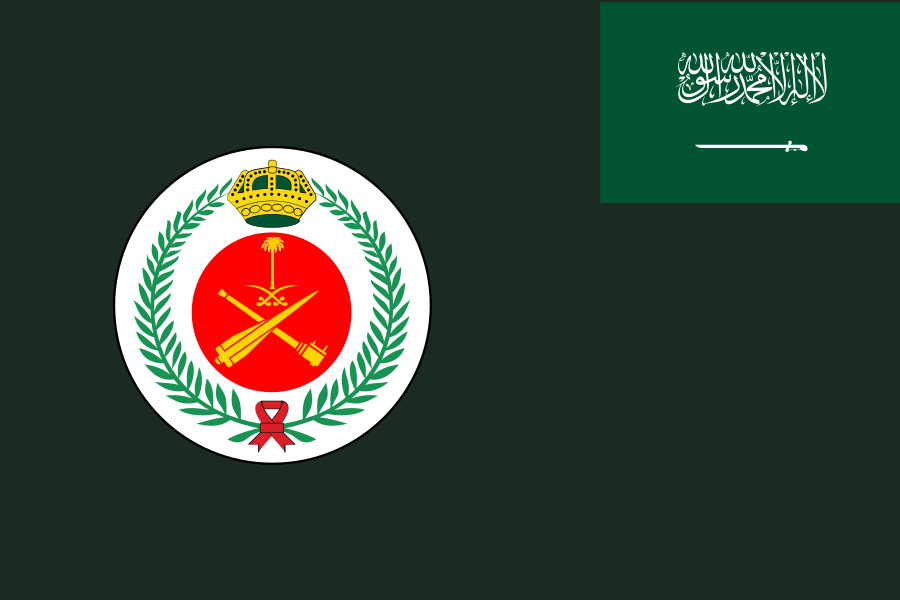
- Service ensign · official
- State affiliation · Saudi Arabia
- Vigil category device · not official insignia
Identity provenance
Service ensign: Flag of the Royal Saudi Air Defense Forces. The Royal Saudi Air Defense Forces flag — a dark green field charged with the service badge. THE ONLY GULF SERVICE MARK THIS PASS COULD SHIP, and the reason the others could not is recorded in the manifest rather than inferred: the Royal Saudi Air Force, Land Forces and Naval Forces marks located on Commons are CC BY-SA, which carries share-alike obligations this site does not take on, and several are 200-570KB besides. FILE: Wikimedia Commons "Flag of the Royal Saudi Air Defense Forces.svg", public domain, no attribution obligation. 80KB optimised to 70KB — editor metadata removed, coordinate precision reduced to two decimals. Geometry, colours and viewBox unaltered. This is a BRANCH record, so nothing inherits from it; the Saudi root keeps the state flag and its category device.
State affiliation: Saudi Arabia.
The smaller square mark is a Vigil category device, drawn from this record’s own domain, echelon and role — not an official insignia.
In brief
A separate air-defence service rather than an air-force command — the institution that owns the kingdom's ground-based air and missile defence, and the reason Saudi air defence is organisationally distinct from Saudi air power.
- Scope
- Structure, role, lineage and links. No subordinate records published.
- Subordination
- Subordination confirmed
- Sources
- 3 on the record
- Record state
- Partial
- Broad area of activity
- Saudi territory, with the historical weight on the eastern oil infrastructure and the Yemen frontier
- Notable history
- Saudi Arabia separated its ground-based air defence from the air force in 1984 and made it a service in its own right, which is unusual and load-bearing: the organisation that owns the Patriot and THAAD batteries is not the organisation that flies the fighters, and integrating the two is a Saudi problem rather than a given. The service's operational history is the Yemen campaign, during which it engaged years of ballistic missiles and drones fired into the kingdom, and the September 2019 attack on Abqaiq and Khurais, in which low-flying drones and cruise missiles reached the oil processing plant without being engaged — the event that reshaped Gulf air-defence thinking before the current war. In the war that began in February 2026 the kingdom was among the six states attacked, and the disputed strike on Ras Tanura in March is the module's Saudi chronology; what this service engaged, and with what result, is not established in anything the module has read.
- Strengths
- A decade of continuous engagement against the missile and drone threat, layered Western systems, and an institutional focus that an air-force sub-command would not have.
- Limitations
- Abqaiq is the standing lesson: a system built against ballistic missiles and aircraft was found by drones and cruise missiles coming low from an unexpected direction, and the gaps between fixed batteries are the structural problem the service has been working on since. The seam with the air force is a second one. No sites, coverage, engagement records or readiness are recorded.
Documented equipment
Lineage & institutional history
Campaigns
Campaigns naming this organisation as a participant. The campaign record owns the relationship and grades it; this list is computed.
- The Saudi–Houthi Red Sea front, 2026 round Opposing force · Since 13 July 2026 · moderate confidence
The service whose mission the 8 September wave engaged; no interception outcome is authored.
Key events
Attack on Saudi oil processing at Abqaiq
A drone and missile attack strikes Saudi Arabia's principal crude processing complex, briefly removing a substantial share of the kingdom's output.
The heaviest Houthi attack wave against Saudi territory of this round
The spokesman of the Saudi-led coalition, Major-General Turki al-Maliki, states that attacks on civilian and economic sites at Abha, Khamis Mushait, Jazan and Najran wounded 73 people, including women and children, and that fires broke out at oil facilities and utilities in the southern region, where operations were temporarily suspended. The Houthi movement claims strikes with dozens of ballistic missiles and drones on Aramco facilities and on King Khalid air base, and states they answered more than a hundred Saudi air strikes in Yemen over the preceding three days. Türkiye condemns the attacks the same day and reaffirms its support for Saudi sovereignty and territorial integrity. THE WAVE CONTINUED THROUGH THE MONTH AND REACHED THE CAPITAL. On 15 September the coalition reported 13 civilians wounded at Khamis Mushait, Abha and Taif and said it had downed a Houthi drone south of Mecca; the movement called the Mecca account a lie and said its targets were oil facilities and military bases. On 17 September Saudi state television reported one person killed and two wounded by debris from a drone intercepted over Taif — the first reported civilian death in Saudi Arabia in this round. At dawn on 19 September the coalition said it had intercepted a ballistic missile fired at Riyadh; an eyewitness told Reuters of flames and smoke near King Khalid International Airport, and the movement claimed "sensitive sites" in Riyadh and Aramco facilities at Yanbu. On 24 September the coalition said it had shot down six ballistic missiles fired at Taif and Yanbu, while the movement claimed a "sensitive target" in Riyadh and Aramco infrastructure at Yanbu. On 26 September it said it had intercepted two drones fired towards Riyadh and two ballistic missiles towards Khamis Mushait, and the Gulf Cooperation Council's Secretary-General condemned the attacks as a violation of Saudi sovereignty. The movement reported fourteen Saudi air strikes in Yemen on 25 September; no coalition acknowledgement of them has been read. On 1 October the coalition said a drone had struck the Taibah electricity distribution station in Medina, which supplies the Prophet's Mosque, at 05:11 on 29 September. It said one transformer was taken out of service without affecting the wider network, and it attributed the attack to the movement on the evidence of the drone's wreckage. The movement denied involvement. Türkiye, Qatar, the UAE and the Arab League condemned the attack. That evening the Yemeni government's military said it had struck Houthi targets in Sanaa, Saada and Taiz. On 3 October a Reuters witness saw a large plume of smoke and fire near an Aramco facility in Riyadh. The movement claimed a missile and drone strike on Aramco in the capital, the coalition called the claims misleading, and neither Saudi authorities nor Aramco confirmed a strike or gave a cause.
Quick actions
System access
Where this record connects into the rest of Vigil. Each row is here because this organisation actually reaches it.
Assessed as of — 2026-09 Last reviewed — 2026-09-09
See this force in the structure Interactive: select this record and follow what connects to it.