
2027 Strategic Outlook / Iran–Gulf
Iran–Gulf · VO-2027-IG
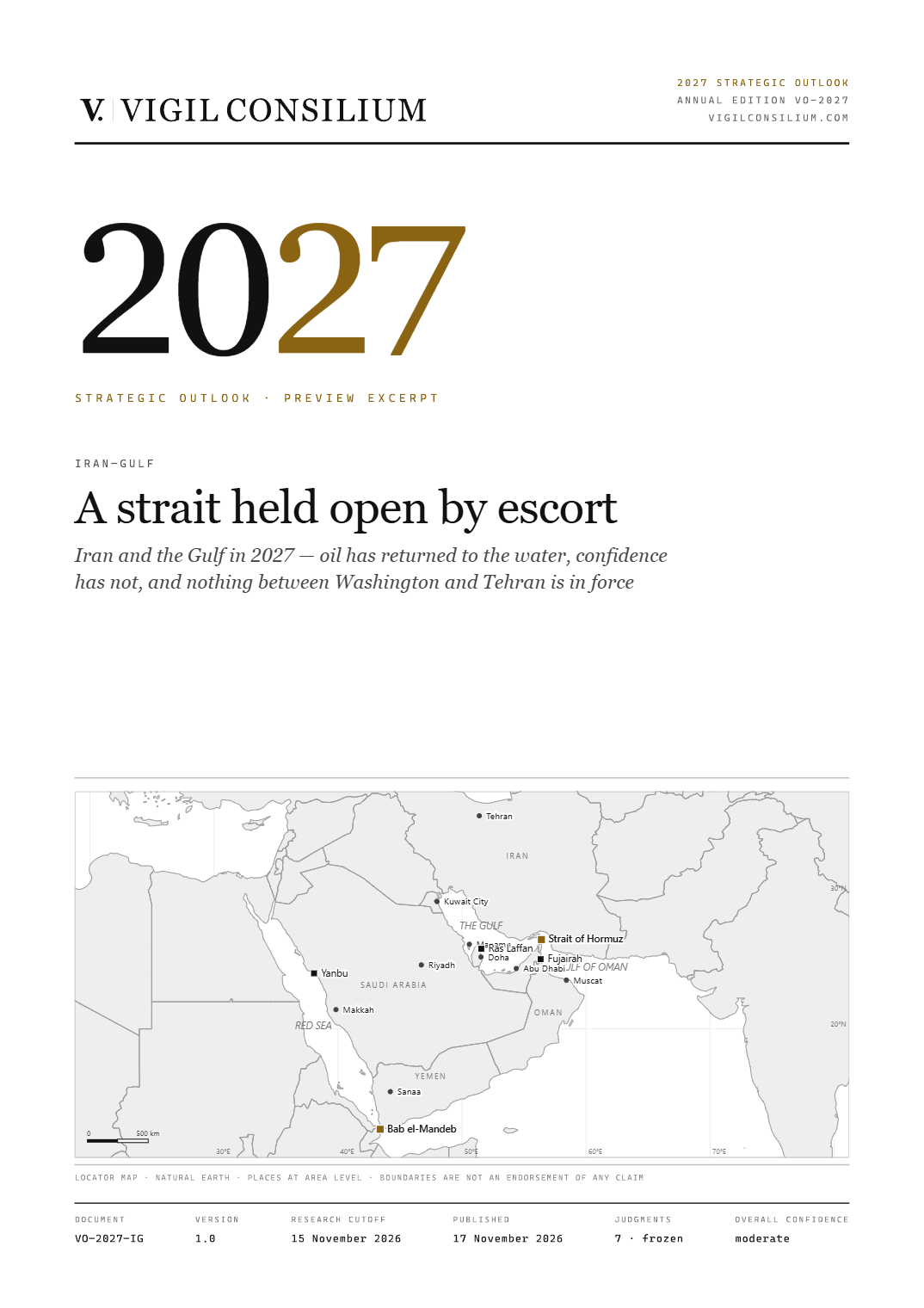
A strait held open by escort
Iran and the Gulf in 2027 — oil has returned to the water, confidence has not, and nothing between Washington and Tehran is in force
Available
Researched, independently audited and approved for publication.
- 23 pages, PDF
- 55 sources
- 7 judgments
- Research cutoff 15 November 2026
- Published 17 November 2026
- €19 / $22
Purchase
This assessment, or a collection that includes it
PDF, delivered at once after PayPal confirms the payment. On sale until 15 January 2027; buyers keep access afterwards. Also part of Middle East 2027 and Complete 2027 Collection.
Executive judgment
What the assessment concludes
Vigil's central case for 2027 is pressure without settlement. Gulf oil has largely returned to its export routes through escorts, shuttle tankers and pipelines, but Vigil does not expect the Strait of Hormuz to return to normal commercial use in the first half of the year, and does not expect a verified account of Iran's enriched uranium by its end. A narrow blockade-for-passage arrangement between Washington and Tehran is plausible; it would restore volume faster than confidence.Central judgment · confidence in the basis: moderate
The Iran–Gulf system enters 2027 in the ninth month of an interstate war with no instrument in force. Its defining condition is volume without access: Gulf crude exports outside Iran recovered to the pre-war average by September, while transits through the Strait of Hormuz remained about two-thirds below the pre-conflict level and ships were still being struck in mid-November. Vigil's central case is pressure without settlement — a strait held open by escort, a nuclear programme no one can verify, and Gulf defence assembled one bilateral arrangement at a time.
Energy, legal and United Nations documents were read at source; so were UKMTO's overview of 13 November and the Agency's report of 1 September 2026, while earlier UKMTO weeks are carried from Vigil's record. The principal uncertainty is a decision: arrangement or renewed campaign.
Research questions
The questions it answers
- Does the Strait of Hormuz return to normal commercial use in 2027, or only to escorted volume?
- Is a limited arrangement between Washington and Tehran plausible, and what would it leave unsettled?
- Can the Agency account for Iran's enriched uranium in 2027, and does Iran leave the Non-Proliferation Treaty?
- What does the Makkah Agreement's entry into force change for Saudi Arabia's defence?
- Which Gulf energy capacity is restored in 2027, and which is not?
Themes
Findings the argument rests on
Volume is not access
Oil moves again through the strait and around it, but on a narrow shuttle fleet under naval escort and at reported insurance rates many times the pre-war level. The assessment separates the barrel count from the commercial confidence a normal market requires.
A nuclear file defined by absence
The Agency's last figure for Iran's highly enriched uranium dates from June 2025. The assessment sets out why neither a verified inventory nor a formal treaty exit is its expectation for 2027, and what would change either.
Security built outside the Gulf's institution
Saudi Arabia is defended through several overlapping arrangements, the newest a trilateral agreement with Türkiye and Pakistan that is not yet in force. The assessment examines what its text obliges, what it does not, and which energy capacity returns in 2027.
The 2027 judgments
7 dated statements, each with its test
The statements are public and frozen in theforecast register. The document adds, for each one, the evidence and mechanism, the strongest alternative reading, the signals to monitor and the evaluation rule.
| Id | Judgment | Expectation | Basis |
|---|---|---|---|
| VO27-IG-01 | Vigil does not expect the Strait of Hormuz to return to normal commercial use by 30 June 2027: UKMTO's weekly combined transits are not expected to stand within 20 per cent of the pre-conflict level for four consecutive weeks, and the Joint War Committee is expected still to list the Gulf.By 30 June 2027 | Not expected | moderate |
| VO27-IG-02 | Vigil considers it plausible that, by 30 June 2027, the United States and Iran announce a written, time-bound arrangement under which the United States suspends its naval blockade of Iranian ports and Iran undertakes to halt attacks on, and permit the passage of, commercial shipping in the Strait of Hormuz.By 30 June 2027 | Plausible | low |
| VO27-IG-03 | Vigil does not expect the International Atomic Energy Agency to report, by 31 December 2027, that it has verified the quantity and location of Iran's stock of uranium enriched to 60 per cent.By 31 December 2027 | Not expected | moderate |
| VO27-IG-04 | Vigil does not expect Iran to give formal notice of withdrawal from the Non-Proliferation Treaty under its Article X by 31 December 2027.By 31 December 2027 | Not expected | low |
| VO27-IG-05 | Vigil expects the Makkah Joint Defence Agreement to enter into force by 31 March 2027 and to remain uninvoked through 31 December 2027: no signatory is expected to name its Article 2 collective-defence clause as the basis of assistance requested or given.By 31 December 2027 | Expected | moderate |
| VO27-IG-06 | Vigil expects ADNOC's second crude pipeline to Fujairah to begin carrying crude by 31 December 2027, and expects the two liquefaction trains damaged at Ras Laffan in March 2026 still to be out of service on that date.By 31 December 2027 | Expected | moderate |
| VO27-IG-07 | Vigil does not expect a written truce between the Houthi movement and Saudi Arabia or Yemen's government, covering attacks on Saudi territory and the declared blockade of Saudi-linked shipping, to be announced by 30 June 2027.By 30 June 2027 | Not expected | low |
Expectation is Vigil's judgment of the outcome; "basis" grades the evidence. Neither is a probability. How the judgments are made.
Monitoring framework
What Vigil will watch
4 of the 8 observables in the document's framework.
| Observable | Review question | Public Watch record |
|---|---|---|
| UKMTO weekly combined and AIS-visible transit counts | Has any four-week run come within 20 per cent of the pre-conflict level? | /watch/iran-gulf/hormuz-commercial-access/ |
| Joint War Committee circulars and hull war rates after 1 January | Has the Gulf been removed from the Listed Areas? | /watch/iran-gulf/hormuz-commercial-access/ |
| Any text published by a mediator between Washington and Tehran | Is there a written arrangement that both governments acknowledge? | /watch/iran-gulf/nuclear-diplomacy-implementation/ |
| Agency reports and statements on inspections in Iran | Has an inspection taken place at a declared site other than Bushehr? | /watch/iran-gulf/iaea-access/ |
Uncertainty and limits
What this document cannot tell you
- This document cannot establish who carried out most strikes on shipping or on Saudi energy sites; unclaimed attacks are recorded as unattributed and claims as claims.
- It states nothing about the current size, enrichment or location of Iran's nuclear material, which no body has verified since June 2025.
- The choice between a limited arrangement and a renewed campaign rests with a few people whose public statements conflict; Vigil grades the pressures, not the decision.
- It rests on 8 official and primary · 31 reporting · 13 Vigil records · 3 research and data. Statements by interested parties are treated as positions, not as confirmed facts.
- It is research, not advice, and it is not operational: no positions, strengths, routes or targeting-relevant detail.
Public research
The Vigil record this assessment is built on
Free to read, and maintained every week. The assessment organises and extends it; it does not replace it.
- Iran and the Gulf: Maritime Access, Energy Systems and Regional SecurityModule
- Watch questions for Iran–GulfWatch
- Weekly briefsRead
- /watch/iran-gulf/hormuz-commercial-access/Watch record cited by a judgment
- /watch/iran-gulf/nuclear-diplomacy-implementation/Watch record cited by a judgment
- /watch/iran-gulf/iaea-access/Watch record cited by a judgment
- /watch/iran-gulf/makkah-operational-mechanism/Watch record cited by a judgment
- /watch/iran-gulf/saudi-houthi-front/Watch record cited by a judgment
- MethodologyHow Vigil grades evidence
The other assessments of the edition
- Ukraine–Russia: The financed stalemateAvailable
- NATO Eastern Flank: The year the flank's deadlines fall dueAvailable
- Syria: A state built ahead of its instrumentsAvailable
- Levant: Arrangements without settlementAvailable
- Sahel: Held capitals, contested roads, borrowed guarantorsAvailable
- Taiwan Strait: Pressure without a deadlineAvailable
- Caucasus: Peace in practice, not yet in lawAvailable
- 2027 Strategic Outlook11 products