
2027 Strategic Outlook / Caucasus
Caucasus · VO-2027-CA
Peace in practice, not yet in law
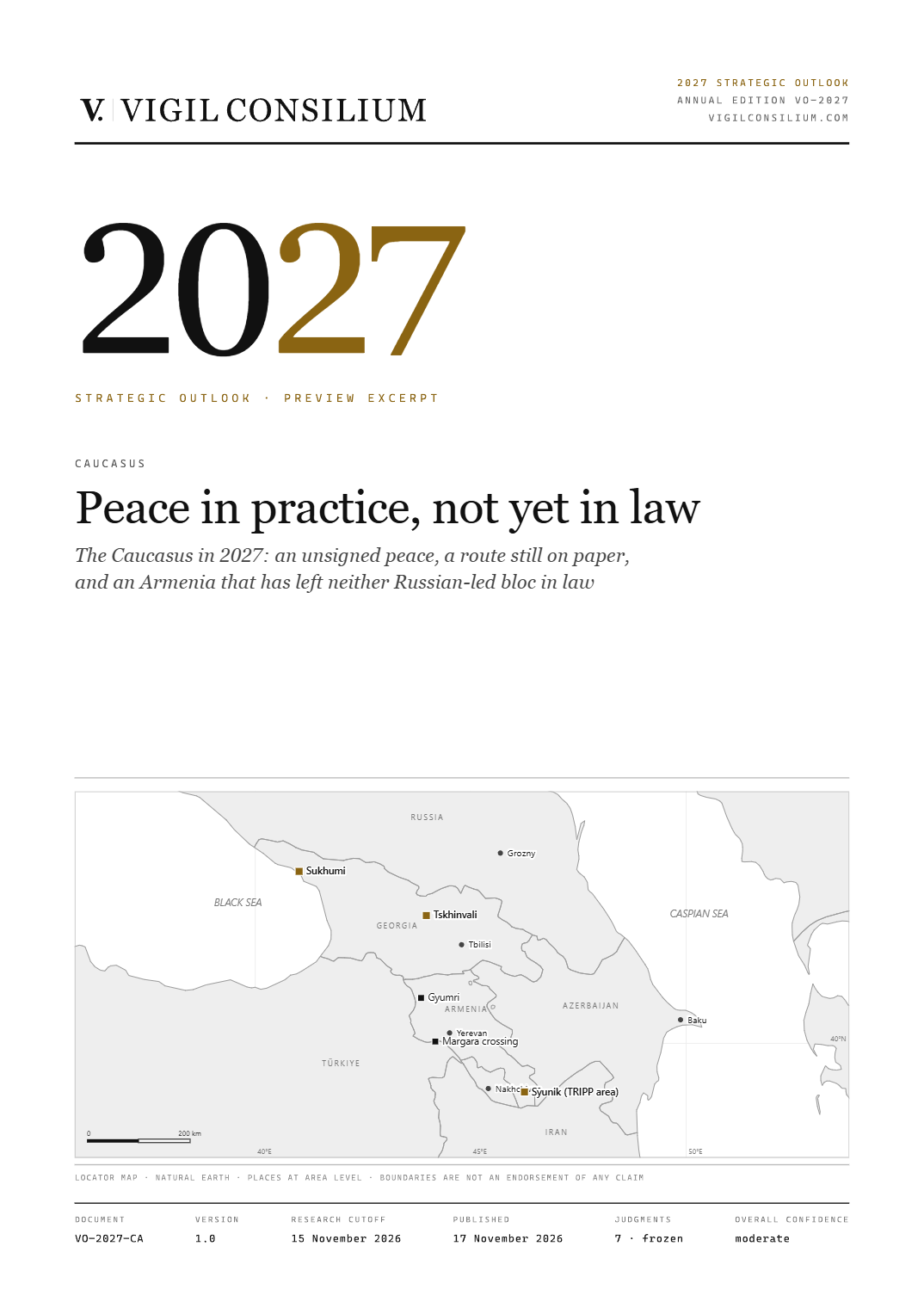
The Caucasus in 2027: an unsigned peace, a route still on paper, and an Armenia that has left neither Russian-led bloc in law
Available
Researched, independently audited and approved for publication.
- 21 pages, PDF
- 61 sources
- 7 judgments
- Research cutoff 15 November 2026
- Published 17 November 2026
- €19 / $22
Purchase
This assessment, or a collection that includes it
PDF, delivered at once after PayPal confirms the payment. On sale until 15 January 2027; buyers keep access afterwards. Also part of Complete 2027 Collection.
Executive judgment
What the assessment concludes
Vigil expects 2027 to extend the condition in which the South Caucasus settlement works in practice and stays incomplete in law. The Armenia–Azerbaijan peace agreement is not expected to be signed, because signature depends on an Armenian constitutional referendum the government cannot call alone. TRIPP is expected to reach a construction start without an operating route, Armenia to end the year a member in law of both Russian-led organisations, and Georgia's European track to stay penalised, not formally ended.Central judgment · confidence in the basis: moderate
The South Caucasus enters 2027 with its central settlement working in practice and stalled in law. Armenia and Azerbaijan trade, move goods and plan a route together, yet the peace agreement initialled in Washington in August 2025 is still unsigned. The obstacle now sits inside Armenia: Azerbaijan conditions signature on a new Armenian constitution, a referendum needs two-thirds of parliament, and the governing party is six votes short against an opposition united to refuse them. Around that block, TRIPP has been ratified and not built, Armenia has lost its vote in the Russian-led security bloc without leaving it, and Georgia remains an EU candidate in name only.
The starting position rests on instruments, votes and dated statements read at source; the outlook rests on decisions a few leaders can take at short notice. The principal uncertainty is whether Armenia's government can assemble a referendum majority.
Research questions
The questions it answers
- Will the Armenia–Azerbaijan peace agreement be signed in 2027, and what would have to happen first?
- Can Armenia's government call and win a constitutional referendum without a two-thirds majority of its own?
- Does TRIPP move from ratification to construction in 2027, and what would still be missing if it does?
- Will Armenia leave, or be suspended from, the CSTO or the Eurasian Economic Union, and how is Russia likely to use gas?
- What does the EU do about Georgia when its visa suspension expires in March 2027?
Themes
Findings the argument rests on
The treaty now depends on seventy votes
Signature is conditioned on an Armenian constitutional change that only a referendum can deliver. The governing party holds 64 of 105 seats; calling a referendum takes two-thirds. The outlook traces what each route around that number would require.
A route with a sponsor and no regime
TRIPP has a ratified agreement, a planned US majority shareholder and trilateral planning groups. It has no published alignment, contractor, financing close or agreement on who controls the crossing. The outlook separates a construction start from an operating corridor.
Russian leverage held in reserve
In 2026 Russia closed its market to Armenian produce and warned about gas without cutting it. With the economic union weighing Armenia's membership and the gas price terms disputed, the outlook assesses which levers Moscow is likely to price and which it is likely to keep.
Georgia penalised by degrees
The EU calls Georgia a candidate in name only and must decide by 6 March 2027 whether to extend or widen its visa measure, while a court decides whether five opposition parties are banned.
The 2027 judgments
7 dated statements, each with its test
The statements are public and frozen in theforecast register. The document adds, for each one, the evidence and mechanism, the strongest alternative reading, the signals to monitor and the evaluation rule.
| Id | Judgment | Expectation | Basis |
|---|---|---|---|
| VO27-CA-01 | Vigil does not expect the peace agreement initialled by Armenia and Azerbaijan on 8 August 2025 to be signed by the two states by 31 December 2027.By 31 December 2027 | Not expected | moderate |
| VO27-CA-02 | Vigil considers it plausible that Armenia holds a national referendum on a new constitution by 31 December 2027.By 31 December 2027 | Plausible | low |
| VO27-CA-03 | Vigil expects physical works on TRIPP rail, road or energy infrastructure, a formal groundbreaking included, to begin at a named location on Armenian territory by 31 December 2027.By 31 December 2027 | Expected | moderate |
| VO27-CA-04 | Vigil expects Armenia to remain a member in law of both the CSTO and the Eurasian Economic Union on 31 December 2027, with no Armenian withdrawal notice lodged and no Supreme Eurasian Economic Council decision suspending the Treaty's application to Armenia.On 31 December 2027 | Expected | moderate |
| VO27-CA-05 | Vigil does not expect Russia, by 31 December 2027, to suspend or denounce the intergovernmental agreement of 2 December 2013 under which it supplies gas to Armenia free of export duty, or to halt gas deliveries to Armenia for more than seven consecutive days other than for announced maintenance or a publicly reported accident.By 31 December 2027 | Not expected | moderate |
| VO27-CA-06 | Vigil expects the EU's suspension of visa-free travel for Georgian holders of diplomatic, service and official passports to be extended or widened, and not allowed to lapse, when its twelve months end on 6 March 2027.At expiry on 6 March 2027, evaluated on 31 March 2027 | Expected | moderate |
| VO27-CA-07 | Vigil does not expect Georgia's EU candidate status to be formally suspended or withdrawn by an act of the European Council or the Council by 31 December 2027.By 31 December 2027 | Not expected | moderate |
Expectation is Vigil's judgment of the outcome; "basis" grades the evidence. Neither is a probability. How the judgments are made.
Monitoring framework
What Vigil will watch
4 of the 8 observables in the document's framework.
| Observable | Review question | Public Watch record |
|---|---|---|
| Publication of Armenia's draft constitution and the National Assembly vote on a referendum | Has a referendum decision been adopted by two-thirds of all deputies, and for what date? | /watch/caucasus/peace-treaty-signature/ |
| Azerbaijani official statements on the constitutional condition | Has Baku restated, revised or dropped the condition in its own words? | /watch/caucasus/peace-treaty-signature/ |
| TRIPP entry into force, company registration, alignment, contractor and first works | Have physical works begun on Armenian territory, and is a customs and border-control arrangement published? | /watch/caucasus/tripp-implementation-stage/ |
| The December 2026 Supreme Eurasian Economic Council and any later act on Armenia | Has the Union taken a decision on the application of its Treaty to Armenia? | /watch/caucasus/armenia-eaeu-standing/ |
Uncertainty and limits
What this document cannot tell you
- The CSTO council's decision of 11 November 2026 is known through the Kremlin spokesman's and the Secretary General's accounts; the text is unpublished, so its legal terms and duration are not established.
- Azerbaijan's current position on the constitutional condition is taken from a February 2026 statement by its president and from Armenian accounts of later conversations; no Azerbaijani primary text from the autumn was read.
- This document does not assess military balance, positions or readiness anywhere in the region, and does not adjudicate the status of Abkhazia or South Ossetia or the competing descriptions of the Syunik route.
- It rests on 12 Vigil records · 6 official and primary · 38 reporting · 5 research and data. Statements by interested parties are treated as positions, not as confirmed facts.
- It is research, not advice, and it is not operational: no positions, strengths, routes or targeting-relevant detail.
Public research
The Vigil record this assessment is built on
Free to read, and maintained every week. The assessment organises and extends it; it does not replace it.
- The Caucasus: Unresolved Wars and Regional PowerModule
- Watch questions for CaucasusWatch
- Weekly briefsRead
- /watch/caucasus/peace-treaty-signature/Watch record cited by a judgment
- /watch/caucasus/tripp-implementation-stage/Watch record cited by a judgment
- /watch/caucasus/armenia-security-realignment/Watch record cited by a judgment
- /watch/caucasus/armenia-eaeu-standing/Watch record cited by a judgment
- /watch/caucasus/georgia-eu-track/Watch record cited by a judgment
- MethodologyHow Vigil grades evidence
The other assessments of the edition
- Ukraine–Russia: The financed stalemateAvailable
- NATO Eastern Flank: The year the flank's deadlines fall dueAvailable
- Iran–Gulf: A strait held open by escortAvailable
- Syria: A state built ahead of its instrumentsAvailable
- Levant: Arrangements without settlementAvailable
- Sahel: Held capitals, contested roads, borrowed guarantorsAvailable
- Taiwan Strait: Pressure without a deadlineAvailable
- 2027 Strategic Outlook11 products