
2027 Strategic Outlook / Ukraine–Russia
Ukraine–Russia · VO-2027-UR
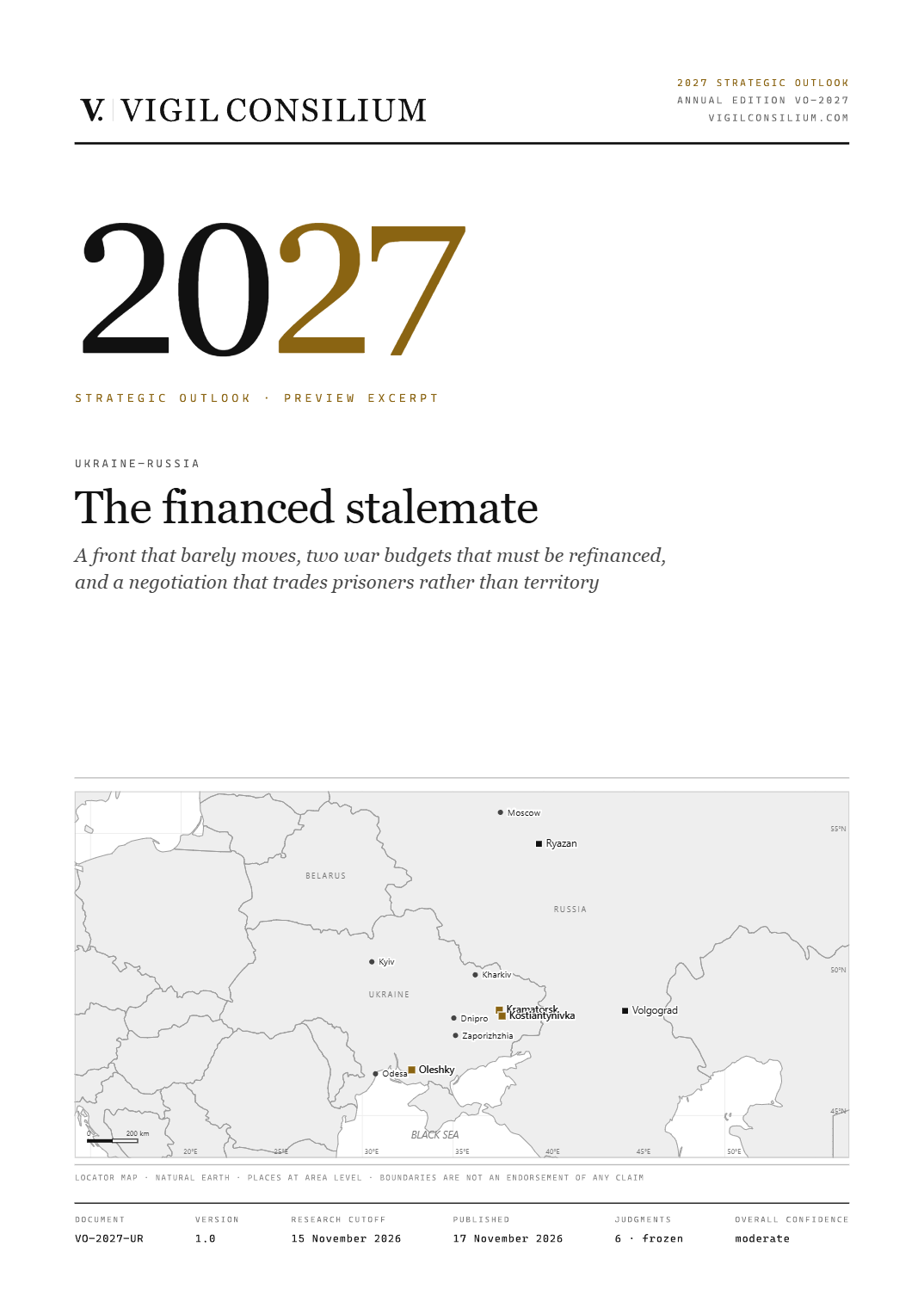
The financed stalemate
A front that barely moves, two war budgets that must be refinanced, and a negotiation that trades prisoners rather than territory
Available
Researched, independently audited and approved for publication.
- 22 pages, PDF
- 62 sources
- 6 judgments
- Research cutoff 15 November 2026
- Published 17 November 2026
- €19 / $22
Purchase
This assessment, or a collection that includes it
PDF, delivered at once after PayPal confirms the payment. On sale until 15 January 2027; buyers keep access afterwards. Also part of European Defence 2027 and Complete 2027 Collection.
Executive judgment
What the assessment concludes
Vigil expects the Ukraine–Russia war to continue through 2027 as a financed stalemate: a front that moves by tens of square kilometres a month, two strike campaigns aimed at the other side's capacity to sustain the war, and a US-mediated negotiation that yields humanitarian arrangements but no settlement. The decisions that matter most are dated and taken away from the front: how Europe funds Ukraine's 2027 gap, how Russia funds a deficit it has already overshot once, and whether Washington turns a reported territory-for-guarantee idea into a text.Central judgment · confidence in the basis: moderate
The war enters 2027 with its front close to stationary. On one independent mapping series, Russian forces lost ground on balance in September and October 2026, and the year's reported gains are a small fraction of 2025's. Both governments have nevertheless budgeted 2027 as a war year, and neither budget is funded on present terms. The negotiation has a working format and no settlement: its products so far are a pause, a local ceasefire and a prisoner exchange agreed in principle. Vigil's central case is continuity under financial strain, a financed stalemate, with the decisive choices of the year taken in Brussels, Moscow and Washington.
Fiscal, legal and calendar facts are documented at source or by consistent reporting; the military picture rests on one independent mapping series read through relays and on belligerents' figures. The principal uncertainty is political: a decision in Washington, Moscow or Brussels can outrun any trend recorded here.
Research questions
The questions it answers
- Is a settlement or general ceasefire likely to be in force by the end of 2027?
- Can either army turn a near-static front into operational movement?
- How does Russia pay for a record defence budget, and does that lead to mobilisation?
- By what instrument, and by when, does Europe close Ukraine's 2027 financing gap?
- Does air-defence supply reach Ukraine before the 2027–28 heating season?
Themes
Findings the argument rests on
A front measured in tens of square kilometres
One independent mapping series shows the Russian advance slowing sharply in 2026 and two months of net loss, while Ukraine's one named offensive moved a single sector. The outlook sets a testable band for 2027 and names the cities that would mark a break.
Two budgets that need refinancing
Russia has overshot its 2026 deficit plan and written a record defence line for 2027; Ukraine's 2027 budget gap is put at €70 billion. The outlook identifies the instruments, dates and vetoes that decide how each is covered.
A negotiation that trades prisoners, not territory
The trilateral format has produced three humanitarian arrangements and no text. The outlook explains why Vigil does not expect a settlement or general ceasefire in force at the end of 2027, and what would change that.
The 2027 judgments
6 dated statements, each with its test
The statements are public and frozen in theforecast register. The document adds, for each one, the evidence and mechanism, the strongest alternative reading, the signals to monitor and the evaluation rule.
| Id | Judgment | Expectation | Basis |
|---|---|---|---|
| VO27-UR-01 | Vigil does not expect a comprehensive peace agreement signed by both Ukraine and Russia, or a general ceasefire covering the whole front, to be in force on 31 December 2027.On 31 December 2027 | Not expected | moderate |
| VO27-UR-02 | Vigil expects the front to remain attritional through 2027: on 31 December 2027 neither Kramatorsk nor Sloviansk is assessed as Russian-controlled, and the net change in Russian-held territory over calendar 2027, on ISW's monthly assessments, is smaller than 1,000 km² in either direction.On 31 December 2027 | Expected | moderate |
| VO27-UR-03 | Vigil expects Russia to sustain the war through 2027 by deficit and paid recruitment: the Finance Ministry's latest estimate of the 2027 federal deficit published by 31 December 2027 exceeds the figure in the 2027 budget law as first enacted (2.2 per cent of GDP in the draft), and no published presidential decree declares a new mobilisation by that date.On 31 December 2027 | Expected | moderate |
| VO27-UR-04 | Vigil expects the European Union to adopt, by 30 June 2027, a legal act providing financing for Ukraine for 2027 beyond the €45 billion already allocated, financed by borrowing or contributions among fewer than 27 member states and not from immobilised Russian assets.By 30 June 2027 | Expected | moderate |
| VO27-UR-05 | Vigil expects power cuts affecting Kyiv and at least five oblasts on the same day in both the first and the fourth quarter of 2027, and does not expect any government to confirm, during 2027, delivery to Ukraine of interceptors from the 500-missile sale approved on 30 October 2026.On 31 December 2027 | Expected | moderate |
| VO27-UR-06 | Vigil expects the Russian government to keep its ban on producers' diesel exports in force beyond 31 January 2027, in whole or with exemptions, by an act published on or before 15 February 2027.By 15 February 2027 | Expected | moderate |
Expectation is Vigil's judgment of the outcome; "basis" grades the evidence. Neither is a probability. How the judgments are made.
Monitoring framework
What Vigil will watch
4 of the 8 observables in the document's framework.
| Observable | Review question | Public Watch record |
|---|---|---|
| A published negotiating text, territorial formula or monitoring body; the Abu Dhabi exchange carried out | Has anything from the trilateral track become readable outside the room? | /watch/ukraine-russia/negotiation-architecture/ |
| ISW and DeepState monthly territorial figures and marker towns | Has either side achieved movement beyond a single sector? | /watch/ukraine-russia/front-line-movement/ |
| Russian mobilisation law, contract terms and enlistment-bonus spending | Is paid recruitment still substituting for a decree? | /watch/ukraine-russia/force-regeneration/ |
| Russian monthly budget execution, oil and gas revenue and the key rate | Is the 2027 deficit tracking above the plan? | — |
Uncertainty and limits
What this document cannot tell you
- The ground picture rests on ISW's series read through Fakty, Al Jazeera, Kyiv Post and Vigil's briefs; ISW's own pages returned an error and DeepState was not read. The basis of the relayed year-to-date figure is not stated, so no annual comparison is charted.
- Casualty, recruitment, interceptor-stock, grid and refinery-throughput figures are unpublished or come from interested parties; how close either side is to exhaustion cannot be concluded.
- The European Council of 26–27 November, the IMF Board decision and the final budget votes in Kyiv and Moscow fall after the cutoff; Judgments 3 and 4 are evaluated against the acts as adopted.
- It rests on 16 Vigil records · 8 official and primary · 33 reporting · 5 research and data. Statements by interested parties are treated as positions, not as confirmed facts.
- It is research, not advice, and it is not operational: no positions, strengths, routes or targeting-relevant detail.
Public research
The Vigil record this assessment is built on
Free to read, and maintained every week. The assessment organises and extends it; it does not replace it.
- Ukraine–RussiaModule
- Watch questions for Ukraine–RussiaWatch
- Weekly briefsRead
- /watch/ukraine-russia/negotiation-architecture/Watch record cited by a judgment
- /watch/ukraine-russia/capitals-strike-pause/Watch record cited by a judgment
- /watch/ukraine-russia/front-line-movement/Watch record cited by a judgment
- /watch/ukraine-russia/force-regeneration/Watch record cited by a judgment
- /watch/ukraine-russia/russian-refining-under-strike/Watch record cited by a judgment
- MethodologyHow Vigil grades evidence
The other assessments of the edition
- NATO Eastern Flank: The year the flank's deadlines fall dueAvailable
- Iran–Gulf: A strait held open by escortAvailable
- Syria: A state built ahead of its instrumentsAvailable
- Levant: Arrangements without settlementAvailable
- Sahel: Held capitals, contested roads, borrowed guarantorsAvailable
- Taiwan Strait: Pressure without a deadlineAvailable
- Caucasus: Peace in practice, not yet in lawAvailable
- 2027 Strategic Outlook11 products