
2027 Strategic Outlook / Sahel
Sahel · VO-2027-SH
Held capitals, contested roads, borrowed guarantors
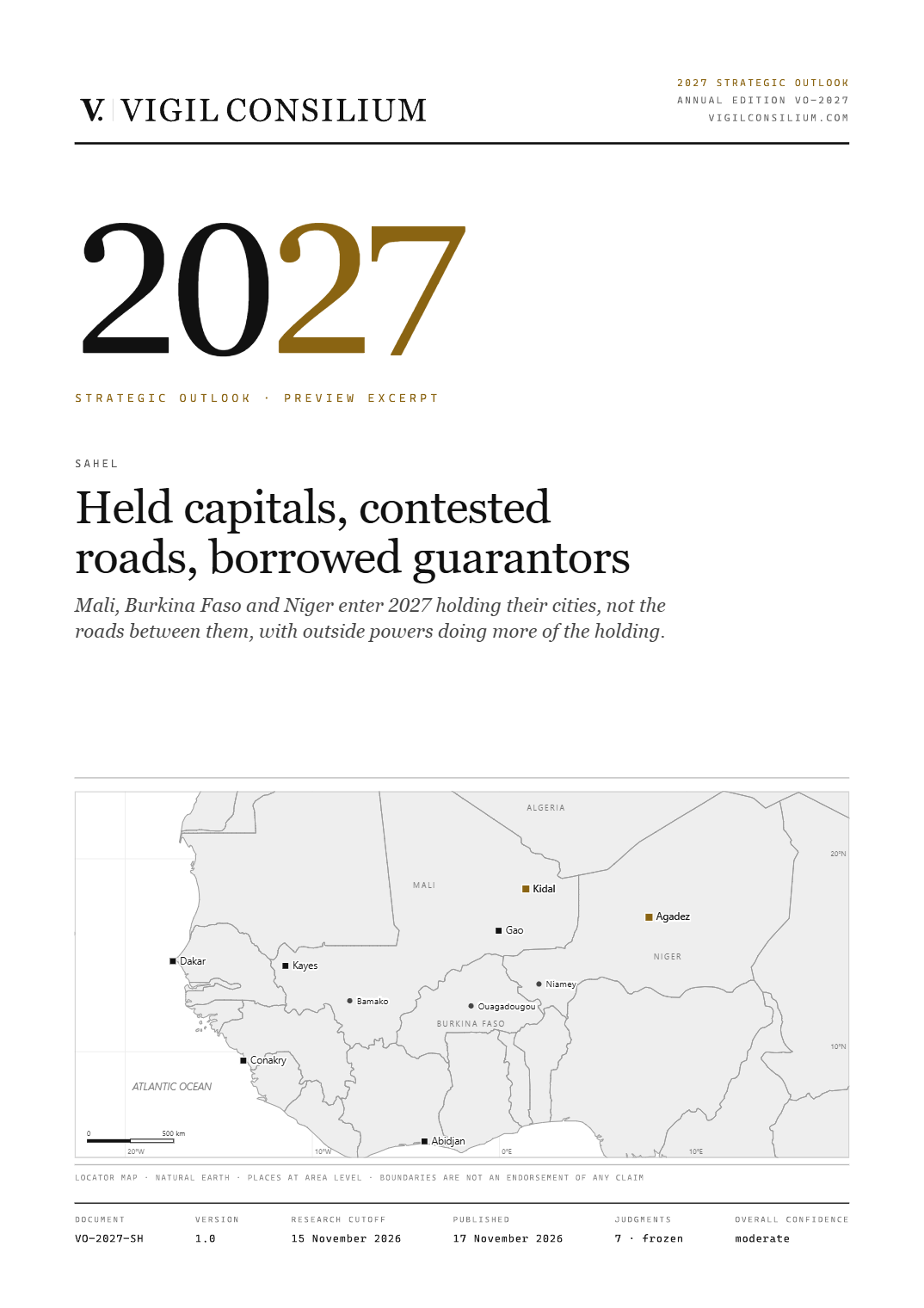
Mali, Burkina Faso and Niger enter 2027 holding their cities, not the roads between them, with outside powers doing more of the holding.
Available
Researched, independently audited and approved for publication.
- 22 pages, PDF
- 67 sources
- 7 judgments
- Research cutoff 15 November 2026
- Published 17 November 2026
- €19 / $22
Purchase
This assessment, or a collection that includes it
PDF, delivered at once after PayPal confirms the payment. On sale until 15 January 2027; buyers keep access afterwards. Also part of Complete 2027 Collection.
En français
Résumé exécutif en français
Le jugement central, l’analyse exécutive et les jugements datés de ce document, en français (3 pages, PDF, libre d’accès). Le document complet est en anglais ; le texte anglais de chaque jugement fait foi.
Executive judgment
What the assessment concludes
Vigil expects 2027 to prolong the equilibrium of 2026, not resolve it: three military governments hold their capitals and hubs, cannot secure the roads between them, and have no election on any calendar. What decides the year is economic and internal: corridors, fuel, gold revenue and the cohesion of armies taking losses. Outside guarantors carry more of the weight: Russia in all three states, and Algeria through a deployment to Niger decided in October 2026 and not yet observed at the cutoff.Central judgment · confidence in the basis: moderate
The central Sahel enters 2027 as it spent most of 2026: three military governments hold their capitals and regional hubs, and armed groups contest the space between them. The decisive arena is the roads that carry fuel into landlocked states, the gold revenue that pays for escorts and foreign partners, and the cohesion of armies taking losses. No transition has an election on its calendar before 2029. Russia remains the principal security partner, the United States has reopened a channel, and Algeria has decided to send troops to Niger. Vigil expects 2027 to prolong this equilibrium, and sets out what would break it.
Moderate: the record is well documented for Mali, but Vigil's records for Burkina Faso and Niger are baselines, Burkina Faso has been a limit of visibility for eight weekly reviews, and army cohesion cannot be observed before it fails.
Research questions
The questions it answers
- Does any of the three military governments have an electoral exit in 2027?
- Is the greater risk to the three governments the insurgency or their own armies?
- Does JNIM's pressure on Mali's fuel corridors continue, and could it take a city?
- Do Russia's role, Washington's reopened contact and Algeria's deployment to Niger change who guarantees these states?
- Does the arrangement keeping borders open with ECOWAS survive the year?
Themes
Findings the argument rests on
The war is on the roads
Mali's capital is supplied by escorted convoy fourteen months after a blockade was declared. The pressure is applied in phases and traded locally for concessions, and in Vigil's record JNIM's assaults on army camps in 2026 were not followed by occupation.
Transitions without a calendar
Each government's own charter runs past 2027 without a vote, and parties are dissolved in all three states. The armed mutiny in Niamey in August 2026 showed where the real exposure lies: inside the armies.
More guarantors, no published terms
Russia sustains its presence by air and sea, Algeria has authorised its first deployment abroad in decades, and Washington is talking to Bamako again. None of these arrangements has public terms, so their limits cannot be read in advance.
A divorce that keeps the borders open
The three states left ECOWAS and still trade and travel under its rules. Their first formal negotiation with the bloc, in Dakar in October 2026, produced working groups, and geography gives both sides reason to keep it that way.
The 2027 judgments
7 dated statements, each with its test
The statements are public and frozen in theforecast register. The document adds, for each one, the evidence and mechanism, the strongest alternative reading, the signals to monitor and the evaluation rule.
| Id | Judgment | Expectation | Basis |
|---|---|---|---|
| VO27-SH-01 | Vigil does not expect Mali, Burkina Faso or Niger to hold a national election or referendum, or to fix a date for one by published law or decree, by 31 December 2027.By 31 December 2027 | Not expected | high |
| VO27-SH-02 | Vigil considers it plausible that a mutiny or attempted seizure of power by serving soldiers, involving gunfire in or around Bamako, Ouagadougou or Niamey, is reported by international news agencies or acknowledged by the government concerned by 31 December 2027.By 31 December 2027 | Plausible | moderate |
| VO27-SH-03 | Vigil expects JNIM to keep Mali's import corridors under phased pressure through 2027, with at least one newly declared blockade or reported attack on a fuel convoy on the Senegal or Côte d'Ivoire routes. Vigil does not expect JNIM or its allies to hold Bamako, or any other Malian regional capital outside the Kidal region, for seven consecutive days.By 31 December 2027 | Expected | moderate |
| VO27-SH-04 | Vigil does not expect Mali's transitional government and the Azawad Liberation Front to sign a political or ceasefire agreement, or to open negotiations that both acknowledge publicly, by 31 December 2027.By 31 December 2027 | Not expected | moderate |
| VO27-SH-05 | Vigil expects Russia's Africa Corps to remain Mali's principal foreign combat partner throughout 2027. Vigil does not expect the United States to conclude a published defence cooperation agreement with, or to announce lethal security assistance to, Mali, Burkina Faso or Niger by 31 December 2027.By 31 December 2027 | Expected | moderate |
| VO27-SH-06 | Vigil considers it plausible that an Algerian army unit is reported as stationed in northern Niger — in an official statement of either government, or independently by at least two of AFP, Reuters, AP, RFI, the BBC and Al Jazeera — by 30 June 2027.By 30 June 2027 | Plausible | low |
| VO27-SH-07 | Vigil expects visa-free movement and the existing trade arrangements between the three AES states and ECOWAS members to remain in force through 31 December 2027, and does not expect any of the three to resume ECOWAS membership.By 31 December 2027 | Expected | moderate |
Expectation is Vigil's judgment of the outcome; "basis" grades the evidence. Neither is a probability. How the judgments are made.
Monitoring framework
What Vigil will watch
4 of the 8 observables in the document's framework.
| Observable | Review question | Public Watch record |
|---|---|---|
| Publicly reported armed action by serving soldiers, command changes or announced plots | Has any of the three governments faced a reported armed challenge from its own forces? | /watch/sahel/regime-consolidation/ |
| JNIM blockade declarations, fuel-convoy attacks, escorted arrivals, and any town entered and then held | Is corridor pressure on Mali tightening, easing or being traded locally? | /watch/sahel/blockade-pressure/ |
| FLA and JNIM statements, any named mediator, and the return of Kidal's governor | Does the alliance hold, and has a negotiating channel been acknowledged? | /watch/sahel/jnim-fla-alignment/ |
| Russian flights, shipments and statements; any US cooperation text or senior visit | Is the Russian presence changing, and has the American contact become a channel? | /watch/sahel/external-posture/ |
Uncertainty and limits
What this document cannot tell you
- Vigil's record is deepest on Mali; Burkina Faso and Niger carry baselines.
- No conflict-event counts are used, so this document cannot say whether violence rose or fell in 2026.
- Morocco's Atlantic initiative, China's and Türkiye's roles, the IMF's 2026 engagement with Burkina Faso and Niger, and the unpublished Russian and Algerian terms carry no judgment here.
- It rests on 12 official and primary · 25 reporting · 17 Vigil records · 13 research and data. Statements by interested parties are treated as positions, not as confirmed facts.
- It is research, not advice, and it is not operational: no positions, strengths, routes or targeting-relevant detail.
Public research
The Vigil record this assessment is built on
Free to read, and maintained every week. The assessment organises and extends it; it does not replace it.
- The Sahel: A Regional Conflict SystemModule
- Watch questions for SahelWatch
- Weekly briefsRead
- /watch/sahel/regime-consolidation/Watch record cited by a judgment
- /watch/sahel/niger-pressure-reach/Watch record cited by a judgment
- /watch/sahel/blockade-pressure/Watch record cited by a judgment
- /watch/sahel/territorial-administration/Watch record cited by a judgment
- /watch/sahel/state-reach-supply/Watch record cited by a judgment
- MethodologyHow Vigil grades evidence
The other assessments of the edition
- Ukraine–Russia: The financed stalemateAvailable
- NATO Eastern Flank: The year the flank's deadlines fall dueAvailable
- Iran–Gulf: A strait held open by escortAvailable
- Syria: A state built ahead of its instrumentsAvailable
- Levant: Arrangements without settlementAvailable
- Taiwan Strait: Pressure without a deadlineAvailable
- Caucasus: Peace in practice, not yet in lawAvailable
- 2027 Strategic Outlook11 products