
2027 Strategic Outlook / Levant
Levant · VO-2027-LV
Arrangements without settlement
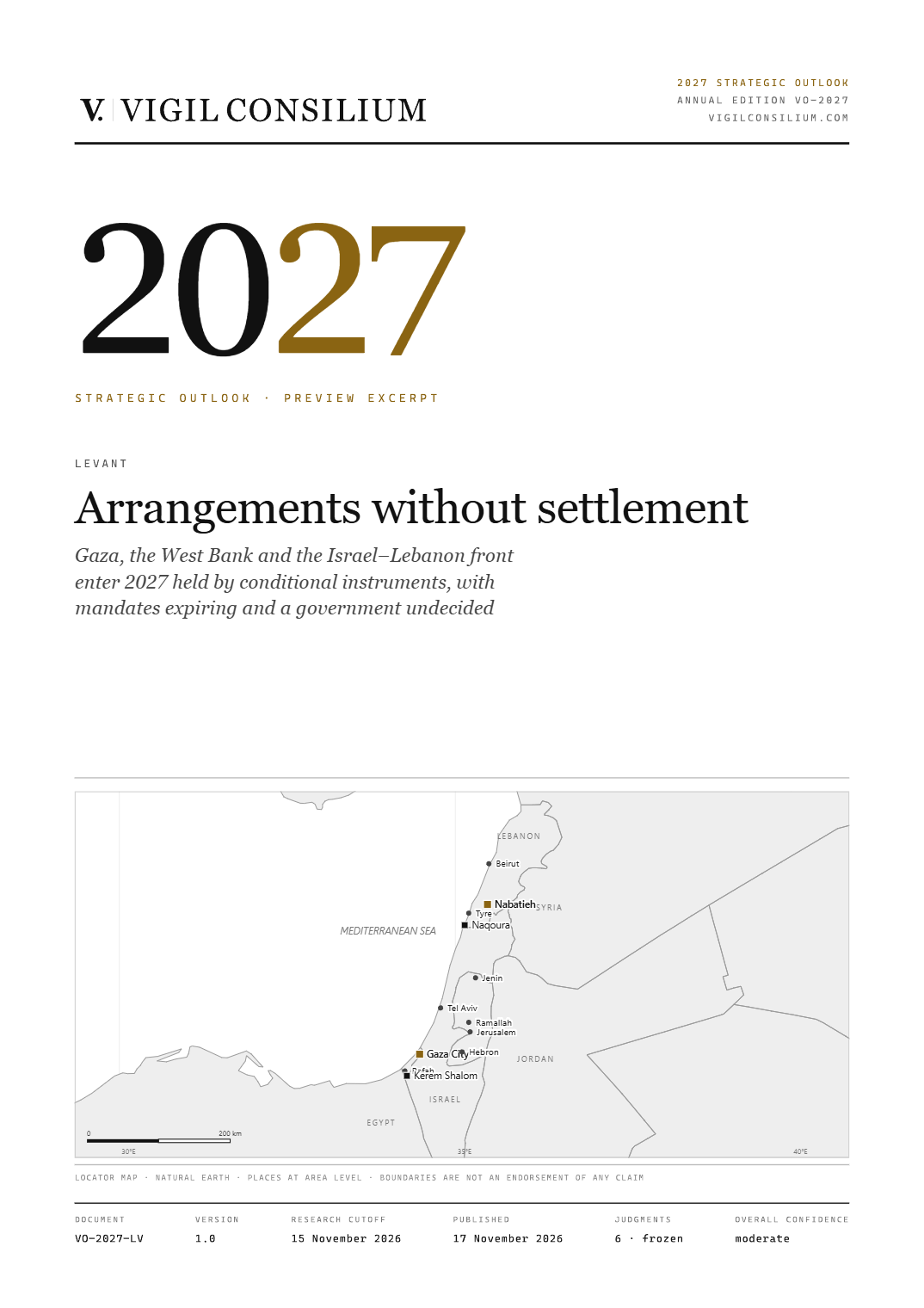
Gaza, the West Bank and the Israel–Lebanon front enter 2027 held by conditional instruments, with mandates expiring and a government undecided
Available
Researched, independently audited and approved for publication.
- 21 pages, PDF
- 62 sources
- 6 judgments
- Research cutoff 15 November 2026
- Published 17 November 2026
- €19 / $22
Purchase
This assessment, or a collection that includes it
PDF, delivered at once after PayPal confirms the payment. On sale until 15 January 2027; buyers keep access afterwards. Also part of Middle East 2027 and Complete 2027 Collection.
Executive judgment
What the assessment concludes
Vigil expects 2027 to be a year of managed non-settlement in the Levant. The conditional arrangements built in 2025 and 2026 persist, their expiry dates are met by renewal or lapse rather than by implementation, and Israeli forces still hold ground in Gaza and southern Lebanon when the year ends. Movement, where it comes, is more likely in presence — a committee, a contingent, a further pilot zone — than in the weapons and withdrawals that each instrument makes the other's condition.Central judgment · confidence in the basis: moderate
The Levant enters 2027 as one system held in place by three arrangements, none of which is a settlement. In Gaza a ceasefire stands under a Security Council mandate that ends on 31 December 2027, with its administrative committee and stabilisation force still outside the Strip. On the Israel–Lebanon front a framework sequences Israeli redeployment behind verified disarmament and sets no timeline, while the UN force's mandate ends on 31 December 2026 with no successor decided. In the West Bank the Palestinian Authority runs on arrears. At the cutoff no instrument had produced its central act, and the Israeli government that is to decide the next steps had not been formed.
The instruments, their dates and the absence of implementation are matters of record. The principal uncertainty is the policy of an Israeli government not yet formed at the cutoff, and how far the United States presses it.
Research questions
The questions it answers
- Is the Gaza mandate completed, renewed or allowed to lapse when it expires on 31 December 2027?
- Do Israeli forces withdraw behind the original Gaza line, or leave southern Lebanon, during 2027?
- Do the bodies of Gaza's transition enter the Strip before any weapon is handed over?
- What replaces UNIFIL, and who still reports on the Israel–Lebanon front?
- Are Palestinian presidential and legislative elections held in 2027?
Themes
Findings the argument rests on
Conditionality as the system's logic
In every arena access, money and withdrawal wait on disarmament or reform, and each party makes the other's step its own precondition. The arrangements of 2025 and 2026 suspend the conflict; none assigns the first move or names a verifier.
Dates that force decisions on form
The end of UNIFIL's mandate, the Gaza mandate's expiry, a decreed Palestinian election and a new US–Israel assistance framework all fall in or around 2027. They are more likely to be met by renewal, rollover or lapse than by the implementation they were meant to mark.
An Israeli government as the open variable
The October 2026 election left no bloc with a majority and a new candidate tasked with forming a government. Five of the six judgments depend partly on what that government decides in Gaza, Lebanon and the West Bank.
The 2027 judgments
6 dated statements, each with its test
The statements are public and frozen in theforecast register. The document adds, for each one, the evidence and mechanism, the strongest alternative reading, the signals to monitor and the evaluation rule.
| Id | Judgment | Expectation | Basis |
|---|---|---|---|
| VO27-LV-01 | Vigil expects the UN Security Council to adopt, on or before 31 December 2027, a resolution extending the authorisation of the Board of Peace and the International Stabilization Force beyond that date.By 31 December 2027 | Expected | moderate |
| VO27-LV-02 | Vigil does not expect Israeli forces to withdraw, by 31 December 2027, from ground on the Israeli-held side of the Yellow Line as it was drawn in October 2025; any pullback in 2027 is more likely to return ground taken since.By 31 December 2027 | Not expected | moderate |
| VO27-LV-03 | Vigil considers it plausible that the National Committee for the Administration of Gaza is working from premises inside the Strip, and that at least one International Stabilization Force contingent has entered it, by 30 September 2027.By 30 September 2027 | Plausible | low |
| VO27-LV-04 | Vigil expects Israeli forces to still hold ground inside Lebanese territory on 31 December 2027, beyond the five positions they kept in February 2025.On 31 December 2027 | Expected | moderate |
| VO27-LV-05 | Vigil does not expect formed military units under UN command to be operating in southern Lebanon with a Security Council mandate on 31 December 2027, whether as UNIFIL under a postponed drawdown or as a successor force.On 31 December 2027 | Not expected | moderate |
| VO27-LV-06 | Vigil does not expect Palestinian presidential and legislative elections to be held across the West Bank, East Jerusalem and the Gaza Strip on 11 September 2027, the decreed date, or on any other date in 2027.By 31 December 2027 | Not expected | moderate |
Expectation is Vigil's judgment of the outcome; "basis" grades the evidence. Neither is a probability. How the judgments are made.
Monitoring framework
What Vigil will watch
4 of the 8 observables in the document's framework.
| Observable | Review question | Public Watch record |
|---|---|---|
| A Gaza verification committee with named members, or an Israeli cabinet decision on the roadmap | Has either party's stated order for weapons and withdrawal changed? | /watch/levant/gaza-decommissioning-line/ |
| Committee officials or a force contingent announced inside the Strip | Is any body of the transition present in Gaza rather than appointed to it? | /watch/levant/gaza-transition-bodies/ |
| Draft texts and Council meetings on the Gaza mandate in late 2027 | Is renewal being negotiated, and on what conditions about the line? | — |
| A further Lebanese zone vacated and entered, or a new Israeli position stated | Is the Framework's sequence running forwards, backwards or not at all? | /watch/levant/lebanon-zone-sequence/ |
Uncertainty and limits
What this document cannot tell you
- The document cannot say what an Israeli government formed after the cutoff decides, and five of its six judgments depend partly on it.
- The Lebanese army's arms plan and the Framework's security annex are unpublished, so implementation short of an announcement is invisible.
- Casualty, displacement and damage figures are those of the counting bodies named, several of them parties; Vigil holds no count of its own and uses no event-count dataset here.
- It rests on 10 official and primary · 27 reporting · 16 Vigil records · 9 research and data. Statements by interested parties are treated as positions, not as confirmed facts.
- It is research, not advice, and it is not operational: no positions, strengths, routes or targeting-relevant detail.
Public research
The Vigil record this assessment is built on
Free to read, and maintained every week. The assessment organises and extends it; it does not replace it.
- Levant: Israel, the Palestinian territories and LebanonModule
- Watch questions for LevantWatch
- Weekly briefsRead
- /watch/levant/gaza-transition-bodies/Watch record cited by a judgment
- /watch/levant/gaza-decommissioning-line/Watch record cited by a judgment
- /watch/levant/gaza-access-regime/Watch record cited by a judgment
- /watch/levant/lebanon-zone-sequence/Watch record cited by a judgment
- /watch/levant/hezbollah-arms-to-state/Watch record cited by a judgment
- MethodologyHow Vigil grades evidence
The other assessments of the edition
- Ukraine–Russia: The financed stalemateAvailable
- NATO Eastern Flank: The year the flank's deadlines fall dueAvailable
- Iran–Gulf: A strait held open by escortAvailable
- Syria: A state built ahead of its instrumentsAvailable
- Sahel: Held capitals, contested roads, borrowed guarantorsAvailable
- Taiwan Strait: Pressure without a deadlineAvailable
- Caucasus: Peace in practice, not yet in lawAvailable
- 2027 Strategic Outlook11 products