
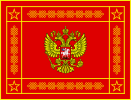
- 軍種旗幟 · 官方
- 國家隸屬 · 俄羅斯
- Vigil類別圖示 · 非官方徽記
識別來源
Service ensign: Banner of the Armed Forces of the Russian Federation. The banner of the Armed Forces of the Russian Federation, the institution’s own symbol. The design itself is not an object of copyright: Article 1259(6) of the Civil Code of the Russian Federation excludes official symbols and signs. The file shipped is the Wikimedia Commons SVG "Banner of the Armed Forces of the Russian Federation (obverse).svg", released under PD-RU-exempt on that basis, so no attribution or share-alike obligation attaches. Optimised for web display; geometry unaltered.
國家隸屬:俄羅斯。
較小的方形標記是Vigil的類別符號,依據本紀錄自身的領域、層級與角色繪製——並非官方徽章。
概要
俄羅斯國家的總體軍事力量——在總參謀部之下的陸軍、空天、空降、海軍、戰略火箭、特種作戰、鐵道與物資支援軍種。本圖譜僅在軍種、集團軍與部隊層級記錄其結構;不公布任何部署、兵力或位置,而與其並肩作戰的若干志願與非正規結構,依設計位於此樹狀結構之外。
- 範圍
- 結構、角色、沿革與連結。已發布8筆下屬紀錄。
- 隸屬
- 隸屬:已證實
- 來源
- 紀錄所載:5
- 紀錄狀態
- 完整
- 廣泛活動地區
- The entire theatre and the strategic depth behind it — a front from the northern border axes to the southern land bridge, a long-range strike campaign reaching every part of Ukraine, and a naval and aerospace component operating from well outside the war zone.
- 重要歷史
- A reformed army that met a war it had not designed for. The post-2008 Serdyukov and Shoigu reforms replaced a mass-mobilisation structure with smaller, permanently ready formations built around contract soldiers, and the Syria intervention and the 2014–15 Donbas operations appeared to validate the result. February 2022 did not. The plan assumed a short campaign against an army that would not fight, and its failure at Kyiv consumed the professional core the reforms had built. What has been reconstituted since is a different institution: refilled by partial mobilisation in 2022 and thereafter by paid contract recruitment at scale, fighting an infantry-heavy attritional war, drawing on refurbished storage stock and on ammunition supplied from North Korea, and expanded again in 2023–24 by the re-creation of military districts and additional formations. It takes ground, slowly, at a cost it has so far proved willing to pay.
- 優勢
- Mass, in manpower, tube artillery and reactivated equipment reserves, and a defence-industrial base placed on a war footing while its opponents' were not. Glide bombs, adopted from 2023, give stand-off strike at a scale and cost no partner-supplied Ukrainian capability matches. A recruitment system that has so far substituted payment for a politically costly second mobilisation. Deep fortification engineering, proven in 2023. Strategic depth that keeps most of its industry and much of its aviation beyond reach.
- 限制
- Quality dilution after four years of attrition among experienced cadres, which is why assault tactics have grown simpler rather than more sophisticated. Centralised command that limits initiative below the level where decisions are needed. Equipment reactivation is drawing on progressively older storage. The strategic rear is no longer a sanctuary: refining, export and airbase infrastructure has proved reachable, and the force has had to redistribute air defence to cover it. And the structures doing some of the hardest fighting — volunteer formations, the Chechen structures, the reorganised PMC lineage — sit partly outside this tree, which is itself a statement about how coherent the whole is.
下屬部隊






各列僅為版面配置 — 位置與順序不代表任何層級、重要性、先後或強度。所顯示的每一筆紀錄都是所選組織的直屬下級。
相關組織
- 瓦格納集團 → 非洲軍團 機構上關聯於 · 截至2023-06 · 高信心
Nominally private 2014–2023, then re-subordinated to Ministry of Defence control after the June 2023 mutiny and the death of its founder. The edge records the post-2023 institutional relationship, not a command position inside the armed forces tree.
相關地點
Moscow: National military command and ceremonial centre — long-standing public knowledge. Rostov-on-Don: Long-publicised military administrative centre for the southern theatre.
Fires before movement, pressure before manoeuvre, and depth used as a resource rather than as a shield. The force takes ground by accumulation and pays for it in people, having abandoned the manoeuvre doctrine its pre-war reforms were built around.
偏好的作戰方式
Fires before movement, pressure before manoeuvre. The pre-war doctrine of battalion tactical groups conducting rapid deep operations was abandoned after 2022, when it failed against a defended state. What replaced it is recognisably different: massed artillery and glide bombs used to make a position untenable rather than to support an assault on it; small dismounted infantry groups attacking on narrow frontages once it has been reduced; and simultaneous pressure across a wide sector rather than concentration for breakthrough. Running alongside the ground war is a separate strategic campaign against Ukraine's electricity system, conducted seasonally with cruise missiles, ballistic missiles and mass-produced one-way attack drones — a cost-exchange strategy against air defence as much as a destructive one, and the clearest expression of the force's preference for imposing cost over seizing objectives.
關於此組織運作方式的廣泛概括,以評估的形式評定等級 — 並非對當前戰術的描述,且刻意不附任何能力或效能分數。
指揮風格
Centralised, with authority held well above the level at which decisions are executed and limited latitude for junior initiative. Formation commanders are held accountable for progress on a timescale that encourages costly attacks. This has been partially offset since 2023 by the growth of drone units operating on shorter loops than the formal chain of command allows, which is the clearest internal tension in the force — and by a parallel structure of volunteer and irregular formations whose relationship to the General Staff has repeatedly been renegotiated rather than settled.
此概括不適用之處
The generalisation fails in three ways. First, it describes the force since mid-2022 and not the force that invaded: the 2022 campaign attempted exactly the rapid deep operation this record says the force does not conduct. Second, performance is uneven between branches and formations — airborne and naval infantry units have repeatedly been employed as a mobile reserve requiring more coordination than the general pattern implies, and the aerospace and strategic-rocket components fight a different war from the ground forces entirely. Third, "accepting casualties" describes observed practice, not intent, and this module has no basis for claiming what any commander considers acceptable.
觀察到的調整
Adoption of glide-bomb kits on existing munitions from 2023, giving stand-off strike at scale from aircraft that could not previously operate near the line — the most consequential Russian adaptation of the war.
Domestic mass production of the Iranian-derived one-way attack drone design at volumes far beyond the original transfers, converting a scarce precision-strike problem into a saturation one.
A shift from mechanised assault to small dismounted infantry groups, forced by drone saturation making vehicle concentrations unsurvivable near the line.
Redistribution of air defence and the addition of point defences around refining and export infrastructure, in response to a Ukrainian deep-strike campaign the pre-war posture did not anticipate.
仍然未知的事項
- Russian doctrinal publications since 2022 are not available, so this record describes observed practice rather than formal doctrine.
- Force strengths, dispositions and casualty figures are not published, and this atlas makes no claim about any of them. Wartime groupings differ from the peacetime affiliations recorded in the tree below.
- The relationship between the formal structure and the volunteer, regional and irregular formations fighting alongside it is described differently by different Russian sources and has changed repeatedly.
戰役
將此組織列為參與方的戰役。該關係由戰役紀錄擁有並評定等級;此清單為計算所得。
- 兵力生成與動員 Opposing force · Since February 2022 · high confidence · as of 2026-06
- 2022年2月的入侵與基輔之敗 Primary force · February – April 2022 · high confidence · as of 2022-04
The invading force as a whole. Component commands are recorded separately where the module publishes them.
系統入口
此紀錄與Vigil其他部分的連結處。每一列之所以列在這裡,是因為此組織確實與之相連。
評估截至 — 2026-08 最近檢視 — 2026-08-26
在結構中檢視此部隊 互動式:選取此紀錄並追蹤與其關聯的內容。