
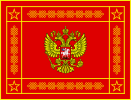
- Pavillon d’armée · officiel
- Affiliation étatique · Russie
- Emblème de catégorie Vigil · pas un insigne officiel
Provenance de l’identité
Service ensign: Banner of the Armed Forces of the Russian Federation. The banner of the Armed Forces of the Russian Federation, the institution’s own symbol. The design itself is not an object of copyright: Article 1259(6) of the Civil Code of the Russian Federation excludes official symbols and signs. The file shipped is the Wikimedia Commons SVG "Banner of the Armed Forces of the Russian Federation (obverse).svg", released under PD-RU-exempt on that basis, so no attribution or share-alike obligation attaches. Optimised for web display; geometry unaltered.
Affiliation étatique : Russie.
La petite marque carrée est un emblème de catégorie Vigil, établi à partir du domaine, de l’échelon et du rôle propres à cette fiche — pas un insigne officiel.
En bref
L’armée faîtière de l’État russe — branches terrestre, aérospatiale, aéroportée, navale, de missiles stratégiques, d’opérations spéciales, ferroviaire et de soutien matériel, sous l’état-major général. Cet atlas consigne sa structure au niveau des branches, des armées et des formations uniquement ; il ne publie ni dispositifs, ni effectifs, ni emplacements, et plusieurs des structures de volontaires et irrégulières qui combattent à ses côtés se situent délibérément hors de cette arborescence.
- Périmètre
- Structure, rôle, filiation et liens. 8 fiches subordonnées publiées.
- Subordination
- Subordination confirmée
- Sources
- 5 dans la fiche
- État de la fiche
- Complète
- Zone d’activité générale
- The entire theatre and the strategic depth behind it — a front from the northern border axes to the southern land bridge, a long-range strike campaign reaching every part of Ukraine, and a naval and aerospace component operating from well outside the war zone.
- Historique notable
- A reformed army that met a war it had not designed for. The post-2008 Serdyukov and Shoigu reforms replaced a mass-mobilisation structure with smaller, permanently ready formations built around contract soldiers, and the Syria intervention and the 2014–15 Donbas operations appeared to validate the result. February 2022 did not. The plan assumed a short campaign against an army that would not fight, and its failure at Kyiv consumed the professional core the reforms had built. What has been reconstituted since is a different institution: refilled by partial mobilisation in 2022 and thereafter by paid contract recruitment at scale, fighting an infantry-heavy attritional war, drawing on refurbished storage stock and on ammunition supplied from North Korea, and expanded again in 2023–24 by the re-creation of military districts and additional formations. It takes ground, slowly, at a cost it has so far proved willing to pay.
- Points forts
- Mass, in manpower, tube artillery and reactivated equipment reserves, and a defence-industrial base placed on a war footing while its opponents' were not. Glide bombs, adopted from 2023, give stand-off strike at a scale and cost no partner-supplied Ukrainian capability matches. A recruitment system that has so far substituted payment for a politically costly second mobilisation. Deep fortification engineering, proven in 2023. Strategic depth that keeps most of its industry and much of its aviation beyond reach.
- Limites
- Quality dilution after four years of attrition among experienced cadres, which is why assault tactics have grown simpler rather than more sophisticated. Centralised command that limits initiative below the level where decisions are needed. Equipment reactivation is drawing on progressively older storage. The strategic rear is no longer a sanctuary: refining, export and airbase infrastructure has proved reachable, and the force has had to redistribute air defence to cover it. And the structures doing some of the hardest fighting — volunteer formations, the Chechen structures, the reorganised PMC lineage — sit partly outside this tree, which is itself a statement about how coherent the whole is.
Formations subordonnées
 Ground ForcesComposante
 Aerospace Forces (VKS)Composante
 Airborne Forces (VDV)ComposanteNavyComposante
 Strategic Missile ForcesComposanteSpecial Operations ForcesComposante
 Railway TroopsComposante
 Logistics & Support (MTO)Composante
Les rangées ne servent qu’à la mise en page — leur position et leur ordre n’indiquent ni hiérarchie, ni importance, ni séquence, ni force. Chaque fiche affichée est un subordonné immédiat de l’organisation sélectionnée.
Organisations associées
- Wagner Group → Africa Corps Lié institutionnellement à · au 2023-06 · confiance élevée
Nominally private 2014–2023, then re-subordinated to Ministry of Defence control after the June 2023 mutiny and the death of its founder. The edge records the post-2023 institutional relationship, not a command position inside the armed forces tree.
Lieux associés
Moscow: National military command and ceremonial centre — long-standing public knowledge. Rostov-on-Don: Long-publicised military administrative centre for the southern theatre.
Fires before movement, pressure before manoeuvre, and depth used as a resource rather than as a shield. The force takes ground by accumulation and pays for it in people, having abandoned the manoeuvre doctrine its pre-war reforms were built around.
Modes opératoires privilégiés
Fires before movement, pressure before manoeuvre. The pre-war doctrine of battalion tactical groups conducting rapid deep operations was abandoned after 2022, when it failed against a defended state. What replaced it is recognisably different: massed artillery and glide bombs used to make a position untenable rather than to support an assault on it; small dismounted infantry groups attacking on narrow frontages once it has been reduced; and simultaneous pressure across a wide sector rather than concentration for breakthrough. Running alongside the ground war is a separate strategic campaign against Ukraine's electricity system, conducted seasonally with cruise missiles, ballistic missiles and mass-produced one-way attack drones — a cost-exchange strategy against air defence as much as a destructive one, and the clearest expression of the force's preference for imposing cost over seizing objectives.
Une généralisation large sur la manière dont cette organisation opère, qualifiée comme une évaluation — pas une description des tactiques actuelles, et délibérément sans aucun score de capacité ni d’efficacité.
Style de commandement
Centralised, with authority held well above the level at which decisions are executed and limited latitude for junior initiative. Formation commanders are held accountable for progress on a timescale that encourages costly attacks. This has been partially offset since 2023 by the growth of drone units operating on shorter loops than the formal chain of command allows, which is the clearest internal tension in the force — and by a parallel structure of volunteer and irregular formations whose relationship to the General Staff has repeatedly been renegotiated rather than settled.
Là où cette généralisation ne tient plus
The generalisation fails in three ways. First, it describes the force since mid-2022 and not the force that invaded: the 2022 campaign attempted exactly the rapid deep operation this record says the force does not conduct. Second, performance is uneven between branches and formations — airborne and naval infantry units have repeatedly been employed as a mobile reserve requiring more coordination than the general pattern implies, and the aerospace and strategic-rocket components fight a different war from the ground forces entirely. Third, "accepting casualties" describes observed practice, not intent, and this module has no basis for claiming what any commander considers acceptable.
Adaptations observées
Adoption of glide-bomb kits on existing munitions from 2023, giving stand-off strike at scale from aircraft that could not previously operate near the line — the most consequential Russian adaptation of the war.
Domestic mass production of the Iranian-derived one-way attack drone design at volumes far beyond the original transfers, converting a scarce precision-strike problem into a saturation one.
A shift from mechanised assault to small dismounted infantry groups, forced by drone saturation making vehicle concentrations unsurvivable near the line.
Redistribution of air defence and the addition of point defences around refining and export infrastructure, in response to a Ukrainian deep-strike campaign the pre-war posture did not anticipate.
Ce qui reste inconnu
- Russian doctrinal publications since 2022 are not available, so this record describes observed practice rather than formal doctrine.
- Force strengths, dispositions and casualty figures are not published, and this atlas makes no claim about any of them. Wartime groupings differ from the peacetime affiliations recorded in the tree below.
- The relationship between the formal structure and the volunteer, regional and irregular formations fighting alongside it is described differently by different Russian sources and has changed repeatedly.
Campagnes
Campagnes nommant cette organisation comme participante. La fiche de campagne détient la relation et lui attribue son degré de confiance ; cette liste est calculée.
- Génération de forces et mobilisation Opposing force · Since February 2022 · high confidence · as of 2026-06
- L’invasion de février 2022 et l’échec devant Kyiv Primary force · February – April 2022 · high confidence · as of 2022-04
The invading force as a whole. Component commands are recorded separately where the module publishes them.
Actions rapides
Accès au système
Là où cette fiche se rattache au reste de Vigil. Chaque ligne figure ici parce que cette organisation y aboutit effectivement.
Évalué au — 2026-08 Dernière revue — 2026-08-26
Voir cette force dans la structure Interactif : sélectionnez cette fiche et suivez ce qui s’y rattache.