
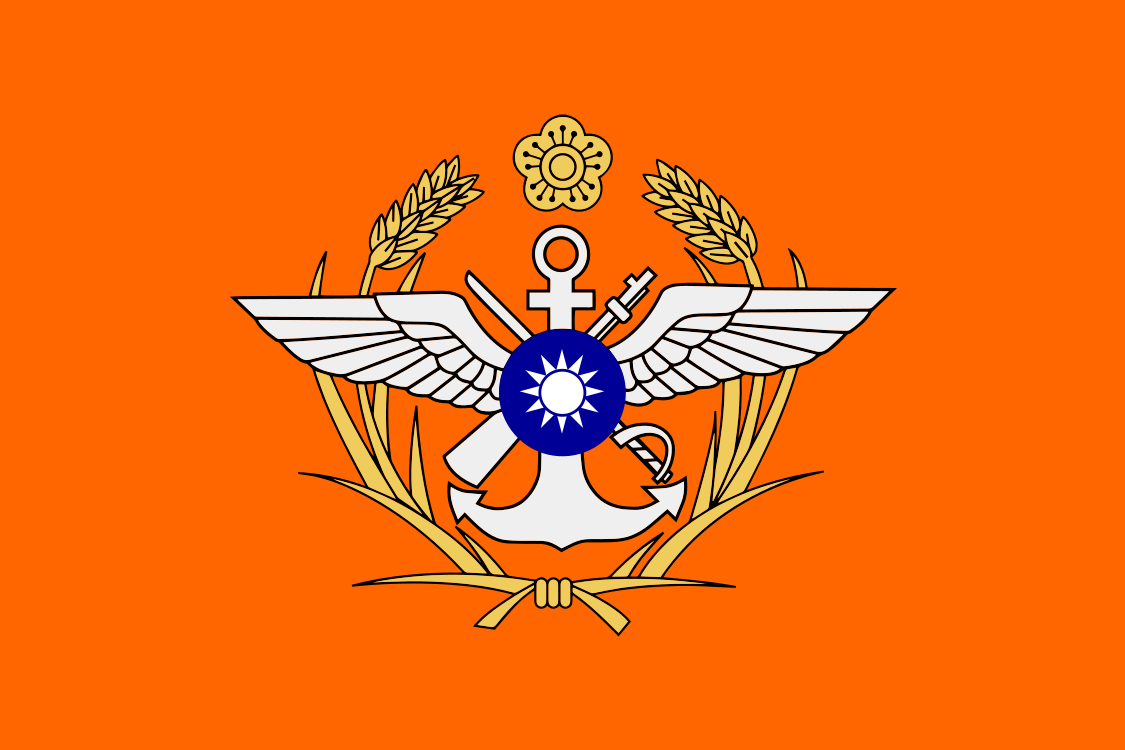
- Institutional emblem · official · carried by Republic of China Armed Forces
- State affiliation · Taiwan
- Vigil category device · not official insignia
Identity provenance
Institutional emblem: Flag of the Ministry of National Defense — the ministry these forces sit under — carried by Republic of China Armed Forces, not issued to this record. THE MINISTRY'S FLAG, NOT THE ARMED FORCES' OWN, and the label says so: the Republic of China Armed Forces are under civilian control through the Ministry of National Defense, and the ministry's flag is the institutional identity the whole structure sits beneath. The services that have flags of their own author them and override this; the ones that do not inherit it, which is the correct reading of what they are. WHAT CHANGED THE EARLIER REFUSAL. The Taiwan pass refused every ROC mark on the SYMBOL test — the ROC Copyright Act names no exclusion for military symbols, so no supplied file could clear. That reasoning was about the FILE'S LICENCE and was applied to a question it does not reach: this Commons file is tagged PUBLIC DOMAIN in its own right, with the ROC Ministry of National Defence recorded as the author of the original, so there is no licence to satisfy and no attribution or share-alike obligation attaches. FILE: Wikimedia Commons "ROC Ministry of National Defense Flag.svg", public domain. Optimised for web display — editor metadata removed and coordinate precision reduced to two decimals on a 1000-unit canvas; no path, colour, proportion or viewBox altered.
State affiliation: Taiwan.
The smaller square mark is a Vigil category device, drawn from this record’s own domain, echelon and role — not an official insignia.
In brief
The operational command that holds the ROC Navy's sea-going forces — the structure through which the shift from sea control to sea denial has to pass.
- Scope
- Structure, role, lineage and links. No subordinate records published.
- Subordination
- Subordination confirmed
- Sources
- 4 on the record
- Record state
- Partial
- Broad area of activity
- Waters around Taiwan and its administered island groups
- Notable history
- The Navy Command's operational arm, holding the fleets and squadrons that go to sea while the service headquarters handles force generation. Its composition is where Taiwan's naval argument becomes visible: the older half of the force is built around a small number of large surface combatants acquired for a sea-control mission, and the newer half around fast missile-armed corvettes, purpose-built minelayers commissioned from 2022 and an indigenous submarine still in trials. The command has to operate both at once, and the annual Han Kuang exercises are where the two halves are seen doing different jobs — the large hulls performing presence and escort, the small ones practising dispersal and denial.
- Strengths
- Operates in home waters within range of land-based anti-ship missiles and air defence, which is the condition that makes a denial force viable at all. The mine-warfare and fast-attack components are recent, purpose-built and matched to the geography rather than inherited from a different mission.
- Limitations
- Large surface combatants in a strait covered by a much larger missile force are a survivability problem the command cannot solve by employment, and outside analysts consistently say so. Taiwan's own mine-warfare capability is assessed by specialist research as still short of the concept it is meant to serve — a small purpose-built minelayer force is not the same thing as a demonstrated ability to lay a barrier under fire. Vigil publishes no basing, no hull counts by class, no dispositions and no readiness.
Documented equipment
Reported & historical equipment associations
Hai Kun-class submarine (Indigenous Defence Submarine): Programme in trials; not an in-service capability claim.
Key events
Han Kuang 42 closes after ten days
Taiwan's 42nd Han Kuang exercise concluded on 14 August 2026 at Bo'ai Camp in Taipei, ten days after it began on 5 August, with the chief of the general staff, service chiefs and regional commanders present. Defence Minister Wellington Koo said the exercise had run with fully operational command centres at every level for the first time and had continued the unscripted format, with units responding to developing orders rather than a rehearsed sequence; he praised participating troops and told officers to address the problems the exercise had identified. Reporting describes it as Taiwan's largest military exercise since 1984, mobilising more than 20,000 reservists. Its components across the ten days included the two mobile-network throttling windows recorded separately here, dispersal of weapons production and mobilisation of civilian manufacturing, urban resilience training run inside the military exercise, and the first joint navy–coast guard anti-blockade drill. China's defence ministry issued its first official comment on the exercise on its final day, spokesperson Chen Xi calling it a posturing, wasteful charade and accusing the governing party of stoking war panic.
Quick actions
System access
Where this record connects into the rest of Vigil. Each row is here because this organisation actually reaches it.
Assessed as of — 2026-09 Last reviewed — 2026-09-09
See this force in the structure Interactive: select this record and follow what connects to it.