
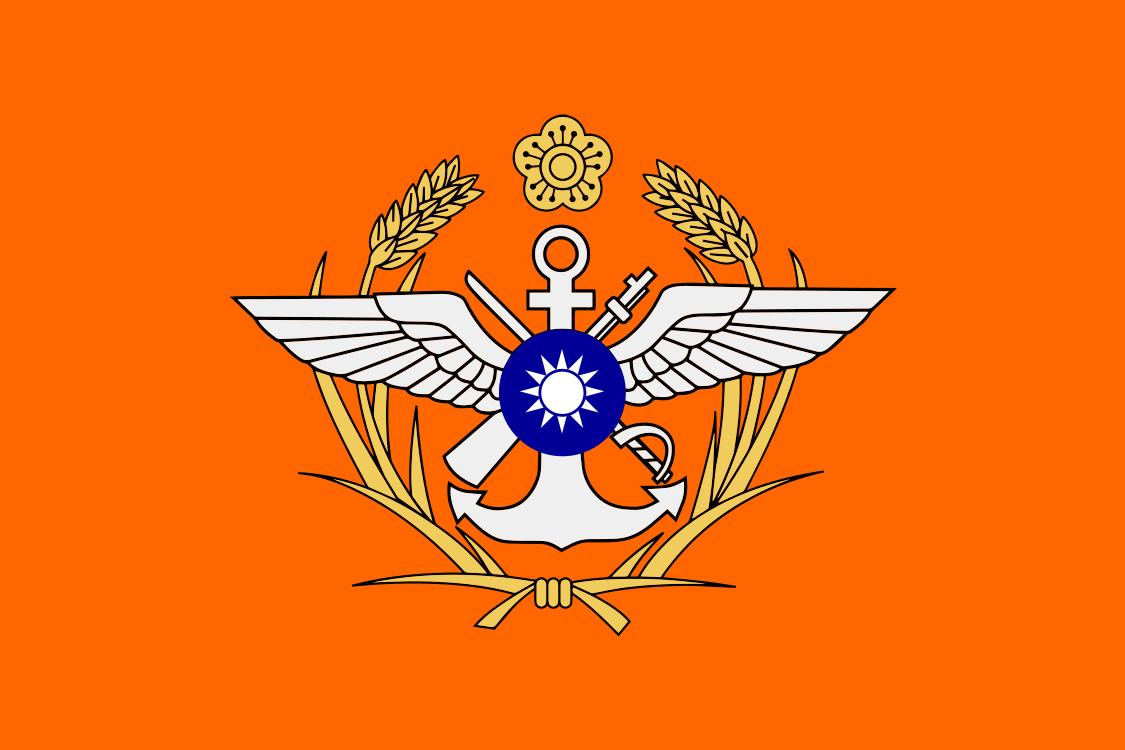
- Institutional emblem · official · carried by Republic of China Armed Forces
- Staatliche Zugehörigkeit · Taiwan
- Vigil-Kategoriezeichen · kein offizielles Abzeichen
Herkunft der Identitätsangaben
Institutional emblem: Flag of the Ministry of National Defense — the ministry these forces sit under — carried by Republic of China Armed Forces, not issued to this record. THE MINISTRY'S FLAG, NOT THE ARMED FORCES' OWN, and the label says so: the Republic of China Armed Forces are under civilian control through the Ministry of National Defense, and the ministry's flag is the institutional identity the whole structure sits beneath. The services that have flags of their own author them and override this; the ones that do not inherit it, which is the correct reading of what they are. WHAT CHANGED THE EARLIER REFUSAL. The Taiwan pass refused every ROC mark on the SYMBOL test — the ROC Copyright Act names no exclusion for military symbols, so no supplied file could clear. That reasoning was about the FILE'S LICENCE and was applied to a question it does not reach: this Commons file is tagged PUBLIC DOMAIN in its own right, with the ROC Ministry of National Defence recorded as the author of the original, so there is no licence to satisfy and no attribution or share-alike obligation attaches. FILE: Wikimedia Commons "ROC Ministry of National Defense Flag.svg", public domain. Optimised for web display — editor metadata removed and coordinate precision reduced to two decimals on a 1000-unit canvas; no path, colour, proportion or viewBox altered.
Staatliche Zugehörigkeit: Taiwan.
Das kleinere quadratische Zeichen ist ein Vigil-Kategoriezeichen, abgeleitet aus Bereich, Führungsebene und Rolle, die dieser Eintrag selbst angibt — kein offizielles Abzeichen.
Kurz gefasst
Das operative Kommando über die seegehenden Kräfte der ROC-Marine — die Struktur, durch die der Wechsel von Seebeherrschung zu Seeverweigerung hindurchmuss.
- Geltungsbereich
- Struktur, Rolle, Entstehung und Verknüpfungen. Keine unterstellten Einträge veröffentlicht.
- Unterstellung
- Unterstellung bestätigt
- Quellen
- 4 im Eintrag
- Eintragsstatus
- Teilweise
- Allgemeines Tätigkeitsfeld
- Waters around Taiwan and its administered island groups
- Bemerkenswerte Geschichte
- The Navy Command's operational arm, holding the fleets and squadrons that go to sea while the service headquarters handles force generation. Its composition is where Taiwan's naval argument becomes visible: the older half of the force is built around a small number of large surface combatants acquired for a sea-control mission, and the newer half around fast missile-armed corvettes, purpose-built minelayers commissioned from 2022 and an indigenous submarine still in trials. The command has to operate both at once, and the annual Han Kuang exercises are where the two halves are seen doing different jobs — the large hulls performing presence and escort, the small ones practising dispersal and denial.
- Stärken
- Operates in home waters within range of land-based anti-ship missiles and air defence, which is the condition that makes a denial force viable at all. The mine-warfare and fast-attack components are recent, purpose-built and matched to the geography rather than inherited from a different mission.
- Einschränkungen
- Large surface combatants in a strait covered by a much larger missile force are a survivability problem the command cannot solve by employment, and outside analysts consistently say so. Taiwan's own mine-warfare capability is assessed by specialist research as still short of the concept it is meant to serve — a small purpose-built minelayer force is not the same thing as a demonstrated ability to lay a barrier under fire. Vigil publishes no basing, no hull counts by class, no dispositions and no readiness.
Dokumentierte Ausrüstung
Gemeldete und historische Ausrüstungszuordnungen
Hai Kun-class submarine (Indigenous Defence Submarine): Programme in trials; not an in-service capability claim.
Schlüsselereignisse
Han Kuang 42 endet nach zehn Tagen
Taiwans 42. Han-Kuang-Übung endete am 14. August 2026 im Bo'ai-Lager in Taipeh, zehn Tage nach ihrem Beginn am 5. August, in Anwesenheit des Generalstabschefs, der Teilstreitkräftechefs und der regionalen Befehlshaber. Verteidigungsminister Wellington Koo sagte, die Übung sei erstmals mit voll einsatzfähigen Gefechtsständen auf allen Ebenen gelaufen und habe das Format ohne Drehbuch fortgesetzt, bei dem Einheiten auf sich entwickelnde Befehle reagieren statt auf einen einstudierten Ablauf; er lobte die teilnehmenden Truppen und wies die Offiziere an, die in der Übung festgestellten Probleme anzugehen. Berichte beschreiben sie als Taiwans größte Militärübung seit 1984, mit mehr als 20,000 mobilisierten Reservisten. Zu ihren Bestandteilen über die zehn Tage gehörten die beiden hier gesondert festgehaltenen Zeitfenster der Mobilfunkdrosselung, die Verlagerung der Waffenproduktion und die Mobilisierung ziviler Fertigung, innerhalb der Militärübung durchgeführte Ausbildung zur städtischen Resilienz sowie die erste gemeinsame Übung von Marine und Küstenwache gegen eine Blockade. Chinas Verteidigungsministerium äußerte sich am letzten Tag erstmals offiziell zu der Übung; Sprecher Chen Xi nannte sie eine großspurige, verschwenderische Farce und warf der Regierungspartei vor, Kriegspanik zu schüren.
Schnellaktionen
Zugang zum System
Wo dieser Eintrag an den Rest von Vigil anschließt. Jede Zeile steht hier, weil diese Organisation tatsächlich dorthin reicht.
Eingeschätzt zum Stand — 2026-09 Zuletzt überprüft — 2026-09-09
Diesen Verband in der Struktur ansehen Interaktiv: Wählen Sie diesen Eintrag aus und verfolgen Sie, was mit ihm verbunden ist.