
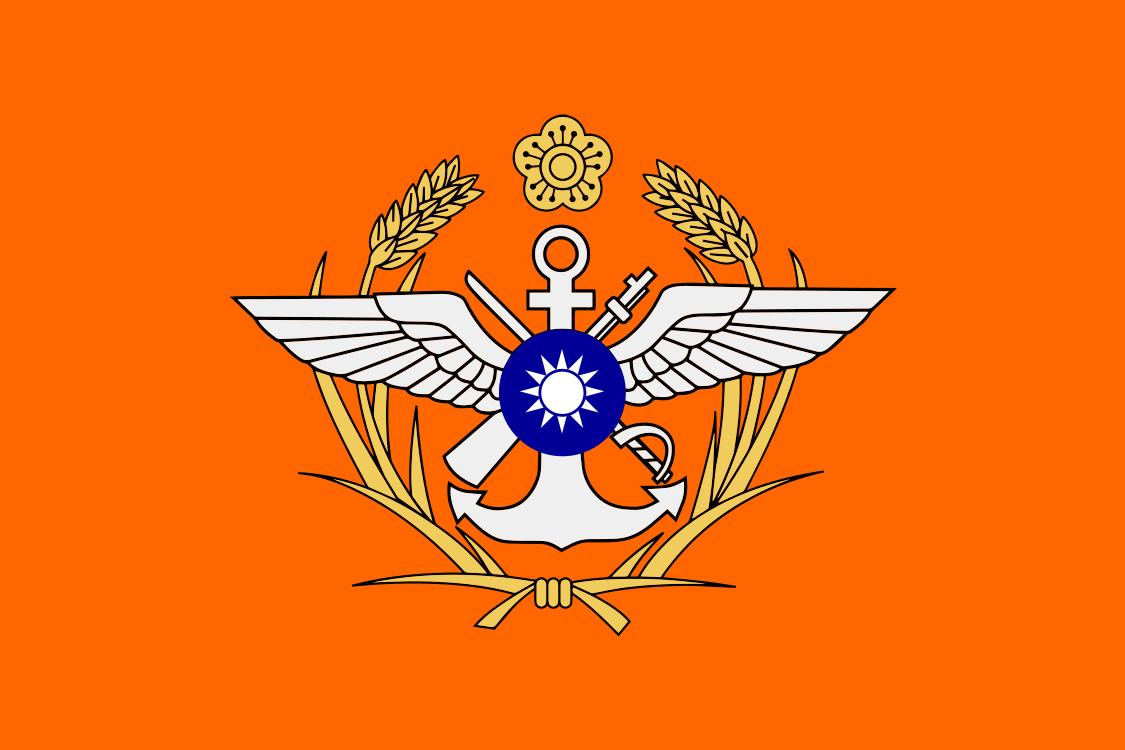
- Institutional emblem · official · carried by Republic of China Armed Forces
- Affiliation étatique · Taïwan
- Emblème de catégorie Vigil · pas un insigne officiel
Provenance de l’identité
Institutional emblem: Flag of the Ministry of National Defense — the ministry these forces sit under — carried by Republic of China Armed Forces, not issued to this record. THE MINISTRY'S FLAG, NOT THE ARMED FORCES' OWN, and the label says so: the Republic of China Armed Forces are under civilian control through the Ministry of National Defense, and the ministry's flag is the institutional identity the whole structure sits beneath. The services that have flags of their own author them and override this; the ones that do not inherit it, which is the correct reading of what they are. WHAT CHANGED THE EARLIER REFUSAL. The Taiwan pass refused every ROC mark on the SYMBOL test — the ROC Copyright Act names no exclusion for military symbols, so no supplied file could clear. That reasoning was about the FILE'S LICENCE and was applied to a question it does not reach: this Commons file is tagged PUBLIC DOMAIN in its own right, with the ROC Ministry of National Defence recorded as the author of the original, so there is no licence to satisfy and no attribution or share-alike obligation attaches. FILE: Wikimedia Commons "ROC Ministry of National Defense Flag.svg", public domain. Optimised for web display — editor metadata removed and coordinate precision reduced to two decimals on a 1000-unit canvas; no path, colour, proportion or viewBox altered.
Affiliation étatique : Taïwan.
La petite marque carrée est un emblème de catégorie Vigil, établi à partir du domaine, de l’échelon et du rôle propres à cette fiche — pas un insigne officiel.
En bref
Le commandement opérationnel qui regroupe les forces hauturières de la marine de la République de Chine — la structure par laquelle doit passer le glissement de la maîtrise de la mer vers le déni maritime.
- Périmètre
- Structure, rôle, filiation et liens. Aucune fiche subordonnée publiée.
- Subordination
- Subordination confirmée
- Sources
- 4 dans la fiche
- État de la fiche
- Partiel
- Zone d’activité générale
- Waters around Taiwan and its administered island groups
- Historique notable
- The Navy Command's operational arm, holding the fleets and squadrons that go to sea while the service headquarters handles force generation. Its composition is where Taiwan's naval argument becomes visible: the older half of the force is built around a small number of large surface combatants acquired for a sea-control mission, and the newer half around fast missile-armed corvettes, purpose-built minelayers commissioned from 2022 and an indigenous submarine still in trials. The command has to operate both at once, and the annual Han Kuang exercises are where the two halves are seen doing different jobs — the large hulls performing presence and escort, the small ones practising dispersal and denial.
- Points forts
- Operates in home waters within range of land-based anti-ship missiles and air defence, which is the condition that makes a denial force viable at all. The mine-warfare and fast-attack components are recent, purpose-built and matched to the geography rather than inherited from a different mission.
- Limites
- Large surface combatants in a strait covered by a much larger missile force are a survivability problem the command cannot solve by employment, and outside analysts consistently say so. Taiwan's own mine-warfare capability is assessed by specialist research as still short of the concept it is meant to serve — a small purpose-built minelayer force is not the same thing as a demonstrated ability to lay a barrier under fire. Vigil publishes no basing, no hull counts by class, no dispositions and no readiness.
Équipements documentés
Associations d’équipement signalées et historiques
Hai Kun-class submarine (Indigenous Defence Submarine): Programme in trials; not an in-service capability claim.
Événements clés
Han Kuang 42 s’achève après dix jours
Le 42e exercice Han Kuang de Taïwan s’est achevé le 14 août 2026 au camp de Bo’ai à Taipei, dix jours après avoir commencé le 5 août, en présence du chef d’état-major général, des chefs d’armée et des commandants régionaux. Le ministre de la Défense Wellington Koo a déclaré que l’exercice s’était déroulé pour la première fois avec des centres de commandement pleinement opérationnels à tous les niveaux et avait conservé le format sans scénario préétabli, les unités répondant à des ordres évolutifs plutôt qu’à une séquence répétée ; il a salué les troupes participantes et demandé aux officiers de traiter les problèmes que l’exercice avait mis en évidence. Les comptes rendus le décrivent comme le plus grand exercice militaire de Taïwan depuis 1984, mobilisant plus de 20,000 réservistes. Ses volets sur les dix jours comprenaient les deux fenêtres de bridage du réseau mobile enregistrées séparément ici, la dispersion de la production d’armement et la mobilisation de l’industrie civile, un entraînement à la résilience urbaine mené au sein de l’exercice militaire, et le premier exercice conjoint anti-blocus de la marine et des garde-côtes. Le ministère chinois de la Défense a publié son premier commentaire officiel sur l’exercice le dernier jour, son porte-parole Chen Xi le qualifiant de mascarade ostentatoire et dispendieuse et accusant le parti au pouvoir d’attiser la peur de la guerre.
Actions rapides
Accès au système
Là où cette fiche se rattache au reste de Vigil. Chaque ligne figure ici parce que cette organisation y aboutit effectivement.
Évalué au — 2026-09 Dernière revue — 2026-09-09
Voir cette force dans la structure Interactif : sélectionnez cette fiche et suivez ce qui s’y rattache.