
The finding
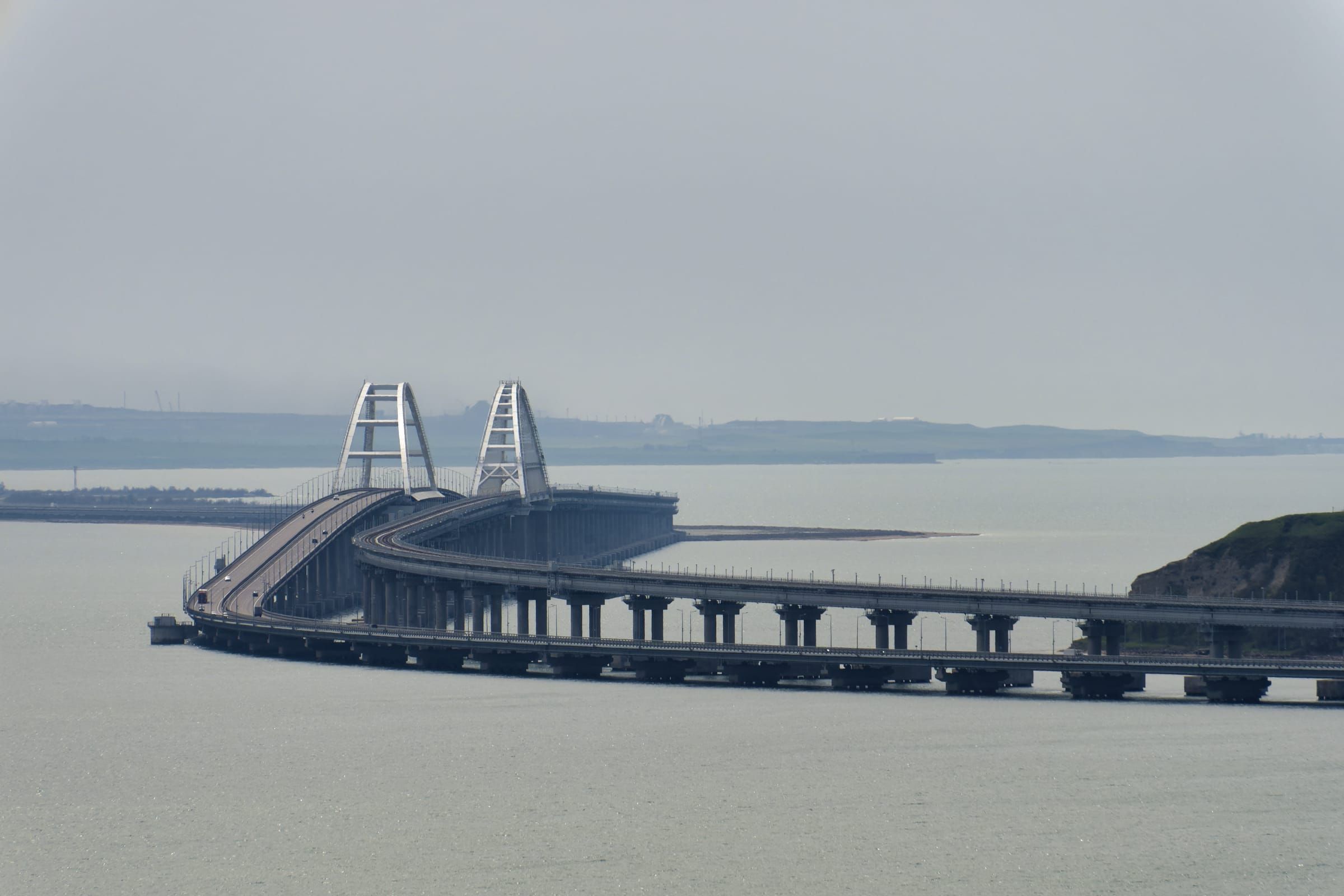
At about midnight on 16–17 November 2026 Ukraine struck the Crimean Bridge for the second night running. By the morning the steel arch that carries the road over the Kerch shipping channel, and the span beneath it, were in the sea. Ukraine’s General Staff said so — “the arch and a span of the bridge’s road section have collapsed” and “no vehicle can cross it” — and Reuters said it had verified the footage President Zelensky posted showing the road arch “crumbled into the sea”. Russian authorities confirmed “damage to the structure” and opened a terrorism case. They have not described a collapse.
That much is established, and it is a serious loss for Russia: the bridge is the flagship of the 2014 annexation and the only fixed link between Russia and Crimea. This Note asks a narrower question than most of the reporting that followed. How far do the strikes actually constrain Russia’s connectivity to Crimea and its ability to sustain forces there, and what evidence would show a lasting effect?
The answer turns on a fact that predates the strike. The road deck that fell was not Crimea’s freight route. Since the 2022 attack heavy lorries had been confined to the ferries and fuel tankers barred from the bridge; Crimea’s bulk supply ran on the railway beside it and on the land road through occupied southern Ukraine. The strikes took away the road, a fast reserve and a symbol. Whether they constrain supply depends on two other links — and in the same weeks, Ukraine was striking both.
What happened, night by night
The first strike came on the night of 15–16 November. Sergey Aksyonov, the Russian-installed head of Crimea, said “the enemy struck the Crimean bridge” and closed it to traffic; the road stayed closed for more than sixteen hours and reopened that evening with traffic alternating in one direction at a time, by Deputy Prime Minister Marat Khusnullin’s account. The Kremlin called the damage “minor”. Open-source analysts said the road span over the channel was visibly deformed. Rail traffic was not interrupted, though trains were delayed. Russia’s defence ministry claimed a record 1,336 drones shot down that night and, over 24 hours, four Flamingo cruise missiles — figures no one outside the ministry can check. Ukraine claimed nothing that day.
The following night Russia struck Kyiv’s two Dnipro bridges with ballistic missiles — four aimed at the Southern Bridge and three at the Northern, by Zelensky’s count. Around midnight Ukraine struck the Crimean Bridge again. Ukraine’s defence minister, Yevhenii Khmara, tied the two together: Russia had been “deliberately hitting our bridges”, and “today, we responded in kind”.
On 17 November Kyiv told the operation’s story. The SBU said it had run for about a month in seven stages: strikes first on air defence, then on the bridge itself, with other branches joining for the last stage; its Alpha group hit the road section with Palianytsia missile-drones, and this was the fourth time the SBU had struck the bridge. Zelensky listed the weapons used across the operation — among them the Neptune missile, the Ruta and Flamingo, and several drone types — and said a Flamingo made the final precision strike. Russia’s transport ministry suspended road and rail traffic, said specialists were assessing the damage and reported no casualties on preliminary information. The Kremlin set up a government commission under Khusnullin, and Dmitry Peskov said the bridge “will be restored and will be even better than before”.
By early afternoon on 17 November trains were crossing again. The rail operator Grand Service Express announced that “rail traffic across the Crimean Bridge has been resumed”, and Aksyonov said rail links between Crimea and Taman were restored. Russia’s rail agency said the timetable was back to normal by 19:40. On 18 November the transport minister said the crossing remained “closed to cars”; long-distance passenger trains were terminating at Kerch, with buses onward, a scheme the operator said would stay in place at least until 23 November; and foot passengers were told they could use the ferry.
The table at the head of this Note sets out where each of Crimea’s links stood before the strikes and where the public record leaves it now.
What is verified, and what is not
The collapse of the road arch is the best-evidenced claim of the two nights. Ukraine’s General Staff and the SBU state it; Reuters verified the footage on 17 November and the New York Times verified video of the same section; a video filmed from a passing train on 18 November, not independently verified, shows the road arch gone. The Russian side’s silence is itself informative: the transport ministry, the Investigative Committee and the Kremlin have all spoken about damage, repair and investigation, and none has described what fell.
Almost everything else is thinner, and the figure below places each claim by who establishes it.
Vigil's classificationEvidence by stage · as of
What each claim rests on
Six things said about the strikes, each placed by the source that establishes it. Further right is more independent of Ukraine's account, not more important; "not established" is a fact about the public record at 18 November.
| Case | Claimedby Ukraine | Acknowledgedby Russian authorities | Verifiedindependently | Effect observedin supply or traffic |
|---|---|---|---|---|
| The road arch and span fell into the sea | DocumentedGeneral Staff and SBU, 17 Nov | Stated"Damage to the structure" (Investigative Committee); no collapse described | DocumentedFootage verified by Reuters, 17 Nov; also the New York Times | DocumentedCrossing closed to cars (transport minister, 18 Nov) |
| The rail section was damaged | DocumentedArch damaged, section standing (General Staff) | StatedRail suspended, then resumed 17 Nov; no damage described | Not established | StatedPassenger trains end at Kerch to at least 23 Nov; freight not reported |
| The shipping channel is blocked | StatedUkrainian outlets and officials say shipping halted | Not establishedNo navigation notice found | StatedSpan lay over the channel (geometry); support vessels on AIS | Not establishedStrait already near-idle since 10 July |
| Ukrainian-made missiles did the damageFP-5 Flamingo | DocumentedFlamingo, Neptune, Ruta and drones named (Zelensky, SBU) | StatedRussian MoD claimed four Flamingos shot down, 15–16 Nov | Not establishedNo independent weapon identification | Does not apply |
| Supply to Crimea was cut | Stated"Main route" for fuel and ammunition (General Staff) | StatedBridge "practically not used" for cargo (Sevastopol governor) | Not established | Not establishedNo rationing; 13 of 76 stations with fuel on 18 Nov |
| People were killed | Does not apply | StatedNo casualties, on preliminary information (transport ministry) | Not establishedOne wire report of two deaths, not found in any Russian source | Does not apply |
- Documented a primary or receiving-party source records it
- Stated claimed by an interested party or reported second-hand; no primary or receiving-party source was read
- Not established no source read establishes it — a fact about the public record, not proof it did not happen
- Does not apply the stage does not apply to this case
Basis: Sources: Ukrainian state publications and official statements↗ · Ukrainian military and General Staff statements · Official government statements · Reuters↗ · Established international media reporting
Follow in Watch6 observables · 2 reviews · latest 2026-11-22
Four gaps matter.
The rail section. Ukraine’s General Staff says it stands “with a damaged arch”. Russian officials say only that traffic resumed, and not consistently: Russia’s transport ministry said trains run on one track while the second is repaired, and Deputy Prime Minister Andrei Nikitin said rail was restored “in full”. Whether freight trains, rather than passenger trains, have crossed since 17 November is not reported by anyone.
The weapon. Ukraine names Palianytsia for the road section and Neptune, Ruta and Flamingo for the rail section and the final strike; one Ukrainian outlet credits the collapse to a Flamingo, a manufacturer credits Ruta, and Russia’s own claim of four Flamingos shot down is the nearest thing to outside corroboration that the missile was used at all. No independent identification exists.
Casualties. Russia’s transport ministry reported none on preliminary information. Reuters wrote that Aksyonov said two people were killed. Vigil found no Russian-language source for that statement; searches return only the couple killed on the bridge in July 2023. The Note records the discrepancy and does not resolve it.
Imagery. Commercial satellite imagery after the first night showed damage around the road arch. No satellite image after the collapse was found by the cutoff.
The road deck was not the freight route
The strike’s military meaning depends on what the road deck carried, and the evidence on that is unusually consistent across sides.
After the truck bomb of October 2022, Russia restricted what could use the bridge. UK Defence Intelligence reported in October 2023 that heavy goods vehicles and fuel were moving by ferry, and again on 27 June 2026 that “lorries may only use the ferries, not the bridge”, with only cars, buses and “certain types of rail transport” crossing it. From 23 June 2026, by an adviser to Aksyonov’s account, a single vehicle could carry 200 litres of fuel across, up from 100. On 17 November the governor of Sevastopol, Mikhail Razvozhayev, said the bridge was “practically not used for delivering cargo”, its main traffic being private cars and buses. Ukraine’s General Staff called it “the main route” for fuel, ammunition, equipment and personnel; the restrictions on the record do not support that for fuel and heavy equipment by road.
The analysts who know the route reached the same view from the other side. Emil Kastehelmi of the Black Bird Group said most heavy traffic had already switched to the land route, but that the bridge served as an emergency route if Russia “had to transport something very quickly — but of course, that option is now gone”. Andrii Kharuk called it “the fastest route for transferring reinforcements to Crimea”.
So the loss is real, but specific: the passenger road, a fast and relatively safe route for people and light vehicles, and a reserve that could have taken heavier traffic in an emergency. It is not the loss of the route Crimea’s fuel and heavy supply was travelling on.
Rail: the link that still carries
The rail deck is now the bridge’s only working link, and the one whose condition matters most. It ran on 17 November on a structure Ukraine says is damaged. That it runs is established by Russian officials; what it carries is not. Before the strike UK Defence Intelligence described only “certain types” of rail traffic on the bridge, and the rail ferries that once duplicated it were struck in March and April 2026 and “almost certainly” under repair in June.
Precedent cuts both ways. After October 2022 Russia ran trains on the less damaged track the same evening and reopened the second track only in May 2023; after the 2023 strike it restored the road section within about three months. Russia has repaired this bridge twice. It has not had to keep it running while both the railway and the land route are being struck.
The observable is simple to state and hard to see: any restriction on the rail section beyond passenger service — freight not crossing, a weight or speed limit, or a renewed closure.
The strait: an obstruction across a closed door
The arch fell over the Kerch–Yenikale canal, the only deep-water passage between the Black Sea and the Sea of Azov. A grain analyst at SovEcon, Andrey Sizov, said the debris could “substantially delay any eventual resumption of shipping from the Sea of Azov” and estimated clearance at one to three months; on 17 November AIS data showed two tugs, a pilot boat and a dredger at the bridge. Ukrainian outlets reported that shipping was halted.
Two facts qualify that. No Russian navigation warning, harbour-master notice or ministry statement about the canal was found — a Russian-installed official’s “movement across the Kerch Strait is temporarily suspended” referred, from its context, to road traffic. And the strait was already largely shut: on 10 July, after Ukrainian drones struck vessels in the Sea of Azov, Russian border guards stopped accepting passage applications, according to Reuters’ sources, and Russia suspended shipping on the Don–Azov canal. Traffic through the strait had been close to zero since.
The maritime effect is therefore a plausible obstruction of a route that was already closed, which matters for when the Azov ports could reopen rather than for whether they are open now. A navigation notice, a transit, or a clearance announcement would settle it.
The land route: the link everything now leans on
The land road through occupied southern Ukraine — the R-280, running from Rostov-on-Don through Mariupol, Berdiansk and Melitopol into Crimea — has carried Crimea’s heavy freight since the bridge was restricted. It is also the route Ukraine has been striking hardest.
In the spring and summer of 2026, Ukrainian medium-range drones hunted lorries along it; the commander of Ukraine’s unmanned systems forces said traffic on it fell sharply, on figures that are his alone. From June Ukraine struck the crossings between the mainland and Crimea — the Henichesk road bridge and the rail bridges at Chonhar and over the North Crimean Canal — and Russia answered with air defence and temporary crossings. The Centre for Eastern Studies concluded in September that a full blockade of the peninsula remained unlikely and that the campaign had lost momentum in August. Ukraine’s General Staff now says the Chonhar and Henichesk bridges “went down” this autumn.
Then the strikes moved north. Militarnyi, citing a Ukrainian monitoring channel, counted six bridges struck on the Rostov end of the route between 10 October and 15 November, three of them in the week before the arch fell. The Rostov governor confirmed damage at the Mius bridge near Nataliivka on 8 November and at a road overpass on 15 November; the Nataliivka crossing reopened on 14 November on a temporary bridge, with traffic alternating. A bridge near Novoazovsk was reported critically damaged on 11 November.
This is where the strikes’ effect will or will not show. A struck bridge with a detour within a week is an inconvenience; a land road that stays cut while the railway is restricted is a constraint. Neither the length of the detours nor the freight the route carries is published, and the Note does not estimate either.
From the MapRecorded strike events · Weekly bins · 01 Mar 2026 → 14 Nov 2026
The strikes on the Kerch crossing before the bridge
- Records in the bin
- Covered zero
- Records
- 26
- Markers
- 9
- Series status as of
- Reviewed
What the series counts Reported strikes on ports, terminals, fleet facilities and vessels at the Black Sea and Azov markers this module publishes, by either side — never an effect.
What Russia can absorb
Russia’s ability to absorb the loss rests on three things the record shows and one it does not. It has redundancy: a railway on the bridge, a land road and a land railway through the occupied south, and ferries, though the ferries are depleted. It has repaired the bridge before, faster than critics predicted each time. And it moved heavy supply off the road deck years ago, precisely because the bridge was a target.
What the record does not show is how much slack is left. Crimea rationed fuel from May to October 2026, when Sevastopol’s governor lifted the limits because the gasoline supply had “practically stabilised”. On the morning of 18 November fuel was on open sale at 13 of Sevastopol’s 76 stations by one local outlet’s count, and the governor warned of limits if canister buying went on. No authority has tied that to the bridge. It is the kind of signal that would matter if it persisted and was attributed to logistics.
Military, economic and political implications
Military. The road deck’s loss falls on people and light traffic: troop rotations by bus, leave, families, light vehicles, and the option of a quick move of heavier equipment in an emergency. Bulk military supply, as far as the record shows, already travelled by rail and by the land road. ISW assessed the strike as part of a systematic campaign to deny Russian forces their main ground lines of communication; that is the right frame, because the strike’s weight depends on what else in the campaign holds.
Economic. The obstruction matters most for the Azov ports, which a grain analyst puts at up to a quarter of Russia’s grain exports, but those ports were already largely cut off from the Black Sea by the July suspension. For Crimea itself, the near-term economic effect is on passenger travel and tourism; the supply effect, if any, has not yet appeared.
Political. The political effect is the largest and the best established. The bridge was Putin’s personal emblem of the annexation; Tomas Jermalavicius of the International Centre for Defence and Security said its loss, even if temporary, would reverberate through the regime’s image of control. The strike came two days before Putin’s scheduled meetings with Xi Jinping and Donald Trump, and the same night as Russia’s strikes on Kyiv’s bridges, which made bridges an explicit object of exchange between the two sides.
Competing readings
Crimea is now an island. Kharuk’s phrase, and the headline reading. It rests on the road arch’s fall and on the land route being under attack. It is not supported: a railway still crosses the bridge, the land road is open with detours, and no supply constraint is documented.
A symbolic blow with little military effect. It rests on the restrictions that had already moved freight off the road deck and on Russia’s record of repair. It is the stronger reading for the road deck alone, and it understates two things: the loss of the reserve, and the fact that the remaining links are being struck at the same time.
A step in a campaign against the whole system. It rests on the sequence — ferries in the spring, the Crimean crossings from June, the Rostov bridges from October, the bridge in November — and on ISW’s framing. The evidence for the campaign is good. The evidence that it has constrained supply is not yet there. This is the reading the Note adopts, with that limit stated.
What would show a lasting effect
The strikes will have constrained Crimea’s supply if three things become visible together: a restriction on the rail section beyond passenger service; a crossing on the land road that stays cut without a detour; and rationing in Crimea that the authorities attribute to logistics. Any one alone is weak evidence. The reverse is just as observable: freight crossing the rail section and the land road open with its detours through the winter, with no supply limits in Crimea, would show that the strikes changed the symbol more than the supply.
Vigil opens a standing Watch question on exactly that, with this Note as its baseline.
Where the evidence stops
No one publishes the freight carried by the bridge’s railway, the land road, the land railway or the ferries, before or after the strike, and the Note gives no figure for any of them. No Russian official has described the collapse, given a repair method or a schedule, or said whether freight crosses. No navigation notice on the canal was found. The weapon that brought the arch down is Ukraine’s account. The casualty discrepancy is unresolved. Reuters was read as syndicated, ISW through other outlets, and CNN not at all; their own pages refused automated access.
What the strikes demonstrate about Ukraine’s long-range strike is correspondingly bounded. They show a weeks-long sequence, by several services, with Ukrainian-made weapons, that brought down part of one of the most heavily defended structures in Russian-held territory. They do not show how many weapons it took, what was intercepted, or whether the method can be repeated against the rail section or a land-route bridge while Russia watches for it. Those are the next things to observe.