
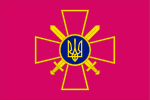
- Pavillon d’armée · officiel
- Affiliation étatique · Ukraine
- Emblème de catégorie Vigil · pas un insigne officiel
Provenance de l’identité
Service ensign: Ensign of the Ukrainian Ground Forces. The service ensign of the Ground Forces. The design itself is excluded from copyright by Article 8 of Ukraine’s Law on Copyright and Related Rights, which names symbols and signs of government authorities, the Armed Forces of Ukraine and other military formations. The file shipped is the Wikimedia Commons SVG "Ensign of the Ukrainian Ground Forces.svg", released under PD-UAexMilitary / PD-UA-exempt on that basis, so no attribution or share-alike obligation attaches. Optimised for web display; geometry unaltered.
Affiliation étatique : Ukraine.
La petite marque carrée est un emblème de catégorie Vigil, établi à partir du domaine, de l’échelon et du rôle propres à cette fiche — pas un insigne officiel.
En bref
La plus grande branche — brigades mécanisées, motorisées et d’infanterie.
- Périmètre
- Structure, rôle, filiation et liens. 16 fiches subordonnées publiées.
- Subordination
- Subordination confirmée
- Sources
- 5 dans la fiche
- État de la fiche
- Complète
- Zone d’activité générale
- The full length of the front since 2022 — from the Kyiv defensive battles through the counteroffensives to the positional fighting around the Donbas hubs.
- Historique notable
- Carried the weight of every phase of the war: the 2022 defence of Kyiv and the Kharkiv and Kherson counteroffensives, the 2023 southern offensive, and the long defensive battles since. Absorbed the bulk of Western equipment deliveries while expanding from a peacetime core to a mobilised force of dozens of brigades — a transformation achieved under fire.
- Points forts
- Deep combat experience at every echelon; proven ability to integrate a dozen foreign equipment families at once; a domestic artillery and drone industry increasingly behind it.
- Limites
- Infantry shortage is the binding constraint, publicly acknowledged since 2024; quality varies widely between veteran and newly formed brigades; dependent on Western ammunition and air-defence supply for high-intensity operations.
Formations subordonnées
Commands & districts 4
Operational Command NorthCommandementOperational Command SouthCommandementOperational Command EastCommandementOperational Command WestCommandementCorps 1
Brigades 11
24th Mechanized Brigade « King Danylo »Brigade · subordination inconnue47th Mechanized Brigade « Magura »Brigade · subordination inconnue53rd Mechanized BrigadeBrigade · subordination inconnue60th Mechanized BrigadeBrigade · subordination inconnue63rd Mechanized BrigadeBrigade · subordination inconnue72nd Mechanized Brigade « Black Zaporozhians »Brigade · subordination inconnue92nd Assault BrigadeBrigade · subordination inconnue93rd Mechanized Brigade « Kholodnyi Yar »Brigade · subordination inconnue125th Heavy Mechanized BrigadeBrigade · subordination inconnue17th Tank BrigadeBrigade · subordination inconnue43rd Heavy Artillery BrigadeBrigade · subordination inconnueLes rangées ne servent qu’à la mise en page — leur position et leur ordre n’indiquent ni hiérarchie, ni importance, ni séquence, ni force. Chaque fiche affichée est un subordonné immédiat de l’organisation sélectionnée. Les intitulés sont dérivés du type et de l’échelon propres à chaque fiche. Ce ne sont pas des niveaux de commandement, et aucun niveau de ce genre n’existe dans l’arborescence des forces.
Équipements documentés
Organisations associées
- Unmanned Systems Forces Lié institutionnellement à · au 2026-06 · confiance modérée
Drone units are attached across the force rather than held within the branch, which concentrates doctrine, procurement and the elite strike formations. The edge records that distribution pattern; it asserts no command relationship in either direction.
Defence in depth with the drone as the primary shaping weapon. Hold with as little infantry as the ground allows, make the approaches to the line lethal for anything that moves, and trade space deliberately where the exchange favours the defence.
Modes opératoires privilégiés
Defence in depth, with the drone rather than artillery as the primary shaping weapon. The force holds forward positions thinly and relies on a deep contested zone behind and in front of the line, in which reconnaissance and strike drones make vehicle movement and troop concentration prohibitively costly. Artillery is used against what the drones find rather than as the primary means of attrition, a reversal of the pre-war relationship forced by ammunition scarcity as much as by choice. Where a position becomes untenable, withdrawal to prepared ground behind it is preferred to holding at cost — a principle stated more consistently than it has been applied, since political considerations have repeatedly kept forces in places the method would have given up.
Une généralisation large sur la manière dont cette organisation opère, qualifiée comme une évaluation — pas une description des tactiques actuelles, et délibérément sans aucun score de capacité ni d’efficacité.
Style de commandement
More decentralised than its Soviet inheritance and less so than its partners' doctrine assumes. Brigade and battalion commanders exercise substantial latitude, and volunteer-origin formations retain distinct cultures. The persistent tension is between that latitude and a General Staff that has periodically centralised control of reserves and of withdrawal decisions, with the July 2026 command change the most recent episode in a recurring argument.
Là où cette généralisation ne tient plus
The generalisation fails in two ways that matter. First, the stated preference for trading space has repeatedly been overridden — Bakhmut and Avdiivka were both held well past the point the method implies, for reasons that were political and reputational as much as military, and the module records that as a real feature rather than as a deviation. Second, "defence in depth" describes the east; the northern border is a standing screening commitment against a possibility, and the southern line is shaped by an obstacle rather than by a method.
Adaptations observées
Institutionalisation of drone warfare as a separate branch rather than as a capability distributed across existing arms — the clearest structural expression of how the force decided to fight.
Abandonment of large combined-arms assault after the 2023 southern offensive, in favour of small-unit action supported by drones and artillery.
Corps-level command structures introduced to reduce the number of formations reporting directly to operational commands, an attempt to fix a span-of-control problem that grew with the force.
Ce qui reste inconnu
- Ukrainian doctrinal publications are not public, so this record describes observed practice.
- Decisions to hold or withdraw from specific positions are debated publicly after the fact and the reasoning is rarely documented.
- Force structure below the level published here is not disclosed, and no claim is made about the state of any formation.
Événements clés
L’Ukraine nomme Mykhailo Drapatyi commandant en chef
Le président Zelensky a démis Oleksandr Syrskyi et nommé Mykhailo Drapatyi commandant en chef des forces armées ukrainiennes le 21 juillet 2026 ; le général de division Ihor Skybiuk a été nommé chef de l’état-major général le lendemain. Le changement de commandement a suivi un remaniement gouvernemental plus large — le limogeage du Premier ministre et du ministre de la Défense réformateur Mykhailo Fedorov — et six jours de manifestations à Kyiv.
Actions rapides
Accès au système
Là où cette fiche se rattache au reste de Vigil. Chaque ligne figure ici parce que cette organisation y aboutit effectivement.
Évalué au — 2026-06 Dernière revue — 2026-06
Voir cette force dans la structure Interactif : sélectionnez cette fiche et suivez ce qui s’y rattache.