
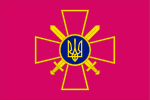
- Bandera rodzaju sił · oficjalna
- Przynależność państwowa · Ukraina
- Symbol kategorii Vigil · nie jest to oficjalne oznaczenie
Pochodzenie tożsamości
Service ensign: Ensign of the Ukrainian Ground Forces. The service ensign of the Ground Forces. The design itself is excluded from copyright by Article 8 of Ukraine’s Law on Copyright and Related Rights, which names symbols and signs of government authorities, the Armed Forces of Ukraine and other military formations. The file shipped is the Wikimedia Commons SVG "Ensign of the Ukrainian Ground Forces.svg", released under PD-UAexMilitary / PD-UA-exempt on that basis, so no attribution or share-alike obligation attaches. Optimised for web display; geometry unaltered.
Przynależność państwowa: Ukraina.
Mniejszy kwadratowy znak to symbol kategorii Vigil, wyprowadzony z domeny, szczebla i roli podanych w samym wpisie — nie jest to oficjalne oznaczenie.
W skrócie
Największy rodzaj sił — brygady zmechanizowane, zmotoryzowane i piechoty.
- Zakres
- Struktura, rola, rodowód i powiązania. Opublikowane wpisy podległe: 12.
- Podporządkowanie
- Podporządkowanie: potwierdzone
- Źródła
- We wpisie: 5
- Stan wpisu
- Pełny
- Szeroki obszar działania
- The full length of the front since 2022 — from the Kyiv defensive battles through the counteroffensives to the positional fighting around the Donbas hubs.
- Istotna historia
- Carried the weight of every phase of the war: the 2022 defence of Kyiv and the Kharkiv and Kherson counteroffensives, the 2023 southern offensive, and the long defensive battles since. Absorbed the bulk of Western equipment deliveries while expanding from a peacetime core to a mobilised force of dozens of brigades — a transformation achieved under fire.
- Mocne strony
- Deep combat experience at every echelon; proven ability to integrate a dozen foreign equipment families at once; a domestic artillery and drone industry increasingly behind it.
- Ograniczenia
- Infantry shortage is the binding constraint, publicly acknowledged since 2024; quality varies widely between veteran and newly formed brigades; dependent on Western ammunition and air-defence supply for high-intensity operations.
Formacje podległe
Commands & districts 4
Dowództwo Operacyjne „Północ”DowodzenieDowództwo Operacyjne „Południe”DowodzenieDowództwo Operacyjne „Wschód”DowodzenieDowództwo Operacyjne „Zachód”DowodzenieCorps 1
Brigades 7
24. Brygada Zmechanizowana „Król Danyło”Brygada · podporządkowanie: nieznane47. Brygada Zmechanizowana „Magura”Brygada · podporządkowanie: nieznane72. Brygada Zmechanizowana „Czarni Zaporożcy”Brygada · podporządkowanie: nieznane92. Brygada SzturmowaBrygada · podporządkowanie: nieznane93. Brygada Zmechanizowana „Chołodny Jar”Brygada · podporządkowanie: nieznane17. Brygada PancernaBrygada · podporządkowanie: nieznane43. Brygada Artylerii CiężkiejBrygada · podporządkowanie: nieznaneWiersze służą wyłącznie układowi — położenie i kolejność nie wyrażają hierarchii, znaczenia, sekwencji ani siły. Każdy pokazany wpis jest bezpośrednio podległy wybranej organizacji. Nagłówki wynikają z własnego typu i szczebla każdego wpisu. Nie są warstwami dowodzenia i w drzewie sił nie istnieje żadna taka warstwa.
Udokumentowany sprzęt
Powiązane organizacje
- Siły Systemów Bezzałogowych Powiązanie instytucjonalne z · stan na 2026-06 · umiarkowana pewność
Drone units are attached across the force rather than held within the branch, which concentrates doctrine, procurement and the elite strike formations. The edge records that distribution pattern; it asserts no command relationship in either direction.
Defence in depth with the drone as the primary shaping weapon. Hold with as little infantry as the ground allows, make the approaches to the line lethal for anything that moves, and trade space deliberately where the exchange favours the defence.
Preferowane metody działania
Defence in depth, with the drone rather than artillery as the primary shaping weapon. The force holds forward positions thinly and relies on a deep contested zone behind and in front of the line, in which reconnaissance and strike drones make vehicle movement and troop concentration prohibitively costly. Artillery is used against what the drones find rather than as the primary means of attrition, a reversal of the pre-war relationship forced by ammunition scarcity as much as by choice. Where a position becomes untenable, withdrawal to prepared ground behind it is preferred to holding at cost — a principle stated more consistently than it has been applied, since political considerations have repeatedly kept forces in places the method would have given up.
Szerokie uogólnienie tego, jak działa ta organizacja, ze stopniem pewności jak każda ocena — nie opis bieżącej taktyki i celowo bez żadnej punktacji zdolności czy skuteczności.
Styl dowodzenia
More decentralised than its Soviet inheritance and less so than its partners' doctrine assumes. Brigade and battalion commanders exercise substantial latitude, and volunteer-origin formations retain distinct cultures. The persistent tension is between that latitude and a General Staff that has periodically centralised control of reserves and of withdrawal decisions, with the July 2026 command change the most recent episode in a recurring argument.
Gdzie to uogólnienie przestaje obowiązywać
The generalisation fails in two ways that matter. First, the stated preference for trading space has repeatedly been overridden — Bakhmut and Avdiivka were both held well past the point the method implies, for reasons that were political and reputational as much as military, and the module records that as a real feature rather than as a deviation. Second, "defence in depth" describes the east; the northern border is a standing screening commitment against a possibility, and the southern line is shaped by an obstacle rather than by a method.
Zaobserwowane adaptacje
Institutionalisation of drone warfare as a separate branch rather than as a capability distributed across existing arms — the clearest structural expression of how the force decided to fight.
Abandonment of large combined-arms assault after the 2023 southern offensive, in favour of small-unit action supported by drones and artillery.
Corps-level command structures introduced to reduce the number of formations reporting directly to operational commands, an attempt to fix a span-of-control problem that grew with the force.
Co pozostaje nieznane
- Ukrainian doctrinal publications are not public, so this record describes observed practice.
- Decisions to hold or withdraw from specific positions are debated publicly after the fact and the reasoning is rarely documented.
- Force structure below the level published here is not disclosed, and no claim is made about the state of any formation.
Kluczowe wydarzenia
Ukraina mianuje Mychajła Drapatego głównodowodzącym
Prezydent Zełenski odwołał 21 lipca 2026 r. Ołeksandra Syrskiego i mianował Mychajła Drapatego głównodowodzącym Sił Zbrojnych Ukrainy; następnego dnia szefem Sztabu Generalnego mianowano gen. mjr. Ihora Skybiuka. Zmiana dowództwa nastąpiła po szerszej rekonstrukcji rządu — odwołaniu premiera i reformatorskiego ministra obrony Mychajła Fedorowa — oraz sześciu dniach protestów w Kijowie.
Szybkie działania
Dostęp do systemu
Miejsca, w których ten wpis łączy się z resztą Vigil. Każdy wiersz jest tu dlatego, że ta organizacja rzeczywiście tam sięga.
Ocena na dzień — 2026-06 Ostatni przegląd — 2026-06
Zobacz te siły w strukturze Interaktywnie: wybierz ten wpis i prześledź, co się z nim łączy.