
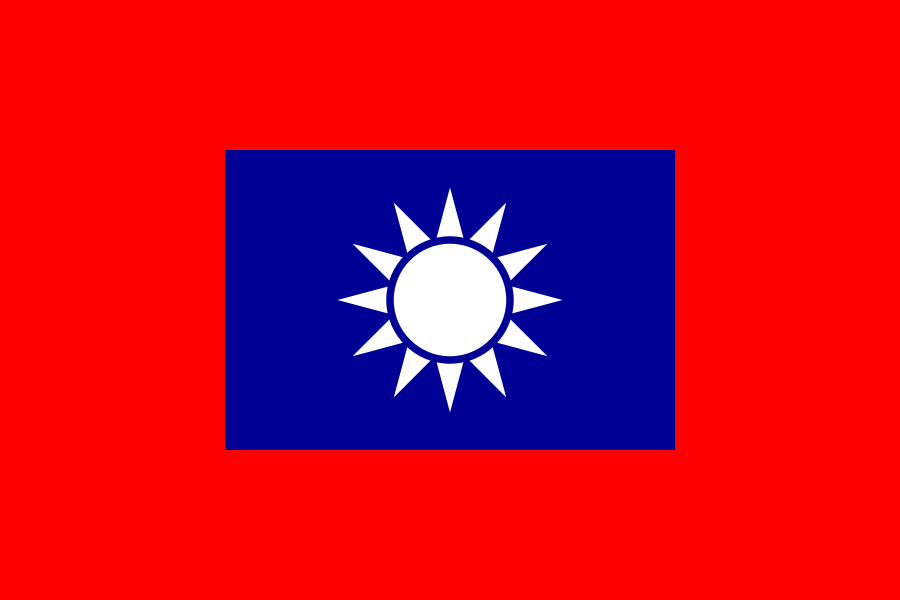
- Service ensign · official · carried by ROC Army
- State affiliation · Taiwan
- Vigil category device · not official insignia
Identity provenance
Service ensign: Army Flag of the Republic of China — carried by ROC Army, not issued to this record. The Army flag: a red field charged with a navy rectangle bearing the white sun of twelve rays, 2:3 — the National Revolutionary Army's flag, carried by the Army since. The design was verified independently of the file: the Armed Forces Flags Act and the vexillological record both give a red field with the blue-sky white-sun panel at the centre, which is what this file draws. FILE: Wikimedia Commons "Flag of the Republic of China Army.svg", public domain, with the ROC Ministry of National Defence recorded as the author of the original. 377 bytes, three paths and two transforms; nothing was optimised because there was nothing to remove. Inherited by every corps and defence command below.
State affiliation: Taiwan.
The smaller square mark is a Vigil category device, drawn from this record’s own domain, echelon and role — not an official insignia.
In brief
The army command for the Matsu islands off northern Fujian — the offshore group whose undersea cables were cut in 2023 and whose isolation is the module's clearest connectivity case.
- Scope
- Structure, role, lineage and links. No subordinate records published.
- Subordination
- Subordination confirmed
- Sources
- 4 on the record
- Record state
- Partial
- Broad area of activity
- The Matsu archipelago (Lienchiang County)
- Notable history
- The northern counterpart to Kinmen, and like it a Cold War front line that was progressively demilitarised. Matsu's significance in the current system is less about the garrison than about what happened to the islands in February 2023, when both undersea cables connecting them to Taiwan were severed within days of each other and the population spent weeks on degraded microwave backup. That episode is the module's most concrete demonstration that a Taiwanese community can be functionally isolated without a shot, and it is why Matsu appears in the connectivity and civil-resilience analysis as often as in the military one. China Coast Guard patrols have since operated in the surrounding waters on the same law-enforcement framing used at Kinmen.
- Strengths
- A standing command on terrain fortified over decades, with the institutional experience of operating at the end of a long and vulnerable line of communication.
- Limitations
- Everything about Matsu is a function of distance from Taiwan and proximity to the mainland, and the 2023 cable failures showed that the binding constraint is not military at all. A defence command cannot restore connectivity, and this module records the isolation problem where it belongs — in the cable and civil-resilience analysis — rather than treating it as a military capability question. No strengths, dispositions or readiness are recorded.
Related locations
Matsu: Area of responsibility only, as published — the command is named for the island group. No garrison, facility or unit location is recorded.
Key events
Undersea cable damage raises civil-infrastructure exposure
Undersea cables serving Taiwan are damaged in a series of incidents, including the severing of both cables to the Matsu islands in 2023 and further cases in 2025 in which Taiwanese authorities detained or investigated vessels. Attribution has been contested in most cases, and cable damage from fishing gear and anchors is common worldwide.
Quick actions
System access
Where this record connects into the rest of Vigil. Each row is here because this organisation actually reaches it.
Assessed as of — 2026-09 Last reviewed — 2026-09-09
See this force in the structure Interactive: select this record and follow what connects to it.